If your radiators are cold at the top, making banging or gurgling noises, or some rooms are warm while others are chilly, the fix is usually straightforward. Bleeding removes trapped air from individual radiators; balancing adjusts the flow rate through every radiator so heat is distributed evenly across the whole system. Both jobs are well within DIY reach and cost nothing beyond a few pence of time and a £1–£3 bleed key.
Part 1: How to Bleed a Radiator
Bleeding is needed when air becomes trapped in the radiator. Air rises to the top, creating a cold zone and reducing the radiator’s output. This is common after the system has been drained, after a new radiator has been fitted, or simply over time as dissolved gases come out of the water.
Signs you need to bleed:
- Cold patch at the top of the radiator, warm at the bottom
- Gurgling or trickling sound when the heating is on
- Boiler pressure dropping more than usual
What You’ll Need
- Radiator bleed key (available from any DIY shop for £1–£3; some modern radiators use a flat-head screwdriver instead)
- Old cloth or small tray to catch water
- Dry cloth to wipe up drips
Step-by-Step: Bleeding
- Turn the heating on and let the system reach full temperature. Identify which radiators need bleeding by carefully feeling across the surface, cold at the top, hot at the bottom confirms trapped air.
- Turn the heating off and let the system cool for 20–30 minutes. Working on a hot pressurised system risks scalding.
- Locate the bleed valve, it’s the small square or slot-head nipple, usually at the top corner of the radiator.
- Place your cloth beneath the bleed valve.
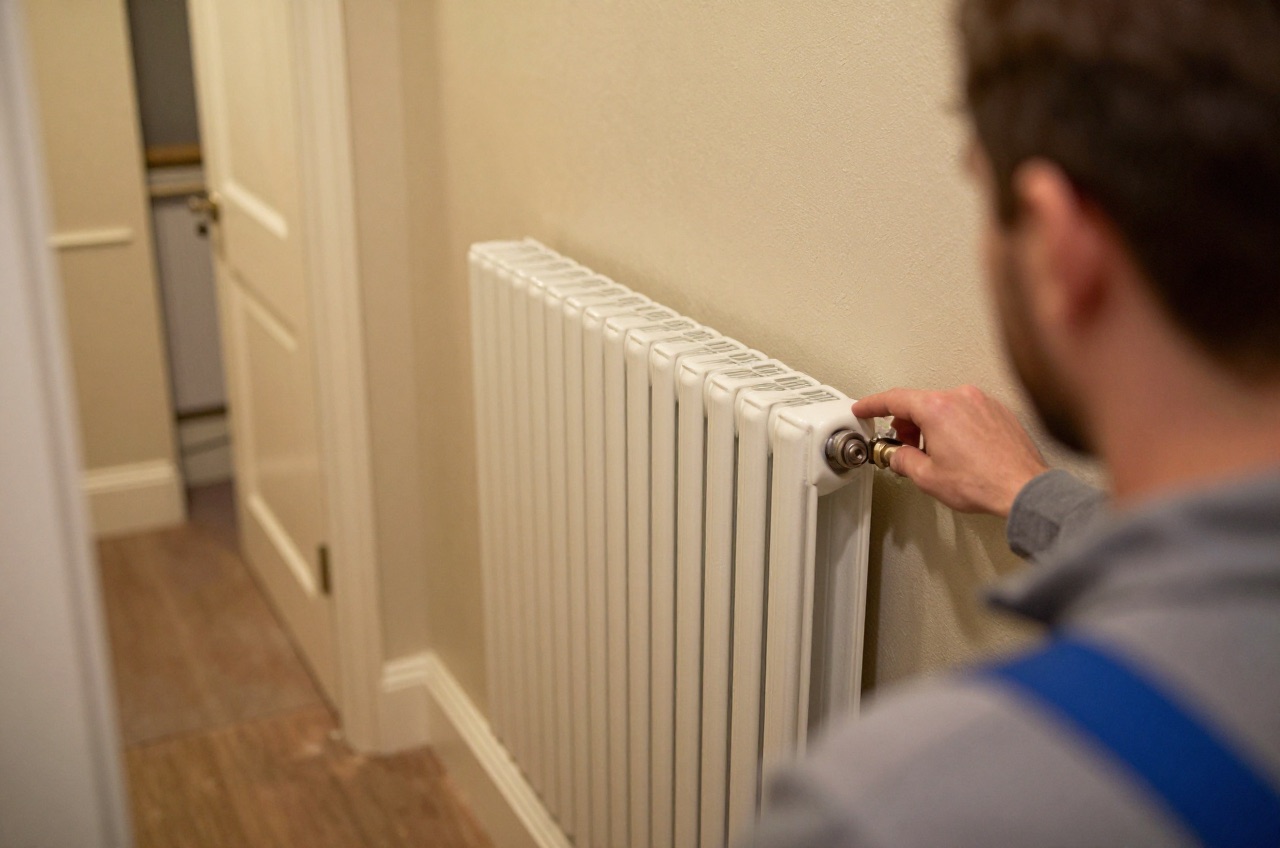
- Insert the bleed key and turn it slowly anti-clockwise, about a quarter to half a turn. You’ll hear a hissing sound as air escapes.
- Wait until water starts to trickle out steadily (without sputtering). This means all the air has been expelled.
- Retighten the valve immediately, do not over-tighten; it only needs to be snug.
- Check your boiler pressure, bleeding can drop the system pressure. Most sealed systems (combi and system boilers) should read 1.0–1.5 bar when cold. If it’s dropped below 1 bar, repressurise via the filling loop (see your boiler manual).
- Repeat for each radiator that needs bleeding, working from the ground floor upward.
Part 2: How to Balance Radiators
Balancing adjusts the flow of hot water to each radiator so they all reach temperature at roughly the same rate. Without balancing, radiators closest to the boiler or on the main flow circuit get the most heat; distant or upstairs radiators may never get fully warm.
The key component is the lockshield valve, the capped valve at the opposite end to the thermostatic radiator valve (TRV) or manual control valve. Opening or closing the lockshield restricts or increases flow to that radiator.
What You’ll Need
- Lockshield valve key or adjustable spanner
- Two clip-on pipe thermometers (or an infrared thermometer), these can be bought or hired for £15–£40
- Pen and notepad
- A helper is useful but not essential
Step-by-Step: Balancing
- Bleed all radiators first (see Part 1).
- Open all lockshield valves fully: remove the plastic cap and turn anti-clockwise as far as it will go. Also open all TRVs to maximum.
- Turn the heating on and note the order in which radiators warm up. The first to get hot is closest to the boiler and receiving the most flow, this is where you start restricting.
- Measure flow and return temperatures: once the system is up to temperature, measure the temperature of the flow pipe (the pipe going into the radiator) and the return pipe (the pipe coming out). The gap between the two is the Delta T. On a conventional system a drop of about 11–12°C across each radiator is the usual target, which sits alongside the way UK radiator outputs are published: at Delta T 50, meaning 75°C flow, 65°C return and a 20°C room.1 Lower-temperature systems are a different exercise. Since 15 June 2022 in England, a wet heating system that is newly installed or fully replaced has to be sized to work at a maximum flow temperature of 55°C or lower, so on a modern system follow the boiler manufacturer’s commissioning figures rather than a rule of thumb.2
- Adjust the lockshield on the fastest-heating radiator: turn it clockwise (closing it) slightly to restrict flow, wait 5–10 minutes, and re-measure. Repeat until you reach the differential you are working to.
- Move to the next radiator in the warm-up order and repeat.
- Work through every radiator in the system. The last radiators to heat up (furthest from the boiler) will generally need their lockshield valves fully or nearly fully open.
| Radiator Position | Expected Lockshield Setting |
|---|---|
| First to heat (closest to boiler) | Nearly closed (1–2 turns) |
| Mid-system radiators | Partially open |
| Last to heat (furthest from boiler) | Fully or nearly fully open |
This process can take 2–4 hours for a full system and may need one or two revisits over the following days to fine-tune.
Common Problems and Fixes
| Symptom | Likely Cause | Fix |
|---|---|---|
| Radiator cold at top only | Trapped air | Bleed the radiator |
| Radiator cold at bottom | Sludge buildup | Power flush the system |
| One radiator stone cold | TRV head stuck or lockshield closed | Check TRV moves freely; open lockshield |
| All radiators lukewarm | Low boiler pressure or pump issue | Repressurise system; check pump |
| Banging pipes (water hammer) | Fast-closing TRVs, unbalanced system | Balance the system; fit bypass if needed |
| Gurgling noises from pipes | Air in the system | Bleed all radiators; check auto air vent |
Boiler Pressure After Bleeding
This is the most commonly overlooked step. Sealed central heating systems, which covers almost every combi and system boiler installed in the UK since the early 2000s, require a specific operating pressure.
- Cold (system off): 1.0–1.5 bar
- Hot (system running): 1.5–2.0 bar
If your pressure gauge reads below 1 bar after bleeding, locate the filling loop (a short flexible hose connecting the mains cold water to the heating pipework, often underneath the boiler) and open both valves until the gauge reads 1.2–1.3 bar, then close both valves. Do not exceed 1.5 bar when filling cold, it will rise as the system heats.
If you’re unsure about repressurise your specific boiler, check the manufacturer’s manual or call your Gas Safe registered engineer.
When to Call a Professional
- If radiators remain cold after bleeding and balancing, the system may have significant sludge buildup requiring a power flush (£350–£600 for a typical property).
- If you find a leak around any valve or fitting, turn off the heating and call a plumber, working on pressurised pipework without the right experience risks water damage.
- Any work on the boiler itself must be carried out by a Gas Safe registered engineer. Regulation 3 of the Gas Safety (Installation and Use) Regulations 1998 requires anyone working on a gas fitting to be competent, and requires the employer or self-employed engineer doing that work to belong to a class of person approved by the HSE, which is the Gas Safe Register.3
Cost Summary
| Item | Typical Cost |
|---|---|
| Radiator bleed key | £1–£3 |
| Pipe thermometers (pair, clip-on) | £15–£40 |
| Plumber call-out to bleed and balance | £80–£150 |
| Power flush (severe sludge) | £350–£600 |
| New TRV (per radiator, fitted) | £40–£80 |
Bleeding and balancing your radiators is the most cost-effective heating maintenance you can do yourself. A well-balanced system runs more efficiently, puts less strain on the boiler pump, and can noticeably reduce your gas bills.
The rules in this note are those that apply in England. Scotland, Wales and Northern Ireland have their own building standards and permitted development rights.
References (3)
Figures in this note were checked against the sources below on 9 September 2026. Superscript numbers in the text point to them. Every source the site cites, by topic.
- 1technicalsupplier figureStelrad, a data sheet.RN-WL3NLJThe manufacturer output tables that radiator sizing depends on. Stelrad states that t50 is the UK industry standard for heating outputs, with an operating temperature of 75/65/20C, and directs users on a low temperature heat source to the t40 or t30 tables instead. At 450mm height and 1000mm length the delta T50 output is 756 W for a K1 single panel single convector, 1055 W for a P+ single panel double convector and 1371 W for a K2 double panel double convector. At 450mm by 1200mm the figures are 907 W, 1266 W and 1645 W. At 300mm by 1000mm they are 509 W, 745 W and 982 W. At 600mm height by 400mm length they are 392 W, 538 W and 693 W. Panel depths are 61mm for K1, 77mm for P+ and 100mm for K2, with total wall projections of 83mm, 101mm and 124mm. Heated surface area runs 2.09 to 9.15 m2 per metre and weight 9.31 to 40.53 kg per metre depending on type and height. Lengths run 300mm to 3000mm. The t50 caveat is the important part: a heat pump running at 45C flow will not get these numbers.
- 2technicalvery strongMinistry of Housing, Communities and Local Government.RN-L0FCJXThe in-force U-value tables a DIY insulation or door note must quote, with the exact numbers. Table 4.2, limiting U-values for new fabric elements in existing dwellings, sets roof 0.15, wall 0.18, floor 0.18, swimming pool basin 0.25, window 1.4 or Window Energy Rating Band B minimum, rooflight 2.2, doors with more than 60 per cent of the internal face glazed 1.4 or Doorset Energy Rating Band C minimum, and other doors 1.4 or Doorset Energy Rating Band B minimum. Table 4.3, for existing elements, gives a roof threshold of 0.35 and an improved value of 0.16, which is the figure a loft insulation note needs: paragraph 4.12 says a retained element whose U-value is higher than the column (a) threshold, for example through a loft or garage conversion, should be upgraded to the column (b) value. Paragraph 4.13 allows a lesser upgrade only where the improved value is not technically or functionally feasible or would not achieve a simple payback of 15 years or less. Paragraph 4.8 requires a replacement element to be no worse than the one it replaces as well as meeting Table 4.2. Paragraph 4.10 gives the heritage exception: where character must be maintained, a centre pane U-value of no more than 1.2 or low-emissivity secondary glazing. Note 9 records that the timber window concession of 1.6 or Band C ended on 14 June 2023. The 2021 edition came into force on 15 June 2022; a 2026 edition exists at https://assets.publishing.service.gov.uk/media/69c122a6cfa346b9d4704a55/ADL1_2026.pdf.
- 3technicalvery strongThe National Archives (legislation.gov.uk), legislation.RN-UFY1XPRegulation 3(1) makes it unlawful for any person to carry out work in relation to a gas fitting or gas storage vessel unless he is competent to do so, and 3(2) places the duty to ensure that on the employer, on every other employer or self-employed person with any control over the work, and on anyone who required the work to be done at a place of work under their control. Regulation 3(3) goes further: no employer may let an employee, and no self-employed person may themselves, carry out work on a gas fitting or service pipework unless that employer or self-employed person is a member of a class of persons approved by the Health and Safety Executive, which in practice is registration with the Gas Safe Register. Regulation 3(4) exempts only replacing a hose or regulator on a portable or mobile space heater and replacing the hose connecting a re-fillable cylinder to installation pipework. Regulation 3(7) makes it an offence to falsely pretend to be a member of an approved class. This is the legal basis for saying a boiler must be fitted by a Gas Safe registered engineer.
-
Stelrad Compact Horizontal radiator output tables, Stelrad, accessed 9 September 2026. stelrad.com
-
Approved Document L, Conservation of fuel and power, Volume 1: Dwellings, 2021 edition incorporating 2023 amendments, HM Government (GOV.UK), accessed 9 September 2026. assets.publishing.service.gov.uk
-
Gas Safety (Installation and Use) Regulations 1998, regulation 3: qualification and supervision, The National Archives (legislation.gov.uk), accessed 9 September 2026. legislation.gov.uk