A blocked drain is a problem most UK households encounter at least once. Whether it is a slow-draining kitchen sink, a gurgling toilet, or a flooded manhole in the garden, the fix ranges from a £5 bottle of drain cleaner to a several-hundred-pound professional jetting job. Knowing which you are dealing with saves both time and money.
How Drains Work and Where They Block
Your property has two separate drainage systems. Above-ground pipework takes water from sinks, baths, showers, toilets, and appliances to the underground drainage, either a private drain (serving only your property) or a public sewer (adopted by your water company). Blockages occur at different points in each system.
Underground drainage is designed under Part H of the Building Regulations, which sets a minimum internal diameter of 75 mm for a foul drain and 100 mm for anything carrying WC effluent, requires pipes to be laid to even gradients, and requires an access point at the head of each run, at every bend, at every change of gradient or pipe size, and at junctions that cannot otherwise be rodded through.1 Those access points are what a drainage contractor works from, which is why a well-built drain is far cheaper to clear than a badly built one.
Common blockage locations:
- Kitchen sink trap, grease, food waste, and soap accumulate in the P-trap directly under the sink
- Shower or bath waste, hair and soap scum bind around the trap and standpipe
- Toilet pan or soil pipe, wet wipes, sanitary products, and excessive paper
- Underground inspection chambers, root ingress, grease build-up from kitchen waste, collapsed clay pipes
- Shared lateral (party drain), shared pipework between semi-detached or terraced properties; since the 2011 transfer this is almost always a public sewer rather than yours2
Signs of a Blockage
- Water draining slowly or not at all
- Gurgling from other outlets when one is in use (air displacement in the pipework)
- Foul smells from drains or manholes
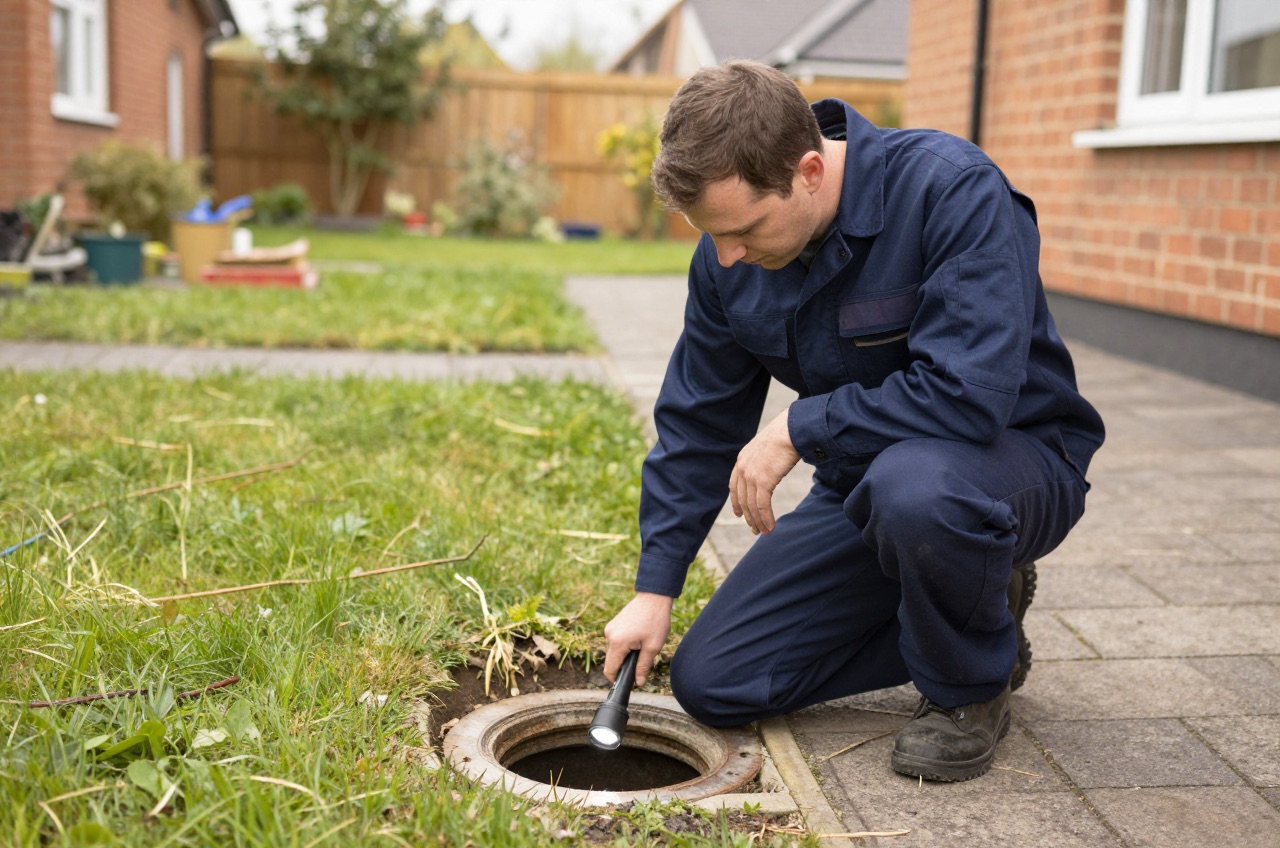
- Overflowing inspection chamber in the garden
- Sewage backing up into the lowest-level toilet or bath
Multiple outlets failing simultaneously usually indicates a blockage in the underground drain rather than an individual waste pipe.
Clearing Costs: 2026 UK
| Job | Typical Cost | Notes |
|---|---|---|
| Chemical drain treatment (DIY) | £5–£20 | Suitable only for partial blockages; avoid with plastic traps if caustic |
| Manual drain rod (DIY or trade) | £0–£80 | Drain rod sets cost £15–£40 from hardware stores |
| Sink or bath unblocking (plumber) | £80–£150 | Trap clearance and rod access; call-out usually included |
| High-pressure water jetting (domestic) | £150–£350 | Clears underground drains; most effective for grease and scale |
| CCTV drain survey | £150–£3003 | Diagnoses root intrusion, cracks, misalignment; often combined with jetting |
| Drain repair (relining, patch) | £500–£2,000+ | Depends on depth, access, and length of damaged pipe |
| Full drain excavation and replacement | £1,500–£6,000+ | Last resort; includes reinstatement of surface |
| Emergency call-out (out of hours) | £100–£250 surcharge | Evening/weekend; verify with contractor before booking |
Prices include VAT and assume straightforward access. Expect higher prices in London and the South East.
DIY Methods: What Works and What Does Not
Plunger, The first tool to reach for. Works well on sink and bath blockages that are close to the surface. Use a cup plunger on sinks, a flange plunger on toilets. Create a seal and use firm, rhythmic strokes.
Boiling water, Can shift a soft grease blockage close to the sink, but it does not clear the fat for good. When greasy water hits cooler pipes further down the drain, it hardens and sticks again.4 Use it on metal pipework only; avoid pouring boiling water into plastic pipes, which can soften joints.
Drain cleaning enzymes, Biological cleaners digest grease and organic matter slowly. Good for maintenance and mild slow-draining but not for solid blockages.
Caustic soda / sodium hydroxide, Works on grease but can damage older pipework and should never be mixed with other chemicals. Keep off skin.
Drain rods, Flexible rods screwed together to reach underground blockages through an inspection chamber. A basic set costs £15–£40 from any hardware store.5 Always turn clockwise only, reversing can unscrew the rods inside the drain, requiring professional retrieval.
DIY limitations: Rods and plungers cannot remove root intrusion, realign a collapsed pipe, or diagnose why a blockage keeps recurring. If the same drain blocks more than twice a year, a CCTV survey is the most reliable way to find out why.
When to Call a Professional
Call a drainage contractor (not just a general plumber) when:
- The blockage does not clear after DIY attempts
- Multiple outlets are backing up simultaneously
- The inspection chamber in the garden is overflowing
- You suspect root ingress or a damaged pipe
- There is any sign of sewage at ground level, a health hazard requiring prompt action
- You live in a property over 50 years old with clay pipes, which are prone to cracking and root penetration
Responsibility: Who Pays?
This is often misunderstood. On 1 October 2011 every privately owned sewer and lateral drain that already drained to a public sewer as at 1 July 2011 transferred to the sewerage undertaker for the area, under regulations made under the Water Industry Act 1991.2 Private pumping stations followed on a slower timetable, all of them transferring by 1 October 2016.6 The current rules:
- Private drains (serving only your property, inside your boundary), your responsibility
- Sewers and lateral drains (a “sewer” is pipework shared by more than one property; a “lateral drain” serves one property but runs outside its boundary, under a neighbour’s land or the street), transferred and now the water company’s to maintain6
Report the blockage to your water company’s sewerage department if it is in a shared drain or beyond your boundary. Thames Water, Anglian, Severn Trent, and others all have 24-hour sewerage lines. Sewerage undertakers carry a statutory duty to cleanse and maintain their public sewers and the lateral drains vested in them, though that duty is enforced by the Secretary of State or Ofwat rather than by you directly.7 Two practical points follow: you can only commission work inside your own private drain, and you have no authority to have work done in a public sewer or lateral drain without contacting the water company first.6 Interfering with one without consent can lead to prosecution.6
Buildings insurance may cover drain clearance if caused by storm damage or tree root intrusion, but typically excludes normal maintenance blockages. Check your policy wording.
High-Pressure Water Jetting
Jetting is the most effective method for clearing grease, scale, and debris from underground drainage. A contractor inserts a flexible hose with a specialist nozzle into the drain; water, typically at 2,000–4,000 psi (140–280 bar), scours the pipe walls clean.
Most domestic properties can be jetted in 30–90 minutes. Jetting is often combined with a CCTV survey, the camera passes through the cleaned pipe to reveal any structural damage.
CCTV Drain Survey
A push-rod camera is fed from an inspection chamber through the drain run. The survey produces a recorded video and written report identifying:
- Blockage cause and location
- Root ingress
- Displaced, cracked, or collapsed pipe sections
- Incorrect gradients causing standing water
- Any offending connections
A standard domestic survey costs £150–£300 and is worth every pound if you have recurring blockages. The report is also useful when buying a property, include it as a condition of purchase if there are any drain concerns.
Tree Root Intrusion
Root ingress through joints in clay pipes is increasingly common as older pipe systems age and tree canopies mature. Roots follow moisture and can fill a pipe entirely within a few years of first entry. Options once roots are confirmed by CCTV:
- Mechanical cutting, a rotating cutter removes the roots, typically combined with jetting; buys time but roots return
- Pipe relining, a resin-impregnated liner is inserted and inflated; creates a smooth, root-resistant bore with no excavation; costs £500–£2,000 for a typical run
- Excavation and replacement, removes the source of the problem; most disruptive and expensive
Preventing Blocked Drains
- Install hair-catch strainers in showers and baths; clear them weekly
- Never pour cooking fat down the kitchen sink, collect in a container and bin it
- Do not flush wet wipes, cotton wool, or sanitary products, even those labelled “flushable”8
- Have outside gullies cleared of leaves before autumn
- Consider annual enzyme treatment for properties with a history of grease blockages
Following these habits significantly reduces call-out costs over the lifetime of the property.
The rules in this note are those that apply in England. Scotland, Wales and Northern Ireland have their own building standards and permitted development rights.
References (8)
Figures in this note were checked against the sources below on 30 September 2026. Superscript numbers in the text point to them. Every source the site cites, by topic.
- 1technicalvery strongMinistry of Housing, Communities and Local Government.RN-SM6TRWThe statutory source for soakaway design and the discharge hierarchy every garden drainage note should state. Requirement H3(3) lists the order of priority for rainwater discharge: (a) an adequate soakaway or other adequate infiltration system, or where not reasonably practicable (b) a watercourse, or where not reasonably practicable (c) a sewer. Paragraph 3.25 bars infiltration devices within 5 metres of a building or road, in ground where the water table reaches the bottom of the device at any time of year, too close to other drainage fields or soakaways, or where contamination could pollute groundwater. Paragraph 3.26: soakaways serving less than 100 square metres are generally square or circular pits filled with rubble or lined with dry-jointed masonry or perforated ring units. Paragraph 3.27: design to a return period of once in ten years, and for small soakaways serving 25 square metres or less a design rainfall of 10mm in 5 minutes may be assumed as the worst case. Paragraph 3.28 requires percolation tests to derive the infiltration rate, and paragraph 3.30 sends larger soakaways to BS EN 752-4 or BRE Digest 365 Soakaway design. Paragraphs 2.10 to 2.12 cover pervious paving over a granular storage reservoir and warn against its use where sediment or oil spillage would block the pores. For foul drainage, paragraph 2.33 sets a minimum 75mm internal diameter, or 100mm for a WC, and Table 6 gives minimum gradients of 1 in 40 for 75mm and 100mm at peak flows under 1 litre per second.
- 2technicalvery strongThe National Archives, legislation.RN-HCZJP3SI 2011/1566 regulation 3, the legal instrument behind the private sewers transfer. It requires the Secretary of State to make a main scheme for the adoption of private sewers and private lateral drains by every sewerage undertaker whose area is wholly or mainly in England, with the Welsh Ministers doing the same for Wales. The vesting date for private sewers and lateral drains (excluding pumping stations) is 1st October 2011; pumping stations vest no later than 1st October 2016. The main scheme catches pipework situated in the undertaker's area which immediately before 1st July 2011 communicated with a public sewer (or, for a lateral drain, with a public sewer vested in that undertaker), excluding exempt sewers and those already subject to a declaration. This is the citation to use instead of a vague 'since 2011' or a bare 'Water Industry Act 1991 (amended)'.
- 3costsupplier figureTrents Drains.RN-NA0Q1MA price, true at 2026-09. a drainage contractor's own published prices for a CCTV drain survey and what moves them, which is the survey figure the cost book records
- 4technicalfairThames Water, guidance.RN-RHJS1IThames Water's customer advice on fats, oils and grease. It says hot water does not melt grease because the water cools further down the drain and the fat hardens and sticks.
- 5costsupplier figureB&Q.RN-FVCJCEA price, true at 2026-09. B&Q's product page for a 12-piece drain rod set (ten 920 mm rods, plunger and worm) priced at £27.54 including VAT, inside the note's £15 to £40 range for a basic set.
- 6technicalvery strongDepartment for Environment, Food and Rural Affairs, guidance.RN-TPT915Defra guidance, last revised 28 September 2011, and the authoritative plain-English account of the private sewers transfer that most drainage guides get vague about. Paragraph 2: on 1 OCTOBER 2011 all privately owned sewers and lateral drains which communicate with (drain to) an existing public sewer as at 1 JULY 2011 became the responsibility of the sewerage undertaker. Paragraph 3: private pumping stations on transferred pipework transfer between 1 October 2011 and 1 OCTOBER 2016, with any not transferred earlier transferring on that date; pipework upstream of a pumping station transferred on 1 October 2011. Definitions (from s.219 Water Industry Act 1991): a SEWER is a drain shared or used by more than one property; a LATERAL DRAIN serves a single property but lies outside its curtilage, under another property or the street. Both definitions include manholes, ventilating shafts, access chambers, pumps and valves. Paragraph 48: an occupier can only commission work within the private drain and has no authority to commission work in a public sewer or lateral drain without first contacting the water and sewerage company. Paragraph 49: interfering with a public sewer or public lateral drain without consent may lead to prosecution.
- 7technicalvery strongThe National Archives, legislation.RN-TTNQO7The statutory duty behind 'the water company has to deal with it'. Section 94(1) requires every sewerage undertaker to provide, improve and extend such a system of public sewers, and so to cleanse and maintain those sewers AND ANY LATERAL DRAINS WHICH BELONG TO OR VEST IN THE UNDERTAKER, as to ensure that its area is and continues to be effectually drained, and to make provision for emptying those sewers and dealing with their contents at sewage disposal works. IMPORTANT LIMIT for consumer guidance: section 94(3) makes the duty enforceable by the Secretary of State, or by the Authority (Ofwat) with the Secretary of State's consent or general authorisation - it is not a duty a householder enforces directly, so wording like 'they are legally obliged to attend' overstates it.
- 8technicalfairWater UK, guidance.RN-5VU39SWater UK's statement for the water industry that only poo, pee and toilet paper should be flushed, and that products sold as flushable still cause sewer blockages.
-
Approved Document H, Drainage and waste disposal, 2015 edition, Ministry of Housing, Communities and Local Government, accessed 9 September 2026. assets.publishing.service.gov.uk
-
The Water Industry (Schemes for Adoption of Private Sewers) Regulations 2011, regulation 3, The National Archives, accessed 9 September 2026. legislation.gov.uk
-
How Much Does a CCTV Drain Survey Cost in the UK?, Trent’s Drains, accessed 17 September 2026. Priced at 2026-09, so no calibration is needed. trentsdrains.co.uk
-
Fats, oils and grease, Thames Water, accessed 30 September 2026. thameswater.co.uk
-
Amtech C3250 12 Piece drain rod set, B&Q, accessed 30 September 2026. Priced at 2026-09 and left there. diy.com
-
The private sewers transfer regulations: provisional non-statutory guidance, Department for Environment, Food and Rural Affairs, accessed 9 September 2026. assets.publishing.service.gov.uk
-
Water Industry Act 1991, section 94: general duty to provide sewerage system, The National Archives, accessed 9 September 2026. legislation.gov.uk
-
Only flush poo, pee and paper, Water UK, accessed 30 September 2026. water.org.uk