Woodworm is a term used for the larval stage of several wood-boring beetles whose grubs tunnel through timber, leaving behind a network of galleries and the familiar round exit holes. In most UK properties it is a cosmetic nuisance rather than a structural emergency, but knowing how to identify the species, assess whether an infestation is active, and choose the right treatment will save you from either unnecessary expense or from ignoring a problem that could genuinely weaken timbers over time.
Which Beetles Cause Woodworm in the UK?
Four species are commonly encountered in UK homes:
| Species | Hole Diameter | Prefers | Common Location | Risk Level |
|---|---|---|---|---|
| Common Furniture Beetle (Anobium punctatum) | 1–2 mm | Sapwood of softwood and hardwood | Floorboards, joists, furniture, roof timbers | Low–moderate |
| House Longhorn Beetle (Hylotrupes bajulus) | 6–10 mm (oval) | Sapwood of softwood | Roof timbers (mainly SE England) | High, can cause structural failure |
| Deathwatch Beetle (Xestobium rufovillosum) | 3 mm | Hardwood, especially oak; often already decayed | Old hardwood floors, historic beams | Moderate–high |
| Powder Post Beetle (Lyctus spp.) | 1.5–2 mm | Hardwood sapwood; high starch content | New hardwood: oak flooring, ash, elm | Low–moderate; mainly in new timber |
The Common Furniture Beetle accounts for the overwhelming majority of woodworm encountered in residential properties. It affects both softwood and hardwood, prefers damp or slightly humid conditions, and exits the timber as an adult beetle between May and August. Its small exit holes (1–2 mm) are what most people recognise as woodworm.1
The House Longhorn Beetle is more serious but geographically restricted in the UK: it is mainly found in north-west Surrey and neighbouring parts of Hampshire and Berkshire. It can cause significant structural damage to roof timbers and is the only UK woodworm species that Building Regulations guidance singles out. Approved Document A lists the areas, including Elmbridge, Runnymede, Woking and parts of Hart and Bracknell Forest, where new softwood roof timbers should be treated against it.2
Is the Infestation Active?
Distinguishing active from old (dead) woodworm is critical before spending money on treatment.
Signs of active woodworm:
- Fresh, clean, pale-coloured exit holes (not filled with dust or discoloured)
- Fine, creamy-yellow powdery dust (frass) in or below the holes, it looks like sawdust but finer1
- Small oval beetles (the adult Anobium punctatum is 2.5–5 mm long, reddish-brown) appearing in the room between May and August
- The frass still feels soft or powdery, not compressed or discoloured
Signs of old, inactive infestation:
- Exit holes with dark or dirty edges (oxidised over time)
- No frass, or frass that is grey/dark and compressed
- No beetle sightings in several seasons
Old woodworm holes are extremely common in Victorian and Edwardian timber, the vast majority of Victorian floorboards have some woodworm holes from historical infestations that have been dead for decades. Treatment of inactive woodworm in non-structural timber is unnecessary.1
When Is Treatment Necessary?
Treatment is warranted when:
- The infestation is active (fresh holes and frass present)
- The affected timber is structural, joists, rafters, purlins, ridge boards, floor bearers
- The affected area is significant (more than one or two isolated exit holes)
Treatment is not urgently necessary when:
- The woodworm appears inactive
- The timber is non-structural (furniture, skirting boards, decorative panelling)
- The affected area is a small section of isolated holes without current frass
Treatment Options
DIY Treatment
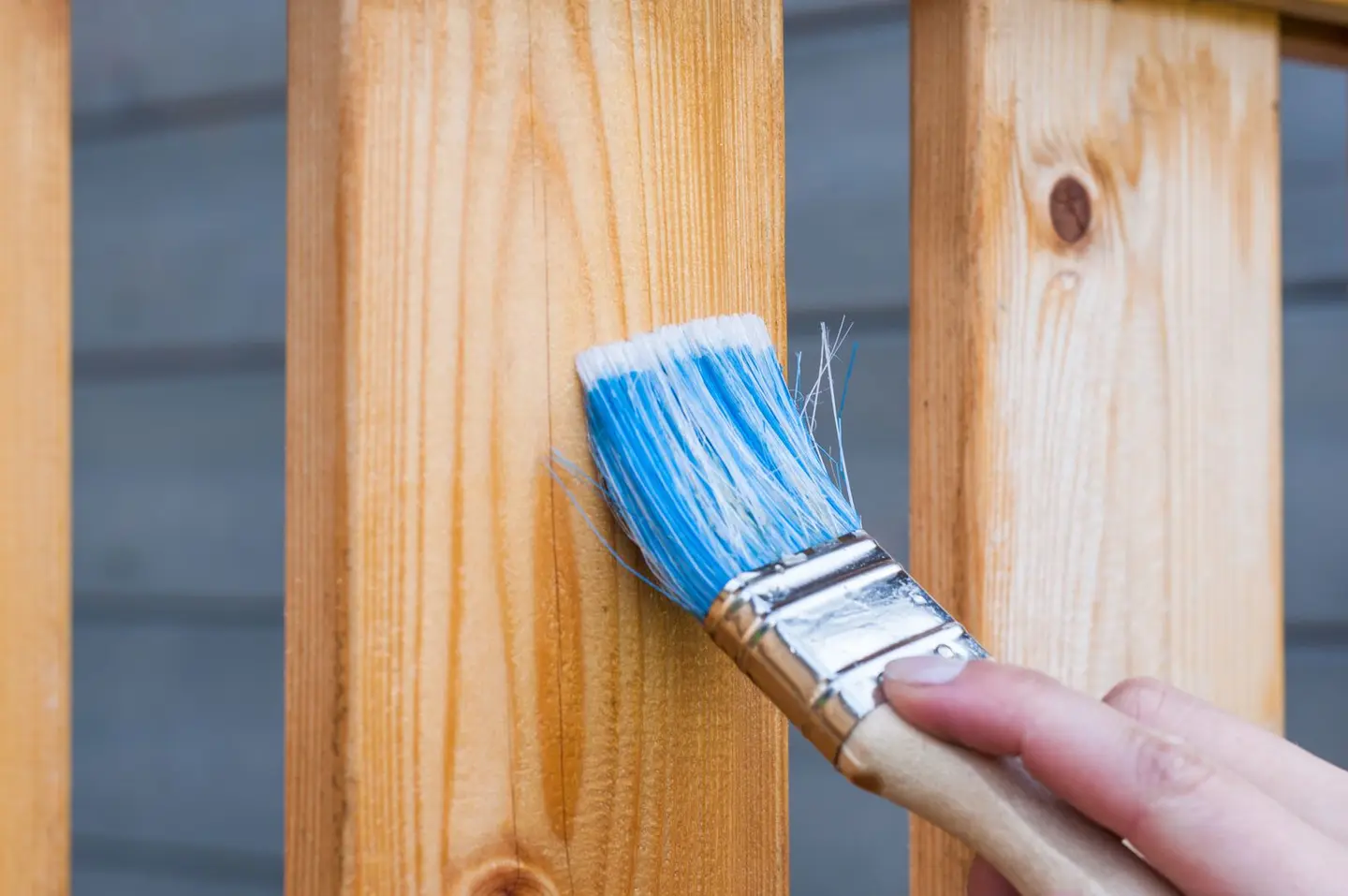
For non-structural timber and confirmed active but minor infestations, proprietary woodworm killer products are widely available. These are typically permethrin-based or boron-based liquids applied by brush or spray. Apply generously to all surfaces and into holes, allow to soak in, and repeat as the label directs: Ronseal’s Woodworm Killer, for example, asks for three coats, two hours apart.3
DIY treatment is suitable for: furniture, skirting boards, non-structural panelling, small areas of floorboarding where the boards can be lifted to treat the underside and the joist tops.
DIY treatment is not suitable for: roof timbers (access and coverage are the issues), whole-floor treatment of a suspended ground floor (impractical and inadequate coverage), or structural damage requiring repair rather than treatment.
Professional Treatment
Professional treatment uses two main approaches:
Permethrin spray treatment, the most common method, where a professional applies a water-based permethrin insecticide by spray or brush to all accessible timber surfaces. In roof spaces this typically means treating all visible softwood. Occupants and pets are normally kept out of the treated areas during application and until the surfaces are dry, as the product label directs. Firms usually give a long-term written guarantee; ask whether it is insurance-backed, so that it still holds if the firm stops trading.
Boron-based treatment, boron salts (usually disodium octaborate) are applied as a gel, paste, or liquid. Boron is less toxic to mammals than permethrin and is considered preferable in occupied homes, around food preparation areas, and where children are present. It is also effective against fungal decay. Boron treatment is slower-acting and requires the timber to have some residual moisture to carry the boron into the wood, so it is less suitable for very dry softwood.
Fumigation, treatment with a toxic gas, used only in extreme cases or for heritage buildings where spray penetration is inadequate. Requires complete evacuation and specialist contractors.
Structural Damage Assessment
Where woodworm has been active over many years, particularly Deathwatch Beetle in old oak or House Longhorn in roof timbers, structural timber may have been weakened. Before treatment, a structural engineer or chartered surveyor should assess whether any timber members need sistering (adding a new joist alongside a damaged one), reinforcing, or replacing entirely. Treatment alone will not restore the strength of heavily damaged timber.
Cost Guide
| Work | Typical Cost (2026) |
|---|---|
| DIY woodworm spray (materials only) | £15–£50 per tin; £50–£200 for a typical room |
| Professional treatment, one room | £200–£500 |
| Professional treatment, whole house (roof + floors) | £400–£1,200 |
| Professional report / survey | £150–£350 |
| Structural timber replacement (per joist, if needed) | £200–£600 per member |
Prevention
Woodworm needs damp timber: if timber is kept at a sufficiently low moisture content, it is highly unlikely to sustain an infestation.1 Reducing humidity in roofspaces and subfloor voids is the most effective long-term prevention. A cold roof space above an insulated ceiling should be ventilated to carry moisture away.4 BS 5250:2021, the code of practice on managing moisture in buildings, gives the detailed recommendations.5 Keep the airbricks to a suspended timber floor clear: Approved Document C asks for ventilation openings on opposite sides equal to at least 1,500mm² per metre run of external wall or 500mm² per m² of floor area, whichever is greater.4 Treating timbers with a preservative before installation (pressure impregnation or surface treatment) is standard on new structural softwood used externally or in contact-with-ground situations, and most modern timbers used in damp-prone areas are pretreated.1
Any timber salvaged for reuse, particularly reclaimed floorboards or structural beams, should be inspected carefully for signs of active woodworm before installation, and treated if any doubt exists.
Choosing a Contractor
Use a contractor registered with the Property Care Association (PCA) or a surveyor who holds its CSRT (Certificated Surveyor in Remedial Treatments) qualification or the CSTDB that replaced it in 2018.6 Request a written survey report identifying species and extent of infestation before accepting a treatment quotation. Be wary of surveys conducted by companies offering treatment, where there is an obvious incentive to over-specify.
References (6)
Figures in this note were checked against the sources below on 30 September 2026. Superscript numbers in the text point to them. Every source the site cites, by topic.
- 1technicalgoodProperty Care Association, a page from the body itself.RN-0U58VYThe trade body's homeowner guidance, and the source for the diagnostic detail a woodworm note needs rather than a treatment firm's sales page. It explains that woodworm is a generic name for wood boring insects in their larval stage rather than one species, most commonly associated with the Common Furniture Beetle, and that few of the many UK timber-boring insects have adapted to infest timber in homes. The identifying sign for the Common Furniture Beetle is small round exit holes approximately 1 to 2mm across left as the adult emerges. The harder question is whether an infestation is active: signs of activity are small piles of bore dust, called frass, around exit holes, particularly visible as trails on vertical surfaces, though in undisturbed conditions even that can mislead, and the best indicator is the presence of adult beetle carcasses. It also gives the prevention rule a note should lead with, which is that the best means of prevention is keeping timber dry, because timber at a sufficiently low moisture content is highly unlikely to sustain infestation.
- 2technicalvery strongMinistry of Housing, Communities and Local Government (GOV.UK).RN-Z6AXUWThe full Approved Document A PDF, which carries the deemed-to-satisfy tables a domestic project is checked against. Section 2E covers foundations of plain concrete: paragraph 2E3 gives the recommended minimum widths of strip foundations in Table 10, keyed to ground type and total load of loadbearing walling per linear metre. Table 10 sets, for rock (not inferior to sandstone, limestone or firm chalk, requiring at least a pneumatic or mechanically operated pick to excavate), a width equal to the width of the wall at every load. For medium dense gravel or sand (requires a pick to excavate, a 50mm square wooden peg hard to drive beyond 150mm) and for stiff clay or stiff sandy clay (can be indented slightly by the thumb), the minimum widths are 250mm at 20 kN per linear metre, 300mm at 30, 400mm at 40, 500mm at 50, 600mm at 60 and 650mm at 70. Firm clay and firm sandy clay (thumb makes an impression easily) start at 300mm. The document also covers minimum depth of strip foundations, wall thickness rules for residential buildings up to three storeys (paragraph 2C10 covers internal loadbearing walls in brickwork or blockwork), buttressing, lateral support by floors and at roof level, interruption of lateral support, wall cladding in Section 3, and Section 5 on reducing sensitivity to disproportionate collapse with the building consequence classes.
- 3technicalsupplier figureRonseal, guidance.RN-RTQML4The maker's product page for a widely sold DIY woodworm treatment. Its technical specification gives three coats at two-hour intervals.
- 4technicalvery strongMinistry of Housing, Communities and Local Government.RN-NPO8FJThe statutory figures behind a damp diagnosis, and the numbers to quote when a note explains why ground levels or a bridged damp proof course cause rising damp. Paragraph 5.2 requires that in an external wall the damp-proof course should be at least 150mm above the level of the adjoining ground (Diagram 8) unless part of the building protects the wall, and that in an external cavity wall the cavity should be taken down at least 225mm below the level of the lowest damp-proof course, or a damp-proof tray provided (Diagram 9a). For suspended timber ground floors it requires a ventilated air space of at least 75mm from the ground covering to the underside of any wall-plates and at least 150mm to the underside of the suspended timber floor or insulation, with ventilation openings on two opposing external walls of not less than 1,500mm2 per metre run of external wall or 500mm2 per square metre of floor area, whichever is greater; for suspended concrete floors the clear ventilated space is at least 150mm with the same opening sizes. Section 2.39 onwards covers radon, referring to BRE Report BR 211 for protective measures. The 2013 edition was published on 3 September 2013 with changes in effect from 1 October 2013.
- 5technicalstrongBSI, a standard.RN-8KZI9QBS 5250:2021, the code of practice for managing moisture in buildings. The UK standard covering ventilation, vapour control layers, roof space and wall construction moisture risk, and the interaction between insulation and condensation. The 2021 revision reorganised the guidance considerably, so an older source quoting BS 5250 may be describing a superseded structure.
- 6technicalgoodProperty Care Association, guidance.RN-IZHFZGPCA history of its surveyor qualifications, confirming that CSTDB replaced CSRT in 2018 as the timber and damp surveying qualification (CTIS being an older predecessor).
-
Woodworm advice, Property Care Association, accessed 30 September 2026. property-care.org
-
Approved Document A: Structure, 2004 edition incorporating 2004, 2010 and 2013 amendments, Ministry of Housing, Communities and Local Government, accessed 30 September 2026. assets.publishing.service.gov.uk
-
Woodworm Killer, Ronseal, accessed 30 September 2026. ronseal.com
-
Approved Document C: Site preparation and resistance to contaminants and moisture, 2004 edition incorporating 2010 and 2013 amendments, Ministry of Housing, Communities and Local Government, accessed 30 September 2026. assets.publishing.service.gov.uk
-
BS 5250:2021, Management of moisture in buildings. Code of practice, BSI, accessed 14 September 2026. knowledge.bsigroup.com
-
The development of specialist timber and damp surveying qualifications, Property Care Association, accessed 30 September 2026. property-care.org