Damp is one of the most frequently misdiagnosed defects in UK housing. Homeowners can spend thousands of pounds on unnecessary treatments because the wrong type of damp has been identified, often by a damp-proofing company with a financial interest in selling the most expensive solution. Getting the diagnosis right first is the single most important step.
There are three fundamentally different types of damp in residential buildings, each with distinct causes, distinct symptoms, and distinct remedies. Understanding how to tell them apart will save you money and protect your home.
The Three Types of Damp
1. Condensation
Condensation is the most common form of damp in UK homes and a leading cause of mould growth.1 It occurs when warm, moisture-laden air contacts a cold surface (typically an external wall, window reveal, or cold-water pipe) and deposits its moisture.
Key signs:
- Black mould growth, particularly in corners, on north-facing walls, around windows, and in unventilated areas such as behind furniture and in wardrobes
- Misting or water droplets on windows in the morning
- Moisture at the tops of walls and in upper corners, not just at floor level
- Worse in winter and immediately after cooking or bathing
- No tide-mark or salt crystallisation on the wall
Condensation is primarily a ventilation and heating problem, not a structural one. It builds up wherever moisture from daily activities (cooking, showering, drying laundry, breathing) cannot escape, including well draught-proofed homes with poor ventilation.1
2. Rising Damp
Rising damp is the upward movement of ground moisture through a permeable wall by capillary action. It requires a direct connection between damp ground and the base of a porous wall, which means the damp-proof course (DPC) must be absent, bridged, or failed.
Key signs:
- A distinct tide-mark on internal walls, typically up to about 1 m above floor level (industry guidance puts the usual maximum at around 1.5 m)2
- Salt crystallisation (efflorescence) or white fluffy deposits on the wall surface at or below the tide-mark
- Damp confined to the lower part of the wall, not extending above the tide-mark regardless of season
- Plaster often sounds hollow, has blown, or has dark staining
- Worse in wet weather and in older properties with no DPC or a compromised one
Rising damp is genuine, but it is often misdiagnosed.1 True rising damp requires a missing, failed or bridged DPC and is less common than damp-proofing companies often suggest. It is usually confined to the lower metre or so of the wall, and rising damp above about 1.5 m is unusual, so moisture higher up usually has another cause.2
3. Penetrating Damp
Penetrating damp is moisture entering through the external envelope of the building, through walls, roof, around windows, or through failed junctions and flashings.
Key signs:
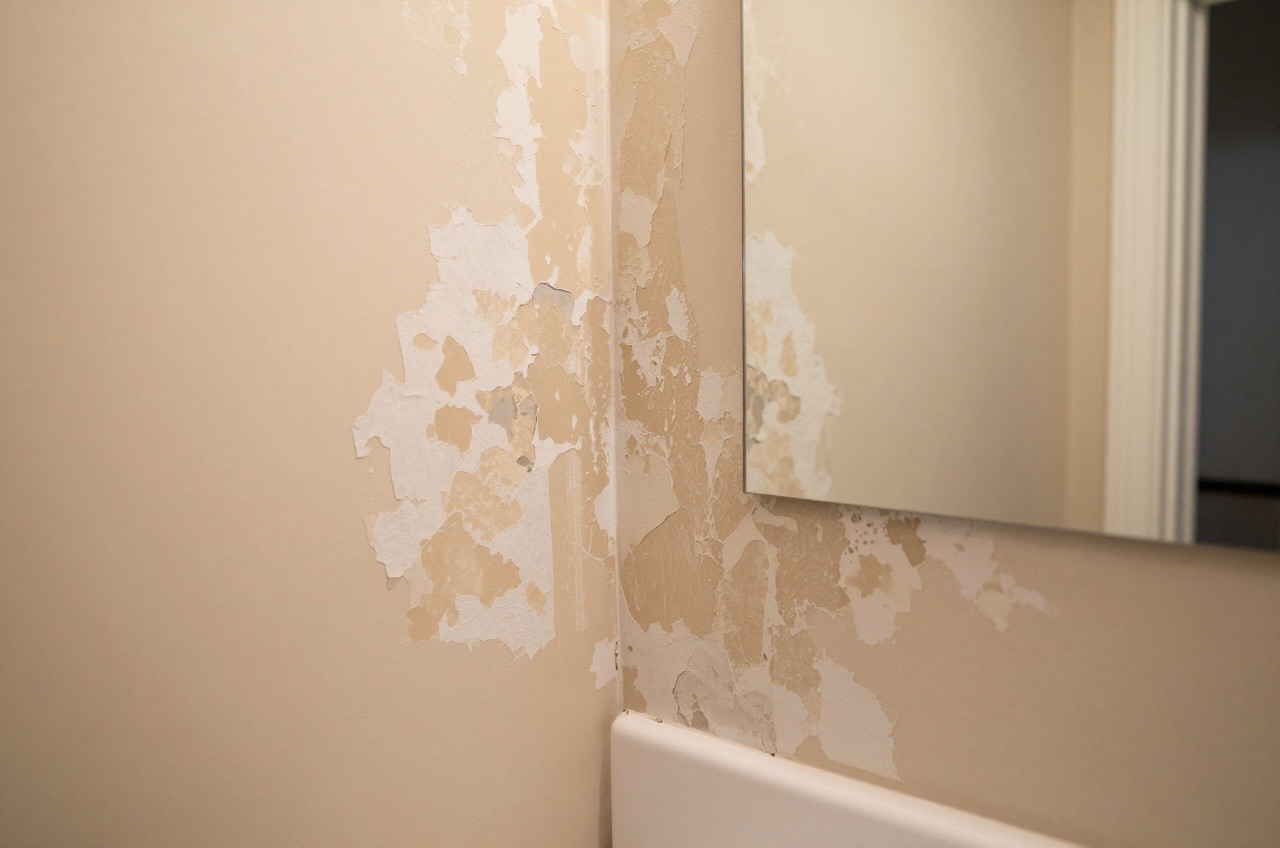
- Damp patches that correspond with heavy rainfall and dry out in dry weather
- Patches at specific locations: below a failed gutter, around window or door frames, near a chimney breast, on a chimney stack-facing wall, or under a flat roof
- In solid-wall properties (most homes built before the 1920s), general moisture penetration across the full wall thickness during prolonged driving rain3
- Dark staining that does not have a distinct lower tide-mark
- May appear at any height on the wall, not just at the base
Diagnostic Comparison Table
| Feature | Condensation | Rising Damp | Penetrating Damp |
|---|---|---|---|
| Location | Corners, cold surfaces, behind furniture | Base of walls, usually below ~1 m | Any level; tracks from source |
| Tide-mark | No | Yes (distinct horizontal line) | Irregular or none |
| Salt deposits | No | Yes, efflorescence | Sometimes |
| Season | Worse in winter | Consistent; worse in wet | Correlated with rainfall |
| Mould type | Black surface mould | Less common; wall staining | Possible; wall staining |
| Worse after cooking/showering | Yes | No | No |
| External source visible | No | No (ground moisture) | Usually, failed gutter, crack, flashing |
How to Investigate
A decent starting point is a handheld moisture meter, the type that presses two pins into the plaster surface. These cost £15–£60 and give a qualitative indication only. Hygroscopic salts in plaster can push readings up even when the wall is not actively wet, so a high reading on salt-stained plaster is not proof of rising damp.2
A more reliable diagnostic technique for distinguishing penetrating damp from rising damp or condensation is to fix a square of polythene sheeting tightly over the damp area (sealing all edges with tape) for 48–72 hours:
- Moisture forms on the room side of the polythene → condensation (moisture from the room air)
- Moisture forms on the wall side of the polythene → the wall itself is wet (rising or penetrating damp)
To distinguish rising damp from penetrating, check the height and location of the wet area, examine the DPC externally (a physical DPC is a layer of engineering brick, slate, or modern plastic strip in a mortar joint, which current guidance for new walls places at least 150 mm above the adjoining ground, about two brick courses), and check externally for obvious water entry points.4
Getting an Independent Diagnosis
The most important advice for significant damp is to get a diagnosis from an independent surveyor or structural engineer rather than from a damp-proofing company. Companies that sell treatment products have a known tendency to diagnose rising damp where condensation or penetrating damp is the actual problem.
An independent damp survey typically costs £150–£300, according to the HomeOwners Alliance, and a chartered surveyor’s more detailed investigation can cost more.5 This cost is almost always recovered by avoiding unnecessary chemical injection or remedial plastering.
Treatment Costs
| Treatment | Typical Cost (2026) | What It Addresses |
|---|---|---|
| Improved ventilation (vents, MVHR, trickle vents) | £200–£2,000 | Condensation |
| Improved heating and insulation | £500–£5,000+ | Condensation (cold bridge) |
| Gutter or downpipe repair | £80–£500 | Penetrating damp |
| Repointing brickwork | £25–£50 per m² | Penetrating damp (solid walls) |
| External wall coating | £50–£120 per m² | Penetrating damp (solid walls) |
| DPC chemical injection | £300–£700 per wall | Rising damp |
| Replastering with salt-retardant plaster | £40–£80 per m² | Rising damp (after treatment) |
| Tanking (basement waterproofing) | £70–£150 per m² | Basement penetrating damp |
Relevant Building Regulations and Standards
Damp-proofing works do not generally require Building Regulations approval when they are like-for-like repairs, but chemical DPC injection is covered by BS 6576, the British Standard code of practice for diagnosis of rising damp in walls of buildings and installation of chemical damp-proof courses.6 Choose a contractor who is a member of a trade body such as the Property Care Association (PCA) and ask for a written, insurance-backed guarantee. PCA contractors also offer the PCA Promise: if the firm goes out of business before the work is finished, another PCA contractor completes it to the original specification at no extra cost.7
For condensation problems, relevant guidance includes BRE Report BR 262, Thermal insulation: avoiding risks, and Part C of the Building Regulations (resistance to moisture).4 In rented homes, the Homes (Fitness for Human Habitation) Act 2018 requires landlords to keep properties free of damp and mould hazards so serious that the home is not reasonably suitable to live in.1
A correct diagnosis costs a fraction of an incorrect treatment. Spend the money on finding out what type of damp you have before committing to any remedial work.
References (7)
Figures in this note were checked against the sources below on 30 September 2026. Superscript numbers in the text point to them. Every source the site cites, by topic.
- 1technicalvery strongDepartment for Levelling Up, Housing and Communities and UK Health Security Agency (gov.uk), guidance.RN-D2PRMRThe government's own classification of damp types and the single best citation for the point that damp is a building fault, not a housekeeping failure. Damp is defined as the build up of moisture in a property, and four types are named: condensation, where moisture generated inside the home cools and condenses onto colder parts; penetrating damp, where water gets in from outside due to defects; rising damp, where moisture from the ground rises up through parts of the building; and traumatic damp, caused by leaking waste and heating pipes or overflowing baths and sinks. The health effects predominantly affect the airways and lungs and include cough, wheeze, shortness of breath, airway infections including aspergillosis and worsening of asthma, and can cause serious illness and in the most severe cases death. Children, older people, people with pre-existing health conditions or weakened immune systems, pregnant women and people with mental health conditions are most at risk. The guidance states plainly that it is totally unreasonable to blame damp and mould in the home on lifestyle choices. It was written in response to the coroner's report on the death of two-year-old Awaab Ishak in December 2020 from a severe respiratory infection caused by prolonged exposure to damp and mould in his home.
- 2technicalgoodProperty Care Association, guidance.RN-KZS1HBPCA guidance on moisture meters: conductivity meters give relative readings, not a direct moisture content, and their value depends on the user's interpretation.
- 3technicalfairEnergy Saving Trust, guidance.RN-RV8Z6HSolid wall insulation costs and the quality problem. Typical installation £12,000 to £15,000, split as around £15,000 for external wall insulation and around £12,000 for internal. Around 33% of the heat lost from an uninsulated home goes through the walls. Homes built before 1920 are more likely to have solid walls, of brick, stone, earth or timber frame with panels. A registered installer should guarantee the work for 25 years, and any TrustMark solid wall insulation company offers a 25 year guarantee backed either by an insurer or through the Solid Wall Insulation Guarantee Agency. Records that in October 2025 the National Audit Office reported on quality failures in wall insulation under government schemes, and that 98% of homes fitted with external wall insulation under ECO4 and the Great British Insulation Scheme have problems needing fixing, with affected households sent an Ofgem letter carrying a Unique Measure Reference Number in early 2026 and a remediation line on 0333 555 1234 option 1.
- 4technicalvery strongMinistry of Housing, Communities and Local Government.RN-NPO8FJThe statutory figures behind a damp diagnosis, and the numbers to quote when a note explains why ground levels or a bridged damp proof course cause rising damp. Paragraph 5.2 requires that in an external wall the damp-proof course should be at least 150mm above the level of the adjoining ground (Diagram 8) unless part of the building protects the wall, and that in an external cavity wall the cavity should be taken down at least 225mm below the level of the lowest damp-proof course, or a damp-proof tray provided (Diagram 9a). For suspended timber ground floors it requires a ventilated air space of at least 75mm from the ground covering to the underside of any wall-plates and at least 150mm to the underside of the suspended timber floor or insulation, with ventilation openings on two opposing external walls of not less than 1,500mm2 per metre run of external wall or 500mm2 per square metre of floor area, whichever is greater; for suspended concrete floors the clear ventilated space is at least 150mm with the same opening sizes. Section 2.39 onwards covers radon, referring to BRE Report BR 211 for protective measures. The 2013 edition was published on 3 September 2013 with changes in effect from 1 October 2013.
- 5costfairHomeOwners Alliance.RN-9W5S6NA price, true at 2026-09. A consumer body's 2026 guide to survey costs, giving the typical price of a specialist damp survey as £150 to £300.
- 6technicalgoodProperty Care Association, guidance.RN-3UDM40The PCA's professional guidance on investigating dampness, listing its key documents, including the PCA Code of Practice for the investigation and control of dampness in buildings.
- 7technicalgoodProperty Care Association, guidance.RN-9LARH1The PCA's homeowner advice on damp proofing, which says misdiagnosis of damp problems is not uncommon and that rising damp in particular is prone to it.
-
Understanding and addressing the health risks of damp and mould in the home, Department for Levelling Up, Housing and Communities and UK Health Security Agency, accessed 30 September 2026. gov.uk
-
Guidance Document: The Use of Moisture Meters to Diagnose Dampness in Buildings, Property Care Association, accessed 30 September 2026. property-care.org
-
Solid wall insulation, Energy Saving Trust, accessed 30 September 2026. energysavingtrust.org.uk
-
Approved Document C, Site preparation and resistance to contaminants and moisture, 2004 edition incorporating 2010 and 2013 amendments, Ministry of Housing, Communities and Local Government, accessed 14 September 2026. assets.publishing.service.gov.uk
-
How Much Does A House Survey Cost In 2026?, HomeOwners Alliance, accessed 30 September 2026. Priced at 2026-09 and left there. hoa.org.uk
-
Damp Investigation Guidance, Property Care Association, accessed 30 September 2026. property-care.org
-
Damp Proofing Advice for Homeowners, Property Care Association, accessed 30 September 2026. property-care.org