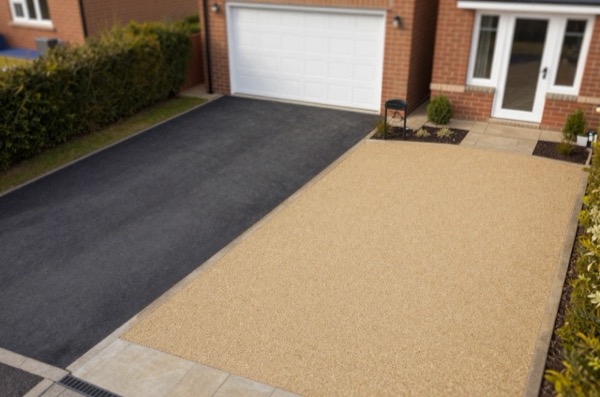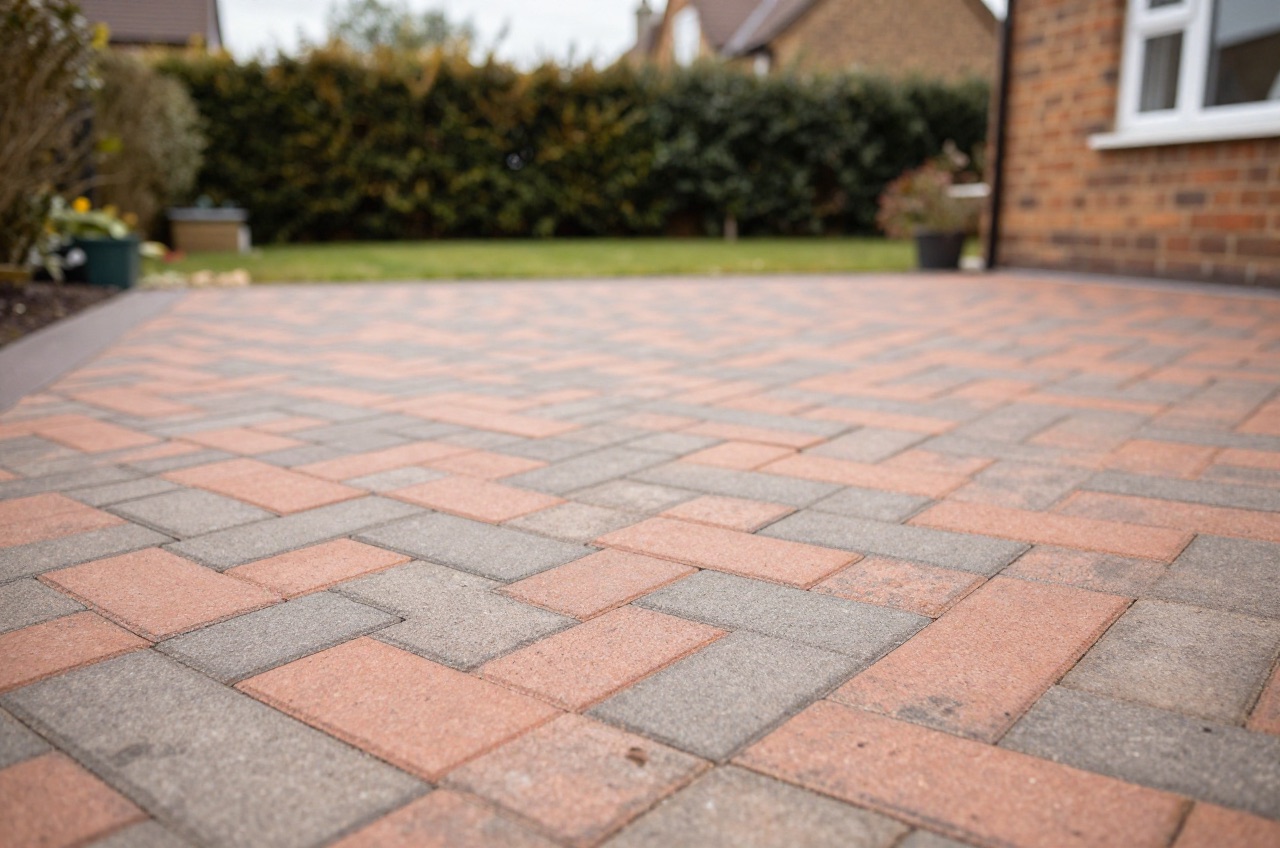
Block paving is one of the most popular hard-landscaping choices for UK driveways and paths. It looks smart, lasts for decades when properly laid, and, unlike solid concrete, individual blocks can be lifted and relaid if you need to access a drain or pipe underneath. Costs typically run from £60 to £130 per m² fully installed, though premium clay bricks or intricate patterns can push that higher.
This guide covers the main block types, the most common patterns, realistic 2026 costs, and what to ask a contractor before you sign anything.
Types of Block Paving
Concrete Blocks
Concrete (pressed or hydraulic) blocks are the go-to option for most UK driveways. They’re manufactured to consistent dimensions, commonly 200 × 100 × 60 mm or 200 × 100 × 80 mm, and come in a wide palette of colours and finishes. The 80 mm thickness is recommended for driveways that will carry cars; 60 mm is acceptable for pedestrian paths.
Concrete blocks are cheaper than clay and easier to source from any builders’ merchant, but they can fade over time and are more susceptible to staining than a good clay brick.
Clay Pavers
Clay pavers (also called clay bricks or engineering bricks) are kiln-fired and colour-fast, they won’t fade because the colour runs right through. They’re denser and harder than concrete blocks, which makes them highly resistant to oil, de-icer salts, and heavy traffic. A clay-paved driveway laid in the 1980s will still look excellent today if it was bedded correctly.
The trade-off is cost: clay pavers typically add £15–£30/m² over equivalent concrete options, and colour choice is narrower (mainly red, buff, and blue-black engineering brick tones).
Natural Stone Setts
Granite or sandstone setts give a more traditional, cobbled appearance. These are common in conservation areas and heritage streets. They’re harder to lay correctly (each piece varies slightly), more expensive to supply, and require an experienced contractor. Expect to pay £100–£180/m² installed for granite setts.
Common Patterns
The laying pattern affects both the look and the structural performance of the finished surface. Herringbone patterns in particular interlock under load and resist creep far better than running-bond arrangements.
| Pattern | Description | Best for | Relative cost |
|---|---|---|---|
| Herringbone (45°) | Blocks laid at 45° to the direction of travel | Driveways, highest structural performance | Standard |
| Herringbone (90°) | Same interlocking pattern, blocks square to boundary | Driveways, more formal look | Standard |
| Stretcher bond | Blocks laid in parallel rows with staggered joints | Paths and patios, not recommended for vehicles | Lower |
| Basket weave | Alternating pairs of blocks at 90° | Decorative patios; low-traffic areas | Standard–slight premium |
| Circular / fan | Radiating courses around a focal point | Feature areas, forecourts | 15–25% premium (labour) |
| Random/mixed | Irregular sizes for a natural look | Patios, paths | Variable, often higher |
For any driveway that takes vehicle loads, always specify herringbone, either 45° or 90°. The interlocking action distributes the load laterally through multiple blocks, preventing the surface from rutting or spreading over time.
Cost Breakdown
These figures reflect 2026 market rates for a standard residential driveway in England. Costs in London and the South East typically run 15–20% higher.
| Item | Typical cost range |
|---|---|
| Concrete block paving (supply & lay) | £60–£85/m²1 |
| Clay paver paving (supply & lay) | £80–£110/m²2 |
| Granite sett paving (supply & lay) | £100–£180/m²3 |
| Edging/kerbing (per linear metre) | £25–£50 |
| Sub-base excavation & disposal | £15–£30/m² |
| Permeable block paving (SuDS compliant) | £75–£130/m² |
| Resin joint stabiliser (per m²) | £8–£15 |
Worked example, 40 m² driveway in concrete blocks:
- Excavation, sub-base (MOT Type 1), and sharp sand bed: 40 m² × £22 = £880
- Concrete blocks, bedding, and laying: 40 m² × £70 = £2,800
- Edging kerbs, 25 linear metres × £35 = £875
- Total (approximate): £4,555
Labour typically accounts for 40–55% of total cost. A two-person team usually lays around 15–20 m² per day on a straightforward driveway.
Planning Permission
Most domestic driveways don’t need planning permission, but there’s an important caveat: if your driveway is more than 5 m² and the surface is not permeable, you may need approval under the rules introduced in 2008 to manage surface water run-off.
Permeable block paving, where the joints are filled with a grit/gravel rather than sand, allowing water to drain through, is exempt from this requirement regardless of size. This is the simplest way to comply without applying for planning permission, and it’s often cheaper in the long run because it avoids the need for a separate drainage channel connecting to the sewer.
Always check with your local planning authority before work starts, especially in a conservation area or on a listed property.
Sub-Base and Bedding
The long-term performance of any block paved surface depends almost entirely on what’s underneath. For vehicles:
- Sub-base depth: minimum 100 mm of compacted MOT Type 1 (crushed limestone or granite) for cars; 150 mm for heavier vehicles or soft ground.
- Sand bed: 30–40 mm of sharp (concreting) sand, screeded level before blocks are laid. Do not use soft building sand, it migrates and the surface will become uneven.
- Compaction: blocks must be vibrated into place with a plate compactor (with a rubber pad to avoid surface damage) before the joints are brushed with kiln-dried sand.
Any reputable contractor will discuss sub-base depth with you; be wary of quotes that skip this conversation.
Maintenance
Block paving needs relatively little upkeep compared to resin or tarmac:
- Weeds: kiln-dried jointing sand inhibits weed germination but doesn’t eliminate it. Re-sanding every 2–3 years is good practice. A resin joint stabiliser eliminates weeds altogether.
- Stains: oil stains respond well to specialist degreasers; act quickly before the oil penetrates. Clay blocks stain less than concrete.
- Lifting and relaying: one of block paving’s great advantages, if a pipe needs access or a block cracks, individual units can be removed, the repair made, and the blocks relaid without any visible join.
- Pressure washing: once a year keeps the surface clean, but follow up by re-sanding the joints each time.
What to Ask Your Contractor
Before agreeing to any work, get clarity on these points:
- What depth of sub-base are you proposing, and what material?
- Will the driveway be permeable or will you install a drainage channel?
- What block specification (thickness, manufacturer, guarantee) are you supplying?
- How will you edge the driveway, and what happens at the boundary with the road?
- Does your quote include waste disposal?
- Are you a member of a trade body (Interpave, BALI, or similar) and do you offer a written guarantee?
A well-laid block paved driveway should last 20–30 years or more. The extra time spent choosing a competent contractor is worth it.
References (3)
Figures in this note were checked against the sources below on 14 September 2026. Superscript numbers in the text point to them. Every source the site cites, by topic.
- 1costsupplier figureB&Q (Kingfisher plc).RN-I41F99A price, true at 2026-09. the retailer's own statement that the prices it displays include VAT, which is why the figures taken from its product pages are recorded in the cost book as VAT-inclusive rather than adjusted
- 2costsupplier figureLondon Stone (UK) Ltd.RN-89S54BA price, true at 2026-09. the retail price London Stone (UK) Ltd publishes for Clay Brick Pavers, which is the supply figure the cost book records for this item
- 3costsupplier figureWickes Building Supplies Ltd.RN-YTU3THA price, true at 2026-09. Wickes's product page for a Marshalls granite textured paving slab in mixed sizes, sold as a pack covering 17.9 m2, with the coverage stated. A published retail price for a named natural stone paving product, which is the dearer end of the paving range and the one a cobblestone or sett comparison is usually reaching for.
-
Terms and conditions, B&Q (Kingfisher plc), accessed 16 September 2026. Priced at 2026-09, so no calibration is needed. diy.com
-
Clay Brick Pavers, London Stone (UK) Ltd, accessed 15 September 2026. Priced at 2026-09, so no calibration is needed. londonstone.co.uk
-
Marshalls Granite Eclipse Mixed Size Textured Light Grey Paving Slab 17 9m2, Wickes Building Supplies Ltd, accessed 18 September 2026. Priced at 2026-09, so no calibration is needed. wickes.co.uk