Choosing a driveway surface is one of those decisions that looks straightforward until you start comparing quotes. Tarmac, gravel, and resin are the three surfaces most UK homeowners consider after block paving, and each makes a compelling case depending on your budget, aesthetic preference, and how much maintenance you’re prepared to do.
This guide sets out honest 2026 costs, practical performance differences, and the planning rules you need to know before work starts.
At a Glance: Cost and Key Facts
| Surface | Typical installed cost | Lifespan | Permeable? | Maintenance |
|---|---|---|---|---|
| Gravel (loose) | £10–£25/m² | Indefinite (top up needed) | Yes | Low–medium |
| Tarmac (asphalt) | £45–£75/m² | 15–25 years | No (standard) | Low |
| Resin-bound | £70–£130/m²1 | 15–25 years | Yes | Very low |
| Resin-bonded | £40–£65/m² | 8–15 years | No | Low |
Note: resin-bound (aggregate mixed into resin before laying) and resin-bonded (aggregate scattered onto wet resin) are different products. Resin-bound is permeable and far more durable; resin-bonded is cheaper but not SuDS-compliant and sheds aggregate over time.
Gravel Driveways
What it is
Loose gravel (typically 10–20 mm angular stone or pea gravel) spread over a compacted sub-base and held in place by plastic or timber edging. Depth is usually 50–75 mm for a functional driveway.
Costs
- Gravel supply and delivery (per tonne): £50–£90 depending on stone type and distance
- Installation with sub-base preparation: £10–£25/m²
- Plastic grid systems (to hold gravel in place): add £5–£10/m²
A 40 m² driveway in plain gravel might cost £500–£1,000 installed, by far the cheapest of the three options.
Pros and cons
Gravel is permeable by nature, so it’s automatically compliant with the 2008 planning rules around surface water run-off. It deters intruders (the crunch of footsteps is hard to muffle), and it’s easy to install yourself if you’re comfortable with a barrow and a rake.
The downsides are real though. Loose gravel migrates, into flowerbeds, onto lawns, and across the pavement, unless you use a grid system or good edging. It needs topping up every few years. Leaves and debris are difficult to sweep, and in autumn it can become a chore to keep clear. Wheelchairs and pushchairs manage poorly on loose surfaces.
Tarmac Driveways
What it is
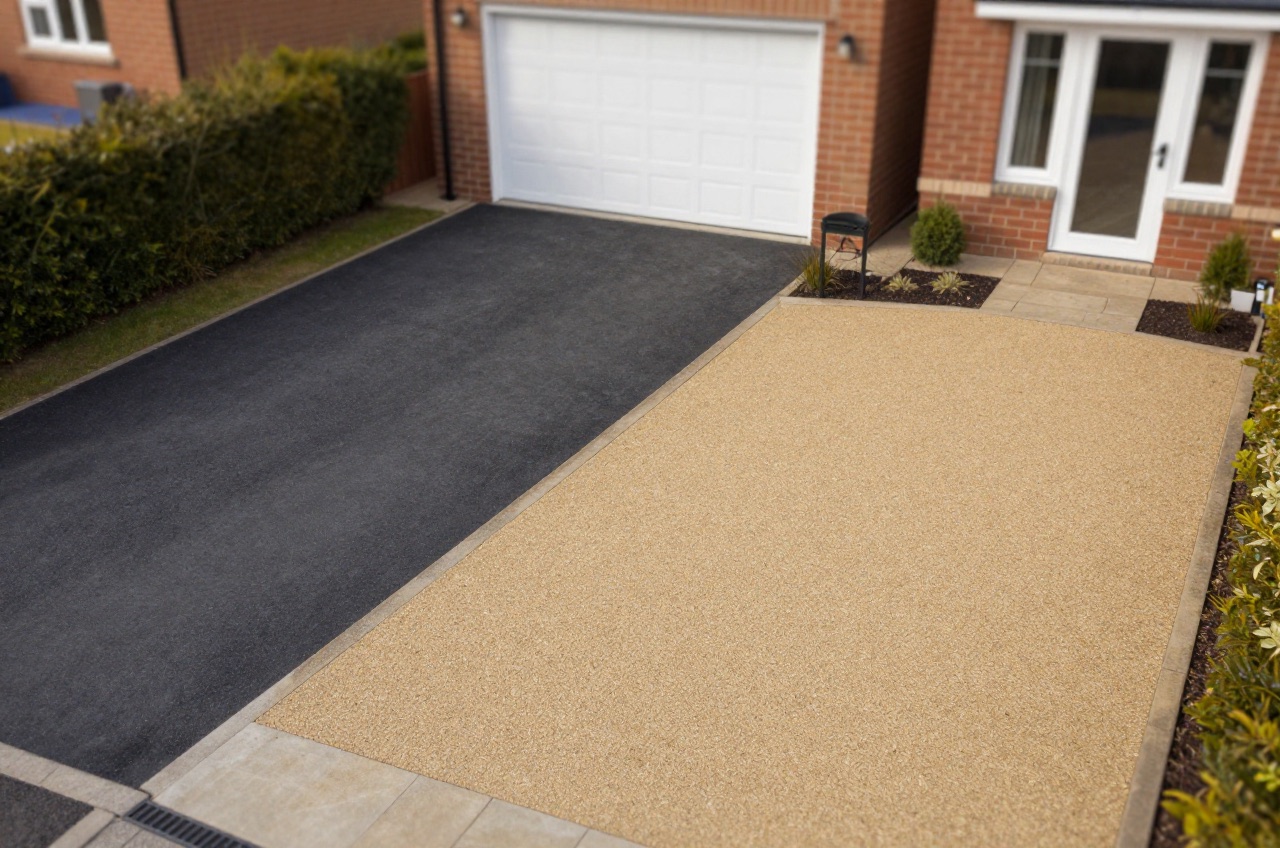
Tarmac (properly called asphalt) is a bitumen-bound aggregate laid hot and compacted by roller. Residential driveways typically use a binder course of 40–50 mm topped with a 20–25 mm wearing course, so around 65–75 mm total depth over a well-prepared sub-base.
Costs
- Standard black tarmac (supply and lay): £45–£65/m²
- Coloured tarmac (red, buff, green): £55–£75/m²
- Sub-base, excavation, and disposal (if needed): £15–£30/m²
Worked example, 50 m² tarmac driveway:
- Sub-base and preparation: 50 × £22 = £1,100
- Tarmac (binder + wearing course): 50 × £55 = £2,750
- Edging and kerbs: 30 m × £30 = £900
- Total (approximate): £4,750
Pros and cons
Tarmac is quick to lay, a typical residential driveway can often be done in a day, and ready to use within 24–48 hours. It’s durable, handles freeze-thaw cycles well, and is straightforward to repair (patches bond well to existing tarmac). Maintenance is minimal: a light seal coat every 5–7 years extends life significantly.
The main limitation is drainage. Standard tarmac is impermeable, which means surface water must drain somewhere. This either requires a gradient to a soakaway or lawn, or a drainage channel connecting to a drain. Properties subject to flooding risk may not be allowed an impermeable surface at all.
Aesthetically, tarmac is plain black (or a limited range of colours). It won’t match a heritage property or a garden landscaped with natural stone. It can soften in prolonged high temperatures, a rare but real issue in very sunny, sheltered spots.
Resin-Bound Driveways
What it is
Resin-bound surfacing mixes natural aggregate (marble, granite, quartz, or recycled glass) with a UV-stable polyurethane resin before laying. The resulting surface is porous, water drains through the voids in the aggregate, and the aggregate is fully bound so it doesn’t shed underfoot.
It’s typically laid at 15–18 mm thickness over a tarmac or concrete base (or onto a suitable existing surface), and can be installed in almost any colour or aggregate combination.
Costs
- Resin-bound surface (supply and lay, onto existing prepared base): £50–£80/m²
- New sub-base and tarmac base layer: £30–£50/m²
- Total installed (new base + resin): £80–£130/m²
Resin-bonded (the cheaper, non-permeable variant) costs £40–£65/m² installed but is not recommended where drainage compliance matters.
Pros and cons
Resin-bound is the premium option for a reason: it’s permeable (SuDS compliant with no planning permission needed for domestic driveways under 5 m²), extremely low maintenance, doesn’t harbour weeds, and looks distinctive. The colour and aggregate palette is wide, and the smooth surface suits wheelchairs and pushchairs well.
UV-stable resin is critical, cheaper resins yellow within a year or two in UK light. Always ask for a UV-stable (aliphatic) resin and check the supplier’s guarantee. On north-facing, permanently shaded areas moss can colonise the surface; an annual treatment keeps this in check.
The base preparation is critical. Resin-bound will crack if the substrate moves, so it can’t be laid over an unstable or poorly draining base. Repairs are visible, as colour-matching a patch exactly is very difficult.
Planning Permission: What You Need to Know
Since October 2008, England has required planning permission for new or replacement front garden driveways larger than 5 m² if the surface is not permeable. Wales, Scotland, and Northern Ireland have similar (or stricter) provisions.
The practical upshot:
- Gravel: always permeable, no permission needed.
- Tarmac: not permeable, permission required if over 5 m² and drains onto a highway, unless you can prove adequate run-off management (e.g., drains to a lawn or soakaway).
- Resin-bound: permeable, no permission needed (resin-bonded is NOT permeable).
The 5 m² threshold is per application, not cumulative. Always check with your local planning authority before proceeding, especially in a conservation area or an Article 4 direction zone where permitted development rights may be reduced.2
Which Surface Should You Choose?
| Priority | Best option |
|---|---|
| Lowest upfront cost | Gravel |
| Low maintenance, value for money | Tarmac |
| Premium look, no weed maintenance | Resin-bound |
| Heritage or period property | Resin-bound or natural stone |
| Must be permeable / avoid planning | Gravel or resin-bound |
| Large, busy driveway with heavy vehicles | Tarmac (thicker spec) or block paving |
No surface is perfect. Gravel is cheap but requires management. Tarmac is practical but plain. Resin is beautiful but expensive and unforgiving of a poor base. The best choice is the one that fits your budget, your property’s character, and how much time you want to spend maintaining it.
Finding a Reliable Contractor
Get at least three written quotes, specifying the same specification in each so you’re comparing like for like. For tarmac, look for members of the National Association of Surfacing Contractors (NASC). Resin-bound specialists should be trained and approved by their resin manufacturer. Be cautious of cold-call firms offering cash-in-hand deals with tarmac, this is a common sector for rogue traders.
Always ask to see examples of previous work and request references from recent customers before you sign.
References (2)
Figures in this note were checked against the sources below on 14 September 2026. Superscript numbers in the text point to them. Every source the site cites, by topic.
- 1costsupplier figureAdvanced Resin Solutions.RN-0MBQX9A price, true at 2026-09. a resin bound driveway installer publishing its own 2026 trade prices, for its own resin binder, split the way the work actually divides: £45 to £85 per m2 to lay an overlay on sound tarmac or concrete and £90 to £125 per m2 for a full system with excavation and a permeable sub-base, with the material alone at £22 to £32. It is the only source the cost book holds for that split, which every aggregated guide blurs into one range, and it is a contractor stating what it charges rather than a summary of what other people say they charge. Trade prices excluding VAT, so not what a householder pays
- 2technicalvery strongThe National Archives (legislation.gov.uk), legislation.RN-3LA2VCArticle 4(1) allows the Secretary of State or the local planning authority, where satisfied that it is expedient that development should not be carried out without permission, to direct that the permission granted by article 3 does not apply to all or any development of a Part, Class or paragraph of Schedule 2 in a specified area, or to any particular development. The procedures for making, modifying or cancelling a direction are set out in Schedule 3, and a direction does not affect development for which prior approval was granted before it took effect.
-
Resin Bound Driveway Costs 2026 (UK), Trade and Contractor Guide, Advanced Resin Solutions, accessed 17 September 2026. Priced at 2026-09, so no calibration is needed. advancedresinsolutions.co.uk
-
The Town and Country Planning (General Permitted Development) (England) Order 2015, article 4: Directions restricting permitted development, The National Archives, accessed 14 September 2026. legislation.gov.uk