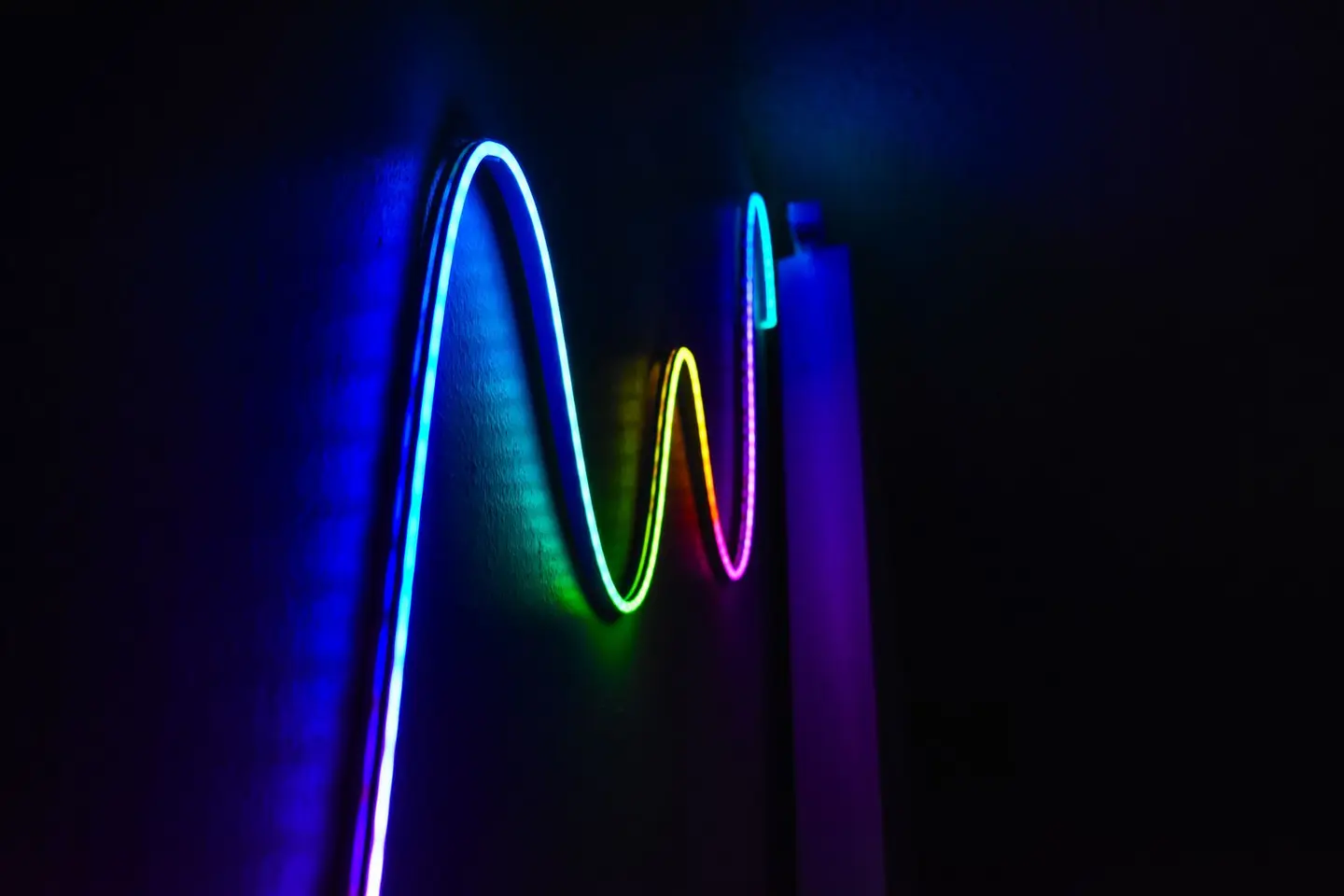
LED strip lighting is now the standard choice for under-cabinet kitchen illumination, cove and coffer lighting, stair nosing lights, and TV bias lighting, at lower running cost than fluorescent or halogen alternatives. Strips run at 12 V or 24 V DC, require a separate driver, and need a little planning around driver sizing, dimming compatibility, and IP rating near water.
Quality varies enormously. Getting the strip type, driver, dimmer, and mounting right is what separates a professional-looking installation that lasts years from one that flickers, overheats, or fades within months.
Strip Types: SMD2835, SMD5050, COB, and RGBW
The four-digit number after “SMD” (Surface Mount Device) gives the chip’s two dimensions in tenths of a millimetre. SMD2835 chips are 2.8 mm × 3.5 mm; SMD5050 chips are 5.0 mm × 5.0 mm. COB (Chip-on-Board) bonds multiple LED dies directly onto a continuous substrate, producing a seamless line of light with no visible hot spots between chips.
| Strip type | Typical lumens/m | Chip / emitter width | Voltage | Best use | Approx. cost/m |
|---|---|---|---|---|---|
| SMD2835 | 400–600 lm/m | 2.8 mm | 12 V or 24 V | Under-cabinet, accent, cove | £3–£8 |
| SMD5050 | 600–900 lm/m | 5.0 mm | 12 V or 24 V | General ambient, ceiling coves | £6–£14 |
| COB | 800–1,500 lm/m | Continuous line | 24 V | Seamless linear lighting, display | £15–£30 |
| RGBW | 200–500 lm/m (white channel) | 5.0 mm (quad chip) | 12 V or 24 V | Colour-changing accent lighting | £8–£18 |
SMD2835 is the workhorse: efficient, cool-running, and available with CRI 90+ at the upper price point. SMD5050 chips carry three or four dies per package for higher output, though the dot effect is more pronounced at close range. RGBW strips use SMD5050-class quad chips to carry red, green, blue, and white dies together. COB strips produce a genuinely uniform line, the preferred choice where the strip or diffuser falls within the line of sight, and almost always run at 24 V.
IP Ratings and Where They Apply
IP (Ingress Protection) ratings describe resistance to dust and moisture. For LED strips, the relevant classifications are:
- IP20, no moisture protection. Suitable for dry internal spaces only: living rooms, bedrooms, hallways, home offices. The most common type and the most affordable.
- IP44, splash-proof. Meets the IPX4 minimum for bathroom Zone 2, the band extending 600 mm beyond Zone 1 up to 2.25 m from the floor or the highest fixed shower head if higher, and suits kitchen areas near sinks.1
- IP65, dust-tight with protection against low-pressure water jets. Appropriate for bathroom Zone 1 (directly above the bath or shower tray, up to 2.25 m or the highest fixed shower head if higher), outdoor covered areas, and garden lighting under a pergola or soffit. The silicone coating can shift the colour of the light slightly and reduces lumen output marginally.
- IP67 / IP68, full submersion protection. Required for strip lights fitted directly into water features, pond edges, or external ground-level step lighting that will pool water.
Bathroom zone compliance
Under BS 7671 (the IET Wiring Regulations), Zone 0 is the inside of the bath or shower tray. Equipment there must be designed for immersion and supplied by SELV at no more than 12 V AC, so ordinary LED strip does not belong there.1 Zones 1 and 2 need at least splash-proof equipment (IPX4), and more where water jets are used for cleaning.1 The driver or transformer feeding any strip in a bathroom must sit outside zones 0, 1 and 2.1
Colour Temperature
Colour temperature is measured in Kelvin (K). 2700 K (warm white) suits living rooms and bedrooms; 3000 K (soft white) is a versatile domestic mid-point; 4000 K (neutral white) works well in kitchens, bathrooms, and home offices; 6500 K (daylight) is used in photography and craft rooms but is rarely flattering in living spaces. RGBW and tuneable-white strips can dial through any range digitally. High-CRI (>90) strips at 2700–3000 K are worth specifying wherever food and skin tones need to render accurately.
Voltage: 12 V vs 24 V DC
All LED strips run on low-voltage DC, 12 V or 24 V, from a separate driver. 12 V is common and marginally cheaper, but voltage drop can make the far end visibly dimmer on longer runs, often beyond about 5 m from the feed point. 24 V halves the current for the same wattage, so a single feed typically serves a longer run, often up to about 10 m; check the maker’s maximum run length. For longer runs, or wherever COB strip is specified, 24 V is usually the better choice.
Driver and Transformer Sizing
An LED driver converts mains 230 V AC to the correct DC voltage and regulates current. “Transformer” is often used interchangeably in retail descriptions, though technically an LED driver is constant-current or constant-voltage regulated.
Wattage calculation: multiply the strip’s rated W/m by total length, then add 20%. Five metres of 12 W/m strip needs 5 × 12 = 60 W + 20% = 72 W minimum. Undersizing causes overheating, flickering, and early failure. Drivers are available as slim in-line units for ceiling voids and plinths, or surface-mount boxes; for dimmable installs the driver must be specified as dimmable and matched to the dimmer type.
Dimming Compatibility
Incorrect dimmer choice is the most common cause of LED strip flicker and premature driver failure.
Trailing-edge (electronic/RC) dimmers are compatible with most LED drivers and are the standard domestic choice for mains-side dimming. Leading-edge (“standard”) dimmers, designed for incandescent and halogen loads, frequently cause buzzing or incompatibility; always check the driver datasheet before specifying. 0–10 V or DALI dimming is used in commercial and high-end domestic installs: the driver accepts a separate low-voltage signal, giving very stable, flicker-free control.
PWM controllers (standard in smart and colour-changing systems) dim by rapidly switching the strip on and off. At low frequencies this can produce visible flicker or strobing, uncomfortable for some people and problematic in spaces used for video or photography. Many specifiers ask for 1,000 Hz or above, and 2,000 Hz or higher for media use.
Smart Controllers: RF, Bluetooth, and Zigbee
For RGBW or tuneable-white strips, a smart controller replaces the basic dimmer. RF controllers need no hub and work through walls but do not integrate with smart home platforms without a separate bridge. Bluetooth controllers pair directly with a phone app, easy to set up but range-limited to roughly 10 m with no remote access outside the home. Zigbee controllers connect to a smart home hub (compatible with common UK ecosystems), enabling scenes, automation, and voice control; they cost more upfront but are the most flexible long-term option.
Mounting: Self-Adhesive vs Aluminium Channel
Most strips ship with a self-adhesive backing (often 3M tape), which is adequate short-term on clean flat surfaces but weakens with heat cycling. Strips mounted directly on wood or plasterboard cannot dissipate heat, which degrades LED lifespan.
Aluminium channels (extrusions) are recommended for permanent installations. They provide mechanical retention and conduct heat away from the strip, maintaining junction temperature. A frosted PC diffuser clips into the channel and eliminates the dot effect between chips, producing a clean even line, particularly desirable with SMD strips in visible positions. Profiles are available in surface-mount, recessed (plasterboard-cut), corner-mount, and plinth/under-cabinet forms; budget £5–£15/m for channel plus diffuser.
Avoid folding strip at corners, use purpose-made corner connectors or cut at designated marks and rejoin with solder-free clip connectors.
UK Building Regulations and Electrical Safety
LED strip lighting at 12 V or 24 V DC is extra-low voltage, which is still within the scope of Part P, so the work must be safe even where it is not notifiable.2 Connecting a driver to an existing lighting circuit is not notifiable in itself. The work becomes notifiable if it needs a new circuit from the consumer unit, or if it adds to or alters a circuit in a special location, such as the space around a bath or shower.2 Kitchens and outdoor lighting are not special locations, so a driver added to an existing circuit there is not notifiable.2 Notifiable work must either be notified to Building Control or done by an electrician registered with a competent person scheme.
Bathroom zone compliance under BS 7671 applies regardless of notifiability. Locate drivers outside zones 0, 1 and 2, and keep mains connections out of the zones.
Common Applications
Under-cabinet kitchen lighting is the most popular domestic use. A run of 24 V SMD2835 or COB strip in a surface-mount aluminium channel under wall units provides shadow-free task lighting on the worktop; CRI 90+ at 3000–4000 K is the standard specification. Four to eight metres of strip typically suffices for an average kitchen.
Cove and coffer lighting bounces indirect light off a ceiling from a ledge or recess. The strip faces upward and is hidden; only the reflected glow is visible. COB strip or high-density SMD with a diffuser channel prevents scalloping on the ceiling.
Stair nosing lighting uses slim recessed profiles in each tread for orientation lighting without wall switches at every level. IP44 is advisable on internal stairs that are cleaned with damp mops.
TV backlighting (bias lighting), typically 2–4 m of strip on the rear of the television panel, reduces eye strain in dark viewing rooms. A tuneable-white strip at 6500 K matches the D65 standard used in content mastering.
Typical 2026 UK Cost Ranges
| Item | Budget | Mid-range | Premium |
|---|---|---|---|
| Strip (per metre, supply only) | £3–£8 (SMD2835)3 | £8–£18 (SMD5050/RGBW) | £15–£30 (COB/high-CRI) |
| Aluminium channel with diffuser (per metre) | £5–£8 | £8–£12 | £10–£15 |
| LED driver (per unit) | £12–£204 | £20–£45 | £45–£90+ |
| Smart Zigbee controller | - | £25–£50 | £50–£100+ |
| Installation (electrician, per hour) | £50–£65 | £65–£80 | £80–£100+ |
A complete under-cabinet kitchen installation (6 m strip, channels, driver, trailing-edge dimmer, and electrician connection) typically costs £250–£500 supply and fit in 2026, depending on region and specification.
References (4)
Figures in this note were checked against the sources below on 30 September 2026. Superscript numbers in the text point to them. Every source the site cites, by topic.
- 1technicalstrongNICEIC, guidance.RN-8VV8NHNICEIC's householder guide to BS 7671 bathroom rules. It defines zones 0, 1 and 2 and covers sockets, shaver sockets, switches and RCD protection.
- 2technicalvery strongMinistry of Housing, Communities and Local Government.RN-JYJ3I5The document that decides what electrical work a homeowner may legally do themselves, and the exact list of notifiable jobs. Regulation 12(6A), reproduced at paragraph 2.5, makes only three things notifiable: the installation of a new circuit, the replacement of a consumer unit, and any addition or alteration to existing circuits in a special location. Regulation 12(9) defines special location as, in a room containing a bath or shower, the zone extending vertically from finished floor level to 2.25 metres (or the shower head position if higher) and horizontally 600mm from the edge of the bath tub or shower tray. Paragraph 2.7 states that all other electrical installation work is not notifiable, namely additions and alterations to existing installations outside special locations, and replacements, repairs and maintenance anywhere. Paragraph 2.8 gives worked examples: a built-in cooker is not notifiable unless a new cooker circuit is needed, and connecting an electric gate or garage door to an existing isolator is not notifiable but running a new circuit from the consumer unit to that isolator is. Paragraph 2.2 confirms Part P reaches outdoor work including fixed garden lighting, pond pumps and outbuildings such as sheds, detached garages and domestic greenhouses. Notifiable work must be certified by self-certification by a registered competent person, third-party certification, or a building control body (paragraph 3.1), with the compliance certificate issued within 30 days (paragraph 3.4). Note that Approved Document P is a source of guidance rather than a ban: non-notifiable work still has to comply with BS 7671.
- 3costsupplier figureBoiler Central.RN-QSHROZA price, true at 2026-07. Boiler Central publishing its own price guidance for this work. A trade supplier writing about what it charges is evidence of the market rate and not a quotation, and the cost book treats it as one figure among several rather than on its own
- 4costsupplier figureTLC Direct (TLC Electrical Distributors Ltd).RN-PW830QA price, true at 2026-09. An electrical wholesaler’s LED driver and transformer index, listing constant voltage 12 V drivers by wattage with the price shown both excluding and including VAT, and quantity breaks stated on the line. Held because it separates the two kinds of driver that a domestic note runs together: constant VOLTAGE, which powers LED tape, and constant CURRENT, which powers downlights. A trade counter list price, so it sits below a consumer retailer on the same part and carries no installation.
-
Bathrooms and electrics: what you need to know, NICEIC, accessed 30 September 2026. niceic.com
-
Approved Document P, Electrical safety: Dwellings, 2013 edition incorporating 2010 and 2013 amendments, Ministry of Housing, Communities and Local Government, accessed 14 September 2026. assets.publishing.service.gov.uk
-
Copper Pipe Cost UK 2026: Price per Metre & Boiler Guide, Boiler Central, accessed 30 September 2026. Priced at 2026-07, so no calibration is needed. boilercentral.com
-
240V to DC LED driver transformer, TLC Direct (TLC Electrical Distributors Ltd), accessed 19 September 2026. Priced at 2026-09, so no calibration is needed. tlc-direct.co.uk