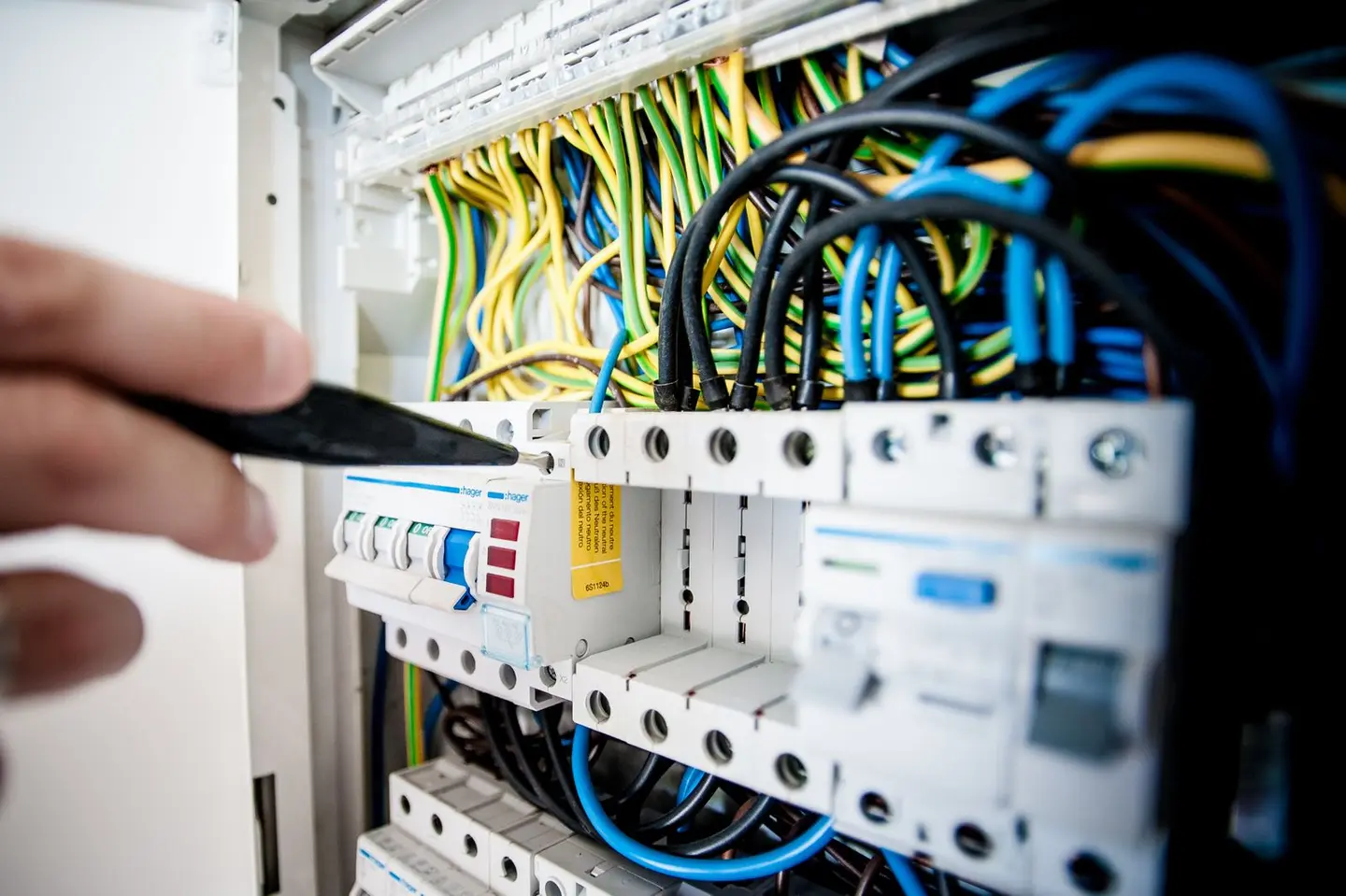
The consumer unit, commonly called the fuse board or fuse box, is the hub of your home’s electrical system. It receives the incoming supply from the meter, divides it into individual circuits, and protects those circuits with fuses or circuit breakers. An outdated or undersized consumer unit is both a practical inconvenience and a safety concern: it may not provide adequate protection against electric shock or fire, and it will fail a periodic electrical inspection.
For most UK homes, a consumer unit replacement costs £400–£900 supply and fit, completed in half a day by a qualified electrician. The work must be notified under Part P of the Building Regulations.1
Types of Consumer Unit
Old rewireable fuse boards
Older properties may still have rewireable fuse boards, common until miniature circuit breakers took over from the 1980s, where each circuit is protected by a porcelain fuseholder with a thin fuse wire that the homeowner replaces when it blows. These boards provide no RCD (residual current device) protection and do not trip instantly, they rely on the fuse wire melting, which takes time. They should be replaced.
MCB-only consumer units (pre-2016)
From the 1980s onward, miniature circuit breakers (MCBs) replaced rewireable fuses. MCBs trip quickly and are reset by a switch rather than requiring fuse wire replacement. However, older MCB-only boards provide no RCD protection. The 17th Edition of the Wiring Regulations (BS 7671:2008) required 30 mA RCD protection for most socket-outlet circuits, cables buried in walls and all bathroom circuits, which in practice led to split-load boards with two RCDs; many boards from the 1990s and early 2000s predate it.
Split-load dual RCD consumer units
The most common type installed from around 2008 to 2016. The board has a main switch and two 30 mA RCDs, each protecting half the circuits. This provides RCD protection throughout, but has one significant weakness: if one RCD trips, it takes out all the circuits it covers simultaneously, losing, for example, both the freezer and the shower at once. Still acceptable in existing installations, but less convenient and less safe than RCBO boards.
RCBO consumer units
An RCBO (residual current breaker with overcurrent) combines MCB and RCD functions in a single device per circuit. Every circuit has its own independent protection: a fault on the shower circuit trips only the shower breaker, leaving all other circuits unaffected. This is now the preferred standard for new consumer unit installations. Supply cost for the unit is higher (RCBOs cost £15–£35 each versus £5–£10 per MCB), but the board requires only a single main switch.
Consumer unit types at a glance
| Type | RCD protection | Individual trip per fault | Notes |
|---|---|---|---|
| Rewireable fuse board | None | No, fuse wire needed | Replace immediately |
| MCB-only board | None | Yes | No RCD = non-compliant for new work |
| Split-load dual RCD | Yes (2 groups) | No, half the circuits trip | Acceptable in existing dwellings; not ideal |
| RCBO board | Yes (per circuit) | Yes | Current best practice; not mandatory |
| High-integrity (dual RCD + RCBOs) | Yes | Partial | Legacy design; largely superseded by RCBO |
Regulatory Requirements: BS 7671 and Part P
The 18th Edition of the Wiring Regulations (BS 7671:2018, with Amendment 4 published on 15 April 2026) requires:2
- Non-combustible enclosures (in practice steel) for all new consumer units in domestic premises, a rule introduced by Amendment 3 to BS 7671:2008 with effect from 1 January 2016.3 Plastic-encased units are no longer acceptable for new installations or full replacements in homes unless housed in a non-combustible cabinet, the metal enclosure provides fire containment if an internal fault ignites.
- 30 mA RCD protection on virtually all final circuits in a home, including socket-outlets, lighting and bathroom circuits.
- Surge protection devices (SPDs), the 18th Edition (2018) dropped the old lightning-exposure test for deciding whether protection against transient overvoltages is needed, and Amendment 2 (2022) redrafted Regulation 443.4 so that protection is required wherever an overvoltage could cause serious injury or significant financial or data loss.4 In most homes this means a Type 2 SPD at the consumer unit.
All consumer unit replacements in England and Wales are notifiable under Part P of the Building Regulations. A registered competent person self-certifies the work; work done by an unregistered contractor must be inspected and certified by Building Control (with a fee). A completion certificate must be provided to the homeowner.1
When Should You Upgrade?
Replace your consumer unit if:
- It is a rewireable fuse board, immediate safety risk; no rapid disconnection on fault
- It has no RCD protection, non-compliant with current standards; fails an EICR
- It is an old plastic board that also needs alterations, a sound plastic board need not be replaced for that reason alone, but any replacement must have a non-combustible enclosure
- The board is full, no spare ways for additional circuits (EV charger, shed supply, electric shower)
- It fails an Electrical Installation Condition Report (EICR), landlords in England must have the installation inspected and tested at least every five years (private lets since 2020, social housing since 2025–26); a C2 (potentially dangerous) or C1 (immediate danger) code on the board triggers required remedial work56
- You are extending, adding a new circuit, or installing an EV charger, this triggers a partial assessment; if the existing board cannot accommodate the new circuit safely, replacement is required
Selling a property: consumer units are inspected during a house buyer’s survey. A visibly old or incomplete board will prompt a surveyor’s recommendation for an EICR, potentially affecting the sale price or requiring upgrade before exchange.
Cost Breakdown
| Item | Typical cost |
|---|---|
| Consumer unit (RCBO, metal-clad, 10–16 way) | £120–£350 supply |
| Electrician labour (half-day, replacement only) | £250–£450 |
| Separate EICR on the rest of the installation (optional) | £150–£300 |
| Part P notification fee (via registered electrician, included in most quotes) | £0–£50 |
| SPD addition | £80–£200 supply and fit |
| Full replacement (supply, fit, testing, EIC, Part P notification) | £400–£900 |
Prices vary significantly by region, London and the South East run 20–40% above the national average for electrical labour.
Additional costs arise if:
- The incoming tails (the cables from the meter to the consumer unit) need replacing, £100–£200 extra for new meter tails
- The earthing or bonding is deficient: main protective bonding of the incoming gas and water pipes to the main earthing terminal is required, and supplementary bonding in a bathroom, where it is still needed (it can often be omitted where all circuits are RCD-protected and main bonding is in place), costs £80–£1507
- Multiple circuits are found to be non-compliant during the EICR, remedial work is quoted separately per fault
Choosing a Consumer Unit: What to Specify
When getting quotes, be clear about:
- Number of ways (circuits): count your existing circuits plus any planned additions. A 12-way board is typical for a three-bedroom house; a 16-way gives more capacity for EV charger, electric shower, garden power, etc.
- RCBO vs split-load: always specify RCBO for a new installation, the price difference is modest at the whole-job level
- SPD: ask whether the quote includes an SPD; under current regulations it should be assessed and usually fitted
- Metal enclosure: confirm the unit being installed is metal-clad; plastic boards must not be installed as replacements
Always use a registered electrician from a recognised scheme such as NICEIC, NAPIT, SELECT (Scotland), or ECA. Ask for the Part P completion certificate and keep it with the property documents.1
What the Electrician Will Check
A conscientious electrician will not simply swap the consumer unit and leave. Before and after the replacement they should:
- Test insulation resistance on all circuits (identifies damaged cables that cannot be seen visually)
- Verify earthing and bonding at all required points
- Test RCD operation (a general-type RCD must trip within 300 ms at its rated residual current)8
- Verify ring main continuity and polarity
- Issue an Electrical Installation Certificate (EIC) for the new work, recording any defects found on the existing circuits
If the electrician proposes to install a new board without testing the circuits first, or without issuing a completion certificate, do not proceed.
References (8)
Figures in this note were checked against the sources below on 30 September 2026. Superscript numbers in the text point to them. Every source the site cites, by topic.
- 1technicalvery strongMinistry of Housing, Communities and Local Government.RN-JYJ3I5The document that decides what electrical work a homeowner may legally do themselves, and the exact list of notifiable jobs. Regulation 12(6A), reproduced at paragraph 2.5, makes only three things notifiable: the installation of a new circuit, the replacement of a consumer unit, and any addition or alteration to existing circuits in a special location. Regulation 12(9) defines special location as, in a room containing a bath or shower, the zone extending vertically from finished floor level to 2.25 metres (or the shower head position if higher) and horizontally 600mm from the edge of the bath tub or shower tray. Paragraph 2.7 states that all other electrical installation work is not notifiable, namely additions and alterations to existing installations outside special locations, and replacements, repairs and maintenance anywhere. Paragraph 2.8 gives worked examples: a built-in cooker is not notifiable unless a new cooker circuit is needed, and connecting an electric gate or garage door to an existing isolator is not notifiable but running a new circuit from the consumer unit to that isolator is. Paragraph 2.2 confirms Part P reaches outdoor work including fixed garden lighting, pond pumps and outbuildings such as sheds, detached garages and domestic greenhouses. Notifiable work must be certified by self-certification by a registered competent person, third-party certification, or a building control body (paragraph 3.1), with the compliance certificate issued within 30 days (paragraph 3.4). Note that Approved Document P is a source of guidance rather than a ban: non-notifiable work still has to comply with BS 7671.
- 2technicalstrongThe Institution of Engineering and Technology, guidance.RN-XDO58UIET press release confirming that Amendment 4 (2026) to BS 7671:2018 was officially published on 15 April 2026, which makes BS 7671:2018+A4:2026 the current edition.
- 3technicalstrongThe Institution of Engineering and Technology, guidance.RN-RROQ4CIET guidance quoting regulation 421.1.201 from Amendment 3 to BS 7671:2008: domestic consumer units must have a non-combustible enclosure (steel is the example), from 1 January 2016.
- 4technicalstrongThe Institution of Engineering and Technology (Wiring Matters), guidance.RN-H3DWPZIET Wiring Matters article on Amendment 2. It explains that the AQ lightning criteria went in 2018 and that A2 redrafted Regulation 443.4 to require protection where an overvoltage could cause injury or significant financial or data loss.
- 5technicalvery strongThe National Archives, guidance.RN-SJ5I0URegulation 1 as amended records that SI 2025/1043 extended the regulations to the social rented sector, in force from 1 November 2025 for specified purposes and fully from 1 May 2026.
- 6technicalvery strongThe National Archives, guidance.RN-21X8F4Regulation 3 requires landlords to have every electrical installation inspected and tested by a qualified person at intervals of no more than five years, and before a new tenancy starts.
- 7technicalstrongThe IET, guidance.RN-76NYWBThe IET's technical article on Section 701 of BS 7671, locations containing a bath or shower. Explains the zones, 0, 1 and 2, what equipment and IP rating is permitted in each, the supplementary bonding rules and where a socket may and may not go. This is the source behind every statement about what can be installed near a bath, and it is written by the IET's own chief engineer answering the questions their helpline actually receives.
- 8technicalstrongThe Institution of Engineering and Technology, guidance.RN-6LAH7BIET Wiring Matters article on RCD testing under BS 7671:2018+A2:2022. It gives the 300 ms maximum operating time at rated residual current for general non-delay RCDs.
-
Approved Document P, Electrical safety: Dwellings, 2013 edition incorporating 2010 and 2013 amendments, Ministry of Housing, Communities and Local Government, accessed 14 September 2026. assets.publishing.service.gov.uk
-
IET & BSI officially publish Amendment 4 (2026) to BS 7671:2018 (IET Wiring Regulations), The Institution of Engineering and Technology, accessed 30 September 2026. theiet.org
-
New non-combustible enclosure requirement for consumer units, The Institution of Engineering and Technology, accessed 30 September 2026. electrical.theiet.org
-
The impact of Amendment 2 of the 18th edition (BS 7671:2018+A2:2022), The Institution of Engineering and Technology (Wiring Matters), accessed 30 September 2026. electrical.theiet.org
-
The Electrical Safety Standards in the Private Rented Sector (England) Regulations 2020, regulation 1, The National Archives, accessed 30 September 2026. legislation.gov.uk
-
The Electrical Safety Standards in the Private Rented Sector (England) Regulations 2020, regulation 3, The National Archives, accessed 30 September 2026. legislation.gov.uk
-
Section 701: Locations containing a bath or shower, The Institution of Engineering and Technology, accessed 30 September 2026. electrical.theiet.org
-
Wiring Matters, Issue 91, July 2022, The Institution of Engineering and Technology, accessed 30 September 2026. electrical.theiet.org