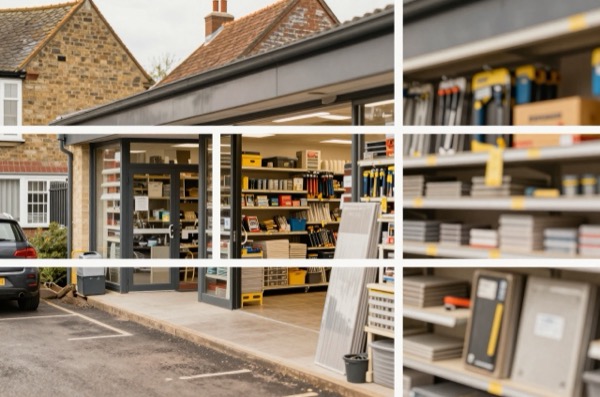
The rise of online ordering has not bypassed the building materials sector. There are now UK merchants operating entirely online, traditional merchants with strong e-commerce arms, and general marketplaces where trade supplies sit alongside consumer goods. The question tradespeople and self-builders regularly ask is whether buying online actually saves money when you factor in delivery and waiting time.
The honest answer is: sometimes, for some products. This guide explains when online purchasing makes sense, what the real cost comparison looks like, and what to watch out for.
How Online Builders’ Merchants Work
Online-only and online-first merchants carry stock in central warehouses and despatch to site or home. They operate with lower overheads than branch networks, no trade counter staff, no local delivery fleet, no branch managers, which in theory gives them room to price more keenly.
Some well-known examples of the model include:
- Roofing Superstore, PlumbNation and similar category specialists, strong range, competitive pricing, but specialist rather than general
- Travis Perkins, Jewson, Huws Gray and other national merchants, traditional merchants with full e-commerce presence, drawing on their branch networks for fulfilment
Then there are general online marketplaces (Amazon, eBay) where third-party trade suppliers list products. These are a mixed bag in terms of reliability and value.
Price Comparison: Online vs Local
For a direct comparison to be meaningful, you need to compare the total landed cost, material price plus delivery, against your local merchant’s delivered or collected price.
| Product category | Online vs local branch | Notes |
|---|---|---|
| Power tools and hand tools | Often 5–15% cheaper online | Amazon/eBay sometimes undercut; check warranty |
| Cable and electrical accessories | Variable; Toolstation/Screwfix hard to beat | Specialist electrical sites competitive on volume |
| Plumbing fittings | Online specialists often 10–20% cheaper on valves | Local merchant wins on convenience for urgent bits |
| Roofing materials | Online specialists often competitive | Delivery charges on tiles significant |
| Insulation (bulk) | Online can be 10–25% cheaper | Pallet delivery manageable for large orders |
| Structural timber | Local merchant usually wins | Timber delivery complex; online rarely practical |
| Fixings and fasteners | Bulk online packs often better value | Minimum order matters |
| Sanitaryware and bathrooms | Major saving possible online (20–40%) | Lead times vary; check returns policy |
These are indicative ranges. Specific products and specific merchants will produce different results. The only reliable approach is to get like-for-like quotes including delivery.
Delivery: The Number That Changes Everything
Delivery cost is the factor that most often makes or breaks the online saving. Key variables:
Minimum order for free delivery. Most online merchants offer free delivery above a threshold, but the threshold varies widely, and heavy materials often carry a pallet charge instead (see below). Screwfix, for example, delivers free on orders over £50.1 Lawsons, a builders’ merchant, offers free standard delivery only on online orders over £350 excluding VAT, and charges from £24 plus VAT below that.2 If your order is below the threshold, the saving often disappears entirely.
Pallet surcharges. Heavy materials (insulation boards, bricks, blocks, tiles) are delivered on pallets by a pallet network. Pallet delivery is usually charged per pallet, often somewhere around £60–£120, and some merchants exclude it from their free delivery offer. A pallet of insulation boards from an online merchant that looks 15% cheaper can easily work out the same as or more than a local merchant who delivers free with a material order.
Lead time. Online orders typically take 2–5 working days; some specialist items take longer.2 If you need something today or tomorrow, click-and-collect from Screwfix or Toolstation wins regardless of price.
Returns. Returns for building materials ordered online can be complicated. Large or heavy items often need to be returned on a pallet at your expense. Check the returns policy before ordering anything you are not certain about. If you buy as a private consumer, the Consumer Contracts Regulations 2013 usually give you 14 days after delivery to cancel an online order.3 You normally pay the direct cost of sending the goods back unless the seller agreed to cover it or failed to tell you beforehand.4 Buying for your business does not give you this right, because the regulations only protect individuals acting mainly outside their trade.5
Online Marketplaces: Amazon and eBay
Both platforms carry building and trade supplies from a wide range of third-party sellers, alongside some first-party Amazon lines.
When Amazon works well:
- Tools and branded accessories where the product is standardised (exact product matches between suppliers)
- Small consumables that qualify for Prime next-day delivery
- Items where multiple sellers compete, driving the price down
When to be cautious:
- Check whether the seller is VAT-registered and whether the listing price includes VAT, Amazon listings vary
- Check delivery charge and estimated date; Prime does not always apply to third-party seller stock
- Warranty and returns with third-party sellers varies; stick to FBA (Fulfilled by Amazon) listings for easier returns
eBay can offer genuine bargains from trade clearances, surplus stock, and direct sellers, but requires more due diligence. Not all eBay trade sellers are VAT-registered.
Checking Online Merchant Reviews
Before ordering from an online merchant you have not used before, check:
Trustpilot and Google Reviews, look at the volume of reviews as well as the rating, and read the negative reviews. Common complaints about building materials e-commerce are: wrong items delivered, long delays on backorders, poor returns handling, and being passed between courier and merchant when something goes wrong.
Delivery area and postcode check. Some online merchants do not deliver to Scotland, Northern Ireland, or remote postcodes, or charge substantial surcharges. Always check before adding to basket.
VAT position. Reputable trade merchants quote prices ex-VAT with a clear VAT addition at checkout. Some consumer-facing sites include VAT in listed prices. Make sure you are comparing like for like.
When Online Genuinely Makes Sense
The cases where online purchasing consistently delivers better value:
Large, non-urgent orders. If you are fitting out a bathroom, ordering a full insulation specification for a loft, or buying cable for a complete rewire, the volume justifies the search time and delivery charge. The savings on a £2,000+ material order can be meaningful.
Specialist products. Items your local merchant does not stock or would need to order in anyway. If the lead time is similar, you may as well buy from the cheapest source.
Sanitaryware and bathroom products. Online retailers (and bathroom-specific e-commerce sites) often carry the same branded products at significantly lower prices than bathroom showrooms or traditional plumbers’ merchants.
Tools and equipment comparisons. Branded power tools are a commodity; price comparison between local stock and online (with standard delivery) is quick and the savings are real.
When to Stick with a Local Merchant
- You need materials today or tomorrow
- The item is heavy or bulky and pallet delivery erodes the saving
- You have a trade account relationship that gives you similar pricing plus credit terms
- You need to inspect product quality (reclaimed materials, timber, etc.)
- The order is likely to change and you need to return or add items easily
Online and local are not either/or for most tradespeople. The practical approach is to use online channels for planned, non-urgent purchases on product categories where the saving is proven, and local merchants for urgent needs, structural materials, and anything where the relationship matters.
References (5)
Figures in this note were checked against the sources below on 2 October 2026. Superscript numbers in the text point to them. Every source the site cites, by topic.
- 1costsupplier figureScrewfix, guidance.RN-CJK7AMA price, true at 2026-09. Screwfix's own delivery page: the charges for standard, Sunday and premium delivery by order value, free delivery over £50, and the order-by times for next day delivery (9pm on weekdays, 6pm Saturdays, 5pm Sundays).
- 2costsupplier figureLawsons.RN-5CWO92A price, true at 2026-09. A builders' merchant's delivery policy: delivery from £24 plus VAT, free over £350 ex VAT, special-delivery items excluded, and a 2 to 5 working day target.
- 3technicalvery strongThe National Archives (legislation.gov.uk), guidance.RN-LG5W1ERegulation 30 sets the 14-day cancellation period for distance sales of goods, running from delivery; regulation 28 excludes goods made to the consumer's specifications.
- 4technicalvery strongThe National Archives (legislation.gov.uk), guidance.RN-Y9FB5MRegulation 35(5) puts the direct cost of returning cancelled goods on the consumer unless the trader agreed to pay it or failed to give the required information.
- 5technicalvery strongThe National Archives (legislation.gov.uk), guidance.RN-PIT8JKRegulation 4 defines a consumer as an individual acting wholly or mainly outside their trade or business, so trade purchases fall outside the cancellation rights.
-
Delivery, Screwfix, accessed 2 October 2026. Priced at 2026-09 and left there. screwfix.com
-
Delivery & Returns Policy, Lawsons, accessed 2 October 2026. Priced at 2026-09 and left there. lawsons.co.uk
-
The Consumer Contracts (Information, Cancellation and Additional Charges) Regulations 2013, regulation 30, legislation.gov.uk (The National Archives), accessed 30 September 2026. legislation.gov.uk
-
The Consumer Contracts (Information, Cancellation and Additional Charges) Regulations 2013, regulation 35, legislation.gov.uk (The National Archives), accessed 30 September 2026. legislation.gov.uk
-
The Consumer Contracts (Information, Cancellation and Additional Charges) Regulations 2013, regulation 4, legislation.gov.uk (The National Archives), accessed 30 September 2026. legislation.gov.uk