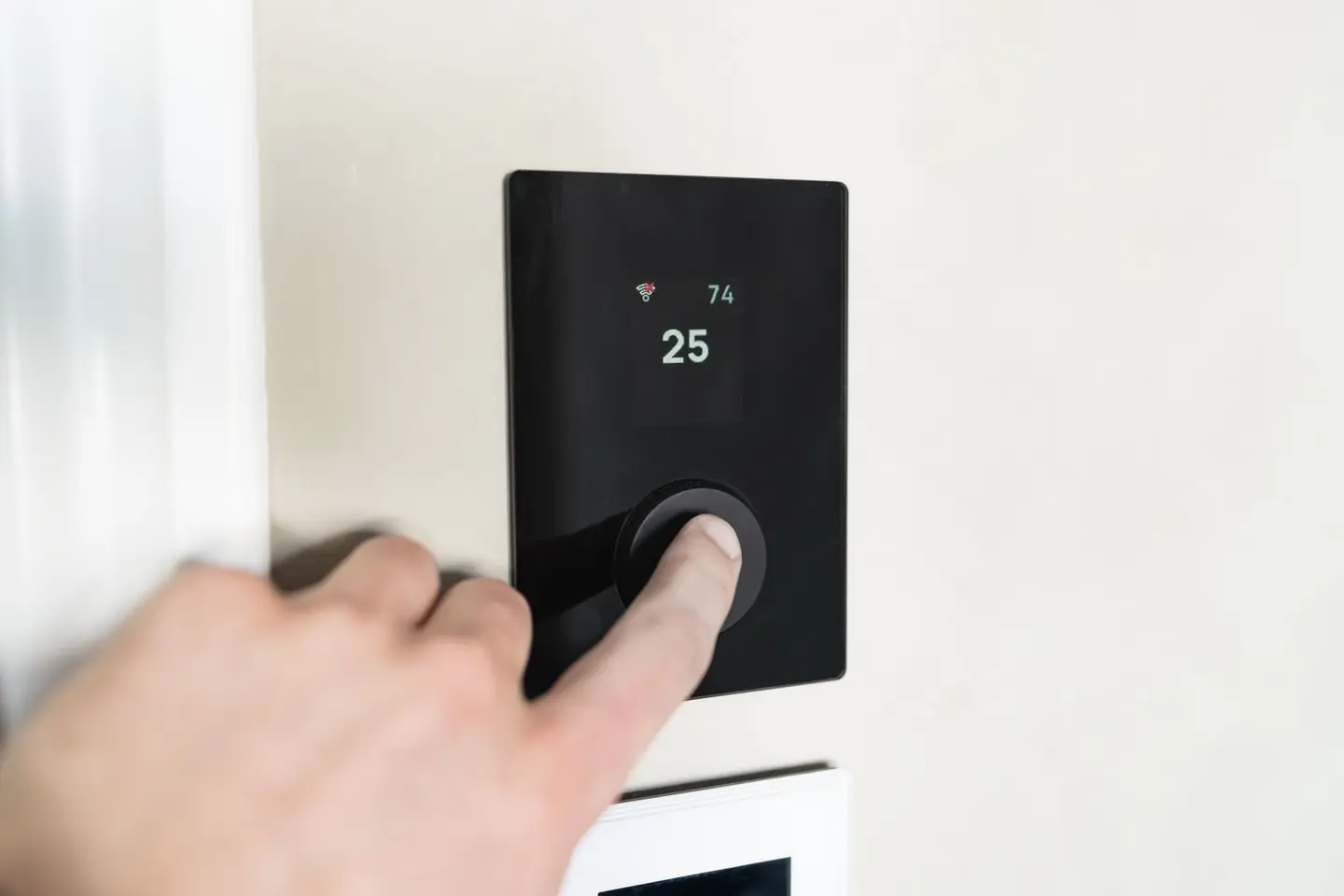
Upgrading to smart heating is one of the most cost-effective energy improvements available to UK homeowners, no scaffolding, no disruption, and the savings usually pay back the investment within a few years. But “smart heating” covers a wide range, from a single connected thermostat replacing your existing programmer to a full multi-room zoning system. Understanding the difference helps you choose the right level of investment.
What Is a Smart Thermostat?
A smart thermostat replaces your existing room thermostat and/or programmer. It connects to your home’s Wi-Fi (and usually to a bridge or hub), allowing you to control your heating remotely via a smartphone app. Most also learn your schedule, adjust for the weather, and provide energy usage reports.
At minimum, a smart thermostat gives you:
- Remote on/off and temperature control from any location
- Schedule setting from a phone rather than a physical timer
- Usage data showing how many hours your heating ran
More advanced models add weather compensation (adjusting target temperature based on the outdoor forecast), geofencing (turning heating off when the app detects you’ve left home), and occupancy detection.
Smart Thermostats: Cost and Options
| System | Components | Supply & Fit Cost | Compatible Boilers |
|---|---|---|---|
| Hive Active Heating | Thermostat + hub + receiver | £150–£250 | Most UK gas boilers |
| Google Nest Learning Thermostat | Thermostat (no hub needed for some installs) | £180–£300 | Most; check Heat Link compatibility |
| tado° Starter Kit | Thermostat + internet bridge | £160–£280 | Most UK gas/oil boilers |
| Drayton Wiser | Thermostat + hub | £130–£220 | Most conventional systems |
| Honeywell Home T6R | Wireless room thermostat | £80–£150 | Conventional systems |
Supply-only costs are typically £80–£200; professional installation adds £60–£150. A Gas Safe engineer is required if any work involves the boiler wiring or controls; an electrician can handle thermostat wiring on the room side.
Heating Zones: What They Are and Why They Matter
A single-thermostat setup heats the whole house based on one location, typically the hallway or living room. Rooms that are unused, face south (and gain solar heat), or have different occupancy patterns are either overheated or underheated.
Zoning divides the house into areas that can be independently controlled:
- Zone 1 (Living areas): Heated to 21°C during the day
- Zone 2 (Bedrooms): Heated only in the morning and evening; cooler overnight (17–18°C)
- Zone 3 (Utility/spare rooms): Frost protection only (8–10°C) when unoccupied
This can be achieved at different levels of complexity and cost:
Level 1: Smart TRVs (Thermostatic Radiator Valves)
Smart TRVs replace the manual TRV on each radiator. They are individually programmable via an app and allow room-by-room temperature control without additional pipework.
Cost: £30–£80 per valve (supply); fitting is usually DIY-possible (no gas qualification needed). A whole-house fit for 8–10 radiators: £250–£800 in smart TRVs. Compatible hubs are often required (e.g., tado° or Drayton Wiser hubs: £50–£100).
Limitation: Smart TRVs control each radiator independently but the boiler is still called by the central thermostat. In a well-designed smart TRV system, the system should have an “open window” bypass or the boiler will keep firing even when all TRVs are closed. Ensure your chosen system includes a “call for heat” signal or a boiler relay.
Level 2: Two-Zone Heating (Upstairs/Downstairs)
Adding a second zone valve and thermostat splits the system into two independently controlled areas. This is the most common upgrade for family homes and requires a qualified plumber.
Cost: £300–£700 for a second zone valve, room thermostat, and wiring, fitted by a plumber and/or electrician. Can be combined with a smart thermostat on each zone.
Level 3: Full Multi-Zone or Underfloor Heating Manifold
Underfloor heating (UFH) systems and newer installations often include manifolds with individual loop valves, allowing truly room-by-room control. Smart systems from companies like Heatmiser, SALUS, or Danfoss connect each zone to a central hub.
Cost: £600–£2,000+ for a hub and wiring harness controlling 6–12 zones; typically quoted as part of a wider heating project.
Typical Energy Savings
Studies from BEIS and independent testing suggest:
| Control Upgrade | Estimated Annual Saving | Approximate Payback |
|---|---|---|
| Smart thermostat (single zone) | 8–15% of heating bill (~£80–£200) | 1–3 years |
| Smart TRVs on most radiators | 5–12% additional saving (~£50–£150) | 2–5 years |
| Two-zone system (up/downstairs) | 10–20% of heating bill (~£100–£250) | 2–4 years |
| Full multi-zone smart system | 15–25% of heating bill (~£150–£350) | 3–6 years |
Savings vary widely depending on your existing controls, occupancy patterns, and how well you currently manage your heating. Homes with no programmable control at all and electric storage heaters see the biggest gains; homes already on a good schedule with modern TRVs may see smaller improvements.
For reference, heating a typical UK semi-detached home with gas currently costs approximately £900–£1,500/year (2026 price cap tariffs). A 15% saving is worth £135–£225 annually.
Is Your System Compatible?
Most UK gas and oil boilers can accept a smart thermostat. Check:
- Wiring type, most UK systems use 240V switching; some older systems use millivolt controls (rare) which may need an adapter
- OpenTherm compatibility, a communication protocol that allows the thermostat to modulate the boiler (rather than just switch it on/off). OpenTherm delivers better efficiency and is supported by Nest, tado°, and some Hive models. Check your boiler’s spec sheet
- Combi vs system boiler, combis have no hot water cylinder, so smart control only covers heating; system boilers can have the hot water cylinder schedule managed separately via the same app on compatible systems
- Heat pump compatibility, if you have or plan a heat pump, ensure the smart system supports lower-temperature operation and the modulating control protocols used by heat pumps (not all thermostats are suitable)
Installation: DIY or Professional?
The thermostat unit itself can often be swapped by a competent homeowner, manufacturers provide wiring diagrams and the task is typically a like-for-like swap on the room thermostat terminals. However:
- If wiring the boiler receiver/relay, this is 240V mains wiring and should be done by a qualified electrician or Gas Safe engineer
- If adding zone valves, a qualified plumber is required
- Smart TRVs on radiators, completely DIY-friendly; drain pressure briefly to swap, or use the simple screw-off design on most modern TRVs
Most smart thermostat manufacturers offer a professional installation service for £60–£100, which includes a compatibility check, fitting, and an app setup walk-through.
What to Watch Out For
- Dead zones, placing the thermostat sensor in a hallway that heats up quickly can cause the thermostat to cut the boiler before the living room reaches target temperature
- Smart TRV battery life, expect to change batteries annually on cheaper models; lithium AA batteries last longer than alkaline
- App dependency, if the smart system relies on a cloud service, manufacturer withdrawal of support can render the system unusable; check the company’s longevity and whether local control is possible
- Boiler short-cycling, some smart systems allow temperature setback to very low levels overnight; if the setback is too aggressive, the boiler fires up multiple times before the home warms, reducing efficiency gains
Smart heating is a genuinely worthwhile upgrade for the majority of UK homes. Start with a quality smart thermostat (tado°, Nest, or Hive) and add smart TRVs where budget allows. For family homes with distinct usage patterns across floors, a two-zone system offers the best balance of cost and savings.