How you heat water accounts for roughly 20–30% of your home’s energy bill, second only to space heating. With energy costs remaining high and a growing range of technology options in 2026, choosing the right hot water system is worth doing carefully. The best option depends on your property size, existing heating system, number of occupants, and long-term plans.
This guide covers every mainstream option available to UK homeowners, with realistic costs and honest trade-offs.
System Types at a Glance
| System | Best For | Capital Cost (installed) | Running Cost (annual estimate, 3-bed) |
|---|---|---|---|
| Combi boiler | 1–3 bed, low demand, no storage space | £2,000–£3,500 | £350–£600 (gas) |
| System boiler + vented cylinder | Older properties, gravity systems | £2,000–£4,000 | £350–£600 (gas) |
| System boiler + unvented cylinder | 3–5 bed, high demand, mains pressure | £2,500–£5,000 | £350–£600 (gas) |
| ASHP + hot water cylinder | Heat pump homes, off-gas | £8,000–£14,000 (BUS grant offsets £7,500)1 | £200–£400 (electricity) |
| Heat pump water heater (standalone) | Single-room/flat, supplement | £2,000–£4,000 | £100–£250 (electricity) |
| Solar thermal | Supplement for existing system | £3,000–£6,000 | Saves £150–£250/yr |
| Direct electric cylinder | Back-up / off-peak / temporary | £600–£1,500 | £400–£700 (Economy 7) |
| Electric shower (instant) | Single user, no storage space | £200–£500 | Per shower: low |
Combi Boiler
A combination (combi) boiler provides both central heating and instantaneous hot water from a single unit, with no separate storage cylinder. Water is heated directly as it’s drawn off.
Pros:
- No cylinder or storage tank, space-saving
- Instant hot water (no waiting for a tank to heat)
- Only heats water as needed (no standing losses)
Cons:
- Flow rate limited by boiler output, typically 10–18 litres/min; multi-outlet use (bath running + shower) can result in pressure drops
- Not suited to large families with high simultaneous demand
- Boiler works harder and may have a shorter service life than a system boiler
A new condensing combi boiler costs £900–£1,800 for the unit; installation adds £1,000–£1,800, totalling £2,000–£3,500 all-in. Gas boilers cannot be installed in new-build properties under the Future Homes Standard (from 2025 onwards).
Unvented (Mains-Pressure) Hot Water Cylinder
An unvented cylinder is fed directly from the mains, providing hot water at mains pressure throughout the house. It’s the premium option for high-demand households.
Pros:
- Mains-pressure hot water to every outlet, powerful showers without a pump
- Works with any heat source: gas, heat pump, solar, immersion
- Faster recovery than vented systems due to direct mains feed
Cons:
- Requires annual service (safety regulations require an annual inspection by a qualified engineer)
- Installation is notifiable work, must be done by a Part G-qualified plumber
- Higher capital cost than vented systems
Cylinder sizes: 120–250 litres for a typical 3–4 bed house. Larger families or properties with multiple bathrooms should specify 180–300 litres.
Cost to install: £2,500–£5,000 including cylinder, programmer, and all associated works.
Air Source Heat Pump Hot Water
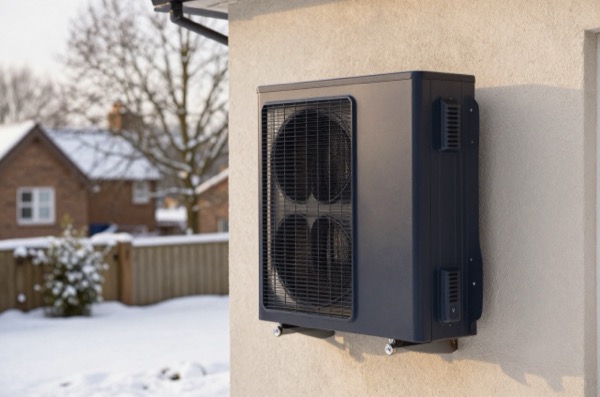
An air source heat pump (ASHP) can provide both space heating and domestic hot water via a thermal store or hot water cylinder. This is the dominant direction for UK homes moving off gas.
Alternatively, a standalone heat pump water heater (sometimes called a monobloc DHW heat pump or hot water heat pump cylinder) is a self-contained unit that sits where a regular cylinder would, it extracts heat from room air to heat the water. These are increasingly available from major manufacturers and cost £2,000–£4,000 including installation.
- CoP (coefficient of performance): 2.5–3.5, meaning 1 kWh of electricity produces 2.5–3.5 kWh of heat
- At 38p/kWh electricity, effective heat cost ≈ 11–15p/kWh (versus gas at ~7p/kWh)
- Over 5–7 years, the running cost advantage over electric immersion is significant
The Boiler Upgrade Scheme (BUS) provides £7,500 grant toward an ASHP installation in England and Wales (2026 figures). Standalone DHW heat pumps do not currently qualify for BUS.2
Solar Thermal
Solar thermal collectors on the roof heat water in a coil inside a specially designed cylinder. In the UK, solar thermal realistically covers 40–70% of annual domestic hot water demand, with a backup immersion heater or boiler coil making up the difference in winter.
- Typical system (2 flat-plate or evacuated tube collectors, 200-litre twin-coil cylinder): £3,000–£6,000 installed
- Annual saving vs. gas DHW: approximately £150–£250
- Payback period: 12–25 years (long, but no moving parts means very low maintenance)
- Best suited to households that already need to replace an old cylinder and have a south-facing roof with good aspect
Solar thermal combines very well with heat pump systems, the ASHP handles space heating and shoulders DHW in cold weather; solar thermal handles DHW in spring/summer/autumn.
Direct Electric Cylinder
The simplest hot water system: a cylinder with one or two immersion heaters running off mains electricity. No boiler needed.
- Unit cost: £400–£900 plus installation £200–£600
- Running cost on standard tariff at 38p/kWh: £600–£900/year for a family home
- On Economy 7 (charged overnight at ~10p/kWh): £180–£300/year
For properties without gas, a direct cylinder on Economy 7 is a simple, low-capital fallback. For long-term use, a heat pump water heater is almost always the better investment.
Water Regulations and Compliance
Hot water systems in the UK are governed by:
- Water Supply (Water Fittings) Regulations 1999: all hot water work must comply; certain work (unvented cylinders, new connections) requires a WaterSafe-approved contractor
- Part G of the Building Regulations: hot water supply, sanitation, and water efficiency, unvented cylinder installation is notifiable work
- Part L (Conservation of Fuel and Power): new boiler and heat pump installations must meet efficiency standards3
When selling a property, building regulations compliance certificates for any notifiable water or heating work can be requested by a buyer’s solicitor. Keep all certificates.
Choosing the Right System
- New-build or recently extended home, off-gas: ASHP with unvented cylinder is the right long-term answer; BUS grant makes it financially comparable to gas.
- Victorian or Edwardian terrace, gas connected, 2 bathrooms: unvented cylinder with modern system boiler; good pressure throughout, easy to add solar thermal later.
- Small flat, one bathroom: combi boiler remains convenient and economical.
- Rural off-gas home, limited budget: direct cylinder on Economy 7 in the short term; budget for heat pump upgrade within 5 years.
- Home with south-facing roof, existing system boiler: adding a solar thermal panel with twin-coil cylinder is a low-disruption upgrade worth costing.
References (3)
Figures in this note were checked against the sources below on 14 September 2026. Superscript numbers in the text point to them. Every source the site cites, by topic.
- 1costvery strongHM Revenue & Customs, guidance.RN-1HRJJ7A price, true at 2026-09. Section 2.1 sets a zero rate of VAT on the installation of energy-saving materials in residential accommodation from 1 May 2023 to 31 March 2027, after which the rate reverts to the 5% reduced rate; section 2.22 extended it to buildings used solely for relevant charitable purposes from 1 February 2024. Section 2.7 lists the qualifying materials: central heating and hot water controls, draught stripping, insulation to walls, floors, ceilings, roofs, lofts and pipes, solar panels, wind turbines, water turbines, ground source heat pumps, air source heat pumps, micro combined heat and power units and wood-fuelled boilers, with water source heat pumps, batteries for energy storage and smart diverters added on 1 February 2024. Section 2.3 is the critical rule for a renovation note: relief applies to an installation service, or materials supplied and installed together, but materials bought without installation stay standard-rated at 20%.
- 2costvery strongGOV.UK.RN-9EFNVZA price, true at 2026-09. The grant values: £7,500 towards an air source heat pump, £7,500 towards a ground source heat pump including water source heat pumps and those on shared ground loops, and £5,000 towards a biomass boiler. A further £1,500 is available until March 2027 where the property is heated by oil or LPG and has no mains gas connection. Only one grant is available per property. Capacity limits are 45kWth for an individual system, 70kWth for multiple heat pumps and 300kWth for shared ground loops. Hybrid systems pairing a gas boiler with a heat pump are not eligible, and an existing low carbon heating system cannot be replaced under the scheme.
- 3technicalvery strongMinistry of Housing, Communities and Local Government.RN-L0FCJXThe in-force U-value tables a DIY insulation or door note must quote, with the exact numbers. Table 4.2, limiting U-values for new fabric elements in existing dwellings, sets roof 0.15, wall 0.18, floor 0.18, swimming pool basin 0.25, window 1.4 or Window Energy Rating Band B minimum, rooflight 2.2, doors with more than 60 per cent of the internal face glazed 1.4 or Doorset Energy Rating Band C minimum, and other doors 1.4 or Doorset Energy Rating Band B minimum. Table 4.3, for existing elements, gives a roof threshold of 0.35 and an improved value of 0.16, which is the figure a loft insulation note needs: paragraph 4.12 says a retained element whose U-value is higher than the column (a) threshold, for example through a loft or garage conversion, should be upgraded to the column (b) value. Paragraph 4.13 allows a lesser upgrade only where the improved value is not technically or functionally feasible or would not achieve a simple payback of 15 years or less. Paragraph 4.8 requires a replacement element to be no worse than the one it replaces as well as meeting Table 4.2. Paragraph 4.10 gives the heritage exception: where character must be maintained, a centre pane U-value of no more than 1.2 or low-emissivity secondary glazing. Note 9 records that the timber window concession of 1.6 or Band C ended on 14 June 2023. The 2021 edition came into force on 15 June 2022; a 2026 edition exists at https://assets.publishing.service.gov.uk/media/69c122a6cfa346b9d4704a55/ADL1_2026.pdf.
-
VAT on energy saving materials and heating equipment (VAT Notice 708/6), HM Revenue and Customs, accessed 21 September 2026. Priced at 2026-09, so no calibration is needed. gov.uk
-
Apply for the Boiler Upgrade Scheme: What you can get, GOV.UK (Department for Energy Security and Net Zero), accessed 15 September 2026. Priced at 2026-09, so no calibration is needed. gov.uk
-
Approved Document L, Conservation of fuel and power, Volume 1: Dwellings, 2021 edition incorporating 2023 amendments, Ministry of Housing, Communities and Local Government, accessed 14 September 2026. assets.publishing.service.gov.uk