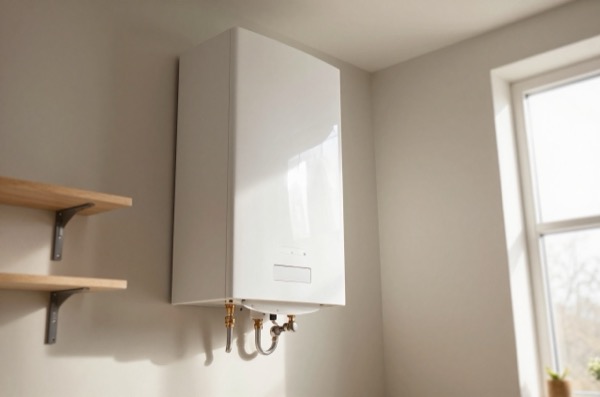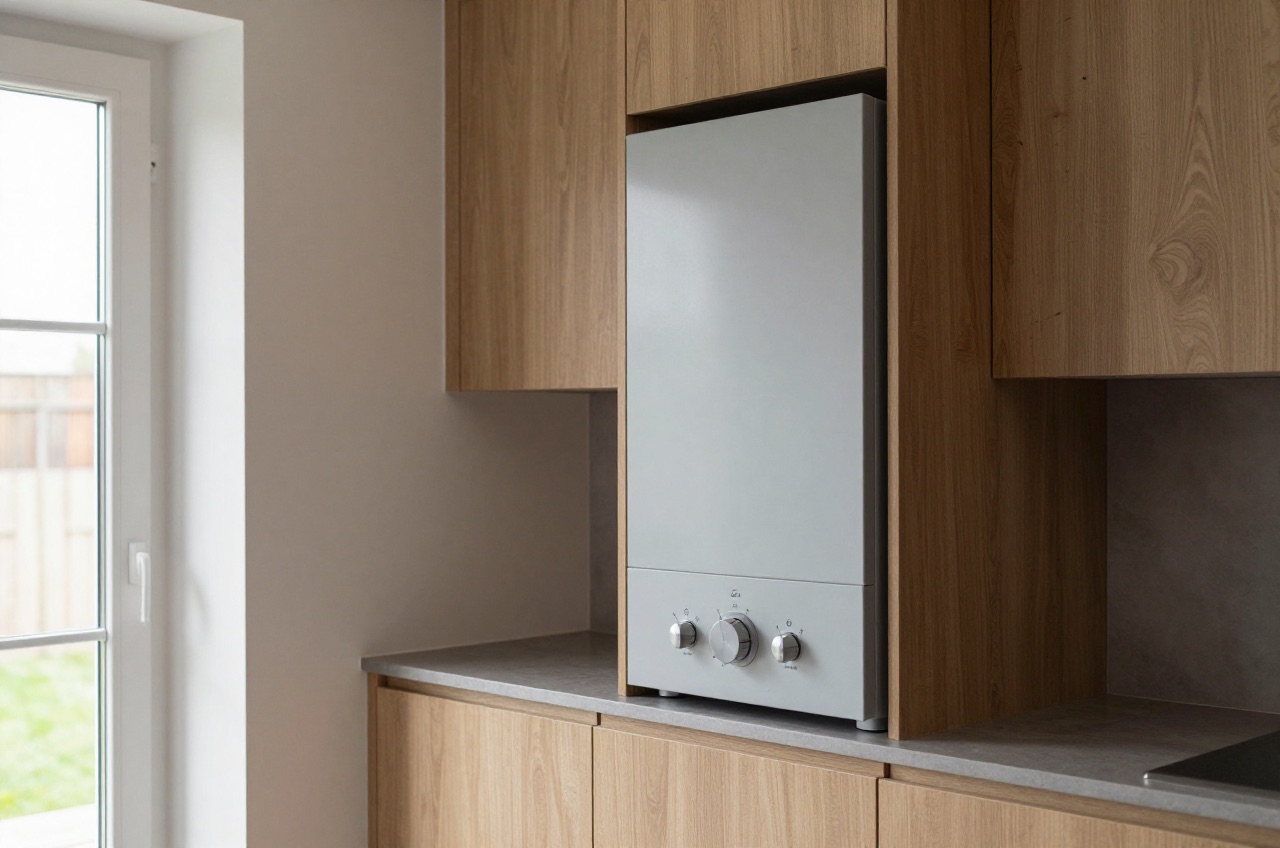
Choosing the right boiler type can mean the difference between a household that never runs out of hot water and one that leaves the second bathroom cold after a morning rush. In the UK, three boiler types dominate: combi (combination), system, and regular (heat-only). Each suits a different set of circumstances, and fitting the wrong type is a costly mistake.
The Three Types at a Glance
| Feature | Combi | System | Regular (Heat-only) |
|---|---|---|---|
| Hot water cylinder needed | No | Yes (unvented) | Yes (vented or unvented) |
| Cold water tank in loft | No | No | Yes (usually) |
| Simultaneous hot water outlets | Limited | Unlimited (cylinder capacity) | Unlimited (cylinder capacity) |
| Best for | 1–2 bathrooms | 2–4 bathrooms, high demand | Older gravity systems, hard water areas |
| Supply & fit cost (rough) | £1,000–£2,500 | £1,500–£3,500 | £1,200–£3,000 |
| Flue required | Yes | Yes | Yes |
| Typical install time | 1 day | 1–2 days | 1–2 days |
Combi Boilers
A combi boiler heats water on demand directly from the mains, there is no storage cylinder. Cold water enters at mains pressure, passes through a heat exchanger, and arrives at the tap or shower at mains pressure (typically 1.5–3.5 bar).
Best for:
- Flats and smaller homes with one bathroom and up to two people
- Properties with limited airing-cupboard or loft space
- Homes with good mains pressure (at least 1.5 bar dynamic pressure)
Limitations:
- Flow rate is finite, typically 10–15 litres per minute at 35°C rise. Running two showers simultaneously will cause pressure and temperature to drop.
- If mains pressure is poor (common in older terraced streets or rural areas), a combi will underperform.
- No hot water if the boiler develops a fault.
Installed cost (2026): £1,000–£2,500 for a standard replacement; add £300–£600 if a new flue route is needed.
System Boilers
A system boiler heats water that is pumped to a sealed unvented hot water cylinder (typically 150–250 litres). The cylinder stores pressurised hot water ready for use. The boiler also feeds the central heating circuit. All components (pump, expansion vessel, pressure relief) are built into the boiler itself, no separate loft tank.
Best for:
- Family homes with two or more bathrooms
- Households with peak morning demand (multiple showers at once)
- Replacing an existing system boiler or regular boiler when the loft tank is to be removed
Advantages over combi:
- Multiple outlets simultaneously without pressure drop
- Hot water is available instantly from the stored cylinder (no wait for combi heat exchanger to respond)
- Works well with solar thermal pre-heat coils in the cylinder
Limitations:
- Cylinder takes up space (typically 400 mm diameter × 900–1,100 mm tall)
- If the cylinder runs empty you must wait for it to reheat (recovery time 30–60 minutes depending on boiler output and cylinder size)
- Higher installation cost than a combi
Installed cost (2026): £1,500–£3,500 for boiler plus a new unvented cylinder; existing cylinder can sometimes be retained if it is compatible and in good condition (saving £400–£900).
Regular (Heat-Only) Boilers
A regular boiler, also called a heat-only or conventional boiler, works with a cold water storage tank in the loft and a separate hot water cylinder (usually vented/gravity-fed). It is the traditional configuration found in pre-2000 UK homes.
Best for:
- Replacing like-for-like in homes with an existing working gravity system where a full conversion is not justified
- Hard water areas where a vented (open) system is easier to maintain without scaling a pressurised cylinder
- Older properties where the heating circuit was designed for low-pressure operation
Limitations:
- Lower water pressure at taps and showers (gravity fed, typically 0.5–1.0 bar)
- Loft tank and associated pipework take space and are a frost risk
- More components mean more potential failure points
Installed cost (2026): £1,200–£3,000 for a replacement; converting to a system boiler and unvented cylinder at the same time adds £600–£1,500 but is often worth doing.
Running Costs: Does the Boiler Type Make a Difference?
Boiler type itself has little effect on running costs, efficiency rating matters far more. A gas wet heating system going into an existing home in England must reach a minimum 92% efficiency as defined by ErP, under Approved Document L Volume 1, Table 6.2.1 An old G-rated (60–70% efficient) boiler of any type wasting 30–40% of the gas it burns will cost significantly more to run than a new one at that standard.
Fit a gas combi into an existing dwelling and Approved Document L paragraph 6.2 asks for one more energy efficiency measure alongside it: flue gas heat recovery, weather compensation, load compensation, or a smart thermostat with automation and optimisation. One of the four, installer’s choice, appropriate to the system.1 This is the requirement usually still called Boiler Plus.
For a typical UK semi-detached home on gas:
| Boiler age/efficiency | Estimated annual gas bill (heating + hot water) |
|---|---|
| Old G-rated (pre-2005) | £1,800–£2,600 |
| Modern A-rated combi/system | £1,100–£1,700 |
| A-rated with weather compensation | £950–£1,500 |
Savings of £500–£900/year are realistic when replacing a very old boiler. Payback on a £1,500–£2,500 install is typically 3–6 years.
Which Should You Choose?
Choose a combi if:
- You have one bathroom and typically no more than two people showering in the morning
- You are short on space (no airing cupboard, no loft access)
- Your mains water pressure is consistently above 1.5 bar (ask your water supplier or test with a pressure gauge)
Choose a system boiler if:
- You have two or more bathrooms with regular simultaneous use
- You are already running an unvented cylinder and just replacing the boiler
- You want to add solar thermal or a heat pump pre-heat coil later
Choose a regular (heat-only) boiler if:
- You have an existing gravity system in good condition and budget is limited
- Your area has very hard water and you prefer the simpler maintenance of an open vented system
- A full conversion would require expensive pipe alterations
Gas Boilers and the Future
There is no date in current UK policy for ending gas boiler installations in existing homes. The Warm Homes Plan, published in January 2026, sets no phase-out deadline and instead backs grants, loans and market growth, on the view that heat pumps will be the best and cheapest form of electrified heating for most homes.2 New-build is the exception: under the Future Homes Standard, whose regulations were due to be laid in Q1 2026, new homes get low-carbon heating, high energy efficiency and solar panels by default.2
A well-chosen high-efficiency gas boiler installed today is a sound investment with a 10–15 year expected lifespan. Future-proofing the pipework for a later heat pump conversion is worth doing, and the regulations already push that way: where a wet heating system is newly installed or fully replaced (appliance, emitters and pipework together), Approved Document L paragraph 5.10 requires it to be sized to work at a maximum flow temperature of 55°C or lower, not the 70–80°C older systems were designed around.1 A boiler-only swap does not trigger that, but sizing radiators for 55°C anyway is the cheap version of the same insurance.
Getting a Quote
When asking for quotes, provide: number of bathrooms and bedrooms, current boiler type and location, flue route options, and whether you want a new cylinder or to retain the existing one. The legal basis for using a registered engineer is regulation 3 of the Gas Safety (Installation and Use) Regulations 1998: nobody may work on a gas fitting unless competent to do so, and the business doing the work must be a member of a class of persons approved by the Health and Safety Executive, which is the Gas Safe Register.3 Check the Gas Safe Register before hiring.
The rules in this note are those that apply in England. Scotland, Wales and Northern Ireland have their own building standards and permitted development rights.
References (3)
Figures in this note were checked against the sources below on 9 September 2026. Superscript numbers in the text point to them. Every source the site cites, by topic.
- 1technicalvery strongMinistry of Housing, Communities and Local Government.RN-L0FCJXThe in-force U-value tables a DIY insulation or door note must quote, with the exact numbers. Table 4.2, limiting U-values for new fabric elements in existing dwellings, sets roof 0.15, wall 0.18, floor 0.18, swimming pool basin 0.25, window 1.4 or Window Energy Rating Band B minimum, rooflight 2.2, doors with more than 60 per cent of the internal face glazed 1.4 or Doorset Energy Rating Band C minimum, and other doors 1.4 or Doorset Energy Rating Band B minimum. Table 4.3, for existing elements, gives a roof threshold of 0.35 and an improved value of 0.16, which is the figure a loft insulation note needs: paragraph 4.12 says a retained element whose U-value is higher than the column (a) threshold, for example through a loft or garage conversion, should be upgraded to the column (b) value. Paragraph 4.13 allows a lesser upgrade only where the improved value is not technically or functionally feasible or would not achieve a simple payback of 15 years or less. Paragraph 4.8 requires a replacement element to be no worse than the one it replaces as well as meeting Table 4.2. Paragraph 4.10 gives the heritage exception: where character must be maintained, a centre pane U-value of no more than 1.2 or low-emissivity secondary glazing. Note 9 records that the timber window concession of 1.6 or Band C ended on 14 June 2023. The 2021 edition came into force on 15 June 2022; a 2026 edition exists at https://assets.publishing.service.gov.uk/media/69c122a6cfa346b9d4704a55/ADL1_2026.pdf.
- 2technicalvery strongDepartment for Energy Security and Net Zero, guidance.RN-AS0G0PPublished 21 January 2026 and last updated 18 March 2026. It commits £15 billion of public investment over this Parliament, 2025/26 to 2029/30, to upgrade up to 5 million homes by 2030, targeting over 450,000 heat pump installations a year by 2030 and solar panels on up to 3 million additional homes. The Boiler Upgrade Scheme gets £2.7 billion to 2030, keeping the £7,500 grant for hydronic heat pumps, adding new £2,500 grants for air-to-air heat pumps and heat batteries used for central heating, and £5,000 for biomass boilers in rural areas. A Warm Homes Fund provides a £5 billion financial transactions facility including £1.7 billion for low and zero-interest consumer loans, rolling out in phases from 2026, and the Warm Homes Social Housing Fund and Local Grant merge into a single low-income scheme from 2027/28. Private rented sector properties must meet EPC Band C across two metrics by October 2030, subject to a £10,000 spending cap, and an EPC C standard is introduced for the social rented sector for the first time. Future Homes Standard regulations were to be laid in Q1 2026.
- 3technicalvery strongThe National Archives (legislation.gov.uk), legislation.RN-UFY1XPRegulation 3(1) makes it unlawful for any person to carry out work in relation to a gas fitting or gas storage vessel unless he is competent to do so, and 3(2) places the duty to ensure that on the employer, on every other employer or self-employed person with any control over the work, and on anyone who required the work to be done at a place of work under their control. Regulation 3(3) goes further: no employer may let an employee, and no self-employed person may themselves, carry out work on a gas fitting or service pipework unless that employer or self-employed person is a member of a class of persons approved by the Health and Safety Executive, which in practice is registration with the Gas Safe Register. Regulation 3(4) exempts only replacing a hose or regulator on a portable or mobile space heater and replacing the hose connecting a re-fillable cylinder to installation pipework. Regulation 3(7) makes it an offence to falsely pretend to be a member of an approved class. This is the legal basis for saying a boiler must be fitted by a Gas Safe registered engineer.
-
Approved Document L, Conservation of fuel and power, Volume 1: Dwellings, 2021 edition incorporating 2023 amendments, Ministry of Housing, Communities and Local Government, accessed 9 September 2026. assets.publishing.service.gov.uk
-
Warm Homes Plan, Department for Energy Security and Net Zero, accessed 9 September 2026. gov.uk
-
Gas Safety (Installation and Use) Regulations 1998, regulation 3: qualification and supervision, legislation.gov.uk, accessed 9 September 2026. legislation.gov.uk