April in the UK means rain, and for garden decking, that means standing water, green algae, and, without treatment, premature rot and warping. The good news is that a single weekend’s preparation every year or two is enough to keep softwood decking in excellent condition for a decade or more.
The approach you take depends on what your decking is made from and what condition it is in right now. Bare or faded softwood needs the most work; composite decking mostly just needs a clean.
Understanding Your Options: Oil, Stain, and Sealant
The three main product categories behave quite differently in practice. Choosing the wrong one, for example, applying a film-forming sealant over a previously oiled deck, can lead to peeling and flaking.
| Product Type | Coverage (per litre) | Durability | Best For |
|---|---|---|---|
| Decking oil (penetrating) | 5–8 m² | 1–2 years | New or bare softwood; feeds the wood |
| Decking stain (semi-transparent) | 6–8 m² | 2–3 years | Adding colour while maintaining grain visibility |
| Decking paint (opaque) | 2–14 m² | 3–5 years | Heavily worn or discoloured decking; hides defects |
| Decking sealer/varnish | 10–15 m² | 2–4 years | Hardwoods; film-forming, less suitable for softwood |
Coverage varies a lot between products, so check the tin before you buy. Wickes lists Cuprinol UV Guard Decking Oil at 8 m² per litre.1 Wickes lists Barrettine All In One Decking Oil at 5–8 m² per litre.2 Ronseal Ultimate Protection Decking Stain is listed at 6.4 m² per litre.3 Ronseal Ultimate Protection Decking Paint, a thick paint made to fill cracks and rescue tired decks, is listed at only 2 m² per litre.4
Price per litre varies as much as coverage, and a big tin is usually the cheaper litre. Barrettine All In One Decking Oil is £42 for 5 litres at Wickes, about £8.40 a litre.2 Osmo UV-Protection Satin Oil Extra is £28 for 750 ml, about £37 a litre.5 Wickes’s own Decking Stain is £20 for 2.5 litres, or £8 a litre.6 Ronseal Ultimate Protection Decking Stain is £40 for 2.5 litres, or £16 a litre.3 Ronseal Ultimate Protection Decking Paint is £45 for 2.5 litres, or £18 a litre.4 Film-forming decking sealers and varnishes cost roughly £14–£30 a litre.
Decking oil is the most forgiving product for UK softwoods like pine, larch, and treated spruce. It penetrates the grain, feeds the wood, and repels water without forming a film that can crack and peel. Reapplication is straightforward because you do not need to strip the previous coat. Most oils are available in clear, natural, or tinted finishes.
Decking stain provides colour and water resistance in one product. It sits somewhere between a penetrating oil and a film-forming paint. Semi-transparent stains preserve the texture and grain of the wood; solid stains cover more imperfections but behave more like thin paint over time.
Decking paint is the right choice when boards are heavily worn, heavily stained, or have lost their surface texture. It provides the most durable waterproof barrier but requires the most prep work and the most effort to re-coat because old paint must be fully sanded or stripped before re-application.
Step 1: Prepare the Surface
Preparation is where most decking projects succeed or fail. New product applied to a dirty, green, or damp surface will not bond properly.
Clean the decking thoroughly. Use a purpose-made decking cleaner from a builders’ merchant or garden centre, diluted as the label directs, and compare what a bottle makes up to rather than its price per litre. Karcher Wood Cleaner is £8 for 1 litre at Wickes.7 KilrockPRO Wood, Deck & Fence Cleaner is £12 for a 5 litre can that makes up to 50 litres.8 Barrettine Super Concentrated Deck Cleaner is £17 for 500 ml, which treats up to 40 m².9 Apply with a stiff brush or pump sprayer, working along the grain, and leave for 10–15 minutes before scrubbing and rinsing off. Decking cleaners combine a biocide (to kill algae and mould) with a mild acid that opens the grain and removes weathered grey pigment.
A pressure washer speeds up rinsing but should be used on a low setting to avoid raising the grain or blowing out the timber between boards. Keep the lance moving and use a fan tip rather than a pencil jet.
Sand if necessary. Weathered or rough boards benefit from a light sand along the grain using 60–80 grit sandpaper. A belt sander or random orbital sander significantly reduces the effort on larger decks. Sanding also opens up the surface to improve oil absorption.
Allow the decking to dry fully. This is non-negotiable. Most products specify that the wood must be dry, and a moisture content below about 20% is a common target. In the UK, this typically means waiting 48–72 hours of dry weather after cleaning. Applying oil or stain to damp timber traps moisture and leads to rapid failure.
Step 2: Apply the Treatment
Work in dry conditions and within the application temperature range printed on the tin. Avoid direct bright sunlight, which causes the product to dry too quickly on the surface before it can penetrate.
For decking oil, apply with a flat brush or a roller fitted with a short-pile sleeve, working along the grain. Apply a generous first coat and allow it to penetrate for 20–30 minutes before wiping off any excess with a clean cloth. A second coat, applied once the first has dried, will significantly improve longevity. Wickes lists the drying time between coats as 6 hours for Cuprinol UV Guard Decking Oil.1 For Barrettine’s solvent-based All In One Decking Oil it lists 12 hours.2 Two thin coats always outperform one thick one.
For decking stain or paint, use a brush rather than a roller for the first coat on rough or profiled boards, as a brush works the product into the grain. Subsequent coats can be rolled for speed. Allow each coat to dry fully before applying the next, typically 4–8 hours depending on temperature and humidity.3
Step 3: Add Non-Slip Protection
Wet decking can become dangerously slippery, particularly when algae growth begins in spring. There are two main approaches to improving grip.
Anti-slip decking strips are aluminium or GRP inserts pressed into routed grooves or screwed across the board surface. They provide excellent grip and last the life of the deck. A 1,000 mm by 50 mm GRP strip sells for £5.74 on B&Q’s marketplace, and a pack of three of the same size for £19.50, so plain 50 mm GRP strips cost about £6 a metre.1011 Wider strips and aluminium inserts cost more. They are particularly effective on step nosings.
Anti-slip additives are fine grit compounds (often aluminium oxide or fine silica sand) mixed directly into decking oil or paint before application. They add texture to the finished surface without altering the appearance significantly. A 250 g pot, enough to treat 15–25 m², costs around £6–£12.
For existing decking, proprietary anti-slip coatings that combine grip and weather protection are available at around £10–£20 per litre, covering 6–10 m².12
Composite Decking: Much Lower Maintenance
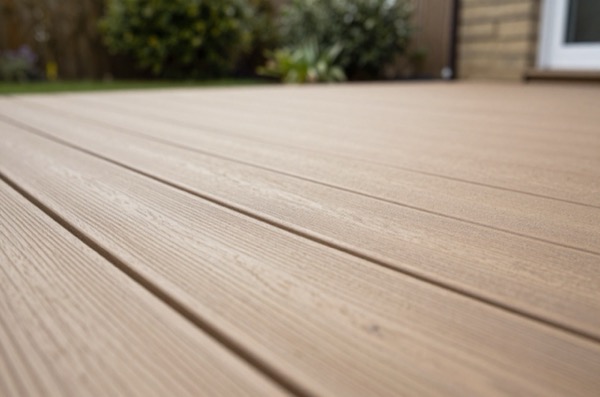
Composite decking, boards made from a blend of wood fibre and recycled plastic, requires considerably less maintenance than softwood. It does not need oiling, staining, or sealing. However, it can still develop a slippery biofilm in wet conditions, and the surface can fade over time without treatment.
Clean composite decking twice a year with warm soapy water and a stiff brush. Avoid abrasive cleaners or pressure washing at high pressure, as these can damage the surface texture. Some premium composite ranges are marketed as wholly maintenance-free, but annual cleaning will always extend appearance and lifespan. For more stubborn staining, use a cleaner made for composite as well as timber. Barrettine Super Concentrated Deck Cleaner, which Wickes lists for wood, composite and plastic decking, is £17 for 500 ml.9
Planning and Building Regulations for Raised Decking
Garden decking is permitted development only if, among other conditions, it is no more than 30 cm above the ground.13 Within the curtilage of a listed building, no decking is permitted development at all.13 The Planning Portal advises that Building Regulations should be assumed to apply to any deck that needs planning permission.14 Where a raised deck needs guarding, Approved Document K gives 1,100 mm as the guarding height for external balconies in single family dwellings, which is the sensible benchmark for a deck.15 For stair guarding in homes that young children may use, it asks that a 100 mm sphere cannot pass through any opening and that children cannot readily climb the guarding, so avoid horizontal rails that act as a ladder.15 If the decking adjoins a house in England, also check whether permitted development rights apply, particularly in conservation areas, and contact your local planning authority if in any doubt before building raised decking.
Maintenance Schedule
A simple schedule helps you stay ahead of the weather.
- Every spring: Clean with decking cleaner, inspect boards for rot or splits, sand any rough patches, check fixings
- Every 1–2 years (softwood oil/stain): Apply a fresh coat of oil or stain after spring clean
- Every 3–5 years (decking paint): Sand back and repaint
- Composite decking: Clean twice yearly; inspect fixings annually
The best time to apply treatment is late spring or early summer, after the worst of the April showers have passed and before summer UV begins to degrade the finish. If you treat in April, choose a dry settled spell of at least 48 hours.
References (15)
Figures in this note were checked against the sources below on 30 September 2026. Superscript numbers in the text point to them. Every source the site cites, by topic.
- 1technicalsupplier figureWickes, guidance.RN-V3545GRetailer product page carrying the maker's specification for Cuprinol UV Guard Decking Oil. It gives the coverage as 8 m2 per litre and 6 hours between coats.
- 2technicalsupplier figureWickes, guidance.RN-8D412WRetailer product page carrying the maker's specification for a solvent-based decking oil. It gives coverage of 5-8 m2 per litre and 12 hours between coats.
- 3technicalsupplier figureWickes, guidance.RN-UOPFM5Retailer product page carrying the maker's specification for Ronseal's decking stain. It gives coverage of 6.4 m2 per litre and 4 hours between coats.
- 4technicalsupplier figureWickes, guidance.RN-NU0DCRRetailer product page carrying the maker's specification for Ronseal's deck-rescue paint, which fills cracks and locks down splinters. It gives coverage of only 2 m2 per litre.
- 5costsupplier figureWickes Building Supplies Ltd.RN-VMXPKKA price, true at 2026-10. Wickes Building Supplies Ltd's published price for the item the cost register files as "decking oil and protector, supply only", which is the figure a cost footnote on this page points at.
- 6costsupplier figureWickes.RN-9DFMR6A price, true at 2026-10. Wickes product page for its own water-based decking stain in a 2.5 litre tin, giving the shelf price, the price per litre and the coverage of 12 m² per litre.
- 7costsupplier figureWickes.RN-08PQD5A price, true at 2026-10. Wickes product page for Karcher Wood Cleaner in a 1 litre bottle, giving the shelf price of a cleaner for decking and other exterior wood.
- 8costsupplier figureWickes.RN-AOZ0ZIA price, true at 2026-10. Wickes product page for a 5 litre concentrated wood, deck and fence cleaner, giving its shelf price and that it makes up to 50 litres and covers up to 125 m².
- 9costsupplier figureWickes.RN-RWIM60A price, true at 2026-10. Wickes product page for a 500 ml concentrated deck cleaner for wood, composite and plastic decking, giving its shelf price and that it treats up to 40 m² once diluted.
- 10costsupplier figureB&Q (marketplace seller Slips Away).RN-NGS6F5A price, true at 2026-10. A B&Q marketplace listing for a single 1,000 mm by 50 mm glass-reinforced plastic anti-slip decking strip, giving its shelf price, which is a price per metre of strip.
- 11costsupplier figureB&Q (marketplace seller Greentec Products Ltd).RN-T3NNU6A price, true at 2026-10. A B&Q marketplace listing for a pack of three 1,000 mm by 50 mm glass-reinforced plastic anti-slip decking strips, giving the pack price, about £6.50 a metre.
- 12costsupplier figureWickes.RN-RSUFPJA price, true at 2026-10. Wickes product page for Cuprinol Anti-Slip Decking Stain in a 2.5 litre tin, giving its shelf price, the price per litre and coverage of 8 m² per litre. It settles what a ready-mixed anti-slip decking coating costs, supply only.
- 13technicalvery strongPlanning Portal, guidance.RN-I5208UPlanning Portal guidance for England on decking. It says decking is permitted development only if it is no more than 30 cm above the ground and meets the other listed conditions.
- 14technicalvery strongPlanning Portal, guidance.RN-98NSI9Planning Portal guidance for England on decking and the Building Regulations. It says the regulations should be assumed to apply to every deck needing planning permission.
- 15technicalvery strongMinistry of Housing, Communities and Local Government.RN-XH6E39The standard that decides whether a loft ladder is legal and when a raised deck needs a balustrade. Published 3 January 2013, it covers protection from falling, collision and impact including stairs, ladders, ramps, guarding and vehicle barriers. Paragraph 1.31 states that retractable ladders must not be used as a means of escape. Paragraph 1.32 permits a fixed ladder, with fixed handrails on both sides, only for access in a loft conversion containing one habitable room, and only where there is not enough space without altering the existing space for a compliant stair, which is the rule that catches most loft ladder installations. Paragraph 1.29 restricts alternating tread stairs to loft conversions. For a private stair the maximum pitch is 42 degrees (Table 1.1 note 1), the normal relationship between rise and going is twice the rise plus the going between 550mm and 700mm, and for dwellings external tapered steps forming part of the building need a going of at least 280mm. Paragraph 3.1 requires guarding wherever it is reasonably necessary for safety at the edge of a floor, gallery, balcony, roof, light well, basement or similar sunken area. Paragraph 3.2 requires guarding to be at least the height in Diagram 3.1, allows any wall, parapet or balustrade to serve as guarding, and requires it to resist the loads in BS EN 1991-1-1 with its UK National Annex and PD 6688-1-1, with BS 6180 for barrier and infill panel design. Handrails should be positioned 900mm to 1000mm from the pitch line or floor.
-
Cuprinol UV Guard Decking Oil - Natural - 2.5L, Wickes, accessed 30 September 2026. wickes.co.uk
-
Barrettine All In One Decking Oil - Clear - 5L, Wickes, accessed 30 September 2026. wickes.co.uk
-
Ronseal Ultimate Protection Decking Stain - Medium Oak - 2.5L, Wickes, accessed 30 September 2026. wickes.co.uk
-
Ronseal Ultimate Protection Decking Paint - Slate - 2.5L, Wickes, accessed 30 September 2026. wickes.co.uk
-
Osmo UV-Protection Satin Oil Extra - Clear - 750ml, Wickes Building Supplies Ltd, accessed 17 October 2026. Priced at 2026-10 and left there. wickes.co.uk
-
Wickes Decking Stain - Natural Oak - 2.5L, Wickes, accessed 17 October 2026. Priced at 2026-10 and left there. wickes.co.uk
-
Karcher Wood Cleaner - 1L, Wickes, accessed 17 October 2026. Priced at 2026-10 and left there. wickes.co.uk
-
KilrockPRO Wood, Deck & Fence Cleaner - 5L, Wickes, accessed 17 October 2026. Priced at 2026-10 and left there. wickes.co.uk
-
Barrettine Super Concentrated Deck Cleaner - 500ml, Wickes, accessed 17 October 2026. Priced at 2026-10 and left there. wickes.co.uk
-
Non Slip Decking Strips GRP Heavy Duty Pro Grade 50mm Black 1000mm x 50mm, B&Q (marketplace seller Slips Away), accessed 17 October 2026. Priced at 2026-10 and left there. diy.com
-
GREENTEC GRP Anti-Slip Decking Strips 1000mm x 50mm Brown, Pack of 3, B&Q (marketplace seller Greentec Products Ltd), accessed 17 October 2026. Priced at 2026-10 and left there. diy.com
-
Cuprinol Anti-Slip Decking Stain - Hampshire Oak - 2.5L, Wickes (wickes.co.uk), accessed 17 October 2026. Priced at 2026-10, so no calibration is needed. wickes.co.uk
-
Decking: Planning Permission, Planning Portal, accessed 30 September 2026. planningportal.co.uk
-
Decking: Building Regulations, Planning Portal, accessed 30 September 2026. planningportal.co.uk
-
Approved Document K, Protection from falling, collision and impact, 2013 edition, Ministry of Housing, Communities and Local Government, accessed 14 September 2026. assets.publishing.service.gov.uk