Bamboo flooring has been sold as a sustainable alternative to hardwood timber since the early 2000s, and in the UK market it sits firmly between laminate and solid hardwood in both price and performance. It genuinely delivers some of what it promises, hardness, warmth, and a renewable source material, but it has specific weaknesses that make it unsuitable for some rooms and some buyers.
Bamboo Flooring Types
Bamboo flooring is not a single product but a family of manufacturing processes that produce quite different end results.
Horizontal and Vertical (Traditional)
The bamboo culm (stem) is split, flattened into strips, and laminated together with the grain either horizontal (showing the natural nodes) or vertical (strips edge-on). The result looks unmistakably like bamboo and has a Janka hardness of approximately 1,300–1,500 lbf, similar to oak. These boards are typically 14–18 mm thick.
Strand-Woven Bamboo
The most common type in UK trade now. Fibres are shredded, compressed with adhesive under extreme heat and pressure, and then sawn into planks. The result has no obvious bamboo grain pattern (it resembles a dense, striped wood) and is substantially harder, Janka 3,000–5,000 lbf, making it more durable than most commercial hardwoods. Strand-woven boards are typically 15–22 mm thick.
Engineered Bamboo
A thin bamboo veneer (horizontal, vertical, or strand-woven) bonded to a multi-ply timber core. Behaves similarly to engineered hardwood: more stable in moisture fluctuations, can be floated or glued, and is suitable for underfloor heating. Typically 9–15 mm thick.
Cost Comparison (2026, UK)
| Type | Supply Cost (£/m²) | Installation (£/m²) | Total Installed |
|---|---|---|---|
| Horizontal/vertical traditional | £15–£28 | £15–£25 | £30–£53 |
| Strand-woven bamboo | £25–£50 | £15–£28 | £40–£78 |
| Engineered bamboo | £30–£55 | £18–£30 | £48–£85 |
| Solid oak (for comparison) | £35–£70 | £20–£40 | £55–£110 |
| LVT (for comparison) | £18–£451 | £12–£22 | £30–£67 |
Premium strand-woven brands from Chinese and Vietnamese manufacturers (the two dominant producing countries) retail in the UK at £35–£50/m²; budget ranges from trade suppliers start at £18–£25/m². Quality differences between price points are real, cheaper strand-woven boards often use higher formaldehyde adhesives and have more variable finish quality.
Performance: What Bamboo Does Well
Hardness, Strand-woven bamboo outperforms most hardwoods in scratch and dent resistance. For homes with dogs, heavy foot traffic, or rolling furniture, this is a genuine advantage over softer hardwoods like pine or European oak.
Sustainability (with caveats), Moso bamboo (the species used for most flooring) is technically a grass and can regenerate in 3–5 years versus 50–80 years for hardwood trees. If certified by FSC or PEFC, it is one of the more credible claims in the flooring market. However, the energy-intensive manufacturing process (heating, pressing, adhesives) means the embodied carbon advantage over responsibly sourced hardwood is smaller than typically advertised.
Visual warmth, Unlike laminate or LVT, bamboo is a real natural material with genuine variation. Many homeowners prefer it aesthetically to artificial-look alternatives.
Price vs. hardwood, At £25–£45/m², strand-woven bamboo offers hardwood-equivalent durability at 60–70% of the price of equivalent solid oak.
Performance: Where Bamboo Falls Short
Moisture Sensitivity
This is bamboo’s most significant weakness. Unlike LVT (fully waterproof) or properly sealed stone, bamboo will swell, cup, and gap when exposed to moisture. It is not suitable for:
- Bathrooms
- Utility rooms with frequent wet access
- Ground floors in older houses with sub-floor moisture issues
- Rooms that flood frequently (kitchens in flood-risk areas)
Engineered bamboo is more moisture-stable than solid bamboo but still not waterproof. The adhesive used in strand-woven bamboo can delaminate under sustained moisture.
UV Fading
Bamboo fades faster than most hardwoods in direct sunlight. South-facing rooms with large glazed areas will see visible colour change within 2–3 years unless UV-protective window film is used. Horizontal-grain bamboo (which shows the natural cream and tan colouring) fades most noticeably; carbonised bamboo (heat-treated to darken the colour) shows fading less, but is also slightly less hard.
Adhesives and Off-Gassing
Bamboo flooring uses adhesives to bond the fibres or layers together. Lower-cost products have historically used urea-formaldehyde (UF) adhesives. Certification to E1 or E0 formaldehyde emission standards (under EN 717) is the minimum to check for. Products certified to CARB Phase 2 or Floorscore have been independently tested for indoor air quality.
Refinishing
Horizontal and vertical bamboo can be lightly sanded and refinished, but strand-woven bamboo is too dense to sand reliably, the compressed structure causes sanding belts to skip and gouge. If you expect to refinish flooring, solid or engineered oak is a better choice.
Underfloor Heating Compatibility
Engineered bamboo is generally compatible with underfloor heating (UFH) systems, but solid bamboo is not recommended by most manufacturers. Checks to make:
- Maximum board temperature: typically 27°C (the same as engineered hardwood); confirm with your UFH supplier
- The floor must be conditioned (acclimatised at normal room temperature for 48–72 hours minimum) before installation
- Do not allow the system to run at full output before the floor has settled for two weeks
Installation Methods
| Method | Suitable Board Type | Notes |
|---|---|---|
| Float (click profile) | Engineered bamboo | Fastest; allows for movement; do not glue |
| Glue-down | Strand-woven or engineered | Best for UFH; no movement allowed once set |
| Nail/staple secret-nail | Traditional solid bamboo | Requires sub-floor access; timber sub-floors only |
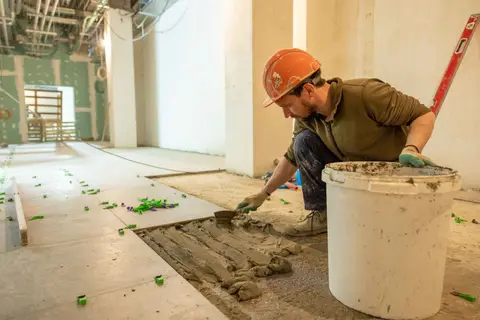
Bamboo requires a flat sub-floor within ±3 mm over 1.8 m, the same tolerance as engineered hardwood. Self-levelling compound is typically needed on older concrete sub-floors.
What to Look For When Buying
- Formaldehyde certification, E1 minimum; E0 or CARB Phase 2 preferred
- FSC or PEFC certification, for the sustainability claim to hold up
- Janka hardness stated, strand-woven should be 3,000 lbf minimum
- Thickness and wear layer, strand-woven at 15 mm+ is preferable; check the warranty period (15–25 years residential use is typical for quality products)
- AC rating, while primarily an LVT/laminate rating, some bamboo products carry AC4 ratings indicating suitability for heavy residential use
The UK Bamboo Flooring market is predominantly supplied from China. Quality control varies significantly between suppliers; buying from a retailer with UK stock (not just-in-time import) allows you to inspect the product before committing to a full order.
References (1)
Figures in this note were checked against the sources below on 14 September 2026. Superscript numbers in the text point to them. Every source the site cites, by topic.
- 1costsupplier figureBuilder Depot.RN-S1CBP9A price, true at 2026-09. the retail price Builder Depot publishes for Vinyl Flooring, Vinyl Floor Tiles, LVT Flooring, which is the supply figure the cost book records for this item
-
Vinyl Flooring, Vinyl Floor Tiles, LVT Flooring, Builder Depot, accessed 21 September 2026. Priced at 2026-09, so no calibration is needed. builderdepot.co.uk