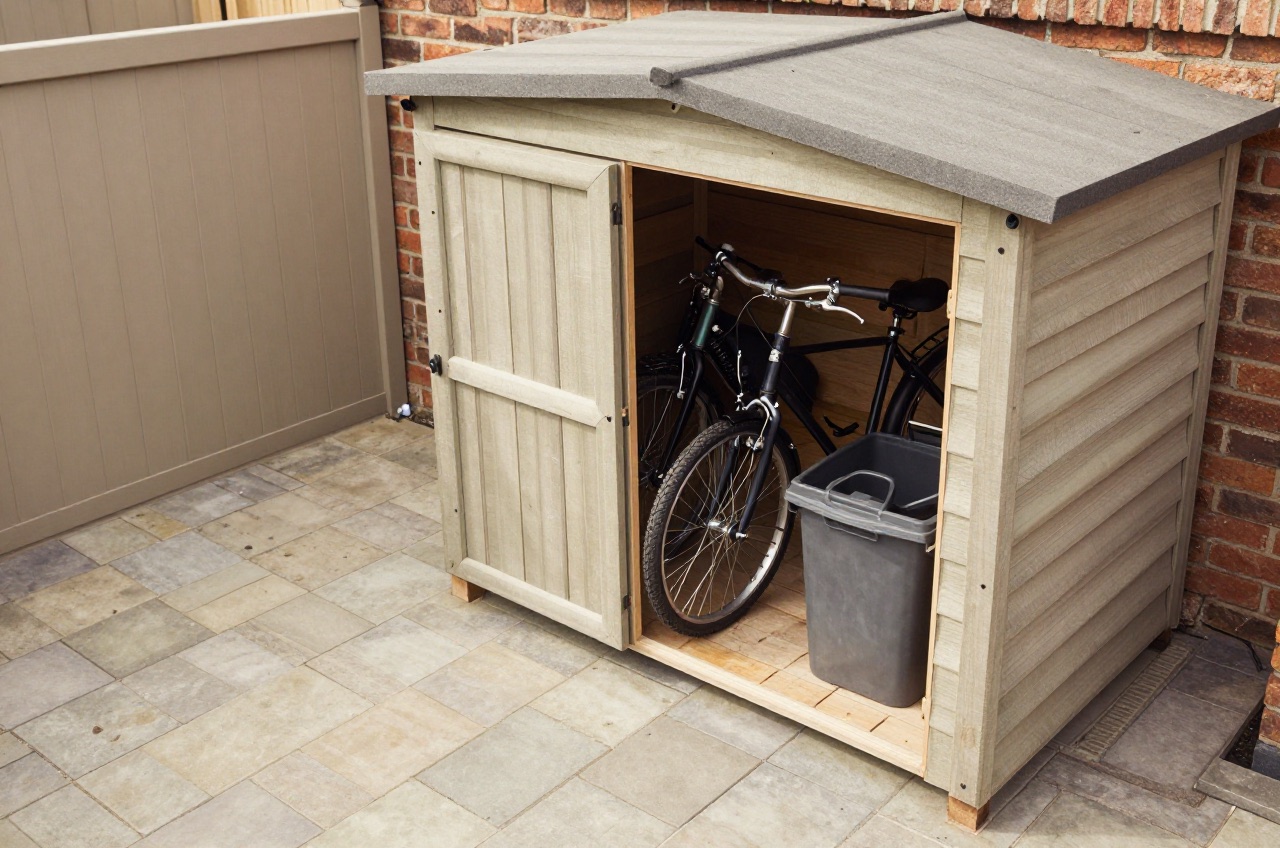
Bins and bikes are a practical fact of life in any UK home, and both tend to end up in exactly the wrong place, wheelie bins blocking the front path, bikes leaning against the hallway wall or taking up a parking space. Good storage for both is a small, cost-effective project that improves kerb appeal, reduces clutter and, in the case of bikes, can meaningfully deter theft.
This guide covers the most practical options for typical UK properties: terraced houses, semis, detached houses with side returns, and flats with communal areas. Planning considerations are different for each.
Bin Storage Options
Slatted Timber or WPC Bin Stores
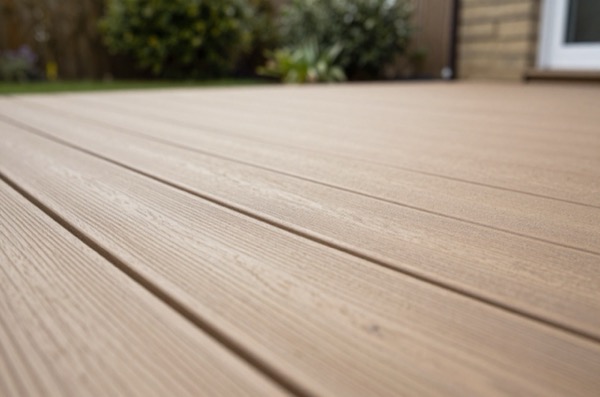
The most popular option for front gardens. A slatted wooden (or wood-plastic composite) bin store has a lid, a front-opening door, and handles to pull bins in and out for collection day. Sizes typically accommodate one, two or three wheelie bins side-by-side.
- 1-bin store: £80–£200 flatpack / £150–£300 installed
- 2-bin store: £150–£350 flatpack / £250–£500 installed
- 3-bin store: £200–£450 flatpack / £350–£650 installed
Pressure-treated softwood stores last 10–15 years; WPC versions 20–25 years with minimal maintenance.
Wicker or Rattan Effect Stores
Moulded polyrattan is UV-stable, lightweight and smart-looking. Popular in urban terraced streets. Similar price point to timber stores. Less durable in high-wind locations.
Lean-To or Side-Return Enclosure
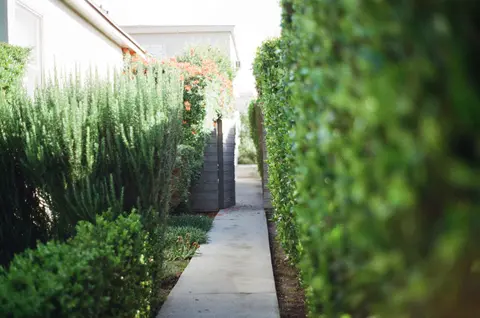
For houses with a side passage, a lean-to store (steel, timber or brick) can accommodate bins, bikes, garden tools and recycling in one enclosure. Costs vary widely: a simple corrugated steel lean-to runs £400–£800; a properly built rendered blockwork store with tiled roof costs £1,500–£4,000. If it has a roof and walls, Building Regulations Part A (structure) and the relevant permitted development rules apply.1
Recessed or Built-In Stores
Some new-build and renovation projects include recessed bin stores built into a front wall or garage projection. These look the neatest but require structural consideration and are most cost-effective when planned into a renovation rather than retrofitted.
Bike Storage Options
Wall-Mounted Horizontal Racks
The cheapest and most space-efficient indoor option. Steel or aluminium hooks mount to a wall joist or solid masonry wall. Bikes hang horizontally, one above the other. One pair of hooks costs £8–£20; a full system for four bikes costs £30–£80.
Use 8 × 70 mm coach screws into noggins or studs for wall fixings; do not trust standard screws into hollow plasterboard for a 15 kg bike.
Floor-Standing Stands
Vertical or angled floor stands accommodate one to six bikes and require no drilling. A two-bike stand costs £30–£80. Less space-efficient than wall mounts but useful in shared hallways or garages where drilling is not permitted.
Outdoor Cycle Sheds and Shelters
For bikes that cannot be brought inside:
| Option | Cost (supply only) | Notes |
|---|---|---|
| Plastic bike box (1–2 bikes) | £250–£500 | Lockable, weatherproof, low-profile |
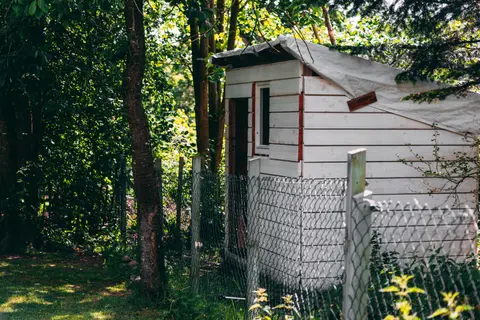
| Timber cycle shed (2–4 bikes) | £400–£900 | Padlock for security; can be secured to concrete pad |
| Steel cycle locker (1 bike, shared) | £300–£700 per unit | Used in communal gardens and car parks |
| Timber lean-to shelter (4–6 bikes) | £600–£1,500 | Semi-open; good for houses with side access |
For security, any outdoor cycle store should be anchored to a concrete pad or secured with ground anchors. Combine with a quality chain (Kryptonite or Squire rated Sold Secure Gold) looped through frames and the anchor point.
Ground Anchors
A Sheffield stand-type ground anchor or ring anchor set into concrete costs £30–£80 supply and fit and is the minimum for outdoor storage. Many local councils and Housing Associations will install these in shared areas on request.
Security Considerations
The majority of bike thefts in the UK involve opportunistic theft of unsecured or poorly secured bikes. Insurance statistics consistently show that:
- Bikes stored outside without a ground anchor are stolen at 5–8× the rate of those with one
- A second lock (D-lock through the rear wheel + ground anchor) reduces theft risk further
- Security lighting triggered by motion deters thieves even in rear gardens
For insurance purposes, most cycle insurance policies require a lock rated Sold Secure Silver as a minimum, Gold for higher-value bikes (£500+). If the bike is stored in a shed or garage, the shed lock itself must be a five-lever mortice (or equivalent) for most policies to pay out.
Planning Permission
In England, outdoor bin stores and cycle shelters are generally permitted development (no planning permission required) provided:
- Maximum height 2.5 m (or 2.0 m within 2 m of a boundary)
- Not forward of the principal elevation of the house as it fronts a highway
- No more than 50% of the curtilage of the house is covered by outbuildings in total
- The property is not listed or in an Article 4 Direction area (common in conservation areas)
Check with your local planning authority if you are in a conservation area, permitted development rights for outbuildings are often restricted. Many councils have interactive PDR maps on their planning portals.2
For flats and leasehold properties, you will need to check your lease and obtain landlord or managing agent consent before installing any permanent fixture in a communal area or garden.
Practical Layout Tips
- Place the bin store as close to the street boundary as practical, wheeling bins to the kerb on collection day is a surprisingly important use consideration
- Ensure the lid of the store opens away from the house wall, not inward into the property boundary
- Leave at least 500 mm clearance behind the store for ventilation and cleaning
- For bike shelters, fit a motion-sensitive light and consider a CCTV camera pointed at the entrance, visible cameras deter approximately 60% of opportunistic cycle thieves according to Met Police data
- If integrating bin and bike storage (popular in narrow side returns), ensure bins can be extracted without moving bikes first
References (2)
Figures in this note were checked against the sources below on 14 September 2026. Superscript numbers in the text point to them. Every source the site cites, by topic.
- 1technicalvery strongMinistry of Housing, Communities and Local Government (GOV.UK).RN-Z6AXUWThe full Approved Document A PDF, which carries the deemed-to-satisfy tables a domestic project is checked against. Section 2E covers foundations of plain concrete: paragraph 2E3 gives the recommended minimum widths of strip foundations in Table 10, keyed to ground type and total load of loadbearing walling per linear metre. Table 10 sets, for rock (not inferior to sandstone, limestone or firm chalk, requiring at least a pneumatic or mechanically operated pick to excavate), a width equal to the width of the wall at every load. For medium dense gravel or sand (requires a pick to excavate, a 50mm square wooden peg hard to drive beyond 150mm) and for stiff clay or stiff sandy clay (can be indented slightly by the thumb), the minimum widths are 250mm at 20 kN per linear metre, 300mm at 30, 400mm at 40, 500mm at 50, 600mm at 60 and 650mm at 70. Firm clay and firm sandy clay (thumb makes an impression easily) start at 300mm. The document also covers minimum depth of strip foundations, wall thickness rules for residential buildings up to three storeys (paragraph 2C10 covers internal loadbearing walls in brickwork or blockwork), buttressing, lateral support by floors and at roof level, interruption of lateral support, wall cladding in Section 3, and Section 5 on reducing sensitivity to disproportionate collapse with the building consequence classes.
- 2technicalvery strongThe National Archives, legislation.RN-OWGIY3Schedule 2 Part 1 of the GPDO 2015, development within the curtilage of a dwellinghouse. This is permitted development itself: Class A enlargement and alteration, with the limits and conditions, through the classes covering roof alterations, porches, outbuildings and hard surfaces. Every statement about what can be built without planning permission traces to this Part, and the exclusions at the start of each class are where most projects actually fall out.
-
Approved Document A, Structure, 2004 edition incorporating 2004, 2010 and 2013 amendments, Ministry of Housing, Communities and Local Government, accessed 14 September 2026. assets.publishing.service.gov.uk
-
The Town and Country Planning (General Permitted Development) (England) Order 2015, Schedule 2, Part 1, The National Archives, accessed 14 September 2026. legislation.gov.uk