Garden privacy is one of the first things homeowners address after moving into a new property or completing a rear extension. The challenge in UK gardens, typically small, overlooked on multiple sides, and subject to planning restrictions, is achieving real seclusion without creating a oppressive, box-like space.
The good news is that there is a wide range of options from cheap DIY trellis to premium composite screening, and a well-chosen combination of hard and soft landscaping can create genuine privacy without triggering planning permission.
Planning Rules: What You Can Do Without Permission
Before spending money, establish what you can legally build. In England, under the General Permitted Development Order (GPDO), fences, walls, and gates are permitted development (no planning permission needed) if:
- They are no higher than 2 metres above ground level, except where they adjoin a highway (road or footway), where the limit is 1 metre.
- They are on the boundary of a dwellinghouse, not on listed buildings or in Article 2(3) designated areas (parts of National Parks, AONBs, etc.), where stricter rules may apply.
Trellis or screen panels added to the top of an existing fence count towards the overall height, so a 1.8 m close-board fence with a 30 cm trellis topper is a 2.1 m structure, which technically requires planning permission. In practice, enforcement action on a modest trellis topper is rare, but it is worth knowing the rule, particularly if you have difficult neighbours.
Pergolas, arbours, and standalone screens within the garden boundary (not on the boundary itself) are treated as garden structures under Class E permitted development and can be taller if they meet the Class E criteria (generally, not forward of the principal elevation, covers less than 50% of the garden area, not for sleeping accommodation).1
Types of Garden Screening
Timber Trellis
The most affordable option. Diamond or square-patterned trellis panels are available in 1.8 × 0.9 m sections from most builders’ merchants and garden centres.
| Trellis type | Cost per panel | Lifespan (approx.) |
|---|---|---|
| Basic softwood (pressure treated) | £12–£222 | 10–15 years |
| Hardwood (oak/iroko) | £35–£70 | 20–25+ years |
| Expanded metal trellis | £25–£50 | 25+ years |
Trellis works best as a plant support rather than an immediate privacy solution. Combined with climbing plants (clematis, roses, evergreen jasmine, or wisteria) it creates a living screen that improves year on year.
Slatted Timber Panels
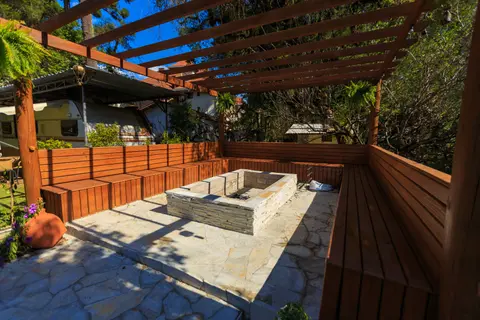
Horizontal slatted panels (50–100 mm timber slats with 10–20 mm gaps) have dominated UK garden design for the past five years. They offer a modern aesthetic and allow air movement while limiting sightlines.
- Pressure-treated softwood slats: £40–£80 per linear metre of 1.8 m high panel (DIY supply).
- Hardwood (cedar, oak, iroko) slats: £80–£160 per linear metre.
- Installed cost (contractor-built): £150–£350 per linear metre.
For an 8-metre rear garden boundary, a contractor-built hardwood slatted screen runs £1,200–£2,800.
Composite Screening Panels
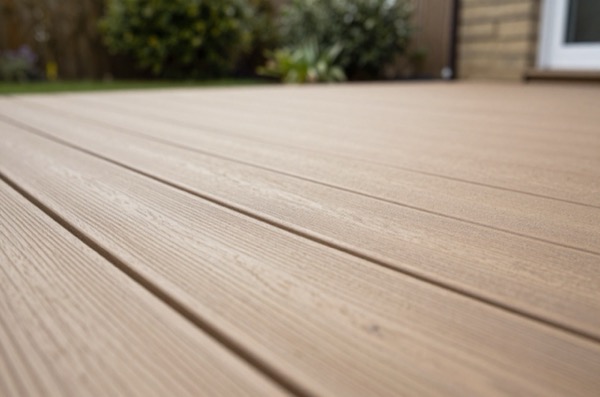
Composite (wood-plastic composite) screening panels require zero maintenance, no staining, no splitting, and look good for 20–25 years. Brands such as Trex, Millboard (specialist decking/screening), and own-brand ranges from Travis Perkins are widely available.
- Supply only: £60–£140 per linear metre of 1.8 m high panel.
- Installed: £250–£500 per linear metre.
The premium price is offset by the zero maintenance cost, hardwood slats need oiling annually (£10–£20 of oil plus a few hours) while composite needs only an annual wash.
Bamboo and Reed Panels
Bamboo roll fencing (natural bamboo canes rolled onto galvanised wire) is a low-cost temporary solution:
- Bamboo roll (1.8 m high, per metre): £4–£8.
- Lifespan: 3–7 years before the canes discolour and split.
For a budget-conscious approach to a rented property or a temporary screen while a hedge establishes, bamboo roll is hard to beat on cost.
Living Screens: Hedging and Climbing Plants
Living screens take 3–5 years to establish but are the most attractive long-term solution and the most ecologically valuable. Common choices:
| Plant | Cost (per plant, 60–90 cm) | Spacing | Growth rate |
|---|---|---|---|
| Laurel (Prunus laurocerasus) | £8–£15 | 60–90 cm | Fast (30–60 cm/year) |
| Bamboo (Phyllostachys aureosulcata) | £15–£35 | 90–120 cm | Very fast once established |
| Photinia ‘Red Robin’ | £10–£18 | 60–90 cm | Moderate |
| Holly (Ilex aquifolium) | £8–£15 | 50–60 cm | Slow |
| Portuguese Laurel | £10–£20 | 60–90 cm | Moderate |
Caution with bamboo: Running bamboo species (Phyllostachys) spread aggressively via underground rhizomes and can cause boundary disputes and even structural damage. Use clumping bamboo (Fargesia) or install a 600 mm deep root barrier membrane if planting running species.
Practical Combinations That Work
Immediate privacy + long-term finish: Install a 1.8 m composite screen on the boundary now, then plant a native hedge (hawthorn, blackthorn, field maple) in front of it. In 5–7 years the hedge matures and the screening panel can be removed, or left as a background structure.
Small urban garden: A slatted panel at 1.8 m with climbing plants (Trachelospermum jasminoides, evergreen clematis) creates a dense green wall that maximises privacy without completely blocking light.
Elevated decking or raised terrace: Where the main seating area is elevated and overlooked, fit a 1.2 m balustrade with 0.6 m trellis topper, staying under 1.8 m overall, and plant evergreen climbers to fill in quickly.
What to Budget
| Approach | Cost for 6 m of boundary |
|---|---|
| DIY bamboo roll | £25–£50 |
| DIY softwood trellis | £80–£140 |
| DIY slatted hardwood panels | £500–£1,000 |
| Contractor-installed composite screening | £1,500–£3,000 |
| Laurel hedge supply & plant | £120–£250 (30 plants) |
For most UK rear gardens, a combination of contractor-installed composite or hardwood panels for the key overlooked elevations, plus established shrubs and climbers, provides the best value. Budget £2,000–£5,000 for a comprehensive rear garden privacy scheme in a typical semi-detached.
References (2)
Figures in this note were checked against the sources below on 14 September 2026. Superscript numbers in the text point to them. Every source the site cites, by topic.
- 1technicalvery strongThe National Archives (legislation.gov.uk), legislation.RN-J6L7TIThe primary legal text for garden rooms, sheds, summerhouses, pergolas, greenhouses and outdoor pools. Class E permits any building or enclosure, swimming or other pool within the curtilage required for a purpose incidental to the enjoyment of the dwellinghouse, plus a domestic heating oil container. Limitations: E.1(b) buildings, enclosures and containers other than the original dwellinghouse must not cover more than 50% of the curtilage; E.1(c) nothing forward of a wall forming the principal elevation of the original dwellinghouse; E.1(d) single storey only; E.1(e) maximum height 4 metres with a dual-pitched roof, 2.5 metres if any part is within 2 metres of a curtilage boundary, otherwise 3 metres; E.1(f) eaves no higher than 2.5 metres; E.1(g) not within the curtilage of a listed building; E.1(h) no verandah, balcony or raised platform; E.1(j) oil containers capped at 3,500 litres. E.4 defines incidental use as including keeping poultry, bees, pet animals, birds or other livestock for domestic needs or personal enjoyment, which is why a garden room used as a separate dwelling falls outside Class E.
- 2costsupplier figureWickes Building Supplies Ltd.RN-7ZFMATA price, true at 2026-09. Wickes's product page for an incised treated timber fence post, 100 x 100 x 2,400 mm. A published price for the post alone, which is the item a fence cost is most sensitive to because the count goes up as the bay width comes down.
-
The Town and Country Planning (General Permitted Development) (England) Order 2015, Schedule 2, Part 1, Class E, The National Archives, accessed 14 September 2026. legislation.gov.uk
-
Incised Timber Fence Post 100 x 100 x 2400mm, Wickes Building Supplies Ltd, accessed 18 September 2026. Priced at 2026-09, so no calibration is needed. wickes.co.uk