Decking is one of the most popular garden additions in the UK, but the choice between timber and composite divides opinion, and budgets. Timber costs less upfront; composite costs more initially but demands almost no ongoing maintenance. The right answer depends on how much you value your weekends.
What Does Decking Cost?
Installed prices in 2026:
| Decking type | Material cost (£/m²) | Installed cost (£/m²) |
|---|---|---|
| Pressure-treated softwood (pine/spruce) | £20–£35 | £120–£160 |
| Hardwood (balau, ipe, cumaru) | £40–£80 | £160–£220 |
| Entry-level composite | £40–£651 | £180–£220 |
| Mid-range composite (capped) | £60–£902 | £200–£240 |
| Premium composite (full encapsulation) | £80–£120 | £220–£280 |
Prices are 2026 UK averages. London and South East typically 20–25% higher. Assumes ground-level or low-rise deck on reasonably accessible site.
Worked Example: 20 m² Deck
| Cost element | Softwood timber | Mid composite |
|---|---|---|
| Decking boards | £500–£700 | £1,200–£1,800 |
| Subframe (treated joists + posts) | £400–£600 | £400–£600 |
| Fixings, clips, hardware | £80–£150 | £100–£200 |
| Labour | £700–£1,000 | £800–£1,200 |
| Total (approx.) | £1,700–£2,500 | £2,500–£3,800 |
Note: both use a timber subframe, there is no cost saving on the structural elements regardless of which board material you choose.
Timber Decking
Pressure-Treated Softwood
Treated pine and spruce are the most widely installed decking boards in the UK. They are widely available, easy to cut and fix, and significantly cheaper than composite. The main catch is maintenance: softwood must be cleaned and re-treated (oil or stain) every one to two years to prevent it greying, splitting, and becoming slippery with algae. Without treatment, softwood decking typically degrades visibly within three to five years.
Lifespan with proper maintenance: 15–20 years.
Hardwood
Tropical hardwoods such as balau, ipe (pronounced ee-pay), and cumaru are significantly denser and more naturally durable than softwood. They do still need oiling, typically every one to three years depending on exposure, but they are harder, less prone to splintering, and last longer. Sustainably sourced hardwood (FSC-certified) is available; verify certification before purchasing, as the hardwood supply chain has a history of mislabelling.
Lifespan: 25–30+ years with maintenance.
Slip Resistance
Timber becomes extremely slippery when wet and covered with algae, a real safety hazard in shaded UK gardens. Regular cleaning (pressure washing plus a decking cleaner) and treatment help. Grooved decking boards provide marginally better grip than smooth-faced boards. Anti-slip strips can be added retroactively.
Composite Decking
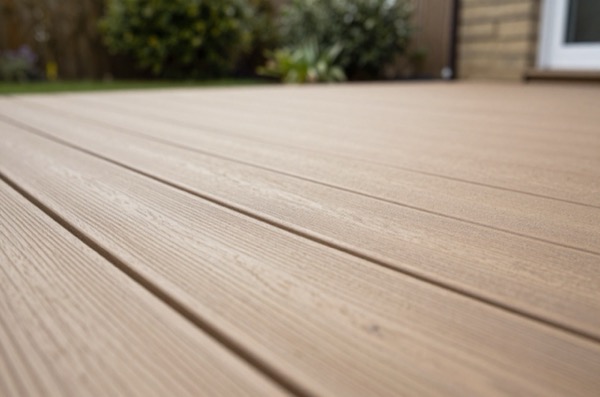
Composite decking is made from a blend of wood fibre and recycled plastic. Early products (pre-2015) had a poor reputation, they were prone to fading, mould and surface checking. Modern capped and fully-encapsulated composites are significantly better and come with manufacturer warranties of 15–25 years.
Composite Types
Uncapped composite: wood-fibre and plastic blend with no outer skin. Cheaper but still susceptible to moisture absorption and surface mould over time. Not recommended for UK’s wet climate.
Capped composite (single-sided or four-sided): an outer plastic shell bonded to the core protects from moisture, staining and UV fade. Requires minimal maintenance, a brush-down and occasional wash.
Fully encapsulated composite: the highest grade, with a thick co-extruded shell on all four sides. Extremely resistant to moisture, fading and staining. Warranties typically 25 years.
Composite Maintenance Reality
The appeal of composite is that it genuinely needs very little upkeep:
- Brush off debris regularly to prevent organic matter building up
- Wash down once or twice a year with soapy water or a composite-safe cleaner
- No oiling, staining or sealing required
Slip resistance is generally better than timber in wet conditions, most quality composite boards have a textured or grooved surface that maintains grip when wet.
Composite Limitations
- Cannot be reclaimed or recycled at end of life as easily as pure timber
- Higher upfront cost
- Looks “plasticky” to some eyes, particularly cheaper products
- Cannot be sanded back if the surface is damaged
Total Cost of Ownership
This is where the comparison really matters. Timber needs annual or biennial treatment.
| Scenario | Softwood timber (20 yr) | Mid composite (20 yr) |
|---|---|---|
| Initial installation | £2,100 | £3,200 |
| Annual maintenance product cost | £40–£80/yr | £0–£20/yr |
| Total maintenance over 20 years | £800–£1,600 | £0–£400 |
| Time spent on maintenance | ~6–8 hours/year | ~1–2 hours/year |
| Estimated total cost (materials only) | £2,900–£3,700 | £3,200–£3,600 |
Over 20 years, the total cost of ownership is roughly comparable, composite’s premium is largely offset by avoided maintenance spending. The real difference is the time and effort saved with composite.
Planning Permission
Decking is normally permitted development in England provided:
- The deck is no more than 300 mm above ground level
- It does not cover more than 50% of the total garden area
- It is not in a listed building’s curtilage or, for front gardens, adjacent to a highway
Raised decks over 300 mm typically require planning permission. Always check with your local planning authority if in doubt, especially in conservation areas.
Building Regulations
Domestic garden decking at ground level does not normally require Building Regulations approval. However:
- Any deck raised more than 600 mm may need approval (structural calculations and balustrade design)
- Balustrades must be designed to resist a horizontal load of 0.74 kN/m where the drop is 600 mm or more (Building Regs Approved Document K)3
Choosing Between Timber and Composite
| Choose timber if… | Choose composite if… |
|---|---|
| Budget is the primary driver | You want near-zero ongoing maintenance |
| You are comfortable with annual treatment | You value your weekend time |
| You prefer a completely natural aesthetic | You want consistent colour for 20+ years |
| You may want to change the deck within 10 years | You want better wet-weather slip resistance |
Both are valid choices. The key mistake to avoid is buying cheap uncapped composite (it performs poorly in the UK climate) or softwood timber and then neglecting the maintenance schedule.
References (3)
Figures in this note were checked against the sources below on 14 September 2026. Superscript numbers in the text point to them. Every source the site cites, by topic.
- 1costsupplier figureWickes.RN-VOKYFFA price, true at 2026-09. Wickes's product page for a Trex Enhance Naturals grooved composite deck board, 25 x 140 x 4,880 mm. A named brand at the upper end of composite decking, priced by the board, which converts to a square metre rate at 140 mm cover.
- 2costsupplier figureLondon Stone (UK) Ltd.RN-FQQUOXA price, true at 2026-09. the retail price London Stone (UK) Ltd publishes for Composite Decking, which is the supply figure the cost book records for this item
- 3technicalvery strongMinistry of Housing, Communities and Local Government.RN-XH6E39The standard that decides whether a loft ladder is legal and when a raised deck needs a balustrade. Published 3 January 2013, it covers protection from falling, collision and impact including stairs, ladders, ramps, guarding and vehicle barriers. Paragraph 1.31 states that retractable ladders must not be used as a means of escape. Paragraph 1.32 permits a fixed ladder, with fixed handrails on both sides, only for access in a loft conversion containing one habitable room, and only where there is not enough space without altering the existing space for a compliant stair, which is the rule that catches most loft ladder installations. Paragraph 1.29 restricts alternating tread stairs to loft conversions. For a private stair the maximum pitch is 42 degrees (Table 1.1 note 1), the normal relationship between rise and going is twice the rise plus the going between 550mm and 700mm, and for dwellings external tapered steps forming part of the building need a going of at least 280mm. Paragraph 3.1 requires guarding wherever it is reasonably necessary for safety at the edge of a floor, gallery, balcony, roof, light well, basement or similar sunken area. Paragraph 3.2 requires guarding to be at least the height in Diagram 3.1, allows any wall, parapet or balustrade to serve as guarding, and requires it to resist the loads in BS EN 1991-1-1 with its UK National Annex and PD 6688-1-1, with BS 6180 for barrier and infill panel design. Handrails should be positioned 900mm to 1000mm from the pitch line or floor.
-
Trex Enhance Naturals Grooved Deck Board Foggy Wharf - 25 x 140 x 4880mm, Wickes, accessed 18 September 2026. Priced at 2026-09, so no calibration is needed. wickes.co.uk
-
Composite Decking, London Stone (UK) Ltd, accessed 15 September 2026. Priced at 2026-09, so no calibration is needed. londonstone.co.uk
-
Approved Document K, Protection from falling, collision and impact, 2013 edition, Ministry of Housing, Communities and Local Government, accessed 14 September 2026. assets.publishing.service.gov.uk