A garden water feature, whether a modest barrel fountain or a planted wildlife pond, adds movement, sound, and biodiversity to an outdoor space. The range of options is wide, and so is the cost range: a simple standalone urn can be installed in an afternoon for under £150, while a formal koi pond with biological filtration and stone coping is a weeks-long project running to several thousand pounds.
Choosing the right type for your plot, understanding the liner and pump options, and knowing the handful of safety and planning considerations up front will save expensive rework later.
Types of Water Feature
Wildlife pond. A naturalistic, irregular-shaped pond designed primarily for amphibians, insects, and birds. No pump or filter needed. A shallow beach entry (graduated slope down to the deepest point) allows wildlife in and out. Useful from as small as 1m × 1m, though 2–4m² gives a more stable ecosystem. Most cost-effective type to build.
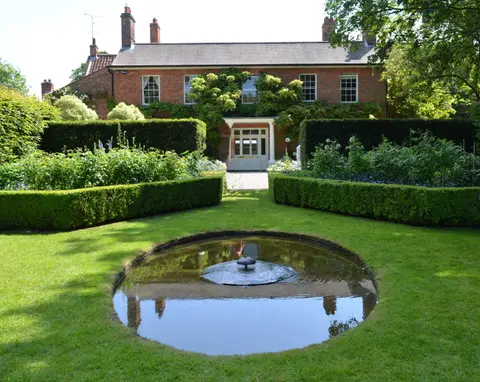
Formal geometric pond. Square, rectangular, or circular pond, typically with hard edging (stone, brick, or porcelain coping). Often incorporates a fountain jet or spitter. Typical size range 2–6m². Requires a pump; fish will need filtration.
Raised pond. A pond built above ground level using sleepers, rendered blockwork, or brick. Easier to build on sloping sites, reduces digging, and doubles as seating. Can be incorporated into a deck or patio design. Usually 1–3m² due to structural and cost constraints.
Pre-formed fibreglass/resin pond. A moulded unit dropped into an excavated hole. Quicker to install than a liner pond and less prone to puncture. Units cost £150–£600 depending on size and shape, but shapes are limited and very large sizes are unavailable. Best for compact, defined spaces.
Flexible liner pond. The most versatile type, excavate any shape, lay underlay and liner, and edge as required. Available in very large sizes. Requires care during installation to avoid folds becoming stress points.
Wall-mounted fountain. A spout (mask, spitter, or trough) fixed to a wall, feeding into a reservoir or basin below. Entirely self-contained. Professional installation typically £500–£2,000 including reservoir, pump, and brickwork if required.
Standalone urn or barrel water feature. A pump recirculates water through or over a decorative vessel into a hidden underground reservoir. No open water surface, which makes it safer around young children. Available as ready-to-run kits from most garden centres, or built from scratch using a glazed pot and reservoir kit.
Sizing Guidance
For wildlife ponds, even 1m × 1m is genuinely useful, it will attract frogs, newts, and insects, but 2m × 3m or larger gives a more stable water temperature, better planting scope, and more diverse habitat.
For fish ponds, volume is the critical dimension:
- Goldfish and common pond fish: minimum 1,000–1,500 litres, minimum 45cm depth
- Koi: minimum 1,500 litres (preferably 4,000+ litres for a small collection), minimum 600mm depth, koi are sensitive to temperature swings and oxygen levels, so both volume and depth are important
- Golden orfe (active surface fish): need larger ponds with good surface aeration
A rough stocking rate of 25cm of fish per 1,000 litres is a reasonable starting point; over-stocking is the most common cause of poor water quality and fish losses in garden ponds.
For formal decorative ponds without fish, sizing is primarily aesthetic, 2–6m² suits most gardens without dominating the space.
Liner Options
Liner choice affects installation difficulty, long-term durability, and running cost. The table below summarises the main options for flexible and pre-formed liners.
| Liner type | Thickness | Approx. cost/m² | Typical lifespan | Fish-safe | Ease of install | Notes |
|---|---|---|---|---|---|---|
| Butyl rubber | 0.75–1mm | £4–£10 | 20–50 years | Yes | Moderate, heavy, folds carefully | Most durable flexible liner; industry standard for larger ponds |
| EPDM rubber | 0.75–1.14mm | £5–£12 | 20–40 years | Yes (fish-safe grade) | Moderate, lighter than butyl | Widely available; check fish-safe certification as industrial EPDM differs |
| PVC liner | 0.5–0.8mm | £2–£5 | 10–15 years | Generally yes | Easy, lightweight and flexible | Less UV-resistant; becomes brittle at exposed edges; lower upfront cost |
| Pre-formed fibreglass | N/A (unit) | £150–£600 per unit | 25+ years | Yes | Easy, drop-in once hole is prepared | Limited shapes; no puncture risk; good for small formal ponds |
| Pre-formed resin/plastic | N/A (unit) | £50–£250 per unit | 10–20 years | Yes | Easy | Budget option; lighter than fibreglass; more prone to UV degradation |
Always lay a geotextile underlay (50–500g/m² non-woven felt) beneath a flexible liner to protect against stones, roots, and ground movement. Underlay adds £1–£2/m² but significantly extends liner life.
Pump Selection
A pump is required for any feature with moving water, and for any pond containing fish. Two specifications matter:
Flow rate (litres per hour, l/h). For fish ponds, the rule of thumb is to circulate the full pond volume once per hour, a 2,000-litre pond needs a pump rated at 2,000 l/h at the relevant head height. For decorative fountains, 500–1,500 l/h is typically sufficient depending on jet height and spread.
Head height (metres). Head height is the vertical distance the pump must lift water. A pump rated at 2,000 l/h may only deliver 1,200 l/h at 1.5m head. Always check the manufacturer’s flow-vs-head curve for the actual operating point, not the headline maximum figure.
Solar-powered pond pumps are available (typically 200–800 l/h) and suit small water features or supplementary aeration where mains power is impractical, but they are not reliable enough for fish ponds where continuous circulation is essential.
Filtration
Filtration is essential for fish ponds and optional for wildlife ponds (which are self-regulating when well planted).
Mechanical filtration removes suspended particles, leaves, fish waste, uneaten food, using foam or filter media. This is the first stage in most filter boxes and needs regular cleaning (weekly in summer, fortnightly in winter).
Biological filtration relies on colonies of beneficial bacteria (primarily Nitrosomonas and Nitrobacter) that convert toxic ammonia (from fish waste) into nitrite and then into relatively harmless nitrate. Biological filters take 4–8 weeks to fully establish (the “cycling” period) and should not be cleaned aggressively, as this kills the bacteria.
UV clarifier (UVC). A UV bulb housed in a sealed chamber kills single-celled algae before they reach the filter, preventing green water. Bulbs need replacing every 12 months regardless of apparent condition, UV output declines before visible light output does. A UV clarifier is not a filter: it must be used in conjunction with mechanical and biological filtration.
For wildlife ponds without fish, good oxygenating plants and a balanced planting scheme generally maintain water quality without a pump or filter.
Plants
Oxygenating plants grow fully submerged and release oxygen directly into the water, which supports both fish and beneficial bacteria. Hornwort (Ceratophyllum demersum) and water milfoil (Myriophyllum spicatum) are hardy, fast-growing, and widely available. Aim for one bunch of oxygenator per 30cm² of surface area.
Marginal plants grow in shallow water (0–30cm depth) around the pond edges. Yellow flag iris (Iris pseudacorus), marsh marigold (Caltha palustris), and water mint (Mentha aquatica) are UK native species that also provide cover for wildlife. Divide every 2–3 years to prevent them dominating the pond.
Floating plants, primarily water lilies (Nymphaea), provide surface shade that slows algal growth and gives fish shelter from herons and sun. Water lilies need 30–90cm water depth depending on variety; miniature varieties suit ponds as small as 60cm across. Coverage of 50–70% of the surface area is the target.
Planning Permission
Garden ponds do not normally require planning permission under permitted development rights. However, it is worth checking if:
- The property is a listed building or in its curtilage, listed building consent may be needed for changes to the garden
- The garden is in a conservation area, permitted development rights are sometimes restricted1
- The pond is proposed in the front garden, any structure or excavation that materially affects the appearance of the front of a dwelling may require consent
When in doubt, submit a free Lawful Development Certificate application to your local planning authority. This provides written confirmation that no consent is required.
Child Safety
Open water is a drowning hazard for young children, and there is no statutory requirement in England for domestic garden ponds to be fenced or covered, unlike, for example, private swimming pools in some local authority areas. Despite the absence of a legal duty, the following measures are strongly recommended wherever young children have access to the garden:
- Rigid steel mesh grille laid over the pond at or just below water level, supported on angle iron or frame. Available in galvanised or stainless steel (stainless preferred for longevity). A mesh of 100mm × 50mm or smaller prevents a child’s head passing through.
- Graduated beach entry on wildlife ponds, a gentle slope rather than vertical sides, means any child or animal that falls in can climb out.
- Garden fencing, a separate garden within a garden, accessed through a self-closing gate, is the most robust option and gives complete separation.
Note that BS EN 1176 (the standard sometimes cited in this context) covers playground equipment, not domestic garden water features. There is no equivalent British Standard specifically for residential garden pond safety; guidance from the Royal Society for the Prevention of Accidents (RoSPA) is the most relevant reference.
2026 UK Cost Guide
| Scope | Approx. cost (2026) |
|---|---|
| Small wildlife pond, DIY materials only (liner, underlay, plants) | £200–£600 |
| Pre-formed pond with basic pump, professionally installed | £600–£1,800 |
| Formal liner pond with pump, filter and UV, professionally installed | £800–£3,500 |
| Wall-mounted fountain (pump, reservoir, brickwork if needed) | £500–£2,000 |
| Standalone urn/barrel water feature (supply and install) | £150–£600 |
| Pond heater/de-icer (annual running cost, 100W unit) | £30–£80/winter |
Prices reflect England; costs in London and the south-east typically run 10–20% higher. Garden contractors vary widely in pricing, always obtain at least two written quotes including VAT and waste disposal.
Seasonal Maintenance
Autumn. Net the pond to catch falling leaves before they sink and decompose, decomposing leaves consume oxygen and release harmful gases. A fine-mesh net supported just above the water surface is the simplest approach; remove and compost once leaf fall ends.
Winter. If temperatures are forecast to drop below freezing for extended periods, remove submersible pumps (or switch to a lower position where water is less likely to freeze solid). A pond heater or floating de-icer (typically 100–300W) keeps a small area ice-free, allowing harmful gases to escape. Do not break ice by striking it, the shockwave can stress or kill fish; use hot water instead.
Spring. Restart the pump and filter once water temperature consistently exceeds 8°C. Begin feeding fish again at this point, below 8°C their digestion slows to the point where uneaten food creates water quality problems.
Ongoing. Remove blanketweed manually as it develops; some algae is normal but dense mats reduce oxygen levels. Divide overcrowded marginals every 2–3 years, ideally in spring or early autumn.
References (1)
Figures in this note were checked against the sources below on 14 September 2026. Superscript numbers in the text point to them. Every source the site cites, by topic.
- 1technicalvery strongThe National Archives, legislation.RN-OWGIY3Schedule 2 Part 1 of the GPDO 2015, development within the curtilage of a dwellinghouse. This is permitted development itself: Class A enlargement and alteration, with the limits and conditions, through the classes covering roof alterations, porches, outbuildings and hard surfaces. Every statement about what can be built without planning permission traces to this Part, and the exclusions at the start of each class are where most projects actually fall out.
-
The Town and Country Planning (General Permitted Development) (England) Order 2015, Schedule 2, Part 1, The National Archives, accessed 14 September 2026. legislation.gov.uk