Garden privacy matters more than it used to. Increasing housing density, rear extensions with large glazed walls, and the general shrinking of plot sizes have left many UK gardens feeling exposed. The good news is there are reliable, affordable ways to screen a garden, ranging from a day’s work to a longer-term planting scheme.
This guide covers the main options, their realistic costs for 2026, and the planning rules you need to check before committing.
Know Your Planning Rules First
Before buying materials or hiring anyone, understand what you can install without permission:
- Boundary fences and walls: up to 2 metres in height are permitted development under Class A, Part 2, Schedule 2 of the Town and Country Planning (General Permitted Development) Order 2015, as long as they are not adjacent to a highway (road, pavement, footpath). Adjacent to a highway, the limit drops to 1 metre.1
- Hedges: no height limit under planning law, but tall hedges between neighbours may be subject to a council complaint under Part 8 of the Anti-social Behaviour Act 2003 (the “High Hedges” legislation). To avoid disputes, keep boundary hedges under 2 m or ensure they’re inset from the boundary.
- Fences over 2 m: require planning permission. Most councils will grant this without difficulty if the design is reasonable, but it’s a process that takes 8 weeks and costs around £548 in England.2
- Listed buildings or Conservation Areas: any external alteration, including fencing, may need Listed Building Consent or a Certificate of Lawful Development. Check with your LPA.
Option 1: Close-Board Timber Fencing
The UK standard for privacy fencing. Vertical feather-edge boards overlap slightly so there are no gaps. A 1.8 m (6 ft) close-board panel fence is the most common garden privacy solution.
Cost: £80–£150 per metre installed (including concrete or spiked posts, gravel boards, and fixings). A 10-metre run costs roughly £800–£1,500.
Lifespan: 15–25 years with pressure-treated timber; needs occasional treatment or painting.
What to watch: post depth is critical. Posts should be set at least 600 mm into the ground (deeper on soft soil), with concrete haunching. Shallow posts are the number-one reason fences fail in storms.
Option 2: Timber Trellis and Climbing Plants
A trellis alone offers very little privacy, but combined with fast-growing climbers it creates a living screen. It can also be used to add height to an existing fence (within planning limits).
Cost: Trellis topper panels, £8–£30 per panel (1.8 m wide); fitting costs £60–£100 per day for a carpenter. Climbers: £5–£25 per plant from a garden centre.
Fast-growing climbers for UK privacy:
- Clematis montana, vigorous, flowers in spring, spreads 6–8 m
- Lonicera japonica (Japanese honeysuckle), semi-evergreen, fragrant
- Fallopia baldschuanica (Russian vine / mile-a-minute), very fast, needs management
- Hedera helix (ivy), dense, evergreen, low maintenance but can damage fences if unchecked
- Rosa (climbing rose), beautiful but needs annual pruning
Option 3: Garden Screening Panels
Alternative materials to timber have expanded significantly. Popular options for 2026 include:
| Material | Cost Per Panel (1.8×1.8 m) | Lifespan | Notes |
|---|---|---|---|
| Close-board timber | £30–£60 | 15–25 yr | Classic; needs treatment |
| Composite fencing | £60–£1303 | 25+ yr | Low maintenance, no painting |
| Bamboo screening rolls | £15–£35 | 5–8 yr | Cheap but degrades |
| Willow hurdle panels | £40–£75 | 8–12 yr | Rustic look; not fully opaque |
| Metal louvred panels | £80–£200 | 30+ yr | Modern look; heavy, needs good posts |
| Slatted hardwood panels | £100–£250 | 20+ yr | Striking; expensive |
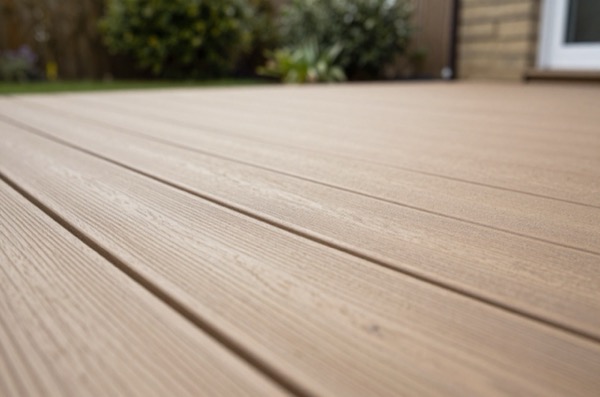
Composite fencing has become the most popular long-term alternative, it looks like timber, requires no maintenance, and holds colour well. Labour costs for installation are similar to timber.
Option 4: Hedges and Living Screens
A well-chosen hedge is arguably the best long-term investment for garden privacy. It’s self-renewing, absorbs sound, supports wildlife, and improves kerb appeal.
Fast-growing options for UK conditions:
| Plant | Annual Growth | Height Potential | Notes |
|---|---|---|---|
| Leylandii (Leyland cypress) | 90 cm | 20 m+ | Very fast; legal disputes if over 2 m neighbour-facing |
| Griselinia littoralis | 40–60 cm | 4–8 m | Coastal, evergreen, tidy; good for mild areas |
| Prunus laurocerasus (cherry laurel) | 30–60 cm | 4–8 m | Dense, evergreen, good for shade |
| Buxus sempervirens (box) | 10–15 cm | 1–2 m | Formal but slow; affected by blight |
| Ilex aquifolium (holly) | 20–40 cm | 5–10 m | Dense, spiky, security benefit |
Cost: bare-root native hedging (e.g. hawthorn, hornbeam) costs £0.80–£2 per plant; semi-mature instant hedging is £15–£60 per plant. A 10 m “instant” privacy screen using 60 cm hornbeam could cost £300–£600 in plants plus planting.
Option 5: Pergola or Garden Structure with Screening
A pergola with side panels and a climbing plant canopy creates a defined outdoor room with privacy on multiple sides. This suits gardens where a fence isn’t practical or where you want an outdoor dining area screened from neighbours above and beside.
Cost: a freestanding timber pergola (3×3 m, with side screening and roof) costs £800–£2,500 supplied and built. Prefab kits start from £300 self-assembly.
A pergola does not require planning permission unless it exceeds 2.5 m in height or occupies more than 50% of the garden area (Class E permitted development rules). If placed within 2 m of a boundary and over 2.5 m tall, permission is required.4
Option 6: Pleached Trees
Pleached trees, trained to grow flat, like a hedge on a clear stem, are a sophisticated option that gives privacy at head height without blocking light at ground level. Common species: hornbeam (Carpinus betulus), lime (Tilia), and olive (Olea europaea) for milder climates.
Cost: semi-mature pleached trees cost £80–£300 each, plus planting. A row of six trees to screen an overlooking window might cost £800–£2,500 fully planted.
They require annual trimming to maintain their shape.
Quick Wins and Low-Cost Ideas
For renters or those on tight budgets, several lower-cost options provide interim privacy:
- Bamboo screening roll on an existing fence: £20–£50 for a 4 m roll, takes an hour to clip on.
- Large container planting: pots of bamboo (Fargesia species, not invasive clumping types) or tall grasses provide immediate soft screening on a patio.
- Outdoor sail shades or canopies: block sightlines from above and cost £30–£200.
- Frosted or opaque garden room panels: adhesive privacy film on existing transparent fencing or gates, £10–£40 per panel.
Choosing the Right Solution
Think about what you’re screening from and where the sightline comes from:
| Overlooking Source | Best Solution |
|---|---|
| Neighbour’s first-floor window | Pergola canopy, tall pleached trees, climbing plants |
| Overlooking road / pavement | Solid close-board fence to 2 m, dense hedge |
| Adjacent garden (same level) | 1.8 m fence, hedge, or trellis with climbers |
| Upstairs neighbour (flat) | Pergola with opaque roof panel |
Combining two approaches, a solid fence with a planted screen inside it, is often the most effective and sustainable long-term solution.
References (4)
Figures in this note were checked against the sources below on 14 September 2026. Superscript numbers in the text point to them. Every source the site cites, by topic.
- 1technicalvery strongThe National Archives (legislation.gov.uk), legislation.RN-Z0XQ8VParagraph A.1 sets the householder extension limits: buildings may not cover more than 50 per cent of the curtilage (A.1(b)); a single-storey rear extension may not extend more than 4 metres beyond the rear wall of a detached house or 3 metres for any other house, nor exceed 4 metres in height (A.1(f)), rising to 8 metres and 6 metres under the larger home extension route (A.1(g)); an extension of more than one storey may not extend more than 3 metres beyond the rear wall or be within 7 metres of the rear boundary (A.1(h)); eaves within 2 metres of a boundary may not exceed 3 metres (A.1(i)); a side extension may not exceed 4 metres in height, have more than one storey or be wider than half the width of the original house (A.1(j)). Paragraph A.2 removes cladding and side or multi-storey rear extensions on article 2(3) land such as conservation areas. A.3 requires materials of similar appearance and obscure-glazed, non-opening upper-floor side windows unless the opening part is more than 1.7 metres above the floor, and A.4 sets the neighbour consultation (prior approval) procedure with its 42-day determination period.
- 2technicalvery strongPlanning Portal, guidance.RN-M2KUCTThe Planning Portal's consolidated guide to planning application fees in England from 1 April 2026, built from the 2012 fees regulations as amended and MHCLG's annual indexation. More usable than the regulations themselves because it puts each application type next to its current fee and its definition. The statutory amounts are in the regulations; this is the readable index to them.
- 3costsupplier figureWickes Building Supplies Ltd.RN-9ATQ7HA price, true at 2026-09. the retail price Wickes Building Supplies Ltd publishes for Terms & Conditions, which is the supply figure the cost book records for this item
- 4technicalvery strongThe National Archives (legislation.gov.uk), legislation.RN-J6L7TIThe primary legal text for garden rooms, sheds, summerhouses, pergolas, greenhouses and outdoor pools. Class E permits any building or enclosure, swimming or other pool within the curtilage required for a purpose incidental to the enjoyment of the dwellinghouse, plus a domestic heating oil container. Limitations: E.1(b) buildings, enclosures and containers other than the original dwellinghouse must not cover more than 50% of the curtilage; E.1(c) nothing forward of a wall forming the principal elevation of the original dwellinghouse; E.1(d) single storey only; E.1(e) maximum height 4 metres with a dual-pitched roof, 2.5 metres if any part is within 2 metres of a curtilage boundary, otherwise 3 metres; E.1(f) eaves no higher than 2.5 metres; E.1(g) not within the curtilage of a listed building; E.1(h) no verandah, balcony or raised platform; E.1(j) oil containers capped at 3,500 litres. E.4 defines incidental use as including keeping poultry, bees, pet animals, birds or other livestock for domestic needs or personal enjoyment, which is why a garden room used as a separate dwelling falls outside Class E.
-
The Town and Country Planning (General Permitted Development) (England) Order 2015, Schedule 2, Part 1, Class A, The National Archives, accessed 14 September 2026. legislation.gov.uk
-
A guide to fees for Planning Applications in England, from 1 April 2026, Planning Portal, accessed 7 September 2026. ecab.planningportal.co.uk
-
Terms & Conditions, Wickes Building Supplies Ltd, accessed 16 September 2026. Priced at 2026-09, so no calibration is needed. wickes.co.uk
-
The Town and Country Planning (General Permitted Development) (England) Order 2015, Schedule 2, Part 1, Class E, The National Archives, accessed 14 September 2026. legislation.gov.uk