Tiles are one of the most price-variable building products available. The same room tiled with a basic ceramic from a trade merchant and a premium large-format porcelain from a design showroom can differ by a factor of five or more in material cost alone. Knowing where to buy, how pricing works, and how to calculate quantities accurately can save a substantial amount, and avoid the expensive mistake of running short mid-job.
Tile Retailers vs Trade Merchants
The UK tile market divides broadly into three channels, each with a different pricing model and offer:
High-street tile showrooms (Topps Tiles, Mandarin Stone, and many independents) are primarily retail-focused. They offer a curated range, often with room sets on display, design advice, and the comfort of seeing materials in a showroom environment. Prices are set at retail, though most showrooms offer trade accounts for registered contractors and some run sale events. These are the right choice when design, colour-matching, and service matter most.
Trade tile merchants (sometimes part of a builders’ merchant or a specialist tile wholesaler) stock a broader range of workhorse products, floor tiles, wall ceramics, porcelain, at prices aimed at tilers and contractors who buy in volume. The range is less curated, but prices for equivalent products are often lower.
Online tile retailers (Walls and Floors, Direct Tile Warehouse, and many others) offer price transparency and the widest possible range. They’re strong for budget and mid-range products; the risk is that screens display colour and texture imperfectly, and returns on heavy tiles are expensive and slow.
| Channel | Typical Price Range (per m²) | Trade Account? | Design Support |
|---|---|---|---|
| Premium showroom | £40–£150+ | Often available | Strong |
| High-street tile chain | £15–£80 | Usually available | Moderate |
| Trade tile merchant | £8–£50 | Yes | Limited |
| Online retailer | £8–£70 | Rarely | Minimal |
| Builders’ merchant tile aisle | £10–£40 | Via main account | None |
Per m² Pricing: What to Watch
Tiles are almost always priced per square metre, which makes comparison straightforward in principle. In practice, a few nuances matter:
Box quantity and coverage: tiles are sold in boxes, and each box covers a specific area (stated on the box). Divide your room area by the box coverage to find the number of boxes needed, always round up to the nearest full box, then add your wastage allowance (see below). You cannot usually return a partial box.
Format and thickness: larger-format tiles (600×600 mm, 600×1200 mm, or bigger) often carry a higher per-m² price partly because they’re more material-intensive and partly because they command a premium in the market. They also require a flatter substrate, higher-coverage adhesive, and more care in laying, so the overall installed cost is higher than the tile price alone suggests.
Rectified vs non-rectified: rectified tiles are machine-cut to precise dimensions after firing, allowing tighter grout joints (sometimes 1.5–2 mm vs the 3–5 mm conventional for non-rectified tiles). Rectified tiles cost more, but the tighter joint gives a cleaner look.
Surface finish: matte, polished, and anti-slip textured finishes all affect price. Polished porcelain often attracts a 10–20% premium over matte equivalents of the same format and quality.
Ordering: Wastage, Batch Numbers, and Contingency
Getting the quantity right is one of the most important, and most frequently misjudged, parts of buying tiles. Running out mid-job can be a serious problem: not only does it delay the project, but tiles from a different production batch may not match in colour or tone even if the product code is identical.
Typical wastage allowances to add to your net m² area (confirm with your tiler):
- Straight lay (tiles parallel to walls, simple room): +10%
- Diagonal lay (45-degree pattern): +15%
- Herringbone or complex pattern: +15–20%
- Lots of cuts (awkward angles, many penetrations): add extra on top
Batch numbers: every tile box carries a batch (lot) number. When ordering, ask the merchant to supply all boxes from the same batch. This matters especially for hand-made, wood-effect, or stone-look tiles where natural variation between batches is greatest.
If stock is limited, consider whether you can complete the job on what’s available. If you’re choosing a tile that’s a clearance line or end-of-range, be especially careful, there may be no further stock at any price.
Adhesive and Grout
The tile itself is only part of the cost; adhesive and grout add meaningfully to both budget and project complexity. Buying these from the same trade merchant as your tiles simplifies logistics and often qualifies for combined delivery.
Adhesive selection:
- Standard flexible tile adhesive (C2 grade), suitable for most wall and floor tiles on a stable substrate; typically £15–£25 per 20 kg bag
- Deformable adhesive (C2 with an S1 or S2 rating), recommended by adhesive makers for large-format tiles; costs more but tolerates more movement1
- Rapid-set adhesive, allows grouting within about 3 hours rather than the 24 hours typical of a standard-setting adhesive; useful when time is short, but less forgiving to apply21
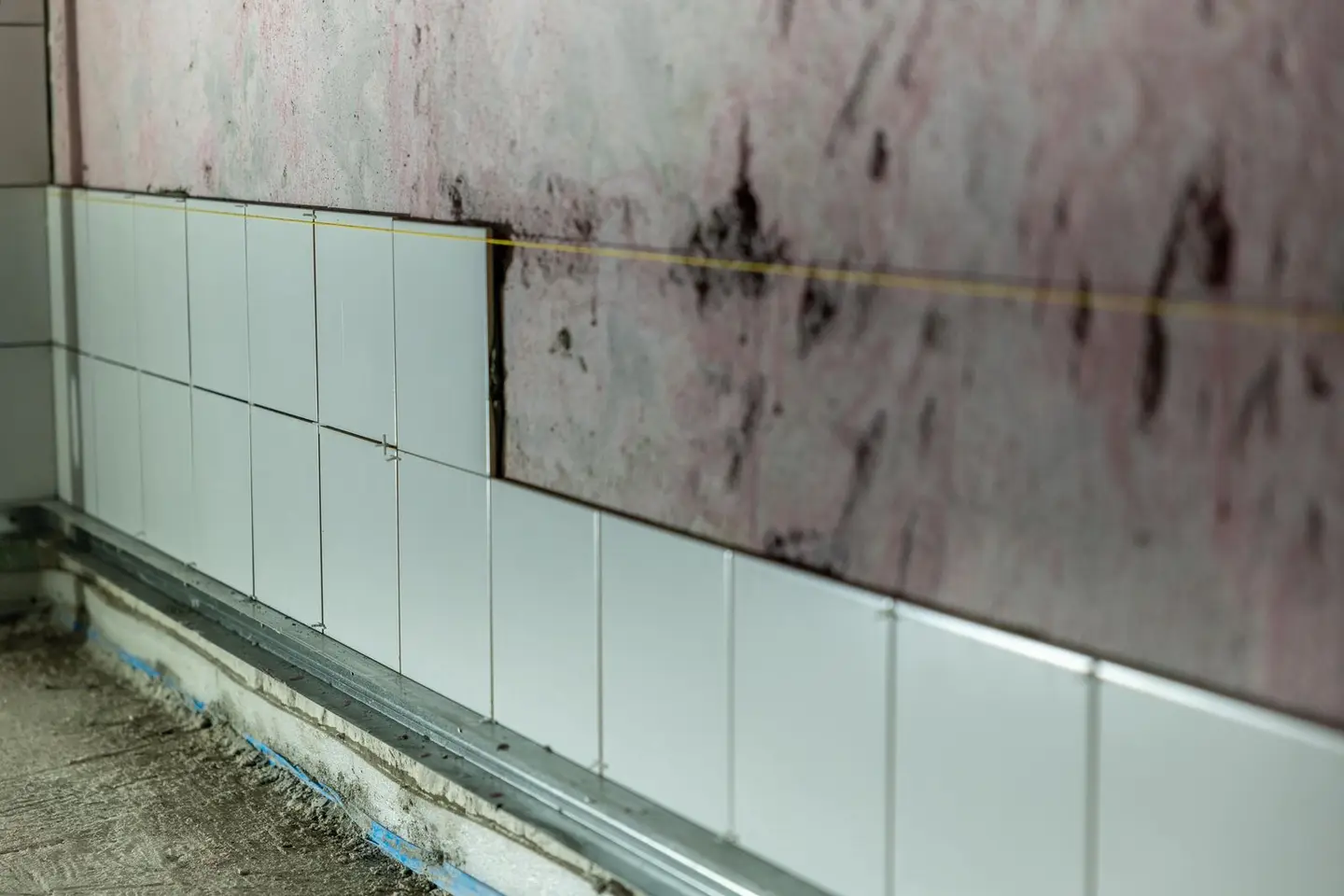
Coverage rates vary by adhesive and tile back profile, but as a rough guide: at a 3 mm bed, a 20 kg bag of standard adhesive covers about 10 m² of dry wall (2 kg/m²) but only about 5.7 m² of floor or wet area (3.5 kg/m²).2 Back-buttering (spreading adhesive on the back of the tile as well as the substrate) uses noticeably more adhesive, but is good practice on large floor tiles to get the solid bed that floor tiling needs.
Grout: the price difference between economy and premium grout is relatively small in the context of a whole tiling job, but the performance difference on high-use floors and wet areas is significant. Epoxy grout (two-part, stain-resistant, suitable for food prep areas and heavy commercial use) costs substantially more, typically £30–£60 per 2 kg kit versus £5–£12 for standard cementitious grout, but lasts far longer and resists staining.
Sale-or-Return and Returns
Many tile retailers and merchants offer sale-or-return on full, unopened boxes within a specified period (often 28–60 days). This means you can over-order by one box as insurance against wastage, then return what you don’t use. Key points:
- Condition: boxes must be undamaged, tiles uncut, and the batch label intact
- Restocking charges: some merchants charge a restocking fee (typically 10–20%) on returned tile orders; others return the full purchase price. Confirm the policy before ordering
- Special orders: tiles ordered specifically for you (non-stocked lines) are generally non-returnable. This is particularly common with large-format porcelain slabs and bespoke or artisan tiles
If a merchant doesn’t offer sale-or-return, you’ll need to be more precise with your quantity calculation. In that case, it’s worth spending a few extra minutes measuring carefully and confirming the wastage percentage with your tiler before ordering.
Getting the Best Price
For a bathroom renovation or kitchen splash-back, the difference between buying at showroom retail and trade merchant prices is meaningful but not transformative. For a whole-house floor tiling project or a large commercial kitchen, it can run to hundreds or even thousands of pounds.
Practical steps to reduce tile costs:
- Open a trade account if you’re a contractor or are doing regular renovation work, the saving over walk-in retail typically pays back the modest administrative effort quickly
- Buy direct from a trade merchant for workhorse tiles (bathroom floor, utility room, kitchen splash-back) and save the showroom budget for a feature wall or hallway where design impact justifies the premium
- Ask about end-of-line or clearance stock, both showrooms and trade merchants regularly clear surplus stock at significantly reduced prices; quality is unchanged
- Compare at least two suppliers for any order over £300 of tiles, even from the same tile range, merchant pricing can vary by 10–20%
- Order with your tiler if possible, a tiler with a trade account can often buy tiles at a better rate than a homeowner walk-in, and may pass on some or all of that saving
VAT at the standard rate of 20% applies to tile purchases.3 Trade quotes are almost always ex-VAT; retail prices on showroom tickets are usually inclusive. Make sure you’re comparing like-for-like figures when assessing value.
References (3)
Figures in this note were checked against the sources below on 30 September 2026. Superscript numbers in the text point to them. Every source the site cites, by topic.
- 1technicalsupplier figureBAL Adhesives, guidance.RN-HHZZUMProduct page for a C2FTE S1 deformable tile adhesive, which the maker recommends for large-format wall and floor tiles.
- 2technicalsupplier figureDunlop (ARDEX), a data sheet.RN-HVB1D6Manufacturer technical data for a standard water resistant floor and wall tile adhesive, useful as the baseline against a flexible adhesive. At 3mm thickness a 20 kg bag covers approximately 2 kg/m2 on dry wall areas and 3.5 kg/m2 on floors, exterior and wet areas. Open time is 15 to 20 minutes, noticeably shorter than the 30 to 45 minutes of the S1 grade. Bed thickness is 3 to 6mm. Mix ratio is about 2.5 parts powder to 1 part water by volume, roughly 5.6 litres of cold water per 20 kg bag. Application is at about 20C and never below 5C. It exceeds BS EN 12004 for a C1T adhesive, and the manufacturer states it is not suitable for porcelain tiles or exterior areas unless a flexible additive is used. Maximum weight of tiling including adhesive is 20 kg/m2 onto plaster and 32 kg/m2 onto plasterboard, with plasterboard requiring fixing at 300mm centres or as the board manufacturer directs.
- 3technicalvery strongHM Revenue & Customs (GOV.UK), guidance.RN-4W7T33Sets the three UK VAT rates: standard 20% on most goods and services, reduced 5% on some goods and services such as children's car seats and home energy, and zero 0% on zero-rated goods such as most food and children's clothes. The standard rate rose to 20% on 4 January 2011 from 17.5%. Some supplies are exempt rather than rated, including postage stamps and financial and property transactions. This is the reference for converting a merchant's ex-VAT trade quote into the figure a homeowner actually pays.
-
BAL Rapid XP Plus, BAL Adhesives, accessed 30 September 2026. bal-adhesives.com
-
Adhesives technical data: CX-24 Essential tile adhesive, Dunlop Adhesives, accessed 30 September 2026. dunloptrade.com
-
VAT rates, HM Revenue and Customs, accessed 30 September 2026. gov.uk