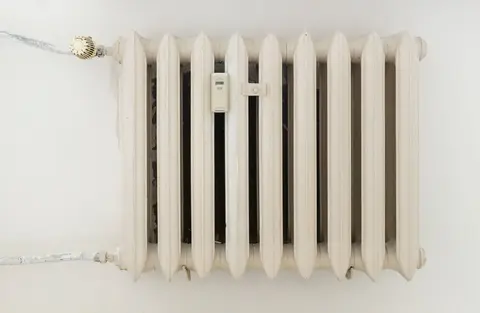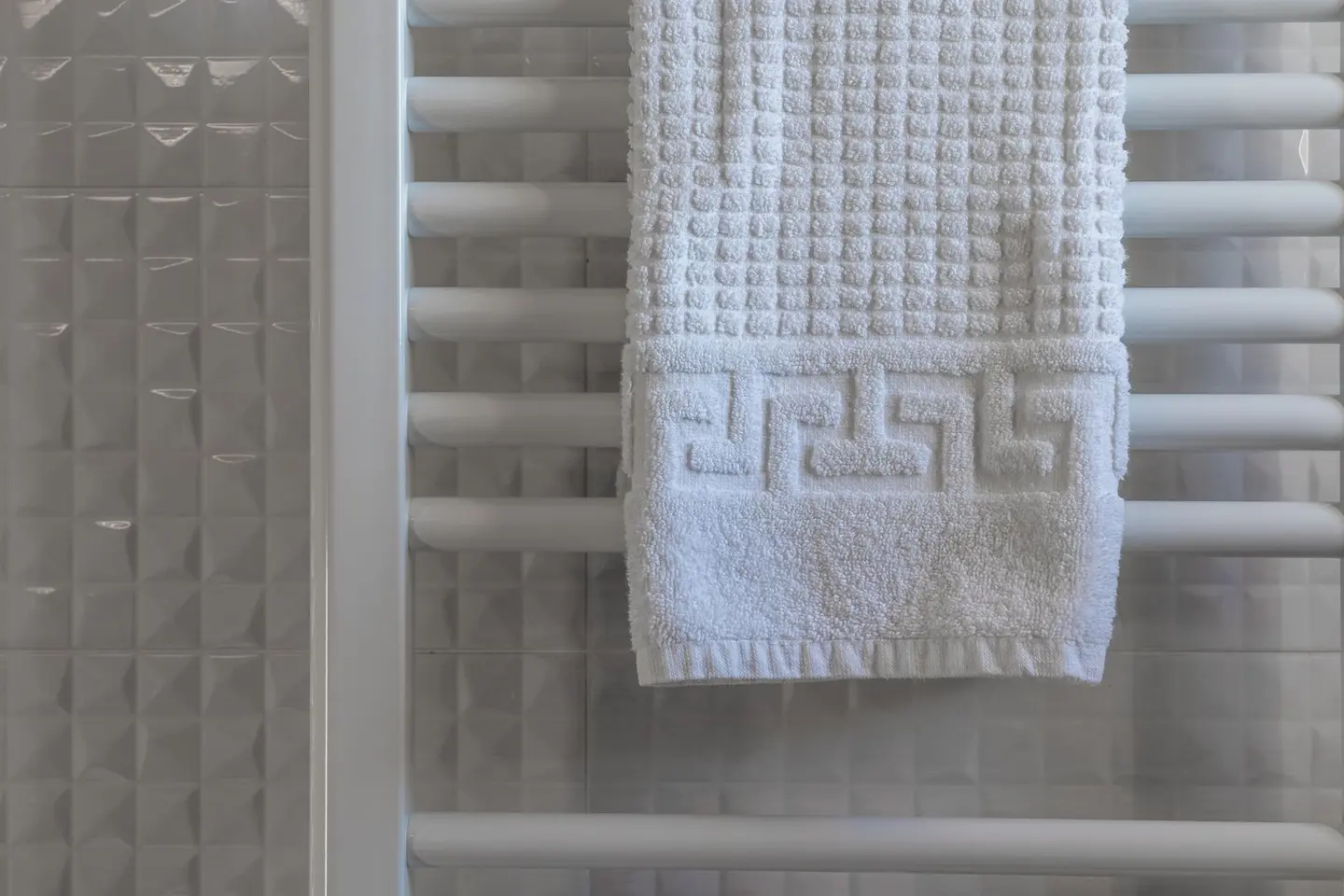
A heated towel rail serves two purposes, drying towels and contributing to the room’s heat load. Most bathrooms need both. Get the sizing wrong and you are left with a cool bathroom even when the rail is warm, or a rail that costs a surprising amount to run electrically. This guide covers sizes, heat outputs, fuel types, and what you can expect to pay.
Sizing: How Much Heat Does a Bathroom Need?
The starting point is calculating the room’s heat loss: the heat needed to hold the room at its design temperature on a very cold day. MCS heat loss calculations use 22 °C for a bathroom.1 The outdoor design temperature depends on location: the figure MCS uses for London Heathrow, for example, is −3.0 °C.1 Heat loss depends on room dimensions, insulation, window area, and how many external walls the room has.
A rough rule of thumb for a well-insulated modern bathroom: allow 60–80 W per m² of floor area. For an older, poorly-insulated bathroom with a single-glazed window: 100–130 W per m².
| Bathroom size | Indicative heat requirement (modern insulation) | Indicative heat requirement (older property) |
|---|---|---|
| Small (2 m × 1.5 m = 3 m²) | 180–240 W (600–820 BTU) | 300–390 W (1,020–1,330 BTU) |
| Medium (2.5 m × 2 m = 5 m²) | 300–400 W (1,020–1,365 BTU) | 500–650 W (1,705–2,220 BTU) |
| Large (3 m × 2.5 m = 7.5 m²) | 450–600 W (1,535–2,050 BTU) | 750–975 W (2,560–3,330 BTU) |
These outputs assume the towel rail is the sole heat source in the room. If you have underfloor heating or a separate radiator, the rail only needs to supplement, a lower-output decorative rail is then sufficient.
Heat Output: BTU vs Watts
Towel radiator heat outputs are quoted in BTU/h (British Thermal Units per hour) or Watts. The conversion is: 1 W = 3.41 BTU/h. Manufacturers test and quote output to BS EN 442 at a delta T (ΔT) of 50 °C, the difference between the mean water temperature and room temperature.2 In a modern condensing boiler system running cooler flow temperatures (55–65 °C flow, 45–55 °C return), the mean water temperature is about 50–60 °C, so in a bathroom at 22 °C the actual ΔT is around 28–38 °C and real-world output is roughly 30–50% lower than the headline figure. At ΔT40, multiply the quoted ΔT50 output by about 0.75; at ΔT30, by about 0.5.
Common Sizes and Outputs (Central Heating)
| Size (H × W) | Quoted output, ΔT50 (chrome to white) | Realistic output (ΔT40) |
|---|---|---|
| 678 × 400 mm | 175–275 W | 130–205 W |
| 760 × 500 mm | 245–375 W | 185–280 W |
| 760 × 600 mm | 295–445 W | 220–335 W |
| 1,211 × 500 mm | 380–575 W | 285–430 W |
| 1,211 × 600 mm | 455–685 W | 340–515 W |
| 1,744 × 500 mm | 555–845 W | 415–635 W |
| 1,744 × 600 mm | 665–1,000 W | 500–750 W |
The figures are the published outputs of one maker’s ladder rails, Stelrad’s Classic and Classic Mini straight towel rails: at ΔT50 the 1,211 × 500 mm model is rated at 576 W in white.3 The same rail in chrome is rated at 379 W, about a third less, so a chrome rail needs to be larger to give the same heat.3 On these figures a towel rail on its own can heat only a small or well-insulated bathroom at ΔT40; in a larger or older room, choose a taller or white rail or add a second heat source.
Bar count and tube diameter also affect output, a 6-bar 500 mm wide rail outputs less than an 8-bar 500 mm rail of the same height. Check the manufacturer’s data sheet rather than relying on size alone.
Fuel Types
Central Heating (Hot Water) Only
Connected to the existing wet central heating system via 15 mm compression or push-fit connections. Runs only when the heating is on, which in summer may be never. Most energy-efficient when the boiler is running anyway. Not suitable if you want towel warmth independently of the heating season.
Best for: main bathroom in a property with gas central heating; primary heat source in the room.
Electric Only
Contains a sealed element and glycol-filled fluid or a heating element in a dry rail. Plugged in or hard-wired, controlled by a separate thermostat or timer. Costs more to run than a wet system per unit of heat, but allows use all year including summer. Wiring a rail in on a new circuit, or altering a circuit within the special location around a bath or shower, is notifiable under Part P, so use a registered electrician or notify building control.4
Typical electricity cost (at the price cap unit rate of 26.32p/kWh from 1 October 2026): a 150 W electric rail running 2 hours/day costs approximately £2.40/month.5 Running costs scale directly with wattage and hours of use.
Best for: en-suites, cloakrooms, or bathrooms where extending the plumbing is expensive; properties without gas.
Dual Fuel
The most flexible option, connected to the central heating circuit but also fitted with an electric element (commonly 150–600 W, matched to the rail’s size).6 In winter it runs on the boiler; in summer the electric element keeps towels dry on a timer. The electric element is usually removable and upgradeable.
Best for: family bathrooms where year-round use is wanted without high running costs.
Finishes and Price Ranges (Supply Only, 2026)
| Finish | Price range |
|---|---|
| White (epoxy powder coat) | £50–£200 |
| Chrome | £80–£300 |
| Anthracite / matt black | £90–£350 |
| Brushed stainless steel | £150–£500 |
| Copper / brushed brass | £200–£600+ |
Designer brands such as Bisque and Vogue command significant premiums. Budget chrome units from trade suppliers are functionally identical but less refined.
Installation Costs
| Job | Typical cost (2026, England) |
|---|---|
| Replace existing towel rail (same pipework positions) | £80–£150 |
| New towel rail, extending pipework (drop from floor above) | £180–£350 |
| Hard-wired electric towel rail (new circuit) | £150–£250 |
| Dual fuel, connect to existing circuit + pipework | £200–£350 |
Plumber labour typically runs about £300–£420/day in London and £270–£350 elsewhere. A straightforward swap is usually under two hours.
Valve Types
Towel radiators with bottom connections take straight valves where the pipes rise from the floor and angled or corner valves where the pipes come out of the wall.7 H-block valves are a different fitting, made for radiators with central connections.8 Thermostatic radiator valves (TRVs) are one of the ways Approved Document L accepts for room-by-room temperature control: a room thermostat, plus a TRV on every radiator outside the room that contains the thermostat.9 TRVs should not be used in the same room as the room thermostat, which in practice is usually the hallway or landing.9
For dual-fuel rails, the electric element usually shares one of the bottom connections with a valve through a T-piece, so plan for it when choosing valves; dual-fuel valve sets with a built-in T-piece are also available.10
Key Questions Before Buying
- Is the rail the sole heat source? If yes, size generously and apply the ΔT40 correction.
- Where are the pipes? Pipes rising from the floor need straight valves; pipes coming out of the wall need angled or corner valves.
- Do you want year-round use? If so, choose dual fuel or electric.
- What are the pipe centres? The centre-to-centre spacing depends on the rail’s width and varies between models, so measure your existing connections before buying.
- What finish suits the room? Match to brassware (taps, shower fittings) for a coherent look.
References (10)
Figures in this note were checked against the sources below on 2 October 2026. Superscript numbers in the text point to them. Every source the site cites, by topic.
- 1technicalstrongMCS Heat Load Calculator, guidance.RN-YRKS2VMCS's heat load calculator reference, drawn from the CIBSE Domestic Heating Design Guide, sets internal design temperatures, with 22 °C for bathrooms.
- 2technicalsupplier figureZehnder Group UK, guidance.RN-08REYEA radiator maker's explainer: outputs are tested to EN 442 and published at ΔT 50 °C, with ΔT defined as mean water temperature minus room temperature.
- 3technicalsupplier figureStelrad, guidance.RN-GEHGVOStelrad's product and technical sheet for its Classic and Classic Mini towel rails, giving EN 442 heat outputs at ΔT50 (75/65/20 °C) for each height and width in white and in chrome.
- 4technicalvery strongMinistry of Housing, Communities and Local Government.RN-JYJ3I5The document that decides what electrical work a homeowner may legally do themselves, and the exact list of notifiable jobs. Regulation 12(6A), reproduced at paragraph 2.5, makes only three things notifiable: the installation of a new circuit, the replacement of a consumer unit, and any addition or alteration to existing circuits in a special location. Regulation 12(9) defines special location as, in a room containing a bath or shower, the zone extending vertically from finished floor level to 2.25 metres (or the shower head position if higher) and horizontally 600mm from the edge of the bath tub or shower tray. Paragraph 2.7 states that all other electrical installation work is not notifiable, namely additions and alterations to existing installations outside special locations, and replacements, repairs and maintenance anywhere. Paragraph 2.8 gives worked examples: a built-in cooker is not notifiable unless a new cooker circuit is needed, and connecting an electric gate or garage door to an existing isolator is not notifiable but running a new circuit from the consumer unit to that isolator is. Paragraph 2.2 confirms Part P reaches outdoor work including fixed garden lighting, pond pumps and outbuildings such as sheds, detached garages and domestic greenhouses. Notifiable work must be certified by self-certification by a registered competent person, third-party certification, or a building control body (paragraph 3.1), with the compliance certificate issued within 30 days (paragraph 3.4). Note that Approved Document P is a source of guidance rather than a ban: non-notifiable work still has to comply with BS 7671.
- 5technicalvery strongOfgem.RN-YYE8U2The live source for any running-cost sum in a heating note. For 1 October to 31 December 2026 the direct debit cap is 26.32p per kWh for electricity with a 54.83p daily standing charge, and 7.97p per kWh for gas with a 29.68p daily standing charge, giving a typical annual dual fuel bill of £1,723, a 4% rise on the previous period. Ofgem states these are the average unit rate and standing charge for direct debit customers in England, Scotland and Wales; gas prices include 5% VAT while electricity carried no VAT in this period. The cap is reset every three months, so any note quoting a pence-per-kWh figure should be dated against this page.
- 6technicalsupplier figureVictorian Plumbing, guidance.RN-QNHGSIA bathroom retailer's range page for towel rail heating elements, showing common element ratings of 150, 300 and 600 W and advising matching to the rail maker's specification.
- 7technicalsupplier figureElegant Radiators, guidance.RN-HH09JMA towel radiator retailer's valve guide stating which valve shape suits pipework from the floor and from the wall; used only for this fitting choice, for want of a maker or trade-body page.
- 8technicalsupplier figureVictorian Plumbing, guidance.RN-JDRDBPA large UK bathroom retailer's valve guide explaining that angled, straight and corner valves suit different pipe runs and that H-block valves are for centrally connected radiators.
- 9technicalvery strongMinistry of Housing, Communities and Local Government.RN-L0FCJXThe in-force U-value tables a DIY insulation or door note must quote, with the exact numbers. Table 4.2, limiting U-values for new fabric elements in existing dwellings, sets roof 0.15, wall 0.18, floor 0.18, swimming pool basin 0.25, window 1.4 or Window Energy Rating Band B minimum, rooflight 2.2, doors with more than 60 per cent of the internal face glazed 1.4 or Doorset Energy Rating Band C minimum, and other doors 1.4 or Doorset Energy Rating Band B minimum. Table 4.3, for existing elements, gives a roof threshold of 0.35 and an improved value of 0.16, which is the figure a loft insulation note needs: paragraph 4.12 says a retained element whose U-value is higher than the column (a) threshold, for example through a loft or garage conversion, should be upgraded to the column (b) value. Paragraph 4.13 allows a lesser upgrade only where the improved value is not technically or functionally feasible or would not achieve a simple payback of 15 years or less. Paragraph 4.8 requires a replacement element to be no worse than the one it replaces as well as meeting Table 4.2. Paragraph 4.10 gives the heritage exception: where character must be maintained, a centre pane U-value of no more than 1.2 or low-emissivity secondary glazing. Note 9 records that the timber window concession of 1.6 or Band C ended on 14 June 2023. The 2021 edition came into force on 15 June 2022; a 2026 edition exists at https://assets.publishing.service.gov.uk/media/69c122a6cfa346b9d4704a55/ADL1_2026.pdf.
- 10technicalsupplier figureThe Radiator Company, guidance.RN-DWPPEHA radiator supplier's guide explaining that dual-fuel installations need a T-piece so an element and a valve share one connection, or a dual-fuel TRV with integrated T-piece.
-
Design Conditions, MCS Heat Load Calculator, accessed 30 September 2026. heatloadcalculator.mcscertified.com
-
Correction Factors (Delta T Conversion), Zehnder Group UK, accessed 30 September 2026. zehnder.co.uk
-
Classic Towel Rail: straight and curved (Boutique Series), Stelrad, accessed 2 October 2026. stelrad.com
-
Approved Document P, Electrical safety, Dwellings, 2013 edition, HM Government, accessed 30 September 2026. assets.publishing.service.gov.uk
-
Energy price cap unit rates and standing charges, Ofgem, accessed 29 September 2026. ofgem.gov.uk
-
Heating Elements for Towel Rails & Radiators, Victorian Plumbing, accessed 30 September 2026. victorianplumbing.co.uk
-
The Ultimate Guide to Towel Radiator Valves: Types, Functions, and Tips, Elegant Radiators, accessed 2 October 2026. elegant-radiators.co.uk
-
Radiator Valves: Which Type Should I Buy, Victorian Plumbing, accessed 2 October 2026. victorianplumbing.co.uk
-
Approved Document L, Conservation of fuel and power, Volume 1: Dwellings, 2021 edition incorporating 2023 amendments, Ministry of Housing, Communities and Local Government, accessed 14 September 2026. assets.publishing.service.gov.uk
-
A Guide to Dual Fuel Heated Towel Rails, The Radiator Company, accessed 30 September 2026. theradiatorcompany.co.uk