Double glazing is one of the most valuable thermal upgrades in any UK home, so when something goes wrong it is worth understanding whether repair or replacement is the right call, and what it is likely to cost. The good news is that most common faults are repairable for a fraction of the price of new windows. This guide covers every common failure mode, what causes it, how to fix it, and realistic 2026 UK costs.
The Most Common Double Glazing Problems
1. Misted or Cloudy Glass (Failed Sealed Unit)
The most frequently reported problem is condensation between the two panes, a milky or steamy appearance that cannot be wiped away. This happens when the seal around the edge of the sealed glass unit breaks down, allowing moist air into the cavity between the panes, which is filled with dry air or an inert gas such as argon.
Repair option: The glass unit (not the frame) can be replaced. A tradesperson removes the glazing beads, slides out the old unit, and fits a new double or triple glazed unit. This is almost always cheaper than replacing the whole window.
Replacement unit cost: £150–£350 per window supplied and fitted, depending on size, glass spec (low-E coating, safety glass, Georgian bar), and accessibility.
Labour: roughly £50–£100 of that total is the glazier’s time. Most sealed units are made to measure, so allow for a short wait between measuring and fitting.
“Resealing” drilled units: Some companies drill small holes to inject desiccant and clear the misting temporarily. This is not a permanent fix, the seal remains broken, and Renovation Notes does not recommend it.
2. Broken or Stiff Hinges
UPVC and aluminium windows use friction stay hinges (also called egress hinges or casement stays). These wear over time, causing the window to drop, drag on the frame, or fail to stay open. Replacement is straightforward.
Cost: £60–£130 per window including labour. Hinge sets cost £20–£50 in parts; a window repairer charges 30–60 minutes labour.
Safety note: If a bedroom window is fitted with a child safety restrictor, make sure the replacement hinge still accommodates it. Restrictors are sensible where there are young children, but the opening-limiter guidance in Building Regulations Approved Document K sits under a requirement that does not apply to dwellings.1 For houses, Approved Document K instead sets a minimum guarding height of 800 mm at opening windows.1
3. Broken Handles and Locks
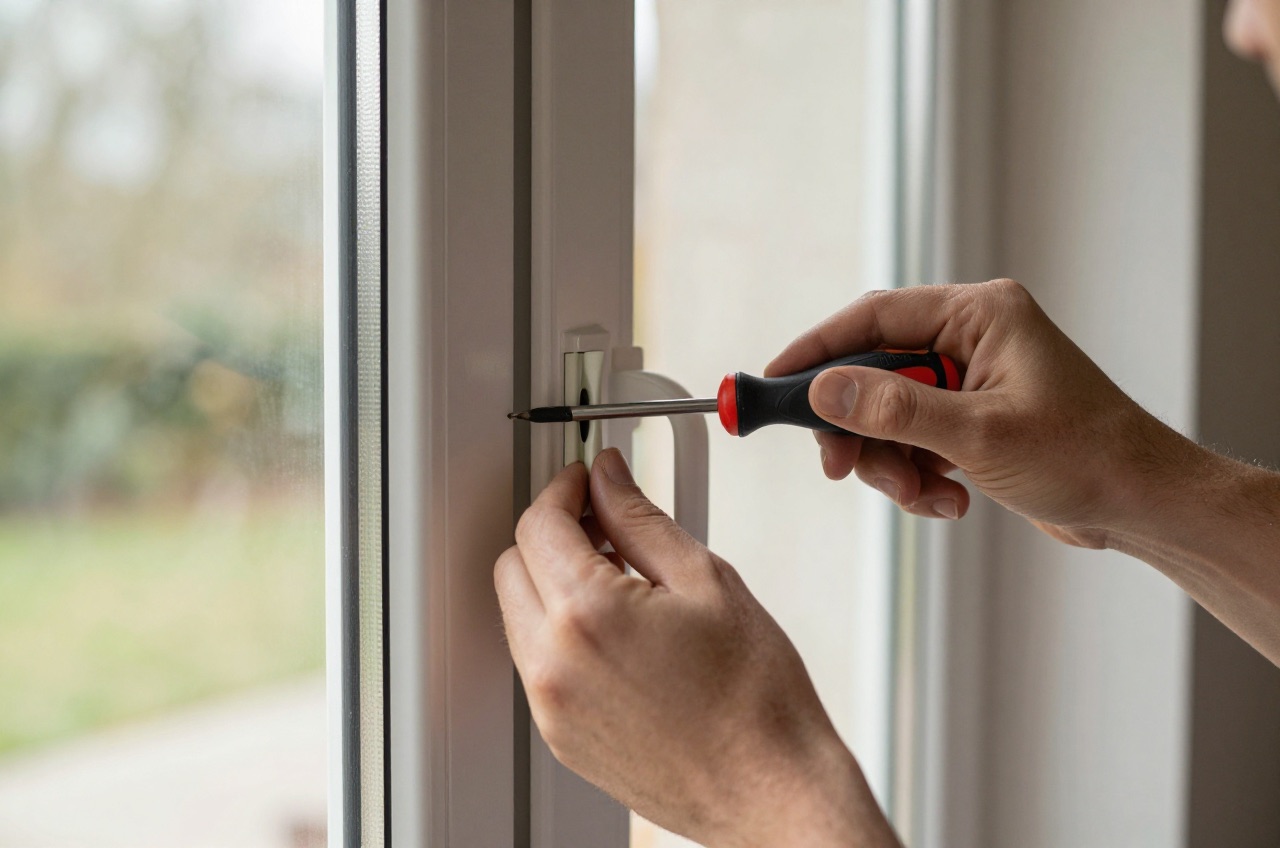
UPVC handles break through repeated use, impact, or UV degradation. Multi-point locks (the long strip locking mechanism in the frame) can seize, fail to engage, or snap. Both are common after 10–15 years.
Handles: Usually £15–£30 for the part if you fit it yourself (a screwdriver job), or £40–£80 with a tradesperson.
Multi-point locking mechanism: £100–£250 fitted, depending on the mechanism brand and whether the lock strip itself needs replacement. This is a specialist job, incorrect fitting can leave a window insecure.
Lock cylinders (euro cylinder): If a key breaks in the lock or a cylinder fails, replacement cylinders cost £20–£60 and swap in 10 minutes. Choose a TS007 3-star or Secured by Design rated cylinder for better protection against lock snapping.
4. Draughts Around the Frame
Air infiltration around the perimeter of the window usually means the rubber gasket seals inside the frame have perished or the frame itself has warped slightly. Gasket replacement is a low-cost repair; frame warping is harder to address.
Gasket replacement: £40–£90 per window including labour. Gasket material is inexpensive (£10–£25 per window in parts); it is the time tracking down and pressing in the correct profile that costs.
Frame adjustment: Many UPVC windows have adjustable compression hinges and strike plates. A window repairer can adjust these to improve the seal for £40–£80 per call-out.
5. Water Ingress and Leaks
If water enters around the frame rather than through the glass, suspect failed exterior silicone sealant or a blocked drainage channel in the frame. UPVC frames have small drainage slots at the bottom of the outer frame face, these can block with debris and cause pooling.
Fix: Clear the drainage slots with a thin implement and re-apply exterior silicone sealant (Soudal FC or similar, paintable grade if needed). Total cost as DIY: £10–£20 in materials. A tradesperson would charge £40–£80.
Double Glazing Repair Cost Summary
| Problem | DIY cost | Tradesperson cost |
|---|---|---|
| Failed sealed unit (misted glass) | Not recommended | £150–£350 per window |
| Hinge replacement | £20–£50 (parts) | £60–£130 per window |
| Handle replacement | £15–£30 (parts) | £40–£80 per window |
| Multi-point lock mechanism | £60–£120 (parts) | £100–£250 per window |
| Gasket/draught seal | £10–£25 (parts) | £40–£90 per window |
| Exterior silicone re-seal | £10–£20 (materials) | £40–£80 per window |
| Full frame + glass replacement | - | £400–£900 per window2 |
The cited prices in this table were published in 2016 and brought to 2026. What that means.
Repair vs Replace: How to Decide
The rule of thumb in 2026: repair if the frame is sound, replace if the frame is damaged or the window is over 25 years old.
Key questions:
- Is the UPVC discoloured, chalky, or cracked? Repainting is possible but once UPVC cracks structurally, replacement is better value.
- Does the frame fit square? Severe distortion means the building structure has moved, address the cause first, then replace the window.
- Are you on an energy-efficiency improvement programme? If so, replacing single-pane or older double-glazed units with modern A-rated or better windows makes financial sense. Some eligible households can get energy-efficiency work funded by their energy supplier under ECO4, which runs until 31 December 2026.3 To check what help you could get, use the Find Ways to Save Energy in Your Home service on gov.uk or call 0800 098 7950.4
Finding a Reputable Double Glazing Repairer
Double glazing installation and repair is not licensable, but use traders who are:
- FENSA-registered (for whole-window replacement, which gives you a completion certificate)
- CERTASS-registered (alternative self-certification body)
- TrustMark-registered (for funded retrofit work)
For repairs that do not replace the whole window, FENSA registration is not required, but always get a written quote and check reviews on Checkatrade or Google.
Building Regulations and Double Glazing
Replacing a full window (frame and glass) in England is controlled under the Building Regulations: either the installer is registered with a competent person scheme such as FENSA or CERTASS, or you apply to a Building Control body.5 The regulations require:
- Thermal performance: U-value of 1.4 W/m²K or better for the whole window unit (Part L)6
- Ventilation: Replacement windows must maintain background ventilation, and under the 2021 edition of Part F that usually means trickle vents in the replacement windows even where the old windows had none: 8,000 mm² equivalent area for habitable rooms and kitchens, 4,000 mm² for bathrooms7
- Safety glazing: Glazing in critical locations (in doors and in side panels within 300 mm of a door, up to 1500 mm above the floor, and in other glazing below 800 mm) must break safely, be robust or be protected, which in practice usually means toughened or laminated safety glass, per Part K in England, Part N in Wales1
Replacing just the glass unit within an existing frame is generally treated as a repair rather than a window replacement, so it is not notifiable.8 Replacing only hardware (handles, hinges, locks) is not notifiable either.
When to Call a Professional
Call a glazier or window repairer rather than attempting DIY when:
- The glass unit has cracked or broken (handling broken toughened glass is hazardous)
- The frame is distorted or out of square
- The multi-point locking mechanism has failed (security implications)
- The window is above ground level (working at height rules apply)
For most hardware repairs, handles, hinges, cylinders, a confident DIYer with basic tools can save £30–£80 per window. The main risk is buying the wrong replacement part: always photograph the existing component and measure before ordering.
References (8)
Figures in this note were checked against the sources below on 30 September 2026. Superscript numbers in the text point to them. Every source the site cites, by topic.
- 1technicalvery strongMinistry of Housing, Communities and Local Government.RN-XH6E39The standard that decides whether a loft ladder is legal and when a raised deck needs a balustrade. Published 3 January 2013, it covers protection from falling, collision and impact including stairs, ladders, ramps, guarding and vehicle barriers. Paragraph 1.31 states that retractable ladders must not be used as a means of escape. Paragraph 1.32 permits a fixed ladder, with fixed handrails on both sides, only for access in a loft conversion containing one habitable room, and only where there is not enough space without altering the existing space for a compliant stair, which is the rule that catches most loft ladder installations. Paragraph 1.29 restricts alternating tread stairs to loft conversions. For a private stair the maximum pitch is 42 degrees (Table 1.1 note 1), the normal relationship between rise and going is twice the rise plus the going between 550mm and 700mm, and for dwellings external tapered steps forming part of the building need a going of at least 280mm. Paragraph 3.1 requires guarding wherever it is reasonably necessary for safety at the edge of a floor, gallery, balcony, roof, light well, basement or similar sunken area. Paragraph 3.2 requires guarding to be at least the height in Diagram 3.1, allows any wall, parapet or balustrade to serve as guarding, and requires it to resist the loads in BS EN 1991-1-1 with its UK National Annex and PD 6688-1-1, with BS 6180 for barrier and infill panel design. Handrails should be positioned 900mm to 1000mm from the pitch line or floor.
- 2costvery strongCambridge Architectural Research for the Department of Energy and Climate Change.RN-SW1L3OA price, true at 2016, brought forward on the Construction Output Price Index. The summary tables behind the government's domestic retrofit cost assumptions, published as a spreadsheet by Cambridge Architectural Research in July 2016. The per-measure installed costs used in national energy modelling, by house type and measure. A 2016 price base: the structure is still useful, the numbers need bringing forward.
- 3technicalvery strongOfgem.RN-FPPUSLECO4 is the fourth phase of the Energy Company Obligation across Great Britain. It applies to measures installed from 1 April 2022 and runs until 31 December 2026 following a nine-month extension; ECO3 closed on 31 March 2022 and ECO4 came into force in July 2022. The scheme places a Home Heating Cost Reduction Obligation on medium and large energy suppliers to promote measures that improve the ability of low-income, fuel-poor and vulnerable households to heat their homes, funding insulation and heating upgrades for both homeowners and tenants. Ofgem also lists the Great British Insulation Scheme as a separate obligation on this page.
- 4technicalvery strongGOV.UK, guidance.RN-5338K3The government's own recommendation tool, and the neutral link a DIY insulation note should offer instead of a comparison site. It gives personalised home improvement recommendations for property owners in England and Wales, and for each suggestion shows an estimated cost of making the improvement and how much could be saved on bills. It cross-refers to the Boiler Upgrade Scheme, the Warm Home Discount Scheme and the Winter Fuel Payment. A telephone helpline is available Monday to Friday 8am to 6pm except bank holidays, and Saturday 9am to 12pm. The page itself carries no eligibility criteria or scheme figures, so a note quoting grant values must cite the individual scheme pages rather than this one.
- 5technicalvery strongPlanning Portal, guidance.RN-33F8DPThe Planning Portal on building regulations for doors and windows: since 1 April 2002 the regulations have applied to all replacement glazing, covering thermal performance, safety glazing, means of escape and ventilation. That 2002 date is the one that matters at sale, because it is when a FENSA certificate or a building regulations notice started being expected for replacement windows.
- 6technicalvery strongMinistry of Housing, Communities and Local Government.RN-L0FCJXThe in-force U-value tables a DIY insulation or door note must quote, with the exact numbers. Table 4.2, limiting U-values for new fabric elements in existing dwellings, sets roof 0.15, wall 0.18, floor 0.18, swimming pool basin 0.25, window 1.4 or Window Energy Rating Band B minimum, rooflight 2.2, doors with more than 60 per cent of the internal face glazed 1.4 or Doorset Energy Rating Band C minimum, and other doors 1.4 or Doorset Energy Rating Band B minimum. Table 4.3, for existing elements, gives a roof threshold of 0.35 and an improved value of 0.16, which is the figure a loft insulation note needs: paragraph 4.12 says a retained element whose U-value is higher than the column (a) threshold, for example through a loft or garage conversion, should be upgraded to the column (b) value. Paragraph 4.13 allows a lesser upgrade only where the improved value is not technically or functionally feasible or would not achieve a simple payback of 15 years or less. Paragraph 4.8 requires a replacement element to be no worse than the one it replaces as well as meeting Table 4.2. Paragraph 4.10 gives the heritage exception: where character must be maintained, a centre pane U-value of no more than 1.2 or low-emissivity secondary glazing. Note 9 records that the timber window concession of 1.6 or Band C ended on 14 June 2023. The 2021 edition came into force on 15 June 2022; a 2026 edition exists at https://assets.publishing.service.gov.uk/media/69c122a6cfa346b9d4704a55/ADL1_2026.pdf.
- 7technicalvery strongMinistry of Housing, Communities and Local Government.RN-QD1SFFTable 1.1 sets minimum intermittent extract rates: kitchen with a cooker hood extracting outside 30 l/s, kitchen without one 60 l/s, utility room 30 l/s, bathroom 15 l/s, sanitary accommodation 6 l/s. Extract terminals and fans other than cooker hoods should be as high as practicable and no more than 400mm below the ceiling; a cooker hood should sit between 650mm and 750mm above the hob if the manufacturer gives no figure. Table 1.7 requires background ventilators of at least 8000mm2 equivalent area in habitable rooms and kitchens for a dwelling, 10,000mm2 for a single-storey dwelling. Background ventilators should be at least 1700mm above floor level and at least 500mm from a fan in the same room. On replacement windows, paragraph 3.14 says new windows must carry background ventilators no smaller than the originals, and paragraph 3.15 gives the fallback minimums where the old size is unknown: 8000mm2 habitable rooms, 8000mm2 kitchen, 4000mm2 bathroom. Paragraph 3.32 confirms that replacing an extractor fan or cooker hood on existing cabling is not notifiable.
- 8technicalvery strongMinistry of Housing, Communities and Local Government, guidance.RN-B869UPThe government plain-language map of the Building Regulations system in England, written after the Hackitt review called for the old manual to be revised, and split into Volume 1 (overview, chapters 1 to 8) and Volume 2 (further guidance, chapters A to F, plus key terms in Appendix I and references in Appendix II). It confirms that the Building Act 1984 sets the enforcement powers, that the Building Regulations 2010 contain 15 technical requirements in Schedule 1 each lettered as a Part, and that regulation 3 defines building work. Chapter 3 gives the list a renovation note can cite verbatim for when approval is likely to be needed: replacing consumer units or installing new circuits, new plumbing and waste connections, changing circuits near a bath or shower, installing ventilation or air conditioning, replacing windows and doors, replacing pitched or flat roof coverings, installing or replacing a heating system, adding extra radiators, removing a chimney breast, removing a wall (load bearing and sometimes non-load bearing) and creating a through lounge; it also confirms that new loft insulation unconnected to other building work is not checked by a building control body although it must still comply. Chapter 4 states that where work is done under a competent person scheme the installer or scheme operator notifies the local authority and issues a completion certificate within 30 days of completion, and that if work has already started or finished without notification an approved inspector cannot be used, leaving only local authority building control, which is not obliged to approve work already carried out. Chapter 3 also confirms courts can impose unlimited fines for non-compliance. Note the manual predates the Building Safety Act 2022 changes, so it still uses the term approved inspector rather than registered building control approver.
-
Approved Document K, Protection from falling, collision and impact, 2013 edition, Ministry of Housing, Communities and Local Government, accessed 14 September 2026. assets.publishing.service.gov.uk
-
Domestic Cost Assumptions: Summary Tables, Cambridge Architectural Research for the Department of Energy and Climate Change, accessed 11 September 2026. Priced at 2016; brought to 2026 on the Construction Output Price Index, housing repair and maintenance (Great Britain), published by Office for National Statistics, a factor of 1.2292. assets.publishing.service.gov.uk
-
Energy Company Obligation (ECO), Ofgem, accessed 30 September 2026. ofgem.gov.uk
-
Find ways to save energy in your home, GOV.UK, accessed 30 September 2026. gov.uk
-
Doors and windows: Building Regulations, Planning Portal, accessed 30 September 2026. planningportal.co.uk
-
Approved Document L, Conservation of fuel and power, Volume 1: Dwellings, 2021 edition incorporating 2023 amendments, Ministry of Housing, Communities and Local Government, accessed 14 September 2026. assets.publishing.service.gov.uk
-
Approved Document F, Ventilation, Volume 1: Dwellings, 2021 edition, Ministry of Housing, Communities and Local Government, accessed 30 September 2026. assets.publishing.service.gov.uk
-
Manual to the Building Regulations, July 2020, Ministry of Housing, Communities and Local Government, accessed 30 September 2026. assets.publishing.service.gov.uk