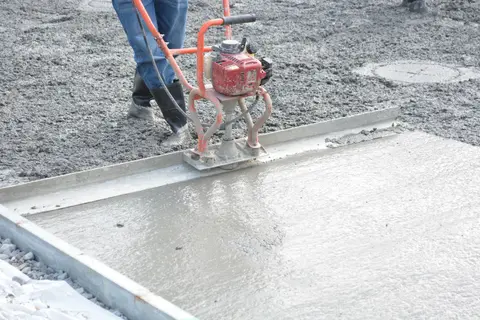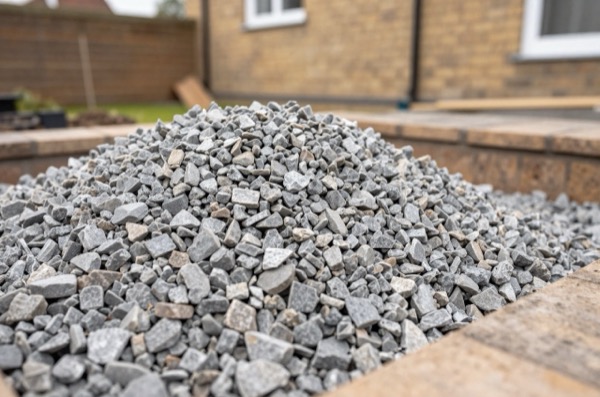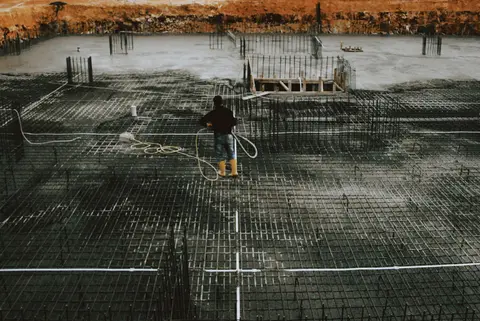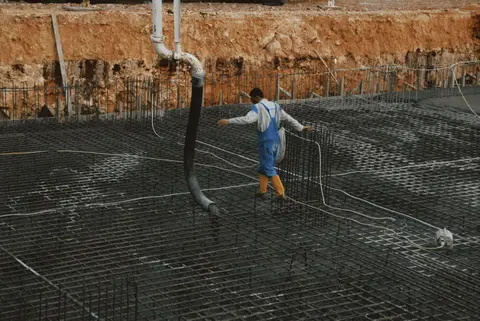
Cement is the binder that makes concrete, mortar and render work. Yet walk into any builders’ merchant and you will find several bags with different designations. Choosing the wrong type will not necessarily cause immediate failure, but it can lead to premature cracking, frost damage or chemical attack, all of which are expensive to put right. This guide explains the four types you are most likely to encounter on UK domestic renovation projects, with their specifications, typical uses and 2026 costs.
CEM I / CEM II: Ordinary Portland Cement
CEM I (formerly labelled OPC, Ordinary Portland Cement) is the workhorse of UK construction. It meets BS EN 197-1 and carries a strength class of 42.5 N or 52.5 N, meaning it achieves that compressive strength at 28 days in N/mm². CEM II blends Portland clinker with up to 35 % of a secondary material such as fly ash (CEM II/B-V) or ground-granulated blast-furnace slag (CEM II/B-S), reducing embodied carbon without meaningfully compromising performance for most domestic work.
CEM I/II is suitable for:
- In-situ concrete foundations, slabs and pads
- General masonry mortars (designations M4 and M6)
- Render and screed
A standard 25 kg bag occupies roughly 0.017–0.018 m³ as loose powder. Mixed at a typical 1:2:4 cement:sand:aggregate ratio by volume, one bag makes roughly 0.08 m³ of finished concrete, or about 12 to 13 bags per cubic metre, because the mixed concrete occupies only about two-thirds of the loose dry volume. For a 100 mm slab you would therefore need a little over one bag per square metre, though in practice ready-mix concrete is more economical above about 0.5 m³.
Rapid-Set and Fast-Setting Cement
Rapid-set products (sold under trade names such as Postcrete) stiffen far faster than ordinary cement: Blue Circle Postcrete, for example, sets a fence post within 5–10 minutes.1 They use accelerated Portland cement blends or calcium aluminate cement, and the strength reached at a given age varies by product, so check the bag. BS 8500-1 still governs the concrete mix design; the cement itself is usually made to BS EN 197-1 or, for calcium aluminate cement, BS EN 14647.
Rapid-set products are almost always sold pre-blended with aggregate to fill fence-post holes and small pad foundations: you simply add water in the hole. They are not recommended for:
- Large pours (heat of hydration causes cracking)
- Sulfate-rich ground (unless specified as SR rapid-set)
- Structural elements requiring controlled, supervised placement
Sulfate-Resisting (SR) Cement
Ground conditions in large parts of the UK, particularly clay soils, brownfield land and sites near mining activity, contain soluble sulfates (SO₄²⁻) that attack ordinary Portland cement by forming ettringite, a crystalline compound that expands and fractures concrete over time. BRE Special Digest 1 (2005) classifies ground sulfate exposure as DS-1 to DS-5.
SR cement (CEM I-SR3 or CEM I-SR5) limits the tricalcium aluminate (C₃A) content to 3 % or 5 % respectively, which dramatically reduces ettringite risk. It complies with BS EN 197-1; in UK practice the concrete for sulfate-bearing ground is specified by design chemical class (DC class) under BS 8500-1 and BRE Special Digest 1. Bagged sulfate-resisting cement at UK merchants is not always a CEM I-SR: Breedon’s, for example, is classified CEM III/A 52,5 L (a blast-furnace slag cement).2
For foundations in chemically aggressive ground, Building Regulations Approved Document A points to BS 8500-1 and BRE Special Digest 1, which set the concrete’s DC class and may call for sulfate-resisting cement or a DC-3 / DC-4 designated concrete from a ready-mix supplier.3
Masonry Cement
Masonry cement is a factory-made blend of Portland clinker, mineral filler (often limestone) and an integral plasticiser or air-entraining agent, conforming to BS EN 413-1. It simplifies site mortar batching: you mix masonry cement with sand only (no separate lime), typically at 1 part cement to 4–5 parts sand to produce a designation (iii) mortar, broadly equivalent to strength class M4.
The built-in air entrainment gives it improved freeze-thaw resistance and workability compared with a plain cement:sand mix.4 It is not suitable for structural concrete. Typical uses are:
- Above-DPC brickwork and blockwork in sheltered to moderately exposed locations
- Cavity wall mortar bedding
- General pointing in M2 to M4 designations
Bag Sizes, Coverage and 2026 Costs
| Cement Type | Standard Bag | Approx. Cost/bag (2026) | Typical Mix | Coverage |
|---|---|---|---|---|
| CEM I 42.5 N | 25 kg | £6–£9 | 1:2:4 (concrete) | ~0.08 m³ concrete/bag |
| CEM II/A-LL or II/B-V 32.5 R (general purpose) | 25 kg | £6–£85 | 1:2:4 (concrete) | ~0.08 m³ concrete/bag |
| Rapid-set (pre-blended) | 20 kg | £6–£10 | Add water only | 1 bag per 75–100 mm dia. post |
| Rapid-hardening cement only | 25 kg | £15–£20 | 1:2:3 | ~0.07 m³/bag |
| Sulfate-resisting (CEM I-SR or CEM III/A) | 25 kg | £8–£112 | 1:2:4 | ~0.08 m³/bag |
| Masonry cement | 25 kg | £7–£10 | 1:4–1:5 w/sand | ~0.1 m³ mortar/bag |
Prices are typical shelf prices including VAT at builders’ merchants and DIY stores; trade prices and pallet quantities are often cheaper. At Wickes in September 2026, a 25 kg bag of Blue Circle General Purpose Cement (a CEM II cement) cost £7.50.6 A 20 kg bag of Blue Circle Ready To Use Postcrete cost £7.50 there too.1 Rapid-hardening cement on its own costs more: one merchant listed a 25 kg bag of Blue Circle Extra Rapid Cement at £18.82 including VAT.7 At Builder Depot, a 25 kg bag of Breedon Sulfate Resisting Cement cost £9.78 including VAT.2
Where Each Cement Type Is Used
Concrete foundations (Strip, trench fill, pad): CEM I or CEM II/B, typically ordered as ready-mix designated concrete: Approved Document A gives GEN1 or ST2 for unreinforced strip and trench-fill foundations, with an RC grade where the concrete is reinforced.3 On sulfate-affected sites, specify concrete to the site’s DC class, for example with GGBS or a sulfate-resisting cement.
Blockwork and brickwork mortar: Masonry cement with sand (about 1:4 to 1:5) or CEM I with hydrated lime and sand at 1:1:5 to 1:1:6, which Approved Document A gives as the standard mortar for house walls (designation (iii), strength class M4).3 The lime is critical for flexibility and preventing differential shrinkage cracking.
Render and scratch coats: CEM I or masonry cement at 1:4 to 1:6 (cement:sand). Never use a stronger mix than the substrate: render harder than the background will debond and crack.
Fence posts and small groundwork: Rapid-set pre-blended bag concrete for speed; avoid where frost is forecast within 24 hours of placement.
Chemically aggressive ground: SR cement-based concrete to BS 8500-1, matched to the DS/DC exposure class from a site ground investigation.
Reading a Cement Bag: What the Markings Mean
UK cement bags carry a CE mark and a designation such as CEM II/B-V 32.5 R:
- CEM II, Portland composite cement
- /B, secondary material content 21–35 %
- -V, secondary material is fly ash (pulverised fuel ash, PFA)
- 32.5, minimum 28-day compressive strength class (N/mm²)
- R, rapid early strength (achieves 10 N/mm² at 2 days)
For most domestic projects CEM II 32.5 R is adequate.8 Specify 42.5 N or 52.5 N when early striking of formwork is needed or for high-strength structural mixes.
Key Standards
- BS EN 197-1:2011, Cement: composition, specifications and conformity criteria for common cements9
- BS EN 413-1:2011, Masonry cements4
- BS EN 14647:2005, Calcium aluminate cement
- BS 8500-1:2023, Concrete: complementary British Standard, specifying and producing concrete
- BRE Special Digest 1 (2005), Concrete in aggressive ground, sulfate exposure classes3
- Building Regulations Approved Document A (2004, amended 2013), Strip and trench-fill foundation concrete3
Lime versus masonry cement
10 Many practitioners use masonry cement for convenience; the traditional alternative is a cement–lime–sand mortar, and factory-made masonry mortars are specified under BS EN 998-2.10 For conservation or listed building work, lime mortars are usually specified, and conservation guidance advises keeping the mortar weaker than the masonry around it.11
The rules in this note are those that apply in England. Scotland, Wales and Northern Ireland have their own building standards and permitted development rights.
References (11)
Figures in this note were checked against the sources below on 2 October 2026. Superscript numbers in the text point to them. Every source the site cites, by topic.
- 1technicalsupplier figureWickes, guidance.RN-2XE501Retailer product page carrying the maker's product description for Blue Circle Postcrete; it states the setting time of 5 to 10 minutes. No maker page was fetchable.
- 2technicalsupplier figureBuilder Depot, guidance.RN-S4QBJZA builders' merchant product page for Breedon's bagged sulfate-resisting cement, stating that it is classified CEM III/A 52,5 L rather than a CEM I-SR cement.
- 3technicalvery strongMinistry of Housing, Communities and Local Government (GOV.UK).RN-Z6AXUWThe full Approved Document A PDF, which carries the deemed-to-satisfy tables a domestic project is checked against. Section 2E covers foundations of plain concrete: paragraph 2E3 gives the recommended minimum widths of strip foundations in Table 10, keyed to ground type and total load of loadbearing walling per linear metre. Table 10 sets, for rock (not inferior to sandstone, limestone or firm chalk, requiring at least a pneumatic or mechanically operated pick to excavate), a width equal to the width of the wall at every load. For medium dense gravel or sand (requires a pick to excavate, a 50mm square wooden peg hard to drive beyond 150mm) and for stiff clay or stiff sandy clay (can be indented slightly by the thumb), the minimum widths are 250mm at 20 kN per linear metre, 300mm at 30, 400mm at 40, 500mm at 50, 600mm at 60 and 650mm at 70. Firm clay and firm sandy clay (thumb makes an impression easily) start at 300mm. The document also covers minimum depth of strip foundations, wall thickness rules for residential buildings up to three storeys (paragraph 2C10 covers internal loadbearing walls in brickwork or blockwork), buttressing, lateral support by floors and at roof level, interruption of lateral support, wall cladding in Section 3, and Section 5 on reducing sensitivity to disproportionate collapse with the building consequence classes.
- 4technicalstrongBSI (British Standards Institution), a standard.RN-XS4XXQSTATUS: CURRENT (marked Under Review). BS EN 413-1:2011 was published 30 June 2011 and supersedes BS EN 413-1:2004, which is withdrawn. It defines the composition and specifications of masonry cement, the cement made specifically for mortar for bricklaying, blocklaying, rendering and plastering, which contains air entraining additives to improve workability and frost resistance after hydration. It sets physical, mechanical and chemical requirements, defines strength classes (the 2011 edition introduced the air entrained class MC 22.5) and gives the conformity criteria. This is the standard to cite when a note distinguishes masonry cement from ordinary Portland cement to BS EN 197-1: they are different products with different standards, and masonry cement should not be dosed with extra plasticiser as if it were OPC. Part 2 (BS EN 413-2:2016) gives the test methods. Catalogue page confirms number, title, date, status and scope; requirements tables are paywalled.
- 5costsupplier figureBuilder Depot.RN-QVCXFBA price, true at 2026-09. the merchant list price of a 25 kg bag of general purpose CEM II cement, the bag size domestic mixes are batched from
- 6costsupplier figureWickes.RN-X3K6PBA price, true at 2026-09. Retail product page for a 25 kg bag of Blue Circle General Purpose Cement, showing the shelf price of £7.50 including VAT in September 2026.
- 7costsupplier figureForward Builders Supplies.RN-IY0N5HA price, true at 2026-09. A builders' merchant product page for a 25 kg bag of Blue Circle Extra Rapid Cement priced at £18.82 including VAT, which backs the corrected rapid-hardening cement row.
- 8technicalsupplier figureTarmac (hosted by Wickes), guidance.RN-8G3FFFTarmac's data sheet for its bagged general purpose cement, a CEM II/B-V or CEM II/A-LL 32,5R cement sold for concrete, mortar, render and screed.
- 9technicalstrongBSI (BSI Knowledge catalogue), a standard.RN-GVL3METhe standard that defines what the cement types mean, dated 28 February 2019 for the current version of the 2011 standard. Its scope defines and specifies 27 distinct common cements, 7 sulfate resisting common cements, 3 distinct low early strength blast furnace cements and 2 sulfate resisting low early strength blast furnace cements, together with their constituents. Each cement definition includes the proportions in which the constituents are combined and the requirements those constituents must meet, across a range of nine strength classes. This is the authority for CEM I being Portland cement and for the CEM II to CEM V families, and for the 32,5, 42,5 and 52,5 strength class numbers with their N and R early strength suffixes that appear on a UK cement bag.
- 10technicalstrongBSI, guidance.RN-D5C2F3the product standard factory-made and site-made masonry mortar is specified to
- 11technicalvery strongDepartment for Communities (Northern Ireland), Historic Environment Division, guidance.RN-A60YKUGovernment conservation guidance on repointing historic masonry, which recommends lime mortars, advises avoiding cement, and says mortar should be weaker than the stone around it.
-
Blue Circle Ready To Use Postcrete, 20 kg, Wickes, accessed 30 September 2026. wickes.co.uk
-
Breedon Sulfate Resisting Cement 25kg, Builder Depot, accessed 2 October 2026. builderdepot.co.uk
-
Approved Document A, Structure, 2004 edition incorporating 2004, 2010 and 2013 amendments, Ministry of Housing, Communities and Local Government, accessed 14 September 2026. assets.publishing.service.gov.uk
-
BS EN 413-1:2011, Masonry cement. Composition, specifications and conformity criteria, BSI, accessed 2 October 2026. knowledge.bsigroup.com
-
Breedon General Purpose Cement 25kg Plastic Bag, Builder Depot, accessed 1 October 2026. Priced at 2026-09, so no calibration is needed. builderdepot.co.uk
-
Blue Circle General Purpose Cement, 25 kg, Wickes, accessed 30 September 2026. Priced at 2026-09 and left there. wickes.co.uk
-
Rapid Set Cement (Blue Circle Extra Rapid Cement, 25 kg), Forward Builders Supplies, accessed 2 October 2026. Priced at 2026-09 and left there. forwardbs.co.uk
-
General Purpose Cement, product data sheet, Tarmac (hosted by Wickes), accessed 30 September 2026. media.wickes.co.uk
-
BS EN 197-1:2011, Cement. Composition, specifications and conformity criteria for common cements, BSI, accessed 2 October 2026. knowledge.bsigroup.com
-
BS EN 998-2:2016, Specification for mortar for masonry. Masonry mortar, BSI, accessed 14 September 2026. knowledge.bsigroup.com
-
Technical note: Repointing stone and brick, Department for Communities (Northern Ireland), Historic Environment Division, accessed 2 October 2026. communities-ni.gov.uk