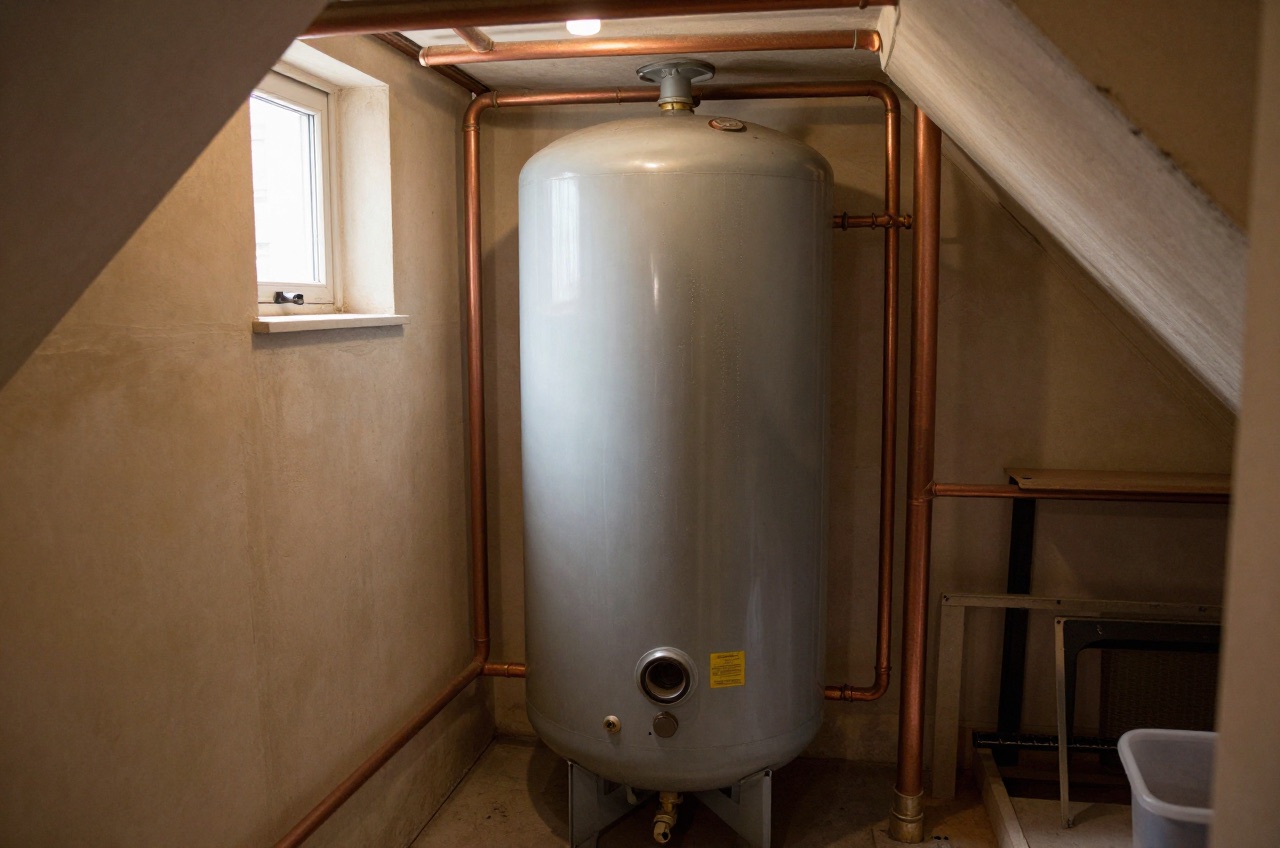
If your home has a system or regular boiler, it stores hot water in a cylinder. The type of cylinder, vented or unvented, determines the water pressure at your showers and taps, the space the system occupies, and the complexity of installation. Most homes built since the late 1990s use unvented cylinders; older properties may have a vented (gravity-fed) setup that is increasingly worth upgrading.
Vented (Open) Cylinders
A vented cylinder is fed by a cold water storage tank, usually in the loft. The tank is open to atmosphere at the top, hence “vented” or “open-vented”. Hot water flows from the cylinder by gravity, typically at 0.3–1.0 bar, depending on the height of the tank above the outlet.
How it works: Cold water from the loft tank fills the cylinder. The boiler heats the water via a coil (indirect) or by immersion heater (direct). Hot water rises to the top of the cylinder and is drawn off as needed; cold replaces it from the loft tank.
Advantages:
- Simple, low-cost to install and maintain
- No risk of dangerous over-pressure (the open vent pipe is the safety device)
- Works at low mains pressures, the system is independent of incoming pressure
Disadvantages:
- Low water pressure at taps and showers, gravity-only
- Requires a cold water tank in the loft (frost risk; takes up space)
- Poor shower performance without a pump
- Loft tank must be cleaned periodically; open systems can be contaminated
Typical cost (2026): £400–£1,200 supplied and fitted for a standard indirect vented cylinder (120–210 litres)
Unvented (Pressurised) Cylinders
An unvented cylinder connects directly to the mains cold water supply. Water is stored under mains pressure (typically 1.5–4.0 bar), which means hot water is delivered at the same pressure as your cold mains, enough for a good power shower without a pump.
How it works: Mains-pressure cold water enters the cylinder through an inlet group (containing a pressure reducing valve, expansion valve, check valve, and expansion vessel or bubble-top air gap). The boiler heats water via a coil; an immersion heater provides backup. Safety is maintained by a temperature/pressure relief valve (T&P valve) and an expansion vessel to accommodate the thermal expansion of the water.
Advantages:
- Mains-pressure hot water, powerful showers, good flow at multiple outlets simultaneously
- No loft tank required, frees up loft space and eliminates frost risk
- Better for modern homes with multiple bathrooms
- Works with solar thermal or heat pump pre-heat coils
Disadvantages:
- More complex installation, requires a G3 Building Regulations notification (see below)
- Higher initial cost
- Requires periodic maintenance: annual check of the T&P valve and expansion vessel
- If mains pressure is below ~1.0 bar dynamic, performance will be limited
Typical cost (2026): £800–£2,500 supplied and fitted, depending on cylinder size and whether a new boiler or new pipework is involved
Cost Comparison
| Item | Vented Cylinder | Unvented Cylinder |
|---|---|---|
| 150-litre cylinder supply | £200–£500 | £500–£1,200 |
| 210-litre cylinder supply | £280–£650 | £650–£1,600 |
| Installation labour | £200–£400 | £350–£600 |
| Building Regs notification (G3) | Not required | £50–£150 (if via competent person scheme) |
| Loft tank removal (if converting) | - | £100–£300 |
| Total fitted (150 L) | £400–£900 | £850–£1,800 |
| Total fitted (210 L) | £500–£1,200 | £1,050–£2,500 |
Building Regulations: The G3 Requirement
Unvented hot water storage systems with a storage capacity above 15 litres are controlled under Building Regulations Approved Document G, Section 3 (G3). This requirement exists because a pressurised cylinder that overheats and fails can release large quantities of scalding steam, potentially with explosive force if safety devices are absent or faulty.
To comply with G3, the work must be either:
- Carried out by a competent person registered with a scheme authorised by government (APHC, BESCA, Certsure, HETAS or NAPIT) who can self-certify, or1
- Notified to the local building control authority before work begins, who will inspect and issue a completion certificate
An unregistered plumber cannot legally self-certify G3 work. Always ask your installer for evidence of their G3 competency registration before they start. Failure to comply can cause problems at the point of sale, a buyer’s solicitor will ask for the G3 certificate.
What Size Cylinder Do You Need?
Cylinder sizing is based on peak daily hot water demand. As a rough guide:
| Household Size | Recommended Cylinder Capacity |
|---|---|
| 1–2 people | 100–150 litres |
| 3–4 people | 150–210 litres |
| 5–6 people | 210–300 litres |
| 6+ people / 3+ bathrooms | 300–400 litres |
These assume a single reheat per day from the boiler. If you have solar thermal, size up by 50–100 litres to store the solar gain. If the cylinder is to be heated primarily by an immersion heater on an Economy 7 tariff, size generously, you need enough stored capacity for the full day without mid-day reheating at peak rate.
Vented or Unvented: Which Should You Choose?
Choose an unvented cylinder if:
- You want good shower pressure without a separate pump
- You have two or more bathrooms in regular simultaneous use
- You are removing the loft cold water tank as part of a wider upgrade
- Your incoming mains dynamic pressure is reliably above 1.0 bar (ideally 1.5–3.0 bar)
Stick with vented if:
- Budget is limited and the existing gravity system is working well
- Your mains pressure is consistently low (under 1.0 bar dynamic), an unvented cylinder will underperform
- The property is a listed building or conservation area where loft alterations are restricted
- The installation is a straightforward like-for-like cylinder replacement with no other work planned
Maintenance
Vented cylinders need very little maintenance, check the loft tank annually for corrosion, debris, or signs of contamination.
Unvented cylinders require annual servicing: the T&P valve must be manually lifted and tested (it should release water freely and reseal cleanly), the expansion vessel pressure should be checked and re-charged if below specification (usually 3.0 bar on the gas side), and the PRV setting should be verified. Servicing typically costs £60–£120 from a qualified engineer. Neglecting unvented cylinder maintenance is both a safety risk and a common cause of premature cylinder failure.
Most reputable cylinder manufacturers (such as Gledhill, Range, Albion, Heatrae Sadia, and Joule) warrant their unvented cylinders for 25 years on the cylinder itself, provided annual service records are maintained.
The rules in this note are those that apply in England. Scotland, Wales and Northern Ireland have their own building standards and permitted development rights.
References (1)
Figures in this note were checked against the sources below on 14 September 2026. Superscript numbers in the text point to them. Every source the site cites, by topic.
- 1technicalvery strongMinistry of Housing, Communities and Local Government.RN-SAMO3MThe official list of competent person schemes whose members can self-certify certain building work instead of getting building regulations approval, published 4 April 2013 and last updated 12 March 2018. Named schemes with contact numbers include ATTMA, APHC, Assure Certification, Blue Flame Certification, the British Board of Agrement, BESCA, Capita Gas Registration and Ancillary Services trading as Gas Safe Register, CIGA, Certass, Certsure LLP trading as NICEIC, the Elmhurst Airtightness Scheme, Fensa Limited, HETAS Limited, NAPIT Registration Limited, the National Federation of Roofing Contractors trading as CompetentRoofer, and OFTEC. Two footnotes matter: the Gas Safe Register is not technically a competent person scheme although in practice its installers carry the same building regulations responsibilities, and Benchmark Certification Limited ceased to operate as a competent person scheme on 10 February 2017, becoming part of NAPIT Registration Limited that day. Installers joining an electrical scheme are added to the single electrical competent person register.
-
Competent person scheme: current schemes and how schemes are authorised, Ministry of Housing, Communities and Local Government (GOV.UK), accessed 10 September 2026. gov.uk