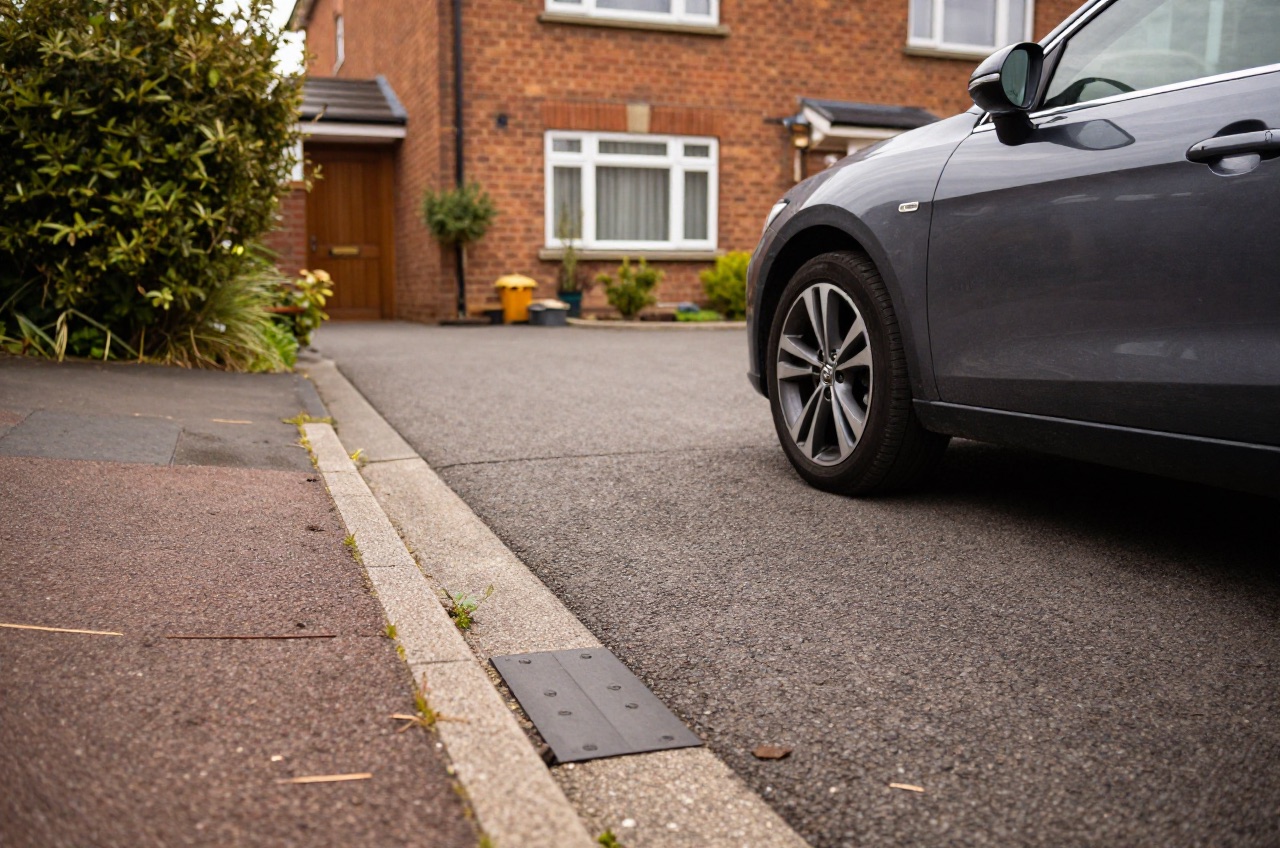
A dropped kerb, formally known as a vehicular crossover, allows vehicles to cross from the public highway onto a private driveway without damaging the kerb or footpath. If you want off-street parking and your property currently has a standard raised kerb at the boundary, you will need one. But you cannot simply hire a contractor and have it done: the highway is public land, and all dropped kerb work requires formal consent from your local highway authority.
How Much Does a Dropped Kerb Cost?
Costs vary significantly depending on your highway authority, the material of the footpath, how wide the crossover needs to be, and whether utility services run beneath the footpath.
| Cost element | Typical range |
|---|---|
| Highway authority application fee | £177–£2991 |
| Constructing the crossover, by the council or an approved contractor | £1,575–£3,050 |
| Reinstatement of utility covers/services (if affected) | £200–£800 |
| Private driveway preparation (separate to crossover) | £500–£3,000+ |
The application fee is charged separately from the construction, so a straightforward job with no utilities to move comes to roughly £1,750 to £3,350 all in. Councils that do the work themselves and councils that let you use an approved contractor publish figures in the same range, which is why they are one line here rather than two: where the difference shows up is not the arrangement but the place, and London sits at the top of it either way.
In London, dropped kerb work is nearly always carried out directly by the borough’s highway team or an approved contractor on their framework, costs tend to be at the higher end, towards £3,000 total. In many other areas, you apply to the council for permission, then hire your own approved contractor to carry out the work to their specification.
A typical straightforward installation, standard concrete footpath, no utilities, 3–4 metre crossover width, starts at about £1,575 in most of England outside London: that is Manchester’s published minimum for a 3 metre crossing, and it is the lowest figure any highway authority we checked puts in writing.
Do You Need Planning Permission?
In most cases, you do not need planning permission for the dropped kerb itself. The work falls under permitted development rights. However, you do need:
- Highway authority consent, always required. The council owns the footpath and carriageway, so any work on it legally requires their permission.
- Planning permission if you are creating a new driveway on a front garden larger than 5m², unless the surface is permeable (gravel, permeable block paving, etc.). This requirement comes from changes made to the General Permitted Development Order in 2008 to combat surface water flooding.2
Check with your local planning authority if you are unsure. Conservation areas and listed buildings may have additional restrictions.
How to Apply for a Dropped Kerb
The process differs slightly by council but follows a broadly similar pattern across England and Wales:
Step 1: Check feasibility Before applying, assess whether a crossover is practical. Highway authorities will typically refuse consent where:
- There is a traffic light or pedestrian crossing nearby (usually within 10–15 metres)
- The road is classified (A or B road) in some circumstances
- The sight lines from your proposed access are insufficient for safe exit
- Trees, lamp posts, bus stops, or utility apparatus cannot be relocated
Step 2: Submit an application Most councils now have an online application portal. You will typically need to provide:
- The address and property details
- A site plan or map showing the proposed crossover location
- Details of the driveway surface material (relevant for planning purposes)
- Payment of the application fee
Step 3: Survey and approval A highways officer will inspect the site, check utility records, and issue a formal approval with conditions. This typically takes 4–12 weeks; some authorities are slower.
Step 4: The work Depending on your council’s policy, you will either:
- Pay the council to carry out the work using their own team or approved contractor, or
- Hire a council-approved private contractor, who must work to the highway authority’s specification and standards
Never instruct any contractor to start work on the footpath or carriageway before written approval is received. Be precise about what the Highways Act 1980 does here, because it is usually stated too loosely. Section 184 does not create an offence of building a crossing without consent. What it does is give the highway authority the power to specify the works, to execute them itself and to recover the expenses reasonably incurred from the owner or occupier, which is how you end up paying to have your own unauthorised crossing taken out and rebuilt.3 The offence section 184 does create is using a footway or verge as a crossing in contravention of the conditions imposed, punishable by a fine up to level 3 on the standard scale. Damaging the highway itself is dealt with elsewhere in the Act.
Step 5: Reinstatement bond (sometimes required) Some authorities require a bond or deposit to ensure the work is completed properly. This is returned once the work has been inspected and approved.
Scotland, Wales, and Northern Ireland
The process is broadly similar across the UK, but administered by local councils (Scotland), local authorities (Wales), or the Roads Service/Department for Infrastructure (Northern Ireland). In Scotland, the Roads (Scotland) Act 1984 applies; in Wales, the Highways Act 1980 still applies with some Welsh-specific guidance.
What Makes a Good Dropped Kerb?
The specification for a vehicular crossover varies by highway authority, but common requirements include:
- Crossover width: Typically a minimum of 2.4 metres (sufficient for one car), with a maximum that varies by authority, often 4.8 metres for a double crossover
- Gradient: The crossover must not create a trip hazard for pedestrians; typically a maximum gradient of 1:10–1:15 is specified
- Material: Normally high-strength concrete kerb units to BS EN 1340, or in conservation areas, reclaimed granite sets to match existing
- Drainage: The new surface must not drain onto the public footpath or carriageway
Common Reasons for Refusal
- Insufficient sight lines for vehicles exiting safely
- The crossover would remove the last remaining on-street parking in a congested street
- Protected trees within root protection areas of the footpath
- Active gas, electric, or telecoms ducts that cannot be moved economically
- The frontage is too narrow to provide a usable parking space
If your application is refused, ask the highway authority for the specific reasons in writing. In some cases, minor amendments to the location or width can resolve the issue. Formal appeal processes exist but are rarely used for crossovers.
Driveway Considerations Beyond the Kerb
The dropped kerb is the highway boundary. Once vehicles cross onto your property, you are responsible for the surface. A functional 2-car parking space typically needs:
- Dimensions: Minimum 4.8m × 2.4m per car space (5.5m × 2.5m is more comfortable)
- Surface: Must be permeable if the area exceeds 5m² (see planning rules above), or surface water must drain to a lawn or border, not to the highway
- Gradient: Flat or sloping away from the property is ideal; steep gradients can cause vehicles to ground on the crossover
Budget £50–£150/m² for block paving, £20–£50/m² for gravel, or £80–£180/m² for resin-bound surfacing.4 (2024 price, brought to 2026)
References (4)
Figures in this note were checked against the sources below on 13 September 2026. Superscript numbers in the text point to them. Every source the site cites, by topic.
- 1coststrong locallyBedford Borough Council, a government page.RN-1JFZP1A price, true at 2026-09. Bedford Borough Council, Apply for a dropped kerb or vehicle crossover. Held in the cost register as a price source; the passage quoted against it reads: From 1 January 2026 you will need to pay £177.25 for a site visit and estimate of the cost of works.
- 2technicalvery strongThe National Archives (legislation.gov.uk), legislation.RN-4C9X4BClass F permits the provision within the curtilage of a dwellinghouse of a hard surface for any purpose incidental to the enjoyment of the dwellinghouse, or its replacement in whole or in part. Condition F.2 applies where the hard surface would lie between a wall forming the principal elevation and a highway and its area would exceed 5 square metres: the surface must then be made of porous materials, or provision made to direct run-off water to a permeable or porous area or surface within the curtilage.
- 3technicalvery strongThe National Archives (legislation.gov.uk), UK Public General Act 1980 c.66, legislation.RN-H1OGTFThe statutory basis for a dropped kerb application, which is a highways matter and separate from planning permission. Section 184(1) lets the highway authority serve notice on the owner or occupier where the footway or verge is being used as a crossing, proposing to execute works for the construction of a vehicle crossing or to impose conditions on its use. Section 184(6) applies Schedule 14 to objections against that notice. Section 184(7) lets the authority recover the expenses reasonably incurred in carrying out the works from the owner or occupier of the premises, which is why the householder pays for the crossing even when the council builds it. Section 184(17) makes it an offence to use a footway as a crossing in contravention of conditions imposed, with a fine not exceeding level 3 on the standard scale.
- 4costvery strongValuation Office Agency, a government page.RN-RSLGJ5A price, true at 2024-04, brought forward on the Construction Output Price Index. The Valuation Office Agency's Rating Cost Guide 2026: estimated replacement costs per square metre for building types, used by the VOA for contractor's basis rating valuations. Each code gives a construction description, the unit of measurement and an ERC at a UK mean location factor of 1.00. It is official, free and unusually comprehensive, and it is a replacement cost for rating rather than a market tender price, which is why the guidance notes matter as much as the table.
-
Apply for a dropped kerb or vehicle crossover, Bedford Borough Council, accessed 21 September 2026. Priced at 2026-09, so no calibration is needed. bedford.gov.uk
-
The Town and Country Planning (General Permitted Development) (England) Order 2015, Schedule 2, Part 1, Class F, legislation.gov.uk, accessed 13 September 2026. legislation.gov.uk
-
Highways Act 1980, section 184: Vehicle crossings over footways and verges, legislation.gov.uk, accessed 14 September 2026. legislation.gov.uk
-
Rating Cost Guide 2026, Valuation Office Agency, accessed 15 September 2026. Priced at 2024-04; brought to 2026 on the Construction Output Price Index, housing repair and maintenance (Great Britain), published by Office for National Statistics, a factor of 1.0239. assets.publishing.service.gov.uk