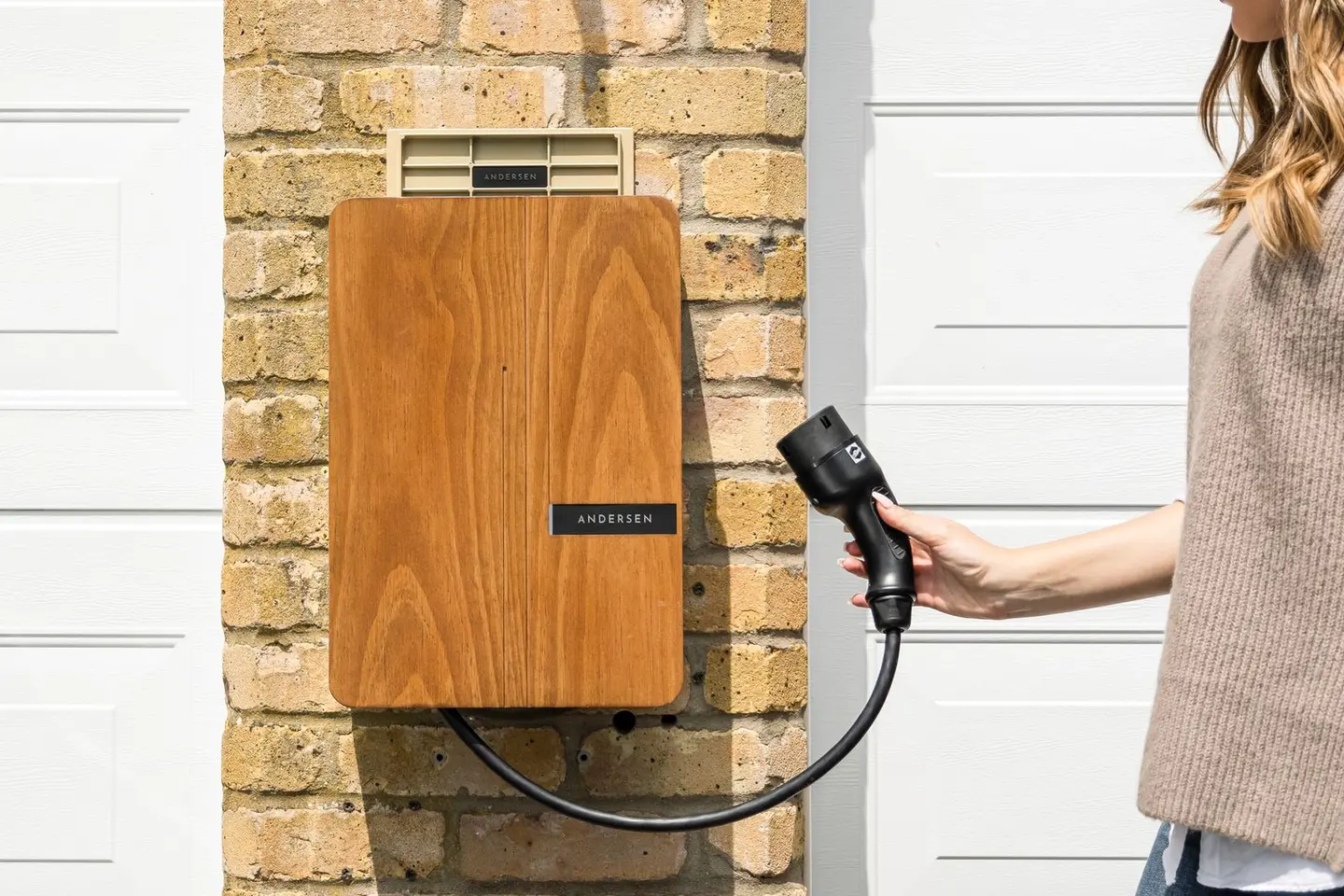
Installing a dedicated home EV charger is the single most cost-effective upgrade for any electric vehicle owner. Charging from a standard 13 A socket (a “granny charger”) delivers around 2.3 kW, a full charge from empty on a 77 kWh battery takes over 30 hours. A dedicated 7 kW wall box cuts that to around 11 hours, and a 22 kW three-phase unit (where the supply allows) to just over 3 hours.
For most homeowners with a standard single-phase 100 A supply, a 7.4 kW smart charger is the right choice: fast enough for overnight charging of any current EV, compatible with all standard domestic supplies, and qualifies for smart-tariff integration that can dramatically cut running costs.
Home EV Charger Costs (2026)
| Item | Typical Cost |
|---|---|
| 7 kW smart charger unit (supply only) | £350–£700 |
| Standard installation (within 10 m of consumer unit, existing cable route) | £400–£600 |
| Long cable run (10–25 m, new trunking or armoured cable) | £600–£900 |
| Three-phase 22 kW charger (if supply available) | £900–£1,800 installed |
| Consumer unit upgrade (if required) | £500–£1,200 extra |
| Typical total for a straightforward 7 kW install | £750–£1,200 |
Prices vary by region; London and South East labour rates typically run 15–25% above the national average. Always get at least two quotes from OZEV-approved installers.
Government Grants in 2026
EV Chargepoint Grant (Flats and Renters)
The Electric Vehicle Homecharge Scheme (EVHS) for homeowners with off-street parking closed to new applications on 1 April 2022.1 It has not been replaced with an equivalent grant for homeowners.
However, the EV Chargepoint Grant remains open for:
- People living in flats (owner-occupiers or renters in purpose-built or converted flats)
- Renters in houses (with landlord permission)
- Landlords of residential properties (separate commercial-rate grant)
The grant covers up to £500 (or 75% of the cost of buying and installing the socket, whichever is lower) per chargepoint for eligible flat-dwellers and renters.2 Applications go through your OZEV-approved installer. The grant cannot be claimed if you have previously received an EVHS grant for the same property.3
Workplace and Public Grants
For businesses and public locations, the Workplace Charging Scheme (WCS) provides up to £350 per socket (maximum 40 sockets across all sites).4 Not applicable to domestic installations.
Choosing the Right Charger
Tethered vs Untethered
- Tethered chargers have a cable permanently attached. Convenient, no cable to store, but if the cable is damaged you replace the whole unit.
- Untethered (socketed) chargers have a Type 2 socket. You use your own cable, which is more flexible for multi-EV households but means managing the cable.
Smart vs Dumb
All chargers installed under the EV Chargepoint Grant must be smart chargers that meet the UK’s EV smart charging requirements, set by the Electric Vehicles (Smart Charge Points) Regulations 2021 and in force since 30 June 2022. Smart chargers:5
- Default to pre-set off-peak charging hours, with a randomised delay of up to 600 seconds so that chargers do not all start at once
- Can be scheduled and monitored via an app
- Are compatible with smart energy tariffs (Octopus Intelligent, OVO Charge Anytime, etc.)
Smart tariffs for EV charging typically offer rates of 7–12 p/kWh overnight, versus the standard unit rate of around 24–28 p/kWh.6 For a typical EV doing 10,000 miles/year, this can save £400–£700 annually.
Output Rating
| Supply Type | Max Charger Output | Full Charge Time (77 kWh) |
|---|---|---|
| 13 A socket | 2.3 kW | ~33 hours |
| 7.4 kW single-phase | 7.4 kW | ~10–11 hours |
| 22 kW three-phase | 22 kW | ~3.5 hours |
Most UK homes have single-phase 230 V supplies. Three-phase is common in newer large homes and rural properties on agricultural supplies, but you must verify with your Distribution Network Operator (DNO) before assuming availability.
Installation Rules and Permitted Development
Permitted Development
In England, installing an EV charger on a house (including the cable route and wall box) is generally permitted development under Class D of Part 2 of the Town and Country Planning (General Permitted Development) (England) Order 2015, provided:
- The wall-mounted outlet is within an area lawfully used for off-street parking
- The outlet and its casing are no greater than 0.2 m³
- It is not within a site designated as a scheduled monument
- It is not within the curtilage of a listed building
Class D also imposes a condition: once the outlet is no longer needed for charging it must be removed and the wall reinstated as far as reasonably practicable. The old restriction on an outlet facing a highway was removed on 29 May 2025.7
Listed buildings and properties in Conservation Areas may need listed building consent or planning permission. Always check with your local planning authority if in any doubt.
Building Regulations
Installing an EV charger on its own new circuit is notifiable under Part P (Electrical Safety) of the Building Regulations in England and Wales, and under the equivalent Scottish Building Standards.8 This means the work must either be carried out by a registered competent person who self-certifies it, or be notified to your local building control before it starts. OZEV-approved installers handle this automatically; if you use a non-approved electrician, you will need to apply for a building regulations completion certificate yourself.
The installation must also comply with BS 7671, the IET Wiring Regulations. Each charging point must be protected by its own RCD of at least Type A with a residual operating current not exceeding 30 mA, and on most units that device sits inside the charging equipment itself.9
Consumer Unit and Meter
A 7 kW charger draws around 32 A. If your consumer unit does not have a free 32 A MCB slot, or if your meter tails are already heavily loaded, your installer may recommend a consumer unit upgrade or a dedicated supply from the meter tails (a “henley block” arrangement). Most modern homes (post-2000) will accommodate a 32 A circuit without issues. Pre-1980s homes with 60 A main fuses may need a DNO supply upgrade, contact your DNO for a quote (typically free if upgrading to 100 A).
What to Check Before Booking
- Do you have a private off-street parking space? (Required for home installation)
- Is your consumer unit modern enough to accept a 32 A MCB? Ask your installer to assess.
- Do you need a cable run longer than 10 m? Get this specified in the quote.
- Are you eligible for the EV Chargepoint Grant? Check at gov.uk/apply-for-ev-chargepoint-grant.
- Does your energy tariff offer smart EV charging rates? Worth switching before installation.
Finding an Installer
Only use an OZEV-approved installer to ensure compliance and grant eligibility. Search the approved installer list at gov.uk. Installers should be registered with NICEIC, NAPIT, or the ECA, and hold the IET’s EV Charging Installations qualification (2913.12) or equivalent. Ask for a written quote including the cable route, protection devices, and make/model of charger.
References (9)
Figures in this note were checked against the sources below on 9 September 2026. Superscript numbers in the text point to them. Every source the site cites, by topic.
- 1technicalvery strongDepartment for Transport.RN-ZSXU2FOfficial DfT statistics that date the scheme change: since 1 April 2022 the Electric Vehicle Homecharge Scheme (EVHS) is no longer open to new applicants and has been replaced with the EV chargepoint grant. The EVHS provided grant funding for up to £350 of the cost of installing electric vehicle charging devices at domestic properties across the UK, and installed 340,222 domestic charging devices from September 2014 with a total grant value of £140.8 million. The EVHS remained open to resubmissions until 31 March 2023. Grant levels quoted for the replacement EV chargepoint grant in this edition: up to £350 per socket for landlords, up to £30,000 for residential car park infrastructure, up to £350 for renters and flat owners, and up to £350 per socket for a cross-pavement charging solution. Useful for correcting notes that date the EVHS closure to 2023.
- 2technicalvery strongGOV.UK, guidance.RN-3GK0B9The current household EV chargepoint grant page. States that you can get 75% off the cost of buying and installing a socket, up to a maximum of £500. Points landlords to a separate application route. The linked eligibility page requires that you live in a flat you own (including shared ownership) or rent a residential property; landlords cannot use this route, and you cannot claim if you rent accommodation where the landlord or homeowner lives. The home must be in the UK with a parking space that is off-street, private and clearly defined, accessible to you at all times, and that you own or have a legal right to. You cannot apply where a chargepoint or charging infrastructure is required by law. The vehicle must be on the list of OZEV-approved electric vehicles, evidenced by registration, a lease of six months or more, work vehicle use of six months or more, or an active order.
- 3costvery strongOffice for Zero Emission Vehicles, guidance.RN-9EETD9A price, true at 2026-04. Electric vehicle chargepoint grants, government guidance cited for the figures and rules it sets out
- 4technicalvery strongGOV.UK, guidance.RN-B3N31OApplicant guidance for the Workplace Charging Scheme. States a maximum grant value of £350 per socket, covering up to 75% of the total purchase and installation cost of EV chargepoints inclusive of VAT, and a combined total of 40 sockets across all sites per applicant; applicants claiming fewer than 40 initially may submit further applications up to that limit. Also sets out the minimal financial assistance limit of £315,000 for an enterprise over any period of three fiscal years. As at September 2026 this page still shows £350 while the GOV.UK chargepoint grants collection page shows £500 per socket under the April 2026 rates.
- 5technicalvery strongThe National Archives (legislation.gov.uk), legislation.RN-3G6RWDSI 2021/1467, in force 30 June 2022, extending to England and Wales and Scotland. Regulation 10 requires a relevant charge point to incorporate pre-set default charging hours outside peak hours, with the owner able to accept, remove or change them on first use and at any time afterwards; peak hours are defined in regulation 10(4) as 8am to 11am and 4pm to 10pm on weekdays. The requirement is disapplied where the charge point is sold with a demand side response (DSR) agreement and configured to comply with it. Regulation 11 requires the charge point to operate at each relevant time with a randomised delay of up to 600 seconds, determined to the nearest second, which the owner can cancel; it must also be capable of a randomised delay of up to 1800 seconds, remotely adjustable over a communications network. A relevant time is the point at which electricity would start flowing or the rate of flow would change. Other regulations cover smart functionality (5), supplier interoperability (6), failsafe on loss of communications (7), safety (8), measuring systems (9) and security (Schedule 1).
- 6technicalvery strongOfgem.RN-YYE8U2The live source for any running-cost sum in a heating note. For 1 October to 31 December 2026 the direct debit cap is 26.32p per kWh for electricity with a 54.83p daily standing charge, and 7.97p per kWh for gas with a 29.68p daily standing charge, giving a typical annual dual fuel bill of £1,723, a 4% rise on the previous period. Ofgem states these are the average unit rate and standing charge for direct debit customers in England, Scotland and Wales; gas prices include 5% VAT while electricity carried no VAT in this period. The cap is reset every three months, so any note quoting a pence-per-kWh figure should be dated against this page.
- 7technicalvery strongThe National Archives (legislation.gov.uk), UK Statutory Instrument 2015/596, legislation.RN-38KO9RClass A of Part 2 is the fence, gate and wall rule cited whenever a note discusses fence height. It permits the erection, construction, maintenance, improvement or alteration of a gate, fence, wall or other means of enclosure up to 1 metre above ground level where adjacent to a highway used by vehicular traffic (or the footpath of such a highway), and up to 2 metres above ground level elsewhere. Where an existing enclosure is maintained, improved or altered, the resulting height must not exceed its former height or the applicable limit, whichever is the greater. Class A is withdrawn within the curtilage of a listed building, or for a gate, fence, wall or other means of enclosure surrounding a listed building. Class B permits forming, laying out and constructing a means of access to a highway that is not a trunk road or classified road where required in connection with other permitted development, and Class C permits exterior painting other than for advertisement, announcement or direction.
- 8technicalvery strongMinistry of Housing, Communities and Local Government.RN-JYJ3I5The document that decides what electrical work a homeowner may legally do themselves, and the exact list of notifiable jobs. Regulation 12(6A), reproduced at paragraph 2.5, makes only three things notifiable: the installation of a new circuit, the replacement of a consumer unit, and any addition or alteration to existing circuits in a special location. Regulation 12(9) defines special location as, in a room containing a bath or shower, the zone extending vertically from finished floor level to 2.25 metres (or the shower head position if higher) and horizontally 600mm from the edge of the bath tub or shower tray. Paragraph 2.7 states that all other electrical installation work is not notifiable, namely additions and alterations to existing installations outside special locations, and replacements, repairs and maintenance anywhere. Paragraph 2.8 gives worked examples: a built-in cooker is not notifiable unless a new cooker circuit is needed, and connecting an electric gate or garage door to an existing isolator is not notifiable but running a new circuit from the consumer unit to that isolator is. Paragraph 2.2 confirms Part P reaches outdoor work including fixed garden lighting, pond pumps and outbuildings such as sheds, detached garages and domestic greenhouses. Notifiable work must be certified by self-certification by a registered competent person, third-party certification, or a building control body (paragraph 3.1), with the compliance certificate issued within 30 days (paragraph 3.4). Note that Approved Document P is a source of guidance rather than a ban: non-notifiable work still has to comply with BS 7671.
- 9technicalstrongInstitution of Engineering and Technology, guidance.RN-GZ3QEKIET FAQ page on Section 722 of BS 7671. States that Regulation 722.531.2.101 requires the charging point to be RCD protected by its own RCD of at least a Type A, having a residual operating current not exceeding 30 mA, and that the requirement attaches to the charging point rather than necessarily the whole final circuit. Notes that in practice the RCD will usually be installed within the charging equipment and advises verifying this with the equipment supplier. Refers on to the IET Code of Practice for Electric Vehicle Charging Equipment Installation. Useful for correcting notes that claim a Type B or Type F RCD is required for domestic EV chargers.
-
Electric vehicle charging device grant scheme statistics: July 2025, Department for Transport, accessed 9 September 2026. gov.uk
-
Electric vehicle chargepoint grant for renters or flat owners: What you can get, GOV.UK, accessed 9 September 2026. gov.uk
-
Electric vehicle chargepoint grants, Office for Zero Emission Vehicles, accessed 15 September 2026. Priced at 2026-04, so no calibration is needed. gov.uk
-
Workplace Charging Scheme: guidance for applicants, GOV.UK, accessed 9 September 2026. gov.uk
-
The Electric Vehicles (Smart Charge Points) Regulations 2021, legislation.gov.uk, accessed 9 September 2026. legislation.gov.uk
-
Energy price cap unit rates and standing charges, Ofgem, accessed 9 September 2026. ofgem.gov.uk
-
The Town and Country Planning (General Permitted Development) (England) Order 2015, Schedule 2, Part 2, legislation.gov.uk, accessed 9 September 2026. legislation.gov.uk
-
Approved Document P, Electrical safety, Dwellings, 2013 edition, Ministry of Housing, Communities and Local Government, accessed 9 September 2026. assets.publishing.service.gov.uk
-
BS 7671 FAQs: Electric vehicle charging installations, Institution of Engineering and Technology, accessed 9 September 2026. electrical.theiet.org