Underlay is the least glamorous part of any flooring project and the most frequently skimped on. It is also one of the decisions that most affects how the floor performs in daily use, how warm it feels, how much sound it absorbs, how well it lasts, and whether the manufacturer’s warranty remains valid. Using the wrong underlay, or none at all, is a common and costly mistake.
This guide covers every mainstream underlay type available in the UK, the key specs to look for, and a clear guide to which product suits which floor covering and subfloor.
Why Underlay Matters
Underlay serves several functions simultaneously:
- Thermal insulation: adds resistance (measured in tog) to heat loss through the floor, reducing heating costs
- Sound insulation: absorbs impact noise (footsteps, dropped items) and reduces airborne sound transmission between floors
- Comfort underfoot: cushioning that makes a hard floor feel warmer and softer
- Subfloor levelling: compensates for minor imperfections in the substrate
- Moisture barrier: in some products, a vapour check layer prevents damp from reaching the floor covering
- Protection: prevents the floor finish rubbing against a rough concrete or timber subfloor
Underlay Types
PU Foam (Polyurethane Foam)
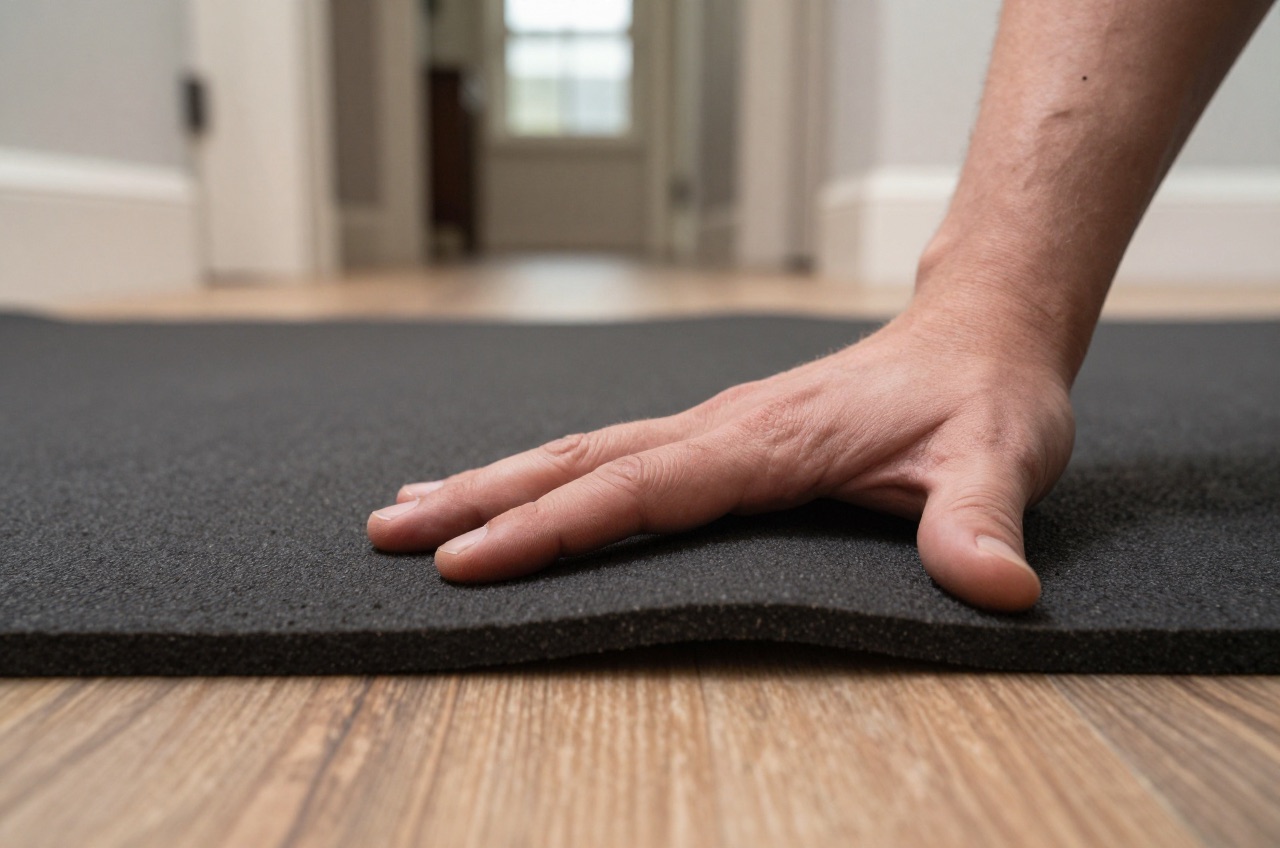
The most common and affordable underlay in the UK. Made from recycled foam (often reconstituted from old mattresses or furniture), PU foam is sold in rolls and is suitable under most carpet types. It is not suitable under laminate or wood.
Thickness typically ranges from 7 mm to 12 mm. Higher-density foam (measured in kg/m³) holds its shape better under heavy furniture and in high-traffic corridors. Look for a density of at least 130 kg/m³ for a hallway or living room.
Cost: £2–£5/m².1
Crumb Rubber (Cloud 9 style)
A waffle-profile crumb rubber underlay is the premium choice for carpet. The waffle cells compress individually under load, providing excellent cushioning and allowing air circulation. It outperforms foam in both comfort and longevity and is particularly suited to high-quality wool carpets where a firm, stable base is preferred.
Thickness: 8–10 mm. Some products include an integral damp-proof layer.
Cost: £4–£8/m².
Felt Underlay
Wool felt is the traditional underlay and still preferred by some carpet manufacturers for high-end Axminster and Wilton carpets. It is firm and flat, which suits patterned carpets where a bouncy underlay can distort the pattern at joins. Increasingly rare and expensive.
Cost: £5–£10/m².
Foam-Backed Laminate Underlay
Thin (2–5 mm) polyethylene or IXPE foam rolls sold specifically for laminate and engineered wood floating floors. Often comes with a silver-foil damp-proof membrane bonded to the underside. The foam provides a small amount of cushion and helps even out minor subfloor ripples (typically up to 2–3 mm).
This is not interchangeable with thicker carpet underlay, most laminate and engineered wood manufacturers specify a maximum underlay thickness (often 3 mm) and require a combined floor-plus-underlay deflection limit. Exceeding this can cause the locking joints to crack.
Cost: £2–£4/m².2
Cork Underlay
Natural cork sheet (typically 2–6 mm) is an eco-friendly option with good acoustic and thermal properties. It is dimensionally stable, resistant to compression set, and compatible with underfloor heating. Suitable under engineered wood, laminate, and LVT.
Cost: £4–£9/m².
Acoustic Underlay
Heavyweight (typically 5–10 mm) underlays designed specifically to meet the requirements of Building Regulations Part E (resistance to sound). These are used in flats and conversions where impact sound transmission between floors must be controlled.3
Products are typically a composite: rubber crumb or recycled foam bonded to a mineral or loaded vinyl layer. They are rated by ΔLw (impact sound reduction, dB) and Rw (airborne sound reduction). For Part E compliance in new builds and material change-of-use conversions, the overall floor construction (including the underlay) must achieve ≥45 dB Rw and ΔLw ≥17 dB, check that your chosen system has a UKAS-accredited test certificate, not just manufacturer claims.3
Cost: £6–£12/m².
Screed-Over and UFH-Compatible Underlay
For floating floors over wet underfloor heating systems, the combined thermal resistance of the underlay and floor covering must be low enough to allow adequate heat transfer. Most UFH manufacturers specify a maximum combined tog value of 1.5–2.5 tog.
Thin IXPE or cork underlays (2–3 mm) are generally compatible. Thick PU foam and waffle rubber are not, they insulate the floor so effectively that the screed overheats trying to push heat through, reducing efficiency and risking damage to the heating pipes.
Always check the UFH manufacturer’s specification and the floor covering manufacturer’s compatibility list before choosing underlay for a heated floor.
Underlay Specification Guide
| Floor Covering | Subfloor | Recommended Underlay | Thickness | Cost (£/m²) |
|---|---|---|---|---|
| Carpet (standard) | Concrete or timber | PU foam or crumb rubber | 8–11 mm | £2–£6 |
| Carpet (wool/high-end) | Timber | Felt or crumb rubber | 8–10 mm | £4–£10 |
| Laminate (floating) | Concrete | IXPE with DPM | 3–5 mm | £2–£4 |
| Laminate (floating) | Timber | IXPE or cork | 3–5 mm | £2–£5 |
| Engineered wood (floating) | Concrete | Cork or IXPE with DPM | 3–5 mm | £3–£6 |
| LVT / click vinyl | Any | LVT-specific foam or cork | 1.5–3 mm | £2–£5 |
| Any floor over UFH | Screed | UFH-rated ≤1.5 tog | 2–3 mm | £3–£7 |
| Flat conversion (Part E) | Timber joists | Acoustic composite | 5–10 mm | £6–£12 |
Tog Rating and Thermal Resistance
The tog is a unit of thermal resistance. A higher tog means more insulation, good under carpet on a cold concrete floor, but problematic over underfloor heating.
Typical tog values:
- Thin IXPE underlay (3 mm): 0.3–0.5 tog
- Cork underlay (3 mm): 0.6–0.9 tog
- PU foam (10 mm): 1.8–2.5 tog
- Crumb rubber waffle (10 mm): 2.0–3.0 tog
The floor covering itself also has a tog value (engineered oak at 15 mm: approximately 1.0–1.2 tog; carpet: 1.5–3.5 tog depending on pile). The sum of floor covering plus underlay must stay within the UFH specification.
Common Mistakes
Using carpet underlay under laminate. The excessive thickness and compressibility can cause click joints to flex and fail. The floor will develop creaks and the locking tongues can chip.
No DPM under concrete. Concrete slabs often pass moisture vapour upward, especially in older properties. Without a polythene DPM (minimum 250 micron, joints overlapped and taped) or an underlay with an integral vapour barrier, moisture can delaminate laminate and buckle engineered wood.
Buying on price alone. A 5p/m² saving on underlay that fails in two years is poor economy. The labour cost to relay a floor dwarfs the cost of a better underlay.
Ignoring warranty requirements. Most reputable laminate and engineered wood manufacturers publish an approved underlay list or specification. Fitting a non-compliant underlay typically voids the warranty. Check the technical data sheet before buying.
What to Expect from Installation
Underlay is typically laid by the flooring fitter as part of the installation. For carpet, it should be stapled at 150 mm centres on timber floors and taped on concrete. For laminate and wood, sheets should be butted (not overlapped) and any damp-proof layer taped at joints. In all cases, underlay must not run under skirting boards, it is trimmed to the base of the wall, and the floor covering sits over it and up to the skirt.
Professional installation of underlay alone, if specified separately, costs £3–£6/m².
References (3)
Figures in this note were checked against the sources below on 14 September 2026. Superscript numbers in the text point to them. Every source the site cites, by topic.
- 1costsupplier figureWickes.RN-IECY8QA price, true at 2026-09. the retail price Wickes publishes for FloorSure Gold 10mm Carpet Underlay - 15m2, which is the supply figure the cost book records for this item
- 2costsupplier figureSelco Builders Warehouse.RN-2HFB1WA price, true at 2026-09. the retail price Selco Builders Warehouse publishes for Fibreboard Flooring Underlay 10.03m2, which is the supply figure the cost book records for this item
- 3technicalvery strongMinistry of Housing, Communities and Local Government.RN-35VE7WTable 0.1a sets separating element performance for dwellings: purpose built walls a minimum 45 dB DnT,w + Ctr, floors and stairs 45 dB airborne and a maximum 62 dB L'nT,w impact; where a dwelling is formed by material change of use the figures relax to 43 dB airborne and 64 dB impact. Table 0.2 sets the laboratory value for new internal walls and floors within a dwelling at a minimum 40 dB Rw. Requirement E2 covers internal walls between a bedroom or a room containing a WC and other rooms, and internal floors, but expressly does not apply to an internal wall containing a door, a wall separating an en suite toilet from its own bedroom, or existing walls and floors in a material change of use. Section 5 gives internal wall types A to D and internal floor types A to C, including timber or metal stud with plasterboard and mineral wool; paragraph 5.14 requires all gaps around internal walls to be filled.
-
FloorSure Gold 10mm Carpet Underlay - 15m2, Wickes, accessed 16 September 2026. Priced at 2026-09, so no calibration is needed. wickes.co.uk
-
Fibreboard Flooring Underlay 10.03m2, Selco Builders Warehouse, accessed 16 September 2026. Priced at 2026-09, so no calibration is needed. selcobw.com
-
Approved Document E, Resistance to the passage of sound, 2003 edition incorporating 2004, 2010, 2013 and 2015 amendments, Ministry of Housing, Communities and Local Government, accessed 14 September 2026. assets.publishing.service.gov.uk