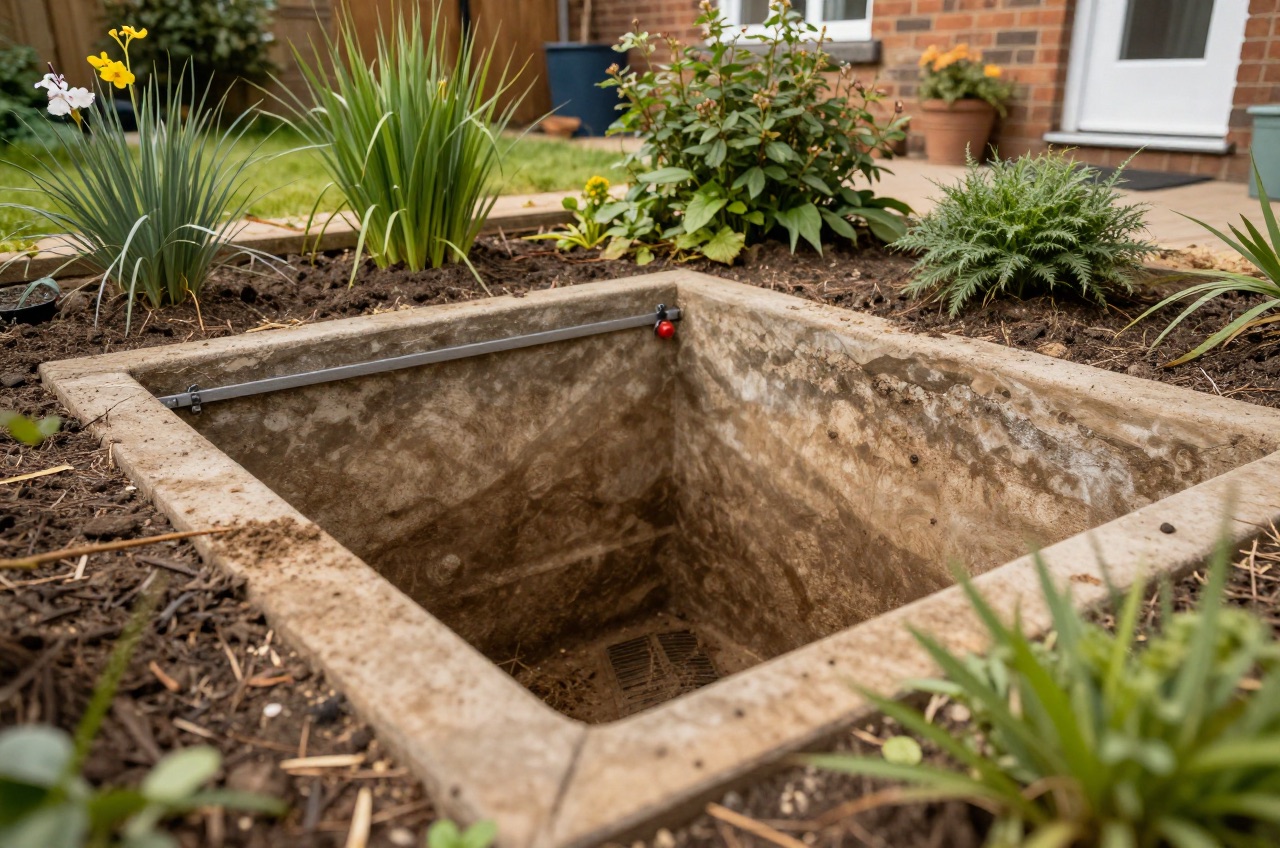
A waterlogged garden is more than an inconvenience, persistent standing water damages lawns, kills plants, creates a breeding ground for mosquitoes, and can eventually threaten the structural integrity of paths, patios, and even your home’s foundations. The good news is that the majority of UK garden drainage problems can be resolved with the right solution at a reasonable cost.
Why UK Gardens Flood
The UK’s combination of heavy clay soils across much of England and Wales, high annual rainfall, and dense suburban development creates near-perfect conditions for waterlogging. Clay soil absorbs water slowly and holds it for days or weeks after rain. Compacted ground, from construction machinery, heavy foot traffic, or years of neglect, makes the problem worse. Poorly graded patios and driveways that slope toward the house rather than away from it direct runoff where you least want it.
Before investing in drainage solutions, it helps to understand whether your problem is:
- Surface water run-off from patios, roofs, or neighbouring land
- High water table, groundwater that rises after sustained rainfall
- Clay-pan waterlogging, water pooling above an impermeable subsoil layer
- Inadequate grading, a flat or wrongly sloped site that cannot shed water
Each cause has a different optimal fix.
Common Garden Drainage Solutions
Soakaways
A soakaway is a buried pit filled with rubble, gravel, or a proprietary crate system (such as Aquacell or Graf cubes) that collects surface water and disperses it slowly into the surrounding soil. They are the most common and cost-effective solution for gardens with reasonably permeable subsoil.
When they work: Gardens with loam or sandy-loam soils, or where clay sits below 1.5m depth. Not suitable if your water table is permanently high.
Sizing: A soakaway must be large enough to handle a 1-in-10-year storm event. Building Regulations Approved Document H3 provides guidance for domestic soakaways. As a rule of thumb, calculate: volume (m³) = area drained (m²) × rainfall depth (m). In most of England, design for 50mm/hour for a 1-in-10-year storm. A 50m² roof area draining to a soakaway needs roughly 2.5m³ capacity.
Positioning: Soakaways must be at least 5 metres from any building or boundary, per Approved Document H.1
| Soakaway type | Approx cost installed |
|---|---|
| Rubble/aggregate pit (1–2m³) | £600–£1,200 |
| Plastic crate system (1–2m³) | £900–£1,800 |
| Large capacity crate system (3–5m³) | £1,500–£3,000 |
| Percolation testing (recommended pre-install) | £150–£350 |
French Drains
A French drain is a perforated pipe laid in a gravel-filled trench, typically 300–600mm wide and 600–900mm deep, that intercepts ground and surface water and channels it to a soakaway, watercourse, or drain. It is particularly effective along fence lines, at the base of slopes, or across a waterlogged lawn.
Typical cost: £40–£80 per linear metre for a basic French drain; £70–£120/m with a perforated pipe in geotextile sock. A 20-metre run across a rear garden costs roughly £800–£2,400 installed.
Key consideration: The pipe must fall consistently at 1:100 minimum (1cm drop per metre) toward the outlet. Flat or undulating sites make this difficult and may require a sump pump.
Channel Drains (Linear Drains)
Channel drains are surface-mounted drainage channels with grated tops, typically installed at the edge of driveways, patios, or across paths. They intercept runoff before it reaches the house or lawn.
Typical cost: £50–£120 per linear metre installed, including connection to existing drain. HDPE and stainless steel channels are most durable; polymer concrete is commonly used on driveways.
Lawn Drainage (Aeration and Slit Drains)
For waterlogged lawns where the underlying issue is compaction rather than high water table, aeration, either hollow-tine or slit aeration, can dramatically improve drainage without excavation.
- Hollow-tine aeration: £150–£400 for a typical garden, carried out by a groundscare contractor
- Slit drainage: Specialist machinery cuts narrow trenches 200–300mm deep, fills them with sharp sand; £500–£1,500 for a typical lawn; significantly improves drainage in clay soils
When to Connect to Mains Drainage
Surface water from gardens must not be connected to the foul sewer. This is prohibited under the Water Industry Act 1991 and Building Regulations Part H. Surface water should drain to:
- A soakaway
- A watercourse (with riparian owner consent and potentially an Environment Agency exemption or permit)
- A surface water sewer (with water company approval)
Connecting garden drainage to a combined sewer without permission is an offence and can result in a substantial fine.
Signs Your Garden Drainage Is Failing
- Standing water more than 24 hours after rain
- Moss taking over the lawn
- Cracks in paths or patios (freeze-thaw damage from saturated ground)
- Damp patches appearing on ground floors or lower walls of the house
- Neighbouring properties with drainage works recently completed (groundwater levels can shift)
Choosing a Contractor
Garden drainage is unglamorous work but requires competence. When getting quotes:
- Ask for a percolation test before any soakaway quote is finalised, without it, the design is guesswork
- Confirm the contractor is familiar with Approved Document H3
- Check that any connection to existing drains will be signed off with building control if required
- Get a minimum of three quotes; prices vary significantly
Most garden drainage work does not require planning permission, but if you are near a watercourse or in a flood risk zone, check with your local authority and the Environment Agency before starting.
References (1)
Figures in this note were checked against the sources below on 14 September 2026. Superscript numbers in the text point to them. Every source the site cites, by topic.
- 1technicalvery strongMinistry of Housing, Communities and Local Government.RN-SM6TRWThe statutory source for soakaway design and the discharge hierarchy every garden drainage note should state. Requirement H3(3) lists the order of priority for rainwater discharge: (a) an adequate soakaway or other adequate infiltration system, or where not reasonably practicable (b) a watercourse, or where not reasonably practicable (c) a sewer. Paragraph 3.25 bars infiltration devices within 5 metres of a building or road, in ground where the water table reaches the bottom of the device at any time of year, too close to other drainage fields or soakaways, or where contamination could pollute groundwater. Paragraph 3.26: soakaways serving less than 100 square metres are generally square or circular pits filled with rubble or lined with dry-jointed masonry or perforated ring units. Paragraph 3.27: design to a return period of once in ten years, and for small soakaways serving 25 square metres or less a design rainfall of 10mm in 5 minutes may be assumed as the worst case. Paragraph 3.28 requires percolation tests to derive the infiltration rate, and paragraph 3.30 sends larger soakaways to BS EN 752-4 or BRE Digest 365 Soakaway design. Paragraphs 2.10 to 2.12 cover pervious paving over a granular storage reservoir and warn against its use where sediment or oil spillage would block the pores. For foul drainage, paragraph 2.33 sets a minimum 75mm internal diameter, or 100mm for a WC, and Table 6 gives minimum gradients of 1 in 40 for 75mm and 100mm at peak flows under 1 litre per second.
-
Approved Document H, Drainage and waste disposal, 2002 edition incorporating 2010 and 2015 amendments, Ministry of Housing, Communities and Local Government, accessed 14 September 2026. assets.publishing.service.gov.uk