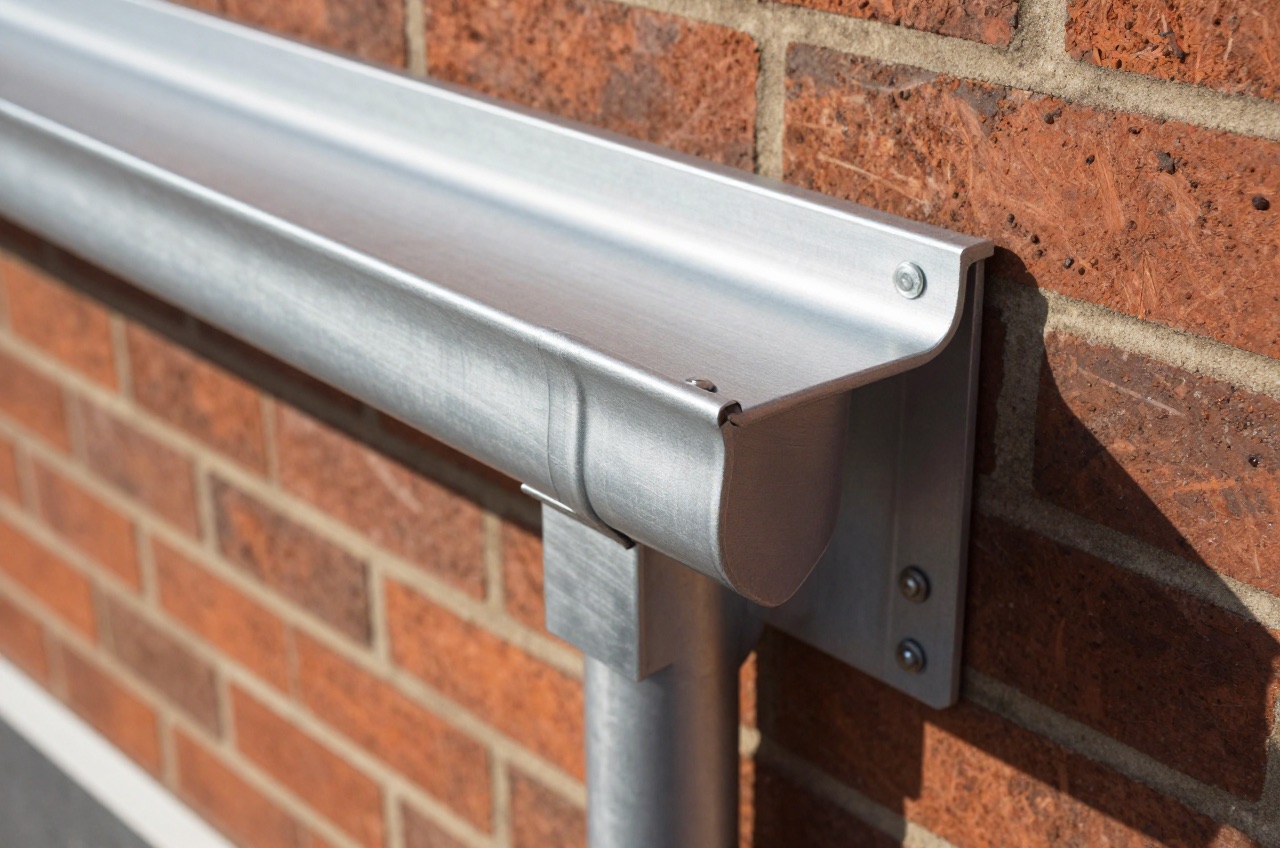
Guttering is a simple system in principle, collect rainwater from the roof, direct it to a downpipe, and get it away from the building, but failures are one of the most common causes of damp in UK properties. Blocked, cracked, or poorly-fitted gutters allow water to run down external walls and saturate brickwork, leading to internal damp and eventually structural damage to fascias and soffits. Maintenance and timely replacement are much cheaper than the remedial work that follows neglect.
For a typical three-bedroom semi-detached house with a simple pitched roof, replacing like-for-like uPVC guttering and downpipes typically costs £1,350–£2,175 including labour, on the 30 m of gutter and 15 m of downpipe used in the cost table below. Cast iron or aluminium systems on older or character properties cost considerably more.
Gutter Materials Compared
uPVC (unplasticised polyvinyl chloride)
By far the most common guttering material on modern UK homes. uPVC is lightweight, cheap, and available in any builders’ merchant. It is joined using push-fit connectors with rubber seals that eventually perish and leak, this is the most common failure point. uPVC becomes brittle after 20–30 years of UV exposure and can crack in hard frosts.
- Cost: £3–£8 per metre for the gutter and £5–£12 per metre for downpipe, supply only; supplied and fitted, typically £30–£50 per metre for gutter and £30–£45 per metre for downpipe
- Lifespan: 20–40 years depending on quality and UV exposure
- Colour: white is standard; black, grey, and brown widely available; anthracite grey popular for contemporary builds
- Profile: half-round, square/ogee, and deep-flow profiles available
Cast iron
The original material on Victorian and Edwardian properties; still specified for many listed buildings, and often expected in conservation areas. Cast iron guttering is heavy, requires regular painting (every 5–10 years), and is prone to rust and joint failure if maintained poorly. However, a well-maintained cast iron system lasts indefinitely and is significantly more attractive than uPVC.
- Cost: £20–£50 per metre for guttering and £25–£60 per metre for downpipes, supply only; supplied and fitted, typically £135–£240 per metre for guttering and £135–£215 per metre for downpipes
- Lifespan: 100+ years with maintenance
- Maintenance: sand and repaint every 5–10 years; re-seal bolted gutter joints when they start to leak
- Weight: considerably heavier, fascia fixings and structural support must be adequate
Aluminium
Aluminium guttering bridges the gap between uPVC and cast iron. It is lightweight, maintenance-free (no painting required), and available in seamless lengths fabricated on-site by specialist contractors, eliminating the joint-leak problem. Powder-coated finishes are available in any RAL colour.
- Cost: £10–£25 per metre for standard sectional aluminium, supply only; supplied and fitted, aluminium guttering typically costs £55–£170 per metre
- Lifespan: 40–60 years
- Maintenance: virtually none, aluminium does not rust; paint does not peel
Seamless aluminium guttering is an excellent option for large or complex roofs where minimising joints reduces maintenance.
Steel (galvanised or Zincalume)
Used mainly in agricultural and commercial settings but increasingly available for domestic use via specialist suppliers. Powder-coated steel guttering is durable and repairable. Less common than aluminium and cast iron for domestic work.
Material comparison table
| Material | Supply cost per metre (gutter) | Lifespan | Maintenance | Best for |
|---|---|---|---|---|
| uPVC | £3–£8 | 20–40 years | Low (clean joints) | Standard modern housing |
| Cast iron | £20–£50 | 100+ years | Medium (painting) | Period properties; listed buildings |
| Aluminium (sectional) | £10–£25 | 40–60 years | Very low | Most properties |
| Aluminium (seamless) | Supplied and fitted only | 40–60 years | Very low | Long runs; large roofs |
| Steel | £15–£30 | 40–60 years | Low | Contemporary; agricultural |
Gutter Sizes and Outlet Spacing
Gutter sizing is governed by the roof area drained and local rainfall intensity. For ordinary eaves gutters, Approved Document H takes the design rainfall intensity from a map of the UK and gives a simple sizing table.1 The more detailed design method is BS EN 12056-3, which Approved Document H accepts as an alternative and calls for on valley and parapet gutters and on roofs where an overflow would do particular damage.1 The key principle: the gutter must carry the design storm without overflowing.
Standard domestic guttering:
| Profile | Width | Capacity | Typical use |
|---|---|---|---|
| Half-round 75 mm | 75 mm | Low | Flat roofs, extensions, garages |
| Half-round 112 mm | 112 mm | Medium | Standard domestic pitched roofs |
| Deep-flow / Ogee 114 mm | 114 mm | Medium–high | Larger pitches; high rainfall areas |
| Half-round 150 mm | 150 mm | High | Large detached properties; high-pitch roofs |
Outlet spacing depends on how much roof each outlet drains, and gutter makers publish flow tables for their own profiles. Approved Document H’s sizing table assumes the outlet is no more than 50 times the water depth from the stop end, and says the gutter’s capacity should be reduced at greater distances.1
Downpipe sizes:
- A downpipe should be at least the size of the gutter outlet it serves.1
- In Approved Document H’s table, a 63 mm outlet on a 100 mm half-round gutter serves up to 37 m² of effective roof area, which is why 68 mm round or 65 mm square pipe is standard on domestic 112 mm systems.1
- 80 mm round and larger: large roof areas; the same table pairs a 150 mm gutter with an 89 mm outlet for up to 103 m² of effective roof area.1
Getting the downpipe size wrong is one of the most common errors in gutter replacement, simply matching the old size is not always correct if the old system was itself undersized or poorly designed.
Fascia, Soffit, and Guttering Together
Guttering is fixed to the fascia board, the horizontal board running along the eaves below the roof tiles. When replacing guttering, it is sensible (and often necessary) to assess the fascia condition at the same time:
- Timber fascias on houses built before the 1990s are often rotted, particularly at joints, around fixing screws, and behind the guttering where water has tracked back
- Replacing guttering without addressing a rotted fascia results in inadequate fixing and likely gutter sag or fall
- Replacing fascia, soffit, and guttering together costs more upfront but avoids double mobilisation costs, typically £80–£150/metre run for supply and fit of uPVC fascia, soffit, and guttering together, versus about £30–£50/metre for guttering alone
Replacement Cost Breakdown
Costs for a typical three-bedroom semi-detached (approximately 30 m of guttering, 3 downpipes of approximately 5 m each):
| Scenario | Rate used (supplied and fitted) | Total |
|---|---|---|
| uPVC guttering only (like-for-like) | £30–£50/m × 30 m | £900–£1,500 |
| uPVC guttering + downpipes | plus £30–£45/m × 15 m of downpipe | £1,350–£2,175 |
| uPVC fascia, soffit, and guttering | £80–£150/m × 30 m | £2,400–£4,500 |
| Cast iron guttering only | £135–£240/m × 30 m | £4,050–£7,200 |
| Aluminium guttering only | £55–£170/m × 30 m | £1,650–£5,100 |
The rates are typical supplied-and-fitted prices including brackets and fittings, applied to the quantities above.
Access costs (scaffolding or cherry picker hire) are a significant variable. For most two-storey semis, access towers or ladder use is sufficient at minimal cost. Three-storey or large detached properties with complex roof lines may require scaffolding at £500–£1,500.
Common Failures and How to Diagnose
| Problem | Likely cause | Fix |
|---|---|---|
| Water dripping at joints | Perished rubber seal | Replace seal or connector (uPVC); re-caulk with gutter sealant |
| Water spilling over front of gutter | Blockage; incorrect fall; undersized gutter | Clear blockage; re-level; upsizing may be required |
| Gutter sagging | Bracket failure; rotten fascia | Replace brackets; replace fascia if rotted |
| Damp internally below eaves | Gutter overflowing or broken joint running on fascia | Clean, repair, or replace guttering; check fascia condition |
| Downpipe not discharging to drain | Blocked underground connection or hopper | Rod drain; clear hopper |
Maintenance Tips
- Clean gutters at least once a year (autumn, after leaf fall) and additionally after any storm, a blocked 112 mm gutter overflows within minutes in heavy rain
- Check joints for weeping each spring, a strip of waterproof gutter sealant is a temporary fix; replacement connectors a permanent one
- Paint cast iron before rust takes hold, once rust has penetrated, sections must be cut out and replaced
- Install gutter guards (mesh or foam inserts) if trees overhang, these reduce the frequency of full cleans but must themselves be checked periodically
References (1)
Figures in this note were checked against the sources below on 30 September 2026. Superscript numbers in the text point to them. Every source the site cites, by topic.
- 1technicalvery strongMinistry of Housing, Communities and Local Government.RN-SM6TRWThe statutory source for soakaway design and the discharge hierarchy every garden drainage note should state. Requirement H3(3) lists the order of priority for rainwater discharge: (a) an adequate soakaway or other adequate infiltration system, or where not reasonably practicable (b) a watercourse, or where not reasonably practicable (c) a sewer. Paragraph 3.25 bars infiltration devices within 5 metres of a building or road, in ground where the water table reaches the bottom of the device at any time of year, too close to other drainage fields or soakaways, or where contamination could pollute groundwater. Paragraph 3.26: soakaways serving less than 100 square metres are generally square or circular pits filled with rubble or lined with dry-jointed masonry or perforated ring units. Paragraph 3.27: design to a return period of once in ten years, and for small soakaways serving 25 square metres or less a design rainfall of 10mm in 5 minutes may be assumed as the worst case. Paragraph 3.28 requires percolation tests to derive the infiltration rate, and paragraph 3.30 sends larger soakaways to BS EN 752-4 or BRE Digest 365 Soakaway design. Paragraphs 2.10 to 2.12 cover pervious paving over a granular storage reservoir and warn against its use where sediment or oil spillage would block the pores. For foul drainage, paragraph 2.33 sets a minimum 75mm internal diameter, or 100mm for a WC, and Table 6 gives minimum gradients of 1 in 40 for 75mm and 100mm at peak flows under 1 litre per second.
-
Approved Document H: Drainage and waste disposal, 2015 edition, Ministry of Housing, Communities and Local Government, accessed 30 September 2026. assets.publishing.service.gov.uk