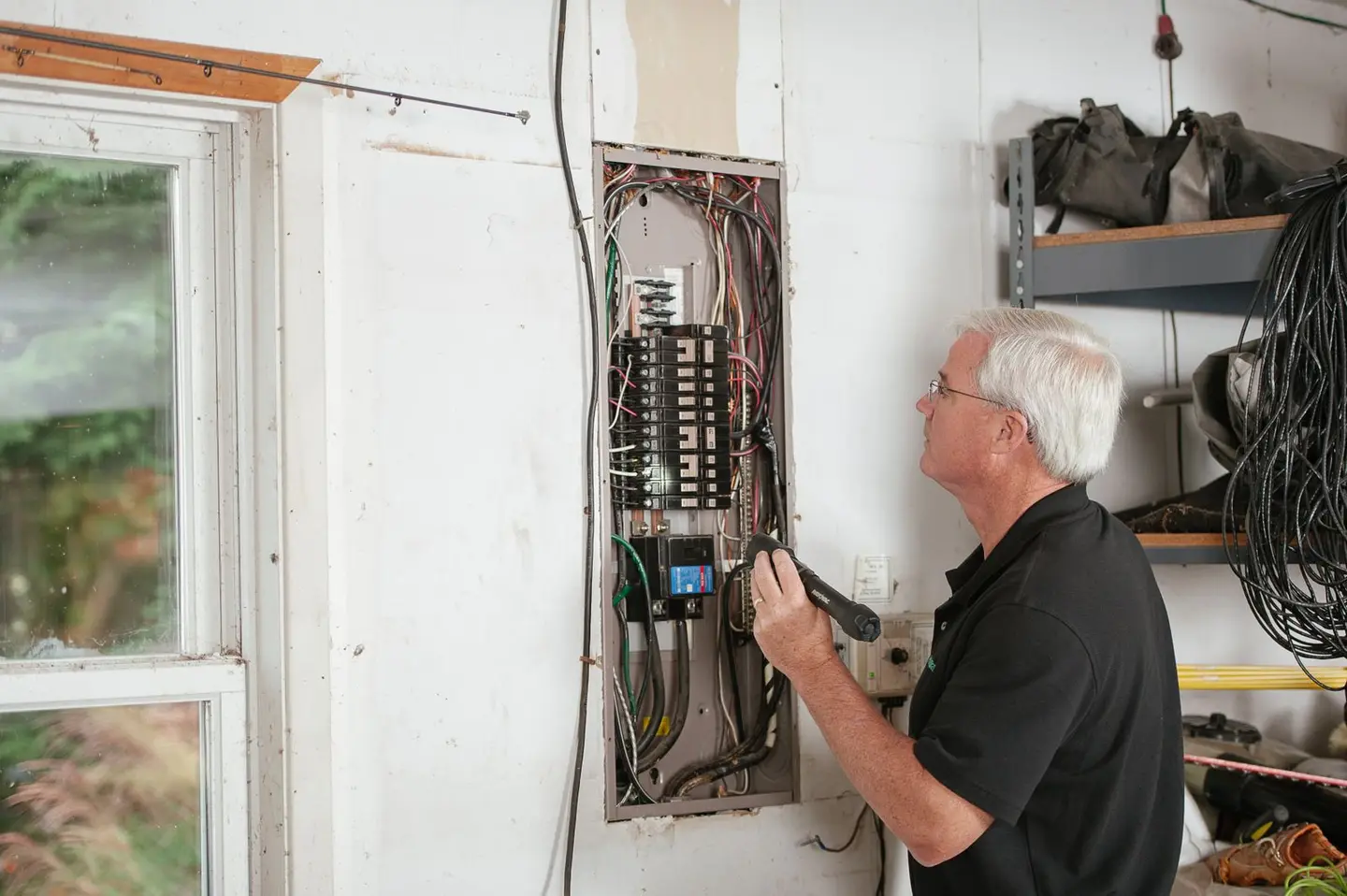
Electrical wiring doesn’t come with an expiry label, which makes it easy to ignore. But faulty electrics are a serious fire risk: Electrical Safety First (the charity formerly called the Electrical Safety Council) says almost half of all domestic fires are caused by electricity, from faulty wiring as well as from appliances and other electrical products.1 Knowing the signs that your wiring needs attention, and understanding what a rewire involves, could save both money and lives.
How Old Is Too Old?
There is no fixed legal lifespan for domestic wiring. As a rough guide by cable type:
- Rubber-insulated wiring: black rubber-insulated cable was phased out in the 1960s; the insulation turns brittle and cracks, so plan to replace it.2
- Lead-sheathed or fabric-covered wiring: older still, and very likely to need replacing.2
- Aluminium wiring: 1960s–1970s, corrodes at connections, requires specialist inspection
- PVC-insulated wiring (1960s–1980s): may still be serviceable, but have it inspected
- Modern PVC-insulated cable: longer-lasting; keep to the regular inspection interval below
Electrical Safety First recommends periodic inspection and testing at least every 10 years for an owner-occupied home, and every 5 years or at each change of occupancy for a rented one.3
Warning Signs to Look For
The Fuse Box (Consumer Unit)
The consumer unit is the best single indicator of wiring age and condition:
- Old-style ceramic or re-wireable fuses rather than modern MCBs (miniature circuit breakers): the installation is likely 40+ years old
- No RCD protection (residual current device, a device that trips in milliseconds if current leaks to earth): the Wiring Regulations, BS 7671, require 30 mA RCD protection for socket-outlets rated up to 32 A.4 Every circuit in a room containing a bath or shower needs it too.5
- Overfused circuits: anyone can fit an incorrectly rated fuse in an old ceramic holder, creating a fire risk
Around the Home
| Warning Sign | What It Suggests |
|---|---|
| Black rubber insulation on cable ends (visible at sockets/switches) | Pre-1960s rubber wiring, needs urgent inspection |
| Round-pin sockets or old bakelite light switches | A very old installation, likely several decades old |
| Scorching, burn marks or discolouration around sockets | Loose connections or overloaded circuits, immediate risk |
| Flickering lights (consistent, not bulb-related) | Loose connections in circuit |
| Sockets or switches feel warm to the touch | Overloaded circuit or failing connections |
| Burning or fishy smell from sockets or consumer unit | Arcing, turn off and call an electrician today |
| Frequently tripping MCBs or blown fuses | Circuits at or over capacity, or failing cable insulation |
| No earthing on metal light fittings or sockets | Missing earth continuity, shock risk |
| Extension lead chains and adaptor plugs throughout | Insufficient sockets for current usage, circuit overloading |
| Only two pins in older-style sockets | No earth, a very old installation |
Electrical Safety First lists plug sockets with round pins, braided flex hanging from ceiling lights and sockets mounted in skirting boards among the signs of old electrics.6
What an Electrical Inspection Reveals
An Electrical Installation Condition Report (EICR), the formal inspection and test, is carried out by a qualified, competent electrician, usually one registered with NICEIC, NAPIT or another scheme authorised by government. It tests every circuit for:
- Insulation resistance
- Earth continuity and bonding
- RCD tripping times
- Loop impedance (the ability of the fuse or MCB to operate in a fault)
- Visual inspection of all accessible components
The report grades observations:
- C1 (Danger present): immediate action required7
- C2 (Potentially dangerous): urgent remedial action needed
- C3 (Improvement recommended): not dangerous but advisory
- FI (Further investigation): further investigation required without delay7
An EICR costs £150–£300 for a typical 3-bedroom house. Landlords in England must have the electrical installation inspected and tested by a qualified person at least every 5 years, and give their tenants a copy of the report.7
Do You Need a Full Rewire or Just Remedial Work?
Not every old installation needs a complete rewire. The decision depends on the EICR findings:
- Consumer unit upgrade only: if circuits are sound but the fuse board lacks RCD protection, a new consumer unit installation (£600–£1,200) may be all that’s needed.
- Partial rewire: if specific areas (kitchen, bathroom, extension) have dangerous wiring but the rest of the house passes, those circuits alone may be rewired.
- Full rewire: if wiring is rubber-insulated, aluminium, or lead-sheathed throughout, or if there are pervasive C1/C2 observations across multiple circuits, a full rewire is the appropriate response.
Signs pointing to full rewire:
- Rubber or lead insulation anywhere in the installation
- No earth on any circuit
- Widespread C1/C2 observations in EICR
- Major renovation (kitchen, loft conversion, extension) that requires re-routing most circuits anyway
- Property built before 1970 that has never been rewired
What a Rewire Involves
A full rewire means replacing every circuit from the consumer unit outward, all cables, socket and switch faceplates, junction boxes, and the consumer unit itself. For an occupied home, it typically requires:
- An electrician chases cable runs into walls (or surface mounts in conduit)
- First fix: all cables installed, consumer unit replaced
- Plastering over chased runs (usually a separate trade, or the homeowner’s responsibility)
- Second fix: sockets, switches, and light fittings connected
- Testing and certification, a BS 7671 electrical installation certificate is issued on completion
A rewire is notifiable work under Part P, so it must either be self-certified by an electrician registered with a competent person scheme, certified by a registered third party, or notified to Building Control before work starts.8 You receive a BS 7671 Electrical Installation Certificate on completion, and a Building Regulations compliance certificate from their scheme within 30 days.9
Cost of a Rewire
| Property | Full Rewire Cost (all-in, 2026) |
|---|---|
| 1-bedroom flat | £2,500–£4,50010 |
| 2-bedroom house | £3,500–£5,500 |
| 3-bedroom semi | £4,500–£7,000 |
| 4-bedroom detached | £6,000–£10,000 |
| 5+ bedrooms, complex property | £9,000–£18,000+ |
The cited prices in this table were published in 2023 and brought to 2026. What that means.
Costs vary significantly by:
- Whether it’s occupied (harder access)
- How much plasterwork is needed after chasing
- Whether consumer unit upgrade is included
- Number of circuits and special circuits (kitchen ring, EV charger, outbuildings)
Add £1,500–£3,000 if you’re simultaneously installing new sockets throughout (going from 1 double per room to 3–4) or adding USB, smart, or outdoor sockets.
After the Rewire
A newly rewired house with a modern 18th Edition consumer unit will have:
- Full RCD protection (split-load board at minimum, RCBO per circuit on quality installs)
- Correct circuit sizing (T&E cable rated for the load)
- Surge protection device (BS 7671 calls for protection against transient overvoltage unless a risk assessment shows it is not needed)11
- An EIC (Electrical Installation Certificate) for insurance and mortgage purposes
Keep the EIC safely, it’s often requested when selling the property.
References (11)
Figures in this note were checked against the sources below on 30 September 2026. Superscript numbers in the text point to them. Every source the site cites, by topic.
- 1technicalfairElectrical Safety First, guidance.RN-2JA5A9The electrical safety charity's fire advice page, stating that almost half of domestic fires are caused by electricity, from faulty electrics and electrical products.
- 2technicalfairElectrical Safety First, guidance.RN-G8EWAUElectrical Safety First's explainer on periodic inspection: a competent person checks the installation against BS 7671 and issues an EICR recording defects and whether the installation is satisfactory.
- 3technicalfairElectrical Safety First, guidance.RN-CBC4YCElectrical Safety First's consumer answer on rewiring. It says there are no set rules on when to rewire, that old wiring is not necessarily unsafe, and advises inspection every 10 years (5 years when rented).
- 4technicalstrongInstitution of Engineering and Technology (Wiring Matters), guidance.RN-PM34TFIET Wiring Matters article quoting BS 7671 Regulation 411.3.3, which requires 30 mA RCD additional protection for socket-outlets rated up to 32 A, subject to a narrow documented risk-assessment exception.
- 5technicalstrongThe IET, guidance.RN-76NYWBThe IET's technical article on Section 701 of BS 7671, locations containing a bath or shower. Explains the zones, 0, 1 and 2, what equipment and IP rating is permitted in each, the supplementary bonding rules and where a socket may and may not go. This is the source behind every statement about what can be installed near a bath, and it is written by the IET's own chief engineer answering the questions their helpline actually receives.
- 6technicalfairElectrical Safety First, guidance.RN-0QLYECElectrical Safety First home safety advice listing the visible signs of old or faulty electrics: round-pin sockets, braided flex to ceiling lights, sockets in skirting boards, burn marks and heat.
- 7technicalvery strongMinistry of Housing, Communities and Local Government, guidance.RN-IUHGG0The definitive figures for an EICR note. The electrical installation must be inspected and tested at least every 5 years by a qualified person competent to undertake the inspection and testing, against the 18th Edition of the Wiring Regulations published as British Standard 7671. The report must go to existing tenants within 28 days of the inspection and test, to new tenants before they occupy the premises, and to the local council within 7 days of a request. Remedial work must be completed within 28 days, or any shorter period specified as necessary in the report. The observation codes are C1 danger present with risk of injury, C2 potentially dangerous, C3 improvement recommended and not mandatory, and FI further investigation required without delay. A local housing authority can impose a financial penalty of up to £40,000.
- 8technicalvery strongMinistry of Housing, Communities and Local Government.RN-JYJ3I5The document that decides what electrical work a homeowner may legally do themselves, and the exact list of notifiable jobs. Regulation 12(6A), reproduced at paragraph 2.5, makes only three things notifiable: the installation of a new circuit, the replacement of a consumer unit, and any addition or alteration to existing circuits in a special location. Regulation 12(9) defines special location as, in a room containing a bath or shower, the zone extending vertically from finished floor level to 2.25 metres (or the shower head position if higher) and horizontally 600mm from the edge of the bath tub or shower tray. Paragraph 2.7 states that all other electrical installation work is not notifiable, namely additions and alterations to existing installations outside special locations, and replacements, repairs and maintenance anywhere. Paragraph 2.8 gives worked examples: a built-in cooker is not notifiable unless a new cooker circuit is needed, and connecting an electric gate or garage door to an existing isolator is not notifiable but running a new circuit from the consumer unit to that isolator is. Paragraph 2.2 confirms Part P reaches outdoor work including fixed garden lighting, pond pumps and outbuildings such as sheds, detached garages and domestic greenhouses. Notifiable work must be certified by self-certification by a registered competent person, third-party certification, or a building control body (paragraph 3.1), with the compliance certificate issued within 30 days (paragraph 3.4). Note that Approved Document P is a source of guidance rather than a ban: non-notifiable work still has to comply with BS 7671.
- 9technicalvery strongThe National Archives (legislation.gov.uk), legislation.RN-TISY8ORegulation 20 of the Building Regulations 2010 is the legal basis for every competent person certificate and, importantly, the deadline attached to it. Paragraph (1) applies the regulation where the building work consists only of work of a type described in column 1 of the Table in Schedule 3 carried out by a person described in column 2. Paragraph (2): the building control authority is authorised to accept, as evidence that the requirements of regulations 4 and 7 have been satisfied, a certificate to that effect from the person carrying out the work. Paragraph (3): within 30 days of completing the work that person must give the occupier a copy of the certificate and either notify the building control authority or send it the certificate. Paragraph (3A) requires the authority to keep a retrievable copy. Paragraph (5) is the sting: such a certificate is evidence, but not conclusive evidence, that the requirements have been complied with. If an installer has not produced the certificate within 30 days, chase it before final payment.
- 10coststrong locallyRoyal Borough of Greenwich, Housing and Safer Communities, a government page.RN-SXB1KMA price, true at 2023-06, brought forward on the Construction Output Price Index. The priced schedules from a London borough's capital programme delivery contract with its contractor, published as a spreadsheet. Genuine competitively tendered rates for housing works at real scale, which is rare to see in public. Read them as contract rates for volume work under a framework, which is a different market from a homeowner buying one job.
- 11technicalstrongThe Institution of Engineering and Technology, guidance.RN-QBGVDQIET consumer guidance explaining when BS 7671:2018 requires surge protective devices and the role of a risk assessment in deciding.
-
Fire safety advice: electrical fire prevention at home, Electrical Safety First, accessed 30 September 2026. electricalsafetyfirst.org.uk
-
Periodic inspection explained, Electrical Safety First, accessed 30 September 2026. electricalsafetyfirst.org.uk
-
Do I need a rewire?, Electrical Safety First, accessed 30 September 2026. electricalsafetyfirst.org.uk
-
Mythbusters #8: Socket-outlets must be protected by a 30 mA RCD, The Institution of Engineering and Technology (Wiring Matters), accessed 30 September 2026. electrical.theiet.org
-
Section 701: Locations containing a bath or shower, The Institution of Engineering and Technology, accessed 30 September 2026. electrical.theiet.org
-
Electrical safety advice for older and vulnerable people, Electrical Safety First, accessed 30 September 2026. electricalsafetyfirst.org.uk
-
Electrical safety standards in the private and social rented sectors: guidance, Ministry of Housing, Communities and Local Government (GOV.UK), accessed 30 September 2026. gov.uk
-
Approved Document P: Electrical safety, Dwellings, 2013 edition, HM Government (GOV.UK), accessed 30 September 2026. assets.publishing.service.gov.uk
-
The Building Regulations 2010, regulation 20: Provisions applicable to self-certification schemes, The National Archives, accessed 30 September 2026. legislation.gov.uk
-
Equans pricing schedules, Royal Borough of Greenwich Capital Programme Delivery Contractors contract SPS-2686, Document 4 Pricing Schedules, Royal Borough of Greenwich, Housing and Safer Communities, accessed 18 September 2026. Priced at 2023-06; brought to 2026 on the Construction Output Price Index, housing repair and maintenance (Great Britain), published by Office for National Statistics, a factor of 1.0358. royalgreenwich.gov.uk
-
Surge protective devices (SPD): consumer guidance, The Institution of Engineering and Technology, accessed 30 September 2026. electrical.theiet.org