Choosing the right radiator is partly an engineering decision, if the output is too low the room will never reach temperature, and partly aesthetic. This guide explains the main radiator types available in the UK, how to calculate the BTU output you need, and what supply and installation typically cost in 2026.
What BTU Means and Why It Matters
BTU (British Thermal Unit) is the traditional unit used to quote radiator heat output in the UK; it measures the amount of heat energy transferred per hour. The equivalent SI unit is Watts (1 W = 3.41 BTU/h). Both units appear on product data sheets, some manufacturers use Watts, some BTU, and some list both.
The BTU figure quoted by manufacturers is measured at delta T (ΔT) 50 °C, the difference between mean water temperature and room temperature in the test.1 In a real installation with a modern condensing boiler running at lower flow temperatures (typically 60–70 °C flow, 50–60 °C return), the actual ΔT in a 21 °C room is closer to 34–44 °C. This means real-world output is roughly 15–40% lower than the quoted figure.2 Always apply a correction factor, or use the manufacturer’s de-rated output tables.
Sizing a Radiator: The Method
Step 1: Calculate Room Heat Loss
The accurate method is a room-by-room heat loss calculation to BS EN 12831-1, which covers the design heat load of single rooms as well as whole buildings.3 The figures below are only a rough rule of thumb for most UK properties:
| Property type | BTU per m³ of room volume |
|---|---|
| New build / well insulated (post-2000) | 100–130 BTU/m³ |
| Standard semi-detached (1960s–1990s) | 140–180 BTU/m³ |
| Older Victorian / Edwardian / poor insulation | 190–250 BTU/m³ |
Example: A 4 m × 3.5 m × 2.4 m living room in a 1970s semi = 33.6 m³. At 160 BTU/m³ = 5,376 BTU required. In Watts: 5,376 ÷ 3.41 = 1,576 W.
Step 2: Add Adjustments
Rule-of-thumb calculators typically add allowances such as these:
- Large window area (more than 20% of wall area): add 15%.
- North-facing room: add 10%.
- Ground floor over uninsulated void: add 10%.
- Open-plan room: size for the entire open area.
Step 3: Account for ΔT Correction
If your boiler runs at lower temperatures (or you plan to in future with a heat pump), apply a ΔT correction. At ΔT40 instead of ΔT50, output drops to approximately 75% of the quoted figure.2 Choose a radiator rated at about a third more than your calculated heat requirement (divide the requirement by the correction factor), or use the manufacturer’s ΔT40 figure if available.2
Radiator Types
Panel Radiators (Convector Radiators)
The standard choice for most UK homes. A flat steel panel with welded internal water channels, usually backed by corrugated convector fins that increase airflow and heat output. Common configurations are single panel single convector (K1, Type 11), double panel single convector (P+, Type 21) and double panel double convector (K2, Type 22).4
- Type 11 (single panel, single convector): lowest output; suitable for small or well-insulated rooms.
- Type 21 (double panel, single convector): mid-range output in a slimmer depth than a Type 22.
- Type 22 (double panel, double convector): highest output of these three for a given footprint, and the most widely used type in UK homes.4
Panel radiators are the cheapest option and are available in a range of standard heights (commonly 300 to 700 mm) and lengths up to about 3,000 mm, allowing precise output matching.
Column Radiators
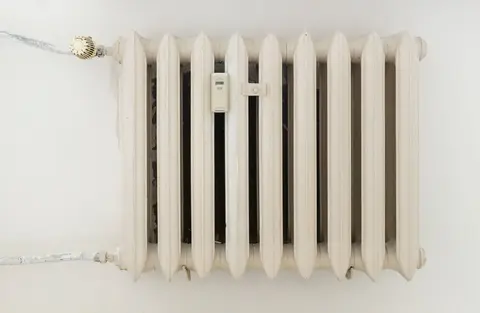
Traditional multi-column design in cast iron or pressed steel. Cast iron retains heat longer (thermal mass) and continues radiating after the boiler shuts off. Pressed steel columns are lighter and less expensive.
Column radiators suit period properties aesthetically and are often used to maintain the look of an original Victorian or Edwardian interior. They tend to be physically larger for the same output as a panel radiator, and significantly heavier (cast iron requires proper wall fixings and may need two people to install).
Designer / Low-Surface-Temperature Radiators
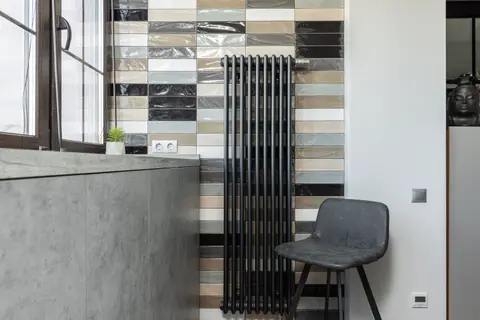
Flat-panel or geometric designs in steel or aluminium. Often used in contemporary bathrooms, home offices, and hallways. Aluminium radiators heat up and cool down more quickly than steel, advantageous with modulating boilers and smart controls.
Low-surface-temperature (LST) radiators are used in care homes, schools and similar places where vulnerable people may touch hot surfaces, because contact with surfaces above 43 °C can cause serious injury.5 Not usually required in standard domestic installations.
Underfloor Heating (UFH)
Not a radiator in the traditional sense, but a competing product for domestic heat delivery. Wet UFH distributes heat via pipes in or under the floor screed at low flow temperatures (35–45 °C), ideal for heat pump systems. The floor acts as a very large low-temperature radiator.
Cost Comparison by Type
| Type | Supply cost range | Typical output range | Notes |
|---|---|---|---|
| Panel type 11 (single) | £20–£80 | 500–3,000 BTU | Budget; limited output |
| Panel type 22 (double) | £30–£200 | 1,500–20,000+ BTU | Most common choice |
| Steel column (white) | £80–£400 | 2,000–15,000 BTU | Stylish; mid-weight |
| Cast iron column | £150–£800+ | 2,000–12,000 BTU | Heavy; period look |
| Aluminium designer | £100–£500 | 1,500–10,000 BTU | Fast response; modern |
| Low-profile (skirting) | £150–£600/m | 500–2,500 BTU/m | Discreet; below windows |
Installation Costs
| Job | Typical cost (2026, England) |
|---|---|
| Replace existing radiator (same size, same pipework) | £150–£250 including supply |
| Replace existing radiator (different size, pipe adjustments) | £200–£350 |
| Add new radiator (extend pipework from nearby circuit) | £300–£500 |
| Full system drain and refill (for multiple swaps) | £100–£200 additionally |
| Thermostatic radiator valve (TRV) upgrade | £30–£60 per valve (supply + fit) |
London and South East pricing typically runs 20–30% above these figures. A plumber or gas engineer typically charges £270–£350/day outside London.
Valves and Controls
Every radiator needs two valves, a flow valve (on the inlet) and a lockshield valve (on the return, used for balancing the system). Options for the flow valve:
- Manual valve, turn by hand to adjust flow. Simple, low-cost, no automatic temperature regulation.
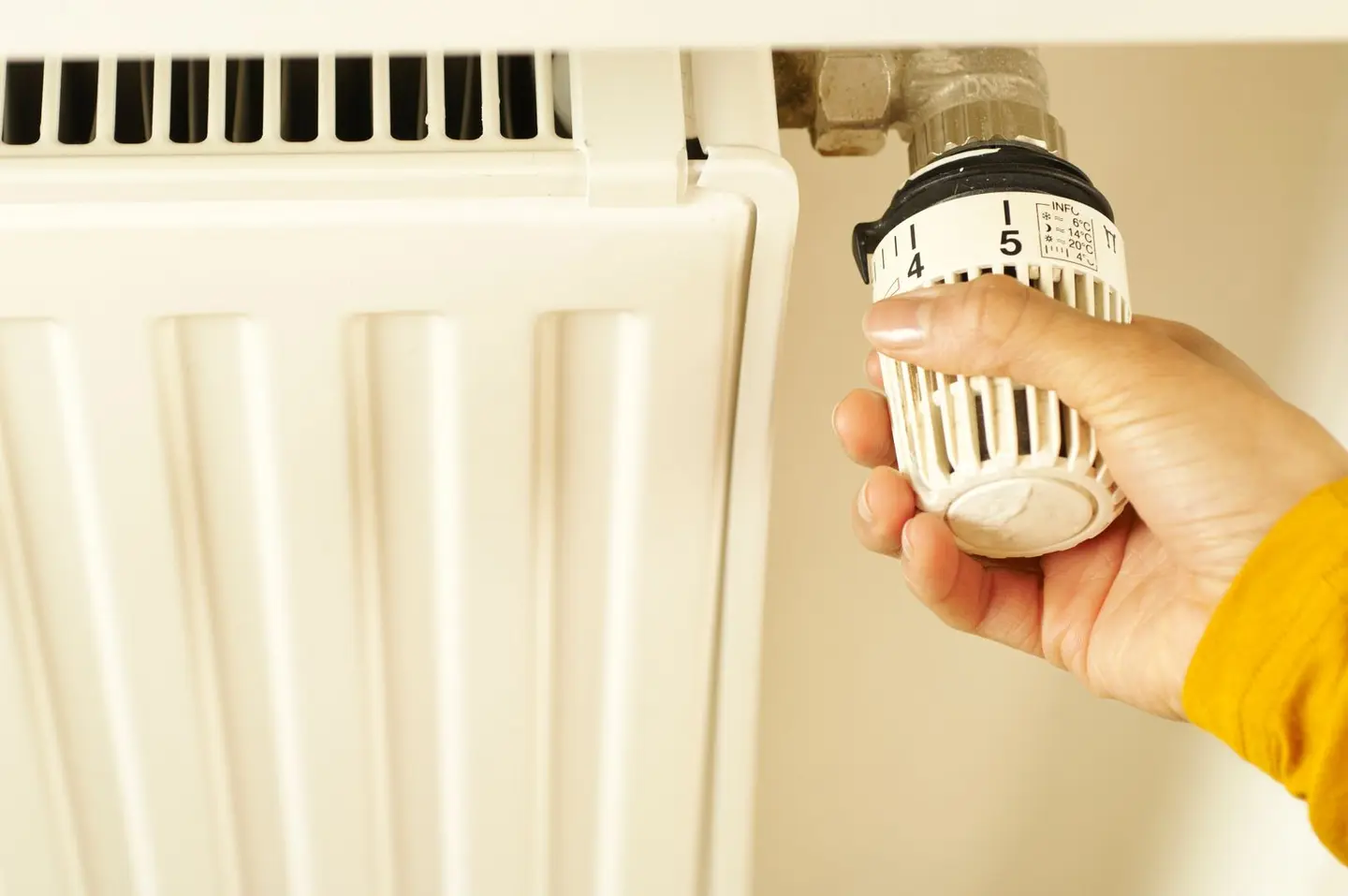
- Thermostatic radiator valve (TRV), senses room temperature and adjusts flow automatically. Approved Document L of the Building Regulations expects thermostatic room controls in each room when heating is installed in a new home or a boiler is replaced.6 One accepted way to meet this is a room thermostat plus a TRV on every radiator outside the room that contains the thermostat, with no TRV in that room.6
- Smart TRV, connects to a smart home system (Hive, Tado, Honeywell) and allows room-by-room scheduling via an app. Smart TRV heads typically cost £30–£75 each, supply only.7
Balancing the System
When adding or replacing radiators, the system may need balancing, adjusting the lockshield valves so heat is distributed evenly across all radiators. An unbalanced system results in radiators near the boiler getting very hot while those at the far end of the circuit remain cool. Balancing can be done DIY using a clip-on thermometer on the flow and return pipes; the aim is a similar flow-to-return temperature drop across each radiator, matching what the system was designed for (traditionally around 10–12 °C; systems designed for condensing boilers often aim for more).
Summary: Choosing the Right Radiator
- Living room or bedroom: type 22 panel radiator, best output for the price.
- Period property: steel or cast iron column, suits the aesthetic and is compatible with standard pipework.
- Bathroom: towel radiator (dual fuel if year-round use is needed), see separate guide.
- Contemporary space: aluminium or flat-panel designer radiator, fast response, slim profile.
- Heat pump system: large low-temperature radiator or UFH, sized to run at ΔT20–30 rather than ΔT50.
References (7)
Figures in this note were checked against the sources below on 30 September 2026. Superscript numbers in the text point to them. Every source the site cites, by topic.
- 1technicalsupplier figureStelrad, guidance.RN-1S9C1CA radiator maker's explainer on Delta T. It defines Delta T as mean water temperature minus room temperature and says Delta T50 is the UK standard for quoted outputs.
- 2technicalsupplier figureStelrad, guidance.RN-W8QXYEThe maker's Delta T correction table. It gives factors of 0.604 at Delta T 34 and 0.846 at Delta T 44, which is 15% to 40% below the Delta T50 rating.
- 3technicalstrongBSI, a standard.RN-7QIL5ZThe standard behind any correct radiator or boiler sizing figure, published 31 July 2017 and current but under review. It gives methods for calculating the design heat load for single rooms, building entities and whole buildings, where design heat load is the heat supply in watts needed to hold the required internal design temperature under design external conditions. The calculation is carried out before heating system components are dimensioned and accounts for multiple heat emission devices in one room, domestic hot water heating power where significant, and how required heating power is split between multiple heat generators. It sits in the EPB standard set as Module M3-3, with PD CEN/TR 12831-2 as the explanatory companion. Cite this when a note says a BTU calculator is a shortcut for a proper room-by-room heat loss calculation.
- 4technicalsupplier figureStelrad, guidance.RN-YLGQPZA radiator maker's guide to panel type codes. It maps K1 to Type 11, P+ to Type 21 and K2 to Type 22, and gives the panels and fins in each.
- 5technicalvery strongHealth and Safety Executive, guidance.RN-F9ZZS0HSE's information sheet on hot water and surfaces in care settings. It sets 43 °C as the burn-risk threshold and lists low surface temperature heat emitters as a control.
- 6technicalvery strongMinistry of Housing, Communities and Local Government.RN-L0FCJXThe in-force U-value tables a DIY insulation or door note must quote, with the exact numbers. Table 4.2, limiting U-values for new fabric elements in existing dwellings, sets roof 0.15, wall 0.18, floor 0.18, swimming pool basin 0.25, window 1.4 or Window Energy Rating Band B minimum, rooflight 2.2, doors with more than 60 per cent of the internal face glazed 1.4 or Doorset Energy Rating Band C minimum, and other doors 1.4 or Doorset Energy Rating Band B minimum. Table 4.3, for existing elements, gives a roof threshold of 0.35 and an improved value of 0.16, which is the figure a loft insulation note needs: paragraph 4.12 says a retained element whose U-value is higher than the column (a) threshold, for example through a loft or garage conversion, should be upgraded to the column (b) value. Paragraph 4.13 allows a lesser upgrade only where the improved value is not technically or functionally feasible or would not achieve a simple payback of 15 years or less. Paragraph 4.8 requires a replacement element to be no worse than the one it replaces as well as meeting Table 4.2. Paragraph 4.10 gives the heritage exception: where character must be maintained, a centre pane U-value of no more than 1.2 or low-emissivity secondary glazing. Note 9 records that the timber window concession of 1.6 or Band C ended on 14 June 2023. The 2021 edition came into force on 15 June 2022; a 2026 edition exists at https://assets.publishing.service.gov.uk/media/69c122a6cfa346b9d4704a55/ADL1_2026.pdf.
- 7costsupplier figureScrewfix.RN-6WF2OSA price, true at 2026-09. the retail price Screwfix publishes for hive trv003 white smart thermostatic radiator head 5 pack, which is the supply figure the cost book records for this item
-
The importance of Delta T in calculating heating output, Stelrad, accessed 30 September 2026. stelrad.com
-
Stelrad Correction Factor, Stelrad, accessed 30 September 2026. stelrad.ie
-
BS EN 12831-1:2017 Energy performance of buildings. Method for calculation of the design heat load. Space heating load, Module M3-3, BSI, accessed 30 September 2026. knowledge.bsigroup.com
-
What is the difference between P1, K1, P+, K2 and K3 radiators?, Stelrad, accessed 30 September 2026. stelrad.com
-
Managing the risks from hot water and surfaces in health and social care (HSIS6), Health and Safety Executive, accessed 30 September 2026. hse.gov.uk
-
Approved Document L, Conservation of fuel and power, Volume 1: Dwellings, 2021 edition incorporating 2023 amendments, Ministry of Housing, Communities and Local Government, accessed 14 September 2026. assets.publishing.service.gov.uk
-
hive trv003 white smart thermostatic radiator head 5 pack, Screwfix, accessed 30 September 2026. Priced at 2026-09, so no calibration is needed. screwfix.com