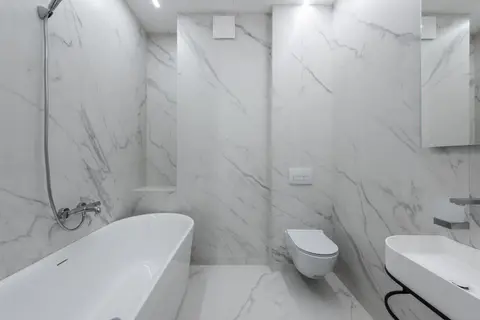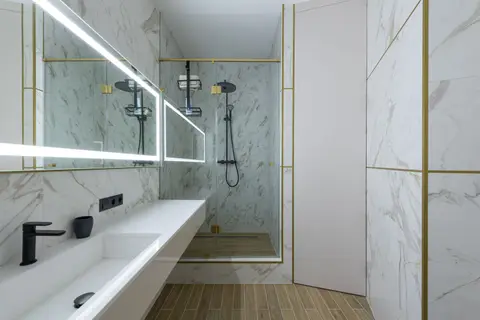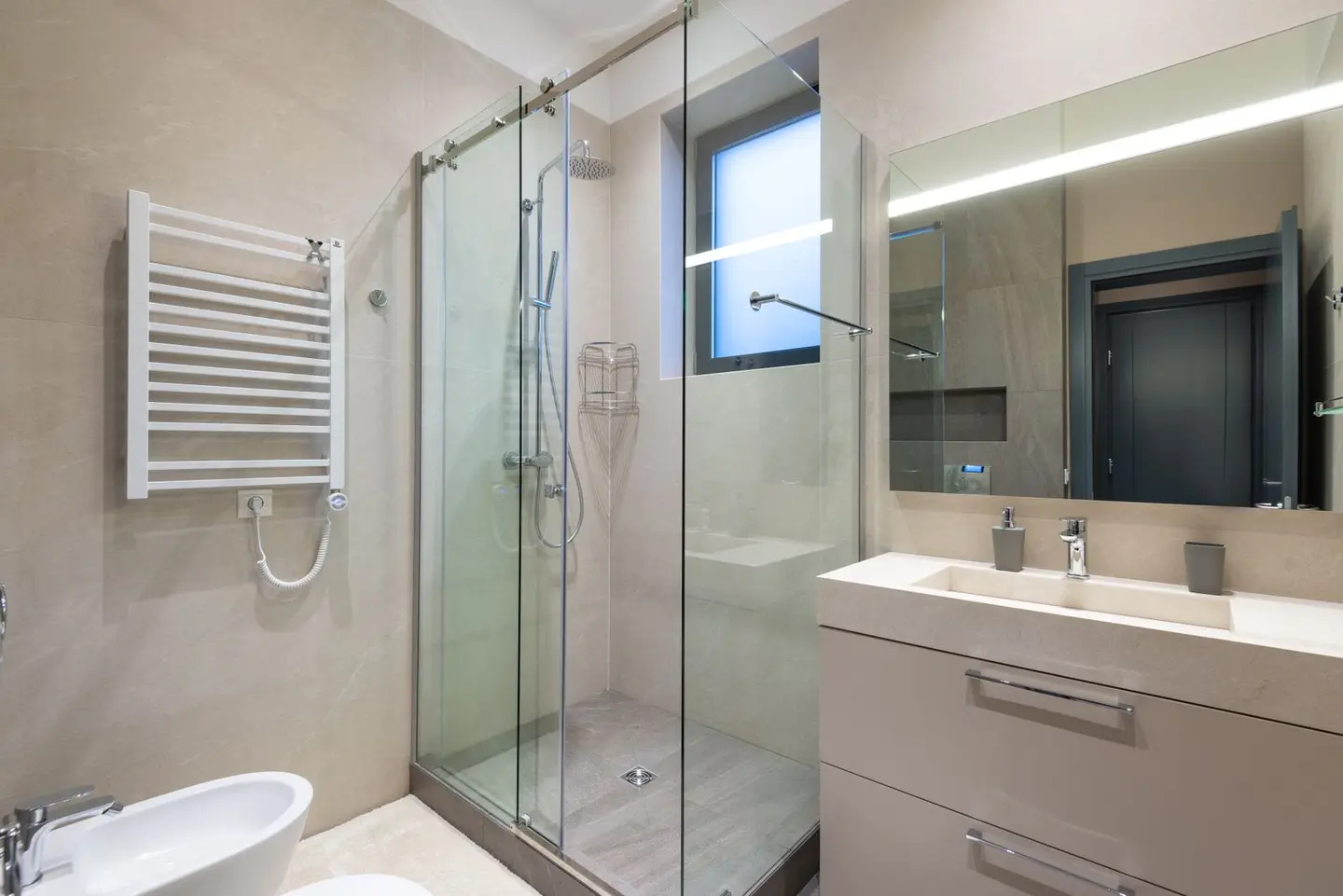
A heated mirror is one of the most consistently useful upgrades in a UK bathroom. At 0.5–1.5 kW, the demister pad behind the mirror keeps the glass clear within minutes of a shower, eliminating the wipe-down that precedes every use of an ordinary mirror. Add integrated LED lighting and magnification, and the combined fitting replaces multiple separate products. Costs range from £80 for a basic hardwired demister pad behind a standard mirror, to £500+ for a large illuminated frameless mirror with colour-adjustable lighting and sensor switching.
Beyond the mirror, understanding the rest of the bathroom extras market, heated towel rails, shaving sockets, extractor fans, and smart controls, helps prioritise a bathroom renovation budget effectively.
Bathroom Electrical Zones
Before specifying any electrical fitting in a bathroom, you need to understand BS 7671 (IET Wiring Regulations 18th Edition) bathroom zones, which dictate IP ratings and permitted fittings:
| Zone | Location | Minimum IP rating | Permitted fittings |
|---|---|---|---|
| Zone 0 | Inside the bath or shower tray | IPX7 | Only SELV (Safety Extra Low Voltage) fittings specifically rated for this zone |
| Zone 1 | Above the bath/shower tray up to 2.25 m height; shower enclosure | IPX4 | SELV or 230V fittings rated IPX4 minimum; RCD protected |
| Zone 2 | 0.6 m outside the bath rim; up to 3 m height; outside the shower enclosure | IPX4 | IPX4 minimum; RCD protected |
| Outside zones | Rest of the bathroom | IPX0+ | Standard fittings permissible; still RCD required |
All bathroom circuits must be RCD-protected, this is non-negotiable in any installation. In practice, this means bathroom circuits should be on an RCD or RCBO at the consumer unit.
Only SELV (Safety Extra Low Voltage, max 12V) fittings should be used in Zone 0. Shaver sockets with an isolating transformer are permitted outside Zone 1.
Switches: standard rocker switches are not permitted inside bathroom zones, pull-cord switches are used instead, or switches positioned outside the room.
Heated Mirrors
Demister Pads (Behind Existing Mirrors)
A resistive heating element bonded to the back of a mirror glass. Controlled by a wall switch (outside the zone) or by a motion sensor or mirror illumination circuit. A 300 × 400 mm pad typically runs at 20–40 W; a full 600 × 800 mm mirror demister uses 60–100 W.
- Supply cost: £25–£80 for the pad only
- Installation: must be wired by an electrician; typically £80–£150 per fitting added to a bathroom electrical project
Illuminated Mirrors with Integrated Demister
The most popular current format. LED lighting (usually along one or two edges, or as a backlit glow) combined with a rear demister pad, sold as a single unit. Features to compare:
- Colour temperature range: 3,000–5,000 K adjustable (warm to cool) is ideal, cooler light suits make-up application; warmer suits a relaxing soak.
- CRI: aim for CRI ≥90 for accurate colour rendering
- Magnification zone: a 5× or 10× magnifying insert is useful for contact lens users and shaving
- Sensor switching: infrared hand-wave sensor turns lights on/off without touching wet hands to a switch
- Display: some mirrors incorporate an integrated clock, temperature display, or Bluetooth speaker
Sizes from 500 × 700 mm to 1,200 × 700 mm are common. Prices:
| Mirror type | Supply price | Installed cost |
|---|---|---|
| Basic illuminated (no demister) | £60–£150 | £130–£250 |
| Illuminated + demister (standard) | £130–£300 | £220–£450 |
| Premium large illuminated + demister | £300–£600+ | £450–£800+ |
| Framed illuminated (oak, walnut) | £200–£500 | £300–£650 |
Heated Towel Rails
Hardwired Electric Towel Rails
Operate on a dedicated circuit with a timer or thermostat. No plumbing connection required, the best choice for bathrooms being renovated without extending the central heating system, or for en-suites and cloakrooms remote from the boiler.
Typical output: 60–250 W depending on size. Running cost: a 100 W rail on 4 hours/day at 26.11p/kWh (Ofgem price cap to 30 September 2026) costs approximately £38/year.
Styles: straight ladder rails, curved, angled, and dual-fuel (works either from the central heating system OR an electric element, ideal for summer use when the boiler is off).
- Supply cost: £80–£400
- Installed cost (hardwired): £150–£500 (add £80–£150 for wiring if a new circuit is required)
Plumbed Towel Rails (Central Heating)
Connected into the heating circuit via a manifold or direct T-junction. Requires a plumber and (for new pipework runs) a decorated chase. Output is higher and consistent across the heating season; cost per heat output is lower than electric if the boiler is already running.
- Supply cost: £80–£400
- Installed cost: £200–£600 (includes plumbing; assumes heating pipes are accessible nearby)
Shaving Sockets
A standard 13 A socket is not permitted in bathroom zones. Shaving sockets (BS EN 61558-2-5) incorporate an isolating transformer that provides 230 V and 115 V output and galvanic isolation, preventing electric shock. They must be positioned outside Zones 0 and 1 (at least 0.6 m from the bath rim).
- Supply cost: £15–£45 (illuminated, dual voltage)
- Installed cost: £60–£120 added to a bathroom rewire project
Extractor Fans
Building Regulations Part F requires adequate ventilation in bathrooms with no openable window (minimum 15 L/s for an intermittent fan, or 8 L/s continuous). For bathrooms with a window, ventilation is recommended but not mandated in the same way.1
| Extractor type | Supply cost | Notes |
|---|---|---|
| Basic axial fan | £20–£50 | Wired to light switch; satisfies Part F |
| Timer fan | £30–£70 | Runs on for set time after light off; better air change |
| Humidity-sensing fan | £50–£120 | Activates on humidity spike; quieter cycling |
| Inline centrifugal fan (ducted through loft) | £80–£250 | Quieter; suits higher-resistance duct runs |
All fans require a dedicated switched live from the light circuit or a separate switch, and must be RCD-protected.
Budget Summary: Typical Bathroom Extras
| Item | Budget range | Mid-range | Premium |
|---|---|---|---|
| Illuminated demister mirror | £200–£300 installed | £300–£500 | £500–£900+ |
| Electric heated towel rail | £150–£250 installed | £250–£450 | £450–£700+ |
| Shaving socket | £60–£90 installed | £80–£120 | - |
| Extractor fan (humidity sensing) | £120–£200 installed | £180–£280 | £300+ |
| Bathroom downlights (per fitting) | £40–£70 installed | £60–£100 | £100–£150+ |
For a full bathroom renovation, allow £600–£1,500 for all electrical extras (mirror, towel rail, fan, downlights, shaving socket) as a realistic mid-range figure, over and above the main sanitaryware and tiling costs.
References (1)
Figures in this note were checked against the sources below on 14 September 2026. Superscript numbers in the text point to them. Every source the site cites, by topic.
- 1technicalvery strongMinistry of Housing, Communities and Local Government.RN-QD1SFFTable 1.1 sets minimum intermittent extract rates: kitchen with a cooker hood extracting outside 30 l/s, kitchen without one 60 l/s, utility room 30 l/s, bathroom 15 l/s, sanitary accommodation 6 l/s. Extract terminals and fans other than cooker hoods should be as high as practicable and no more than 400mm below the ceiling; a cooker hood should sit between 650mm and 750mm above the hob if the manufacturer gives no figure. Table 1.7 requires background ventilators of at least 8000mm2 equivalent area in habitable rooms and kitchens for a dwelling, 10,000mm2 for a single-storey dwelling. Background ventilators should be at least 1700mm above floor level and at least 500mm from a fan in the same room. On replacement windows, paragraph 3.14 says new windows must carry background ventilators no smaller than the originals, and paragraph 3.15 gives the fallback minimums where the old size is unknown: 8000mm2 habitable rooms, 8000mm2 kitchen, 4000mm2 bathroom. Paragraph 3.32 confirms that replacing an extractor fan or cooker hood on existing cabling is not notifiable.
-
Approved Document F, Ventilation, Volume 1: Dwellings, 2021 edition, Ministry of Housing, Communities and Local Government, accessed 14 September 2026. assets.publishing.service.gov.uk