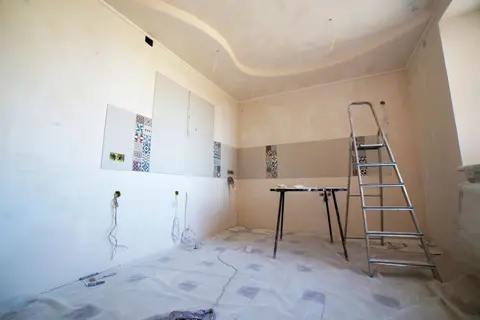
Living through a renovation is one of the most underestimated challenges of home improvement. The dust, noise, and loss of basic facilities are manageable, but only if you plan for them before work starts, not once the first wall has been opened up.
Whether you stay on site or move out temporarily depends on the scale of the project, your household (particularly children, elderly relatives, or pets), and your budget for alternative accommodation. Many homeowners doing a full gut renovation lasting more than three months find that moving out works out cheaper when you account for lost productivity, stress, and the very real risk of a delayed project caused by having to work around an occupied home.
Should You Stay or Move Out?
The honest answer depends on what’s being done. A kitchen extension with the rest of the house intact is liveable with some organisation. A full rewire, replumb, or structural alteration to a single-storey home may leave you without a functioning kitchen, bathroom, or heating for weeks at a time.
| Work Type | Stay or Go? | Key Consideration |
|---|---|---|
| Single room refurb (kitchen or bathroom) | Stay | Plan alternative washing / cooking facilities |
| Loft conversion only | Stay | Scaffold/roof opening causes cold and damp ingress |
| Full rewire or replumb | Marginal, go if budget allows | Multiple rooms unusable simultaneously |
| Structural work / extensions | Go if budget allows | Noise, dust, and access disruption are severe |
| Full house renovation | Move out | Almost always the right call for projects over 3 months |
Temporary accommodation costs (UK, 2026): The ONS puts the average private rent at £2,332 a month in London and £1,459 across England in August 2026, falling to £788 in the North East.1 Furnished short-lets usually cost more than these averages. Housing a family elsewhere for four to six weeks will typically cost £1,500–£4,000 or more depending on location, often less than the cost of a delayed or chaotic project.
Setting Up Zones
If you are staying, zone management is non-negotiable. Divide the property into live zones (where you sleep and eat) and work zones, and seal the boundary between them.
- Use heavy-duty polythene sheeting fixed to door frames with adhesive tape to form an airtight barrier.
- Replace internal doors with zip-wall dust barriers on days of major demolition, these allow contractors to pass through without breaking the seal.
- Identify a single point of entry from outside for tradespeople, and keep it away from the live zone if possible.
- Position temporary kitchen facilities (a microwave, kettle, and camping stove) in a room with an external door if your kitchen is out of action.
Dust Control
Construction dust, particularly from plaster skim, cutting brickwork, or sanding floors, is a genuine health hazard and will permeate a property far beyond the immediate work area if uncontrolled. Fine silica dust from cutting concrete or blocks is a long-term lung hazard (Control of Substances Hazardous to Health Regulations 2002 apply to contractors on site).2
Practical measures for homeowners:
- Insist contractors use on-tool dust extraction or water suppression when cutting, which is how HSE guidance expects construction dust to be controlled.2
- Run a negative pressure arrangement in the work zone: a box fan blowing outward through a window exhausts dusty air outside rather than into the house. Cost: £30–£80 for a decent box fan.
- Seal any extract fans, trickle vents and, if you have MVHR, its ducts in the work zone, so dust does not travel through the house.
- Cover furniture in adjacent rooms with dust sheets (a pack of 10 cotton/polythene sheets costs £15–£40).
- Wipe skirting boards, window cills, and hard surfaces daily in live zones; dust settles surprisingly far from the source.
Managing Utility Disruptions
Expect water, electricity, and gas to be disrupted at various stages. Good contractors will notify you in advance, but you should ask for a schedule of outages before work starts.
- Water off: Understand where the isolation valves are for each section of pipework. A full water shutdown should rarely last more than half a day for planned plumbing work. If it’s longer, arrange water from a neighbour or have containers filled.
- Electricity off: A consumer unit replacement or major rewire may leave you without power for a full working day or more. A petrol/diesel generator (hire cost £30–£60/day) can power essentials. Battery-powered lighting is cheap insurance.
- Gas off: Anyone employed to disconnect, move or reconnect gas appliances must be a Gas Safe registered engineer, who should check the installation is safe before turning the supply back on.3 Plan for at least a day without gas cooking or heating while that work is done.
- Boiler/heating off: If work falls between October and April, plan for this explicitly. Temporary electric oil-filled radiators (£20–£60 each to buy, £15–£25/week to hire) are a practical bridging solution.
Working With Contractors on an Occupied Site
Having occupants on site changes the working dynamic. Be honest with contractors upfront, it affects how they plan sequencing, how they store materials, and whether they can leave work half-done over a weekend.
Practical ground rules to agree in writing or at least verbally:
- Start and finish times. Councils commonly recommend no noisy building work outside 8am–6pm Monday to Friday and 8am–1pm on Saturday, with none on Sundays or bank holidays.4 These are recommended hours rather than a national law, but a council can set the hours for noisy works by serving a notice under section 60 of the Control of Pollution Act 1974.5 Agree the hours for your site.
- Locking up. Who is responsible for securing the property each evening? If contractors have a key, make sure you have a written record.
- Waste. Where does rubble, packaging, and off-cuts go? A skip on a public road needs a licence from the local council, usually arranged by the skip hire company, and fees vary by council.6
- Deliveries. Material deliveries, particularly for a loft conversion or extension, often arrive on pallets. Decide in advance where they will be stored.
- Bathrooms. Agree whether contractors will use your toilet. Most homeowners find it easier to allow use of one designated bathroom rather than deal with site toilet hire (about £36–£45 a week for a serviced portable unit, plus delivery and collection).7
Protecting Children and Pets
Children and pets present specific risks on an active building site.
- Under the Construction (Design and Management) Regulations 2015, a homeowner’s client duties normally pass to the contractor, who must manage health and safety on the job; outside working hours, keeping your household away from the work area is down to you.8
- Block off all work zone access points each evening, a bolt on the homeowner’s side of the dust barrier is the simplest method.
- Loose screws, nails, and cable off-cuts are found universally on floors in work zones. Keep pets out even when you think the site is tidy.
- Silica and lead dust pose serious health risks to young children. Lead is likely in older paintwork, because lead pigments were widely used in household paint until the 1960s and not removed from all common paints until the early 1980s.9 If in doubt, arrange for children to stay elsewhere during the most disruptive phases.
Timeline Expectations
Renovation projects often run late, usually because of hidden defects, design changes or supply delays, so ask any builder you are vetting how they handle delays.
| Project Type | Typical Duration | Common Delay Causes |
|---|---|---|
| Single bathroom refurb | 1–2 weeks | Tiling delays, bespoke sanitaryware lead times |
| Kitchen extension (single-storey) | 10–16 weeks | Groundworks weather dependency, steel fabrication |
| Full loft conversion | 8–14 weeks | Planning conditions, structural engineer sign-off |
| Full house renovation | 4–12 months | Supply chain, design changes, hidden defects |
Build a minimum 10–15% time contingency into your planning, particularly if children’s school terms or lease end-dates are hard constraints. Communicate this buffer to contractors, they should know that the programme has flexibility even if you privately want it done sooner.
Mental Health and Household Stress
Living in a building site is stressful in ways that are easy to underestimate before it starts. Dust, noise from 8am, loss of normal domestic routines, and the constant presence of strangers in your home all compound over weeks and months.
Practical ways to manage this:
- Designate one room as a no-work, no-contractor zone where the household can decompress.
- Schedule a weekly site meeting with the lead contractor to review progress and flag issues, it reduces the background anxiety of not knowing what is happening.
- Set a communication boundary: agree whether questions go via WhatsApp, phone call, or a site visit, and stick to it.
- If you have a project manager or architect administering the contract, use them as a buffer for difficult conversations.
The projects that work best tend to be the ones where the homeowner is engaged but not hovering, trusts competent tradespeople to get on with it, and has thought through the domestic logistics as carefully as the design.
References (9)
Figures in this note were checked against the sources below on 6 October 2026. Superscript numbers in the text point to them. Every source the site cites, by topic.
- 1costvery strongOffice for National Statistics.RN-RHM0XAA price, true at 2026-08. ONS monthly bulletin on private rents and house prices. It gives average monthly private rent for August 2026: £2,332 in London, £1,459 in England and £788 in the North East.
- 2technicalvery strongHealth and Safety Executive, guidance.RN-CDLNT7The specific HSE information sheet behind the dust advice, with the numbers a note can quote. Names three types of construction dust: silica dust, also called respirable crystalline silica, from concrete, mortar and sandstone; wood dust from softwood, hardwood and wood-based products including MDF and plywood; and other general dust from materials with little or no silica, most commonly gypsum as in plasterboard, limestone, marble and dolomite. States that over 500 construction workers are believed to die from exposure to silica dust every year, and that the main dust-related diseases are lung cancer, silicosis, chronic obstructive pulmonary disease and asthma, most developing slowly though advanced silicosis and asthma can come on quickly. The legal framework is the Control of Substances Hazardous to Health Regulations 2002, and the three required steps are Assess, Control and Review. On damping down it corrects a common site habit: water needs enough supply at the right levels for the whole time the work is being done, and just wetting the material beforehand does not work. High dust levels come from high-energy tools such as cut-off saws, grinders and grit blasters.
- 3technicalvery strongHealth and Safety Executive, guidance.RN-HNP39HHSE's domestic gas safety FAQs; they state that anyone employed to work on gas appliances in a home must be on the Gas Safe Register.
- 4technicalstrong locallySpelthorne Borough Council, guidance.RN-L0K2XDA council page illustrating local practice on building noise. It recommends no noisy work outside 8am to 6pm Monday to Friday and 8am to 1pm Saturday, and none on Sundays or bank holidays.
- 5technicalvery strongThe National Archives, guidance.RN-9QKNW3Section 60 of the Control of Pollution Act 1974. It lets a local authority serve a notice on construction works that can specify the permitted working hours and noise levels.
- 6technicalvery strongGOV.UK, guidance.RN-UE5N0QThe government's licence page for skips. It says a skip on a public road needs a council licence and that the skip hire company usually obtains it.
- 7technicalsupplier figureHSS Hire, guidance.RN-FMOBQ5HSS Hire product page for a single portable site toilet; it gives the weekly hire price with and without VAT, including a weekly empty and clean.
- 8technicalvery strongHealth and Safety Executive, guidance.RN-D7GLU7HSE page (updated 7 October 2025) defining a domestic client under CDM 2015 as any individual having construction work done on their own home or a family member's home that is not part of a business. On a single-contractor project the contractor automatically takes on the client's legal duties; where there is more than one contractor the principal contractor takes them on, unless the client makes a written agreement for the designer to act as principal designer.
- 9technicalvery strongHealth and Safety Executive, guidance.RN-DF6UI1HSE's construction lead page. It states lead pigments were commonly used in paints for buildings until the 1960s and that lead was not removed from all commonly used paint until the early 1980s, which is the date test any note about stripping paint in an older house needs. The highest-risk activities it names are stripping or preparing leaded paint from doors and windows, working with lead on roofs, hot cutting of lead or leaded paint in demolition, and blast removal of old leaded paint. Health effects include anaemia and kidney disease, with chronic exposure risking kidney, nerve and brain damage, and a link to a small number of occupational cancers. The governing law is the Control of Lead at Work Regulations 2002, which requires employers to protect employees from the risks from lead, applied through an Assess, Control and Review model with FFP3 respiratory protection at an assigned protection factor of 20, changed work methods, dust control, protective clothing, hygiene and medical surveillance.
-
Private rent and house prices, UK, Office for National Statistics, accessed 30 September 2026. Priced at 2026-08 and left there. ons.gov.uk
-
Construction dust (Construction Information Sheet No 36), Health and Safety Executive, accessed 30 September 2026. hse.gov.uk
-
Domestic gas: frequently asked questions, Health and Safety Executive, accessed 30 September 2026. hse.gov.uk
-
Noise from demolition and construction sites, Spelthorne Borough Council, accessed 30 September 2026. spelthorne.gov.uk
-
Control of Pollution Act 1974, section 60: Control of noise on construction sites, The National Archives, accessed 30 September 2026. legislation.gov.uk
-
Skip licence (England and Wales), GOV.UK, accessed 30 September 2026. gov.uk
-
Portable Toilet Hire: Serviced Single Unit, Weekly Clean Included, HSS Hire, accessed 6 October 2026. hss.com
-
CDM 2015: Domestic clients, Health and Safety Executive, accessed 30 September 2026. hse.gov.uk
-
Construction hazardous substances: Lead, Health and Safety Executive, accessed 30 September 2026. hse.gov.uk