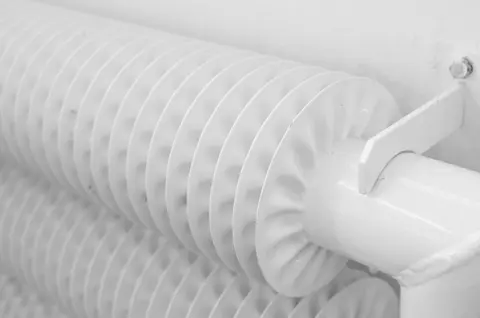
Choosing the right radiator matters for both warmth and energy bills. Get the output wrong and a room stays cold even with the boiler running hard; get the style wrong and a perfectly functional radiator can look out of place for years. This guide explains the main radiator types available in the UK, their typical costs, heat outputs, and which suits which situation.
How Radiators Actually Work
All wet-system radiators do the same job: hot water circulates from the boiler, heat transfers through the metal body into the room, and cooled water returns to be reheated. The differences between types come down to body design, material, surface area, and flow characteristics, all of which affect how quickly they heat a space and how they integrate with modern condensing boilers and heat pumps.
Panel Radiators (Compact Radiators)
Panel radiators, sometimes called compact or convector radiators, are the most common type fitted in UK homes since the 1980s. They consist of flat pressed-steel panels with corrugated fins (convectors) welded behind them. Hot water flows through internal channels.
Single panel (Type 11): One panel, one convector. Lower output, best for small rooms or mild climates. Typical price: £30–£60.
Double panel, single convector (Type 21): Two panels with one convector between them. A good middle-ground option. Typical price: £40–£80.
Double panel, double convector (Type 22): The most common choice for UK living rooms and bedrooms. Two panels, two convector grilles. Significantly higher output than Type 11. Typical price: £55–£130.
Key advantage: cheapest per BTU of any radiator type, widely available, easy to replace like-for-like.
Key limitation: plain appearance; not suited to period properties or high-end refurbishments.
Column Radiators
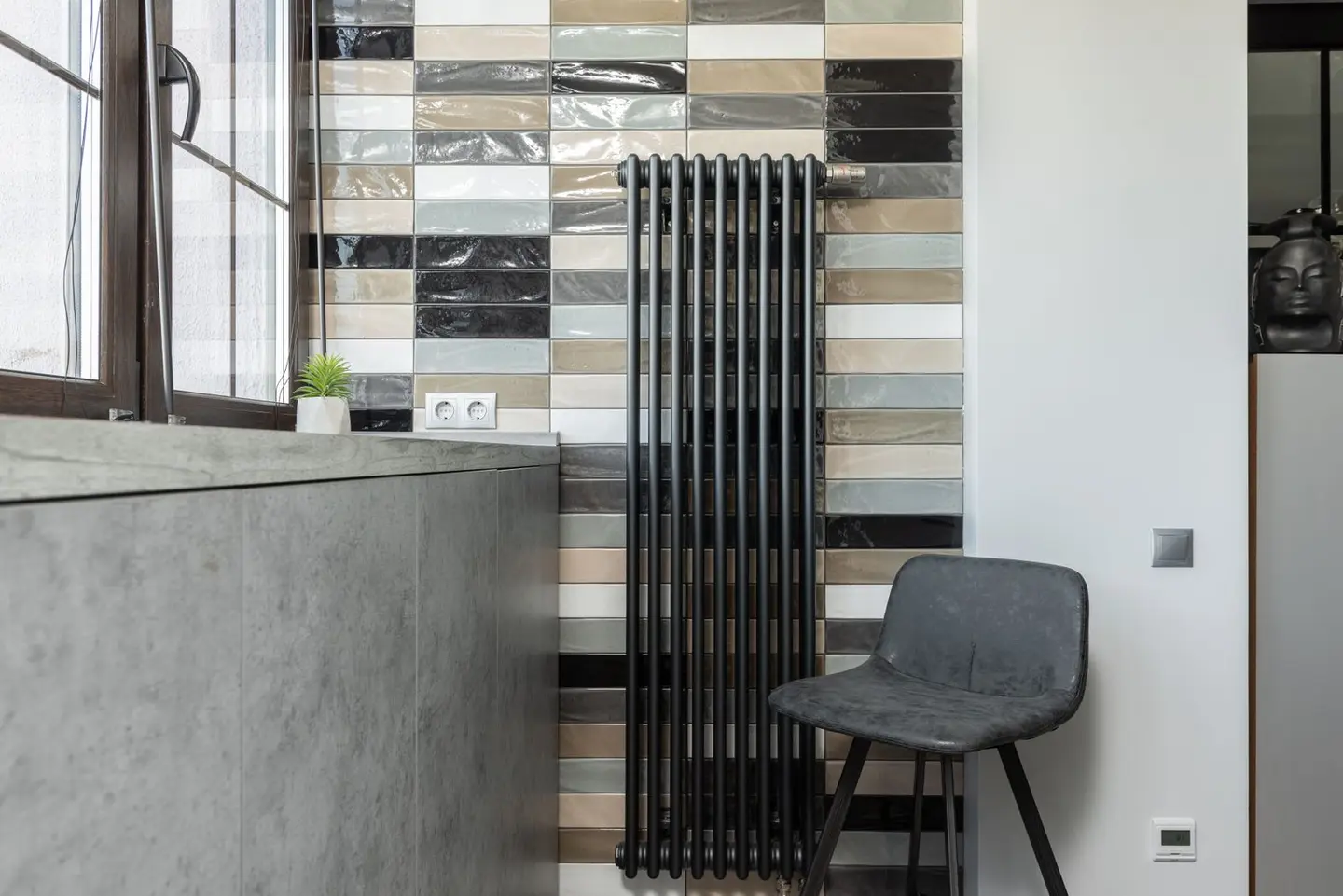
Column radiators use hollow vertical columns, typically round or oval in cross-section, connected at top and bottom headers. Water flows through every column, giving a large wetted surface area. Traditional cast-iron column radiators date to the Victorian era; modern versions are mild steel or aluminium.
Steel column radiators are the most popular current choice. They heat up faster than cast iron and work well with condensing boilers running lower flow temperatures (60–70 °C). Output per section is typically 80–120 W at standard delta-T 50 conditions.
Cast-iron column radiators (salvaged or reproduction) retain heat longer after the boiler cycles off, which some homeowners appreciate in large period rooms. However, they are heavier, require stronger wall fixings, and their higher water volume makes them less efficient with modern low-temperature systems.
Prices vary widely by number of sections, height, and finish. A standard 4-column steel unit at 600 mm high, 10 sections costs roughly £180–£320. A 3-column cast-iron reproduction equivalent runs £350–£700 or more.1
Designer and Towel Radiators
Designer radiators prioritise appearance while still providing adequate heat output. Common formats include:
- Flat-panel designer radiators: Smooth front face, sometimes in non-white RAL colours. Useful where a minimal look is needed. Output is often lower per square metre of wall space than Type 22 panels.
- Vertical radiators: Space-saving where horizontal wall runs are short, hallways, kitchens, narrow chimney breast alcoves. Heights of 1,200–1,800 mm are common.
- Towel rails (ladder radiators): Primarily for bathrooms. Heated towel rails connected to the wet system keep towels dry and contribute background warmth. Electric-only or dual-fuel (electric element + hot water) versions allow summer use without the boiler running.
- Bespoke / statement radiators: Mirror radiators, fluted steel, raw iron finishes. Prices from £400 to over £2,000 for large feature pieces.
Aluminium Radiators
Aluminium heats up and cools down faster than steel, making it well matched to weather-compensated controls and heat pump systems operating at lower flow temperatures (35–55 °C). Output per kilogram of radiator weight is higher than steel. Typical costs are 20–40 % more than equivalent steel panel radiators. Worth considering if you are planning a heat pump installation.
Radiator Comparison Table
| Type | Typical cost (unit only) | Material | Best for | Notes |
|---|---|---|---|---|
| Panel Type 11 | £30–£60 | Steel | Small rooms, supplementary heat | Cheapest output |
| Panel Type 22 | £55–£130 | Steel | Most UK rooms | Best value heat output |
| Column (steel) | £150–£400 | Steel | Period rooms, open plan | Good aesthetics, moderate cost |
| Column (cast iron) | £300–£900 | Cast iron | Victorian/Edwardian restorations | Heavy, slow response |
| Aluminium panel | £80–£200 | Aluminium | Heat pump systems | Fast response, low-temp efficient |
| Designer/vertical | £200–£1,000+ | Steel/aluminium | Kitchens, hallways, feature rooms | Output varies widely, check spec |
| Towel rail (wet) | £60–£300 | Steel/brass | Bathrooms | Low heat output as room heater |
Sizing: How Much Output Do You Need?
The standard rule of thumb for UK homes with double glazing and reasonable insulation is roughly 100 W per square metre of floor area for living rooms and bedrooms, and 150 W per square metre for bathrooms (which lose more heat). These are starting points; a properly sized radiator should be specified using room heat-loss calculations accounting for wall U-values, window area, and room height.
For a typical UK lounge of 18 m², you need around 1,800 W (approximately 6,100 BTU/hr). A standard 600 mm × 1,200 mm double panel double convector radiator delivers around 1,900–2,100 W at delta-T 50, which is a good match.
If you are moving to a heat pump (which runs at lower flow temperatures, typically 45–55 °C rather than 70–80 °C), your existing radiators may be undersized because output drops significantly at lower delta-T. A radiator giving 2,000 W at delta-T 50 might deliver only around 1,100–1,300 W at delta-T 25, the typical heat pump operating condition. This is why heat pump installations often require radiator upgrades or underfloor heating.
Installation Costs
Supply and fit by a Gas Safe or competent plumber typically costs:
- Straightforward like-for-like swap (same position, existing valves): £80–£150 labour per radiator.
- New position requiring pipework re-routing: £150–£350 per radiator.
- New radiator circuit from manifold: priced per job, typically £400–£800 for a single new circuit.
Thermostatic radiator valves (TRVs) should be fitted on all radiators except the one nearest the boiler room thermostat. TRVs cost £10–£30 per pair and allow room-by-room temperature control, which the Building Regulations (Part L) now effectively require in new and replacement heating systems.2
What to Look for When Buying
- Check the BTU/W output at delta-T 50, this is the industry standard for comparison. Some online retailers list output at lower delta-T to make numbers look lower; always compare like with like.
- Confirm connection centres, UK standard is 50 mm between flow and return connections. Unusual spacings can complicate installation.
- Choose finish carefully, powder-coated white is the most forgiving and easiest to touch up. Brushed steel and chrome show limescale and watermarks in hard-water areas.
- Consider valve compatibility, some designer radiators require specific valve types. Confirm before ordering.
Building Regulations
Replacement radiators in existing dwellings do not typically require Building Regulations approval as a standalone job. However, if you are replacing your boiler at the same time, Part L (Conservation of Fuel and Power) applies and requires TRVs, a room thermostat, and a programmer as a minimum. Notifiable work must be signed off by a Gas Safe registered engineer or through a local authority building control application.2
References (2)
Figures in this note were checked against the sources below on 14 September 2026. Superscript numbers in the text point to them. Every source the site cites, by topic.
- 1costsupplier figureScrewfix.RN-5PFKNLA price, true at 2026-09. the retail price Screwfix publishes for acova 600mm x 628mm 2009btu white horizontal 2 column radiator, which is the supply figure the cost book records for this item
- 2technicalvery strongMinistry of Housing, Communities and Local Government.RN-L0FCJXThe in-force U-value tables a DIY insulation or door note must quote, with the exact numbers. Table 4.2, limiting U-values for new fabric elements in existing dwellings, sets roof 0.15, wall 0.18, floor 0.18, swimming pool basin 0.25, window 1.4 or Window Energy Rating Band B minimum, rooflight 2.2, doors with more than 60 per cent of the internal face glazed 1.4 or Doorset Energy Rating Band C minimum, and other doors 1.4 or Doorset Energy Rating Band B minimum. Table 4.3, for existing elements, gives a roof threshold of 0.35 and an improved value of 0.16, which is the figure a loft insulation note needs: paragraph 4.12 says a retained element whose U-value is higher than the column (a) threshold, for example through a loft or garage conversion, should be upgraded to the column (b) value. Paragraph 4.13 allows a lesser upgrade only where the improved value is not technically or functionally feasible or would not achieve a simple payback of 15 years or less. Paragraph 4.8 requires a replacement element to be no worse than the one it replaces as well as meeting Table 4.2. Paragraph 4.10 gives the heritage exception: where character must be maintained, a centre pane U-value of no more than 1.2 or low-emissivity secondary glazing. Note 9 records that the timber window concession of 1.6 or Band C ended on 14 June 2023. The 2021 edition came into force on 15 June 2022; a 2026 edition exists at https://assets.publishing.service.gov.uk/media/69c122a6cfa346b9d4704a55/ADL1_2026.pdf.
-
acova 600mm x 628mm 2009btu white horizontal 2 column radiator, Screwfix, accessed 16 September 2026. Priced at 2026-09, so no calibration is needed. screwfix.com
-
Approved Document L, Conservation of fuel and power, Volume 1: Dwellings, 2021 edition incorporating 2023 amendments, Ministry of Housing, Communities and Local Government, accessed 14 September 2026. assets.publishing.service.gov.uk