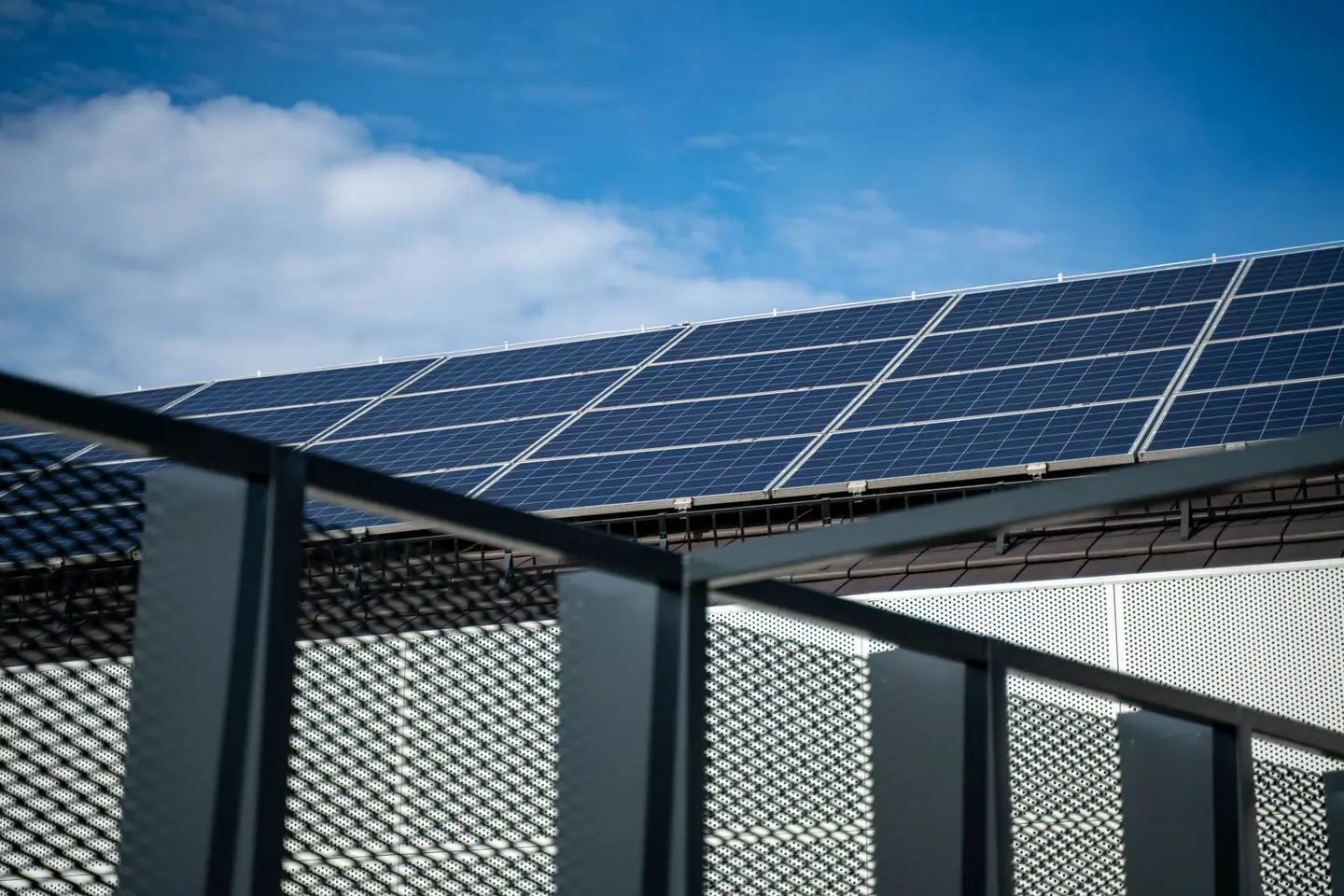
Solar photovoltaic (PV) panels have become one of the most cost-effective home energy investments available in the UK. With electricity prices substantially higher than a decade ago, a solar panel system can meaningfully reduce your bills from the day it is switched on, and with 25-year panel lifespans now standard, the long-term financial case is strong.
What Does a Solar Panel System Cost in 2026?
The cost depends primarily on the size of the system, measured in kilowatt-peak (kWp), the system’s maximum output under ideal conditions.
Typical installed costs (inc. VAT at 0%, 2026):
| System size | Suitable for | Installed cost | Annual generation estimate |
|---|---|---|---|
| 2–3 kWp | 1–2 bed flat/terrace | £3,500–£5,500 | 1,700–2,600 kWh |
| 4 kWp | 3-bed semi | £5,500–£7,500 | 3,400 kWh |
| 5–6 kWp | 4–5 bed detached | £7,000–£10,000 | 4,250–5,100 kWh |
| 6+ kWp with battery | Large property | £9,500–£15,000 | 5,100+ kWh + storage |
VAT on solar panel installations is 0% where a contractor supplies and installs the system. The relief runs to 31 March 2027, after which it reverts to the reduced rate of 5%, not to 20%. Panels bought without installation are standard-rated at 20%.1
These costs include panels, inverter, mounting system, cabling, and connection to the grid. They do not include scaffolding (£600–£1,200) if required, or roof repairs that may be needed before installation.
Smart Export Guarantee (SEG): Getting Paid for Surplus
The Smart Export Guarantee (SEG) obligation came into force on 1 January 2020, following the Feed-in Tariff, which closed to new applicants on 31 March 2019.2 Suppliers with at least 150,000 domestic electricity customers must offer a SEG tariff; smaller suppliers may opt in. The rate is set by each supplier, not by the government, and must always be above zero.3
Typical SEG rates from major suppliers (early 2026):
| Supplier | SEG rate (approx.) | Notes |
|---|---|---|
| Octopus Energy (Outgoing Octopus) | 15p/kWh | Variable, tracks wholesale |
| OVO Energy | 5.5p/kWh | Fixed rate |
| British Gas | 5.0p/kWh | Fixed rate |
| E.ON Next | 5.5p/kWh | Fixed rate |
| EDF Energy | 5.5p/kWh | Fixed rate |
Octopus Energy’s Outgoing Octopus tariff, which pays a variable rate linked to wholesale electricity prices, has consistently outperformed fixed-rate competitors but carries some variability. You can switch SEG provider independently of your electricity supply contract.
To receive SEG payments you must show that the installation and installer are suitably certified, normally with an MCS certificate, though Ofgem also accepts schemes it treats as equivalent. You apply directly to the SEG supplier, and you need an export meter that takes half-hourly readings.2
Calculating Your Payback Period
The payback calculation depends on four variables: system cost, self-consumption rate, electricity avoided, and export earnings.
Worked example, 4 kWp system on a 3-bed semi in the Midlands:
| Factor | Figure |
|---|---|
| System installed cost | £6,500 |
| Annual generation | ~3,400 kWh |
| Self-consumption rate | ~40% (1,360 kWh used directly) |
| Electricity unit rate avoided | 24p/kWh |
| Annual saving from self-consumption | £326 |
| Surplus exported (2,040 kWh at 7p SEG) | £143 |
| Total annual benefit | £469 |
| Simple payback period | ~13.9 years |
The 24p unit rate above is deliberately conservative against the Ofgem price cap, which sets an average direct debit electricity rate of 26.11p/kWh to 30 September 2026 and 26.32p/kWh from 1 October.4 At the October rate the same system saves £358 a year from self-consumption rather than £326, and the simple payback comes down to about 13 years.
If electricity prices rise (the long-run direction), or if you add a battery to increase self-consumption to 70–80%, the payback shortens meaningfully. A battery adding £2,500–£4,000 to upfront costs can increase annual savings by £300–£500 if you are a high daytime user, shortening the combined payback to 10–12 years in many cases.
South-facing roofs at 30–40° pitch generate roughly 10–15% more than average; north-facing or heavily shaded roofs can generate 20–30% less. Most professional installers will provide a site-specific generation estimate.
Battery Storage: Does It Add Up?
A solar battery stores excess daytime generation for use in the evening, increasing your self-consumption rate from a typical 30–40% to 60–80%. Common battery options in 2026:
| Battery | Usable capacity | Installed cost (approx.) | Cycles (lifespan) |
|---|---|---|---|
| Tesla Powerwall 3 | 13.5 kWh | £8,500–£10,000 | 3,000+ |
| Givenergy 9.5 kWh | 9.5 kWh | £4,500–£6,000 | 6,000 |
| SolarEdge Home Battery | 9.7 kWh | £5,000–£6,500 | 6,000 |
| Pylontech US3000C (per module) | 3.5 kWh | £1,800–£2,400 | 6,000 |
For a typical household using 3,500 kWh per year, a 10 kWh battery is more than sufficient for most evenings. Batteries work best when combined with time-of-use tariffs (such as Octopus Flux or Intelligent Octopus), where you can also import cheap overnight electricity to charge the battery.
VAT on battery storage has been 0% since 1 February 2024 where a contractor installs it, whether alongside solar panels or retrofitted later.1
Is Solar Worth It in 2026?
For the majority of UK homeowners with a south, east, or west-facing roof in reasonable condition, solar panels represent a sound financial decision in 2026. Key factors that make the case stronger:
- Electricity prices are high relative to the past decade and are unlikely to return to 2018–2019 levels
- Panel technology has matured; 25-year performance warranties are now standard from reputable manufacturers
- Zero VAT substantially reduces upfront cost
- Systems are now largely plug-and-play for MCS installers, reducing labour variability
The case is less compelling for:
- North-facing or heavily shaded roofs (generation may be 30–40% below average)
- Properties where the roof needs significant repairs before installation
- Leaseholders or properties in blocks of flats where grid connection approval is complex
Planning Permission and Building Regulations
In England, solar panels on a house are generally Permitted Development, planning permission is not required, provided the panels do not protrude more than 0.2 m beyond the roof slope (or sit more than 0.6 m above a flat roof), stay below the highest part of the roof, and the property is not listed or a scheduled monument. In a conservation area or World Heritage Site, Permitted Development rights are withdrawn for panels on a wall that fronts a highway; roof-mounted panels are not caught by that restriction.5
Building Regulations (Part P for electrical safety) apply. A competent person scheme-registered installer (NAPIT, NICEIC, or similar) can self-certify the installation, meaning you do not need a separate building control application.6 Your installer should provide a completion certificate.
Finding an Installer
Use an MCS-certified installer. MCS certification is what SEG suppliers normally ask for, and it is the usual gateway to grant schemes. The MCS website has a postcode search. Get at least three quotes; prices can vary by £1,000–£2,500 for the same system between installers.
Ask each installer to provide:
- An MCS-compliant design and specification document
- Manufacturer datasheets and warranty terms for the panels and inverter
- A generation estimate using PVGIS or equivalent software, not a verbal estimate
- Details of any monitoring app or system they include
- References for completed installations of similar size
The Renewable Energy Consumer Code (RECC) covers most solar installers and gives you access to ADR if a dispute arises. The 14-day right to cancel is separate and statutory: it comes from the Consumer Contracts Regulations 2013 and applies to any contract signed at your home or at a distance, RECC member or not.7
With a 25-year panel lifespan and current electricity prices, a well-specified solar installation remains one of the best-returning home improvement investments available to UK homeowners in 2026.
The rules in this note are those that apply in England. Scotland, Wales and Northern Ireland have their own building standards and permitted development rights.
References (7)
Figures in this note were checked against the sources below on 9 September 2026. Superscript numbers in the text point to them. Every source the site cites, by topic.
- 1technicalvery strongHM Revenue & Customs, guidance.RN-1HRJJ7Section 2.1 sets a zero rate of VAT on the installation of energy-saving materials in residential accommodation from 1 May 2023 to 31 March 2027, after which the rate reverts to the 5% reduced rate; section 2.22 extended it to buildings used solely for relevant charitable purposes from 1 February 2024. Section 2.7 lists the qualifying materials: central heating and hot water controls, draught stripping, insulation to walls, floors, ceilings, roofs, lofts and pipes, solar panels, wind turbines, water turbines, ground source heat pumps, air source heat pumps, micro combined heat and power units and wood-fuelled boilers, with water source heat pumps, batteries for energy storage and smart diverters added on 1 February 2024. Section 2.3 is the critical rule for a renovation note: relief applies to an installation service, or materials supplied and installed together, but materials bought without installation stay standard-rated at 20%.
- 2technicalvery strongOfgem, guidance.RN-OVV4PPOfgem's generator-facing SEG guidance, December 2019. The SEG obligation came into force on 1 January 2020 and follows the Feed-in Tariff scheme, which closed on 31 March 2019. Eligible technologies are AD, hydro, onshore wind and solar PV with a total installed capacity up to 5MW, and micro-CHP up to 50kW. Paragraph 1.12: for PV, wind and micro-CHP installations up to 50kW applicants are asked to demonstrate that the installation and installer are suitably certified, which may be an MCS certificate, but the SEG also recognises other schemes as equivalent to MCS. Paragraph 1.13: without an MCS certificate the installation and installer should be accredited to EN 45011 or EN ISO/IEC 17065:2012. Paragraph 1.17: export must be metered by a meter capable of half-hourly measurement with an export MPAN. Paragraph 1.25: a generator must not be receiving a FIT export tariff while claiming SEG, though FIT generation-only installations can take a SEG export tariff.
- 3technicalvery strongOfgem, guidance.RN-8LC718Defines the two classes of SEG licensee. A supplier is a Mandatory SEG Licensee if it has at least 150,000 domestic electricity customers as at 31 December of the immediately preceding year, and it cannot opt out of offering SEG payments. A supplier with fewer than 150,000 domestic electricity customers as at the same date is a Voluntary SEG Licensee and may choose to opt in. SEG licensees choose the tariff rate, contract length and some other terms they offer generators, and any SEG tariff rate offered must always be above zero. Useful for correcting the common phrasing 'more than 150,000 customers', which misses both the 'at least' and the 'domestic' qualifiers.
- 4technicalvery strongOfgem.RN-YYE8U2The live source for any running-cost sum in a heating note. For 1 October to 31 December 2026 the direct debit cap is 26.32p per kWh for electricity with a 54.83p daily standing charge, and 7.97p per kWh for gas with a 29.68p daily standing charge, giving a typical annual dual fuel bill of £1,723, a 4% rise on the previous period. Ofgem states these are the average unit rate and standing charge for direct debit customers in England, Scotland and Wales; gas prices include 5% VAT while electricity carried no VAT in this period. The cap is reset every three months, so any note quoting a pence-per-kWh figure should be dated against this page.
- 5technicalvery strongThe National Archives (legislation.gov.uk), UK Statutory Instrument 2015/596, as amended, legislation.RN-Y3V96CThe permitted development rules for solar panels and heat pumps in England, in their currently amended form, so this is the text to check before saying anything needs planning permission. Class A covers solar PV and solar thermal on domestic premises: the equipment must not protrude more than 0.2 m beyond the plane of a wall or pitched roof slope, must not sit higher than the highest part of the roof excluding chimneys, and on a flat roof must not exceed 0.6 m above the highest part of the roof. Wall mounted equipment is limited to 0.2 m protrusion where the wall abuts a highway and 0.4 m otherwise. It is excluded on a wall fronting a highway in a conservation area or World Heritage Site, on scheduled monuments, and on listed blocks of flats; new plug-in solar provisions bar installation on a wooden wall, balcony or enclosure or on timber clad exterior. Class B covers stand-alone solar, limited to one within the curtilage. Class C is ground source and Class D water source heat pumps. Class G covers air source heat pumps as amended by SI 2025/560 in force 29 May 2025: up to two units on or within the curtilage of a detached dwellinghouse and one otherwise, outdoor compressor unit volume including housing not exceeding 1.5 cubic metres for a dwellinghouse or 0.6 cubic metres for a block of flats, no installation on a pitched roof, and not within 1 metre of the external edge of a flat roof. The same amendment removed the words requiring compliance with the MCS Planning Standards.
- 6technicalvery strongGOV.UK, a government page.RN-FM4G39The official list of competent person schemes and what each one covers, plus what self-certification means: a registered installer certifies their own work as compliant and notifies building control, instead of the council inspecting it. This is the source for which trades can self-certify what, which is why a FENSA or Gas Safe registered installer does not need a separate building notice.
- 7technicalvery strongThe National Archives (legislation.gov.uk), legislation.RN-514PQFRegulation 30(2) sets the cancellation period for a service contract, or a contract for digital content not supplied on a tangible medium, at the end of 14 days after the day the contract is entered into. Regulation 30(3) sets it for a sales contract at the end of 14 days after the day the goods come into the physical possession of the consumer or a person other than the carrier identified by the consumer. Where multiple goods ordered in one order are delivered on different days (30(4)), or goods consisting of multiple lots or pieces are delivered on different days (30(5)), the 14 days run from the last delivery; for regular delivery over a defined period of more than one day (30(6)) they run from the first. Regulation 31 extends the period where the trader has not given the required cancellation information. This is the cooling-off clock for a builder's contract signed at the homeowner's house.
-
Energy-saving materials and heating equipment (VAT Notice 708/6), HM Revenue & Customs, accessed 9 September 2026. gov.uk
-
Smart Export Guarantee (SEG): Guidance for Generators, Ofgem, accessed 9 September 2026. ofgem.gov.uk
-
Smart Export Guarantee (SEG): Electricity Suppliers, Ofgem, accessed 9 September 2026. ofgem.gov.uk
-
Energy price cap unit rates and standing charges, Ofgem, accessed 9 September 2026. ofgem.gov.uk
-
The Town and Country Planning (General Permitted Development) (England) Order 2015, Schedule 2, Part 14: renewable energy, legislation.gov.uk, accessed 9 September 2026. legislation.gov.uk
-
Competent person schemes, GOV.UK, accessed 9 September 2026. gov.uk
-
Consumer Contracts (Information, Cancellation and Additional Charges) Regulations 2013, regulation 30: normal cancellation period, legislation.gov.uk, accessed 9 September 2026. legislation.gov.uk