An Energy Performance Certificate (EPC) rates how energy-efficient your home is on a scale from A (most efficient) to G (least efficient). Every property sold or let in England, Wales and Scotland must have a valid EPC. The certificate shows your current band, a potential band if you made recommended improvements, and estimated annual energy costs.
Most UK homes are rated D or E. If you are selling, letting, or applying for grants such as the Boiler Upgrade Scheme, your EPC band can directly affect how much interest you attract and what help you qualify for.
How the EPC Score Is Calculated
The score runs from 1 to 100 SAP (Standard Assessment Procedure) points. The band boundaries are:
| Band | SAP Points | Typical Annual Energy Cost |
|---|---|---|
| A | 92–100 | Under £600 |
| B | 81–91 | £600–£900 |
| C | 69–80 | £900–£1,400 |
| D | 55–68 | £1,400–£2,100 |
| E | 39–54 | £2,100–£3,000 |
| F | 21–38 | £3,000–£4,500 |
| G | 1–20 | £4,500+ |
Figures are indicative 2026 estimates for a mid-terraced home; larger detached houses will sit toward the higher end.
The SAP calculation takes account of wall and roof insulation levels, window glazing, heating system efficiency, hot water provision, lighting, renewable generation, and air tightness. Each element is weighted; improvements to a poorly rated element give the biggest score gain.
Who Can Carry Out an EPC Assessment
Only an accredited domestic energy assessor (DEA) can issue a valid EPC. You can find one via Elmhurst Energy, NHER, or the government’s Find an Energy Certificate service. Fees run from around £60–£120 for a standard home; larger or more complex properties may cost £150 or more. The certificate is valid for ten years, so there is no need to renew it unless you make significant changes and want the score updated.
EPC Requirements for Landlords
The minimum EPC E requirement for privately rented property in England and Wales is already in force and has been for some time: it applied to new and renewed tenancies from 1 April 2018 and to all existing tenancies from 1 April 2023. It is not an April 2025 change. The government has proposed raising this to C by 2028 for new tenancies and 2030 for all tenancies, though final legislation has not yet been passed as of mid-2026. Scotland’s equivalent rules under the Housing (Scotland) Act already require EPC C for new private tenancies.
Landlords in breach of minimum standards face civil penalty notices of up to £30,000 per property. The cost cap for mandatory improvements is currently set at £3,500 including VAT; beyond that threshold a landlord may register an exemption.
Most Cost-Effective Ways to Improve Your EPC
Loft Insulation (D→C Potential)
Adding 270 mm of mineral-wool quilt to an uninsulated loft is one of the cheapest measures with the biggest SAP impact. Installed cost: £300–£700 for a typical semi-detached. Payback period: 2–4 years. Almost every EPC recommends loft insulation for homes without it.
Cavity Wall Insulation (D→C or C→B Potential)
Cavity-fill insulation (mineral wool or EPS bead) can be installed in a few hours from outside. Cost: £700–£1,400 for a three-bedroom semi. Not suitable for properties with a wall under 50 mm cavity width or in high-exposure zones (check BBA certificates for product suitability). UKAS suspended the BBA’s accreditation on 26 February 2026, so no new accredited BBA certificates are being issued while that stands, though one issued before that date remains valid and certification from another UKAS-accredited body, or a European Technical Assessment, counts for the same.1
Draught-Proofing and Sealed Letter Boxes
A low-cost measure (£80–£200 DIY to professional fit) that improves air tightness and contributes modestly to SAP points while reducing heating bills.
Upgrading the Boiler
Replacing an old G-rated or non-condensing boiler with an A-rated condensing unit can add 8–12 SAP points on its own. A new gas combi costs £2,000–£3,500 fitted; an oil boiler replacement, £3,000–£5,000. Factor in the potential of switching to a heat pump instead (see below) which scores even higher.
Heat Pump (B or Above)
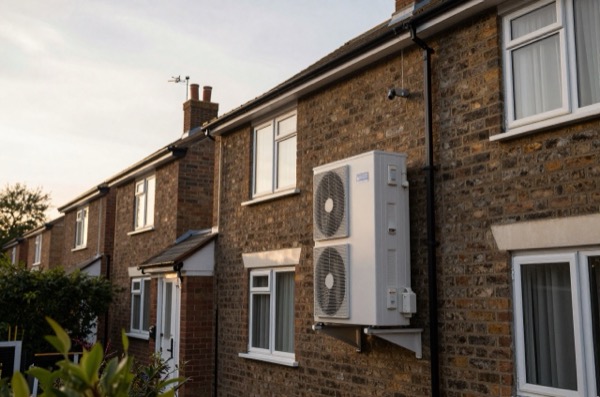
Air source heat pumps operate at a Seasonal Coefficient of Performance (SCOP) of 2.5–3.5, meaning they produce 2.5–3.5 units of heat for every unit of electricity consumed. This translates to a very high SAP score for the heating element. Installed cost is typically £8,000–£15,000 before the Boiler Upgrade Scheme grant of £7,500, bringing net cost to roughly £500–£7,500. Suitability depends on adequate wall/roof insulation and suitable heat emitters (underfloor heating or large radiators).
Solar Photovoltaic Panels
A 4 kWp roof array generates around 3,400–3,800 kWh/year in southern England, less in Scotland. The SAP calculation credits renewable generation against consumption. Cost: £6,000–£9,000 for supply and installation; a battery adds £3,000–£6,000. The EPC score improvement depends on the baseline rating; homes already at D or C see a band gain; lower-rated homes gain more.
Double or Triple Glazing
Single-glazed windows typically score U-value 5.0–5.5 W/m²K. Double-glazed Low-E units reach 1.4–1.6 W/m²K; triple glazing reaches 0.6–0.8 W/m²K. Replacing single with double glazing adds around 2–6 SAP points depending on glazing area. Cost: £4,000–£12,000 for a whole house, depending on number and size of windows. Listed buildings or conservation-area properties may need planning consent.
Prioritising Improvements for Maximum SAP Gain
Focus on the measures your EPC already recommends, they are ranked by impact for your specific home. As a rule of thumb:
- Insulation first (loft, cavity, solid wall if applicable), biggest gains per pound
- Heating system upgrade, boiler or heat pump
- Hot water, solar thermal or heat pump hot water cylinder
- Renewables, solar PV, potentially with battery
Solid-wall insulation (internal or external) is significantly more expensive (£8,000–£25,000+ depending on method and property size) but may be necessary for pre-1920 homes without cavities. Check eligibility for the Great British Insulation Scheme or local authority grants before paying full cost.
Getting a Reassessment After Improvements
Once work is complete, commission a new EPC from your DEA. Bring invoices, FENSA or Competent Persons certificates, and any product data sheets. The assessor will inspect and update the rating. Costs are the same as a first-time assessment (£60–£120). A higher band can increase your property’s value: Rightmove data suggests homes rated C or above command a 3–5% price premium over equivalent D-rated properties.
Sell or Let With a Better Rating
Updating your EPC before marketing can be a low-cost way to present your home more favourably. Even moving from a low D to a high D looks better on portals than a mid-E.
Building Regulations and Standards
Works that change the fabric of the building (new windows, insulation upgrades) may require Building Regulations approval to comply with Approved Document L (Conservation of Fuel and Power). Most reputable installers self-certify under Competent Person Schemes such as FENSA (windows) or the Cavity Insulation Guarantee Agency (CIGA). Always ask for the certificate as it is required when selling.2
References (2)
Figures in this note were checked against the sources below on 14 September 2026. Superscript numbers in the text point to them. Every source the site cites, by topic.
- 1technicalstrongUnited Kingdom Accreditation Service.RN-BNGAIDThe live UKAS register of accredited bodies currently under sanction. It records the British Board of Agrement under imposed suspension from 26 February 2026 across all four of its accreditations: ISO/IEC 17065 product certification and ISO/IEC 17021 management systems under reference 0113, ISO/IEC 17020 inspection under 4345, and ISO/IEC 17025 testing under 0357. This is the page to check before repeating any advice that treats a BBA certificate as accredited third party assurance.
- 2technicalvery strongMinistry of Housing, Communities and Local Government.RN-L0FCJXThe in-force U-value tables a DIY insulation or door note must quote, with the exact numbers. Table 4.2, limiting U-values for new fabric elements in existing dwellings, sets roof 0.15, wall 0.18, floor 0.18, swimming pool basin 0.25, window 1.4 or Window Energy Rating Band B minimum, rooflight 2.2, doors with more than 60 per cent of the internal face glazed 1.4 or Doorset Energy Rating Band C minimum, and other doors 1.4 or Doorset Energy Rating Band B minimum. Table 4.3, for existing elements, gives a roof threshold of 0.35 and an improved value of 0.16, which is the figure a loft insulation note needs: paragraph 4.12 says a retained element whose U-value is higher than the column (a) threshold, for example through a loft or garage conversion, should be upgraded to the column (b) value. Paragraph 4.13 allows a lesser upgrade only where the improved value is not technically or functionally feasible or would not achieve a simple payback of 15 years or less. Paragraph 4.8 requires a replacement element to be no worse than the one it replaces as well as meeting Table 4.2. Paragraph 4.10 gives the heritage exception: where character must be maintained, a centre pane U-value of no more than 1.2 or low-emissivity secondary glazing. Note 9 records that the timber window concession of 1.6 or Band C ended on 14 June 2023. The 2021 edition came into force on 15 June 2022; a 2026 edition exists at https://assets.publishing.service.gov.uk/media/69c122a6cfa346b9d4704a55/ADL1_2026.pdf.
-
Organisations under sanction, United Kingdom Accreditation Service, accessed 7 September 2026. ukas.com
-
Approved Document L, Conservation of fuel and power, Volume 1: Dwellings, 2021 edition incorporating 2023 amendments, Ministry of Housing, Communities and Local Government, accessed 14 September 2026. assets.publishing.service.gov.uk