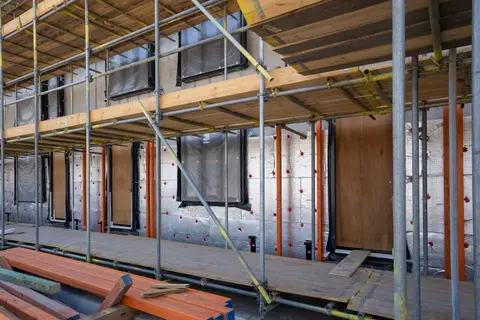
Render beads and mesh are the unglamorous backbone of a durable render finish. Applied correctly before the render goes on, they control every edge, reinforce every vulnerable area, and prevent the hairline cracks that turn into water ingress paths. Applied incorrectly, or omitted, they are the reason so many rendered walls crack, delaminate, or show rust staining within a few years.
What Are Render Beads and Why Do They Matter?
Render beads are profiled sections of metal or PVC that are embedded in the base coat of render at edges, junctions, and terminations. They serve three functions:
- Depth control: the bead’s thickness (typically 10–12 mm) acts as a screed gauge for the plasterer/renderer, ensuring consistent render thickness.1
- Edge protection: the nosing of a bead creates a clean, durable arris (sharp edge) at corners and reveals that would otherwise chip or crack.
- Crack control: beads break the render into manageable panels and absorb differential movement that would otherwise propagate as visible cracks.
Mesh reinforcement performs a related but distinct function, it embeds into the render coat to distribute stress across the face of the panel, preventing cracking from substrate movement or impact.2
Types of Render Beads
Stop Beads
Used at render terminations, the point where render meets an adjacent material or simply stops. Common locations: at the base of a render panel above a damp-proof course (DPC), at the junction with a window frame, or where render meets exposed brickwork.
The bead’s perforated wing is embedded in the wet render; the face nosing creates a clean edge. Water runs off the nosing rather than wicking behind the render.
Available in:
- PVC: the standard for most external renders, especially thin-coat and polymer renders. Chemically compatible with all render systems; no rust risk.
- Galvanised steel: traditional; compatible with cement-sand renders. Risk of rust staining if coating is damaged or in aggressive environments.1
- Stainless steel: premium option for coastal or aggressive environments; no rust risk; significantly more expensive.3
Common sizes run from about 4–6 mm for thin-coat renders up to 10 mm and 15 mm for traditional renders; match the bead to the render coat thickness.1
Angle Beads (Corner Beads)
Protect external corners (arrises) of render, window reveals, quoins, column edges. The bead creates a crisp, hard edge that is far more durable than a hand-formed corner.3 Without a bead, external corners are the first point to chip and crack.
- Standard angle bead: PVC or galvanised; 90° profile; most common.
- Thin-coat angle bead: lower profile for silicone or polymer thin-coat renders, typically about 6 mm deep, often with mesh wings that lap into the base-coat mesh.4
- Adjustable/flexible angle bead: accommodates angles other than 90° for bay windows, angled reveals, and oriel features.
Movement Beads
Expansion/movement beads are double-nosing beads that create a deliberate break in the render plane at intervals or at substrate junctions (for example, where a concrete frame meets a masonry infill, or at floor-to-floor levels on multi-storey buildings).5 The gap between the two nosings accommodates differential movement; without this, the render will crack along the weakest line, usually in an arbitrary, ugly path.
Movement joints in render should align with structural movement joints in the substrate.5 On render boards, vertical movement joints are generally needed at no more than 5 m centres, and on a timber-frame building a joint is also needed where the render crosses an intermediate floor, to allow for timber shrinkage.5
Drip Beads / Bell Beads
Fitted at the base of external render panels, above the DPC line.6 The projecting drip creates a water-shedding edge that throws rainwater clear of the wall face and prevents capillary water tracking back up behind the render. Critical in the UK climate.
EWI Beads (External Wall Insulation)
EWI systems (external wall insulation with render over) use their own family of beads. Most sit in the thin render coat on the face of the boards, so only the starter track at the base has to match the insulation thickness:
- EWI starter track (base profile): an L-profile fixed to the wall just above the DPC at the base of the insulation, which lines up the first row of boards and creates a termination7
- EWI angle bead: a PVC corner bead with wide mesh wings that lap into the base-coat mesh4
- EWI movement bead: same principle as a standard movement bead, carried through the insulation system wherever the substrate has an expansion joint8
- EWI window surround bead: integrates into window reveals within the EWI system
EWI beads are usually PVC, aluminium or stainless steel, and should be the ones the system certificate names, because the system is certified as a whole, typically for a service life of at least 30 years.7 For a 60-year durability, certificates can require stainless steel corner profiles unless they are fully embedded in the render.8
Render Mesh Reinforcement
Fibreglass Alkali-Resistant (AR) Mesh
The primary reinforcement for thin-coat render systems (silicone, acrylic, mineral renders over EWI) and for crack-bridging in base-coat work. Must be alkali-resistant (AR): standard glass fibre is attacked by the alkaline environment of cement-based renders and loses strength over time.
- Standard mesh (145–160 g/m²): general base-coat reinforcement, EWI base coat.2
- Heavy or armour mesh (from about 220 g/m² up to 500 g/m² for high-impact armour mesh): impact-resistant areas (corners, lower sections of buildings), areas of high movement risk.7
Mesh must be fully embedded in the base coat, usually in its outer third, not pressed against the substrate.7 Lap joints between mesh rolls should be at least 100 mm unless the system certificate gives a different figure.7 Corners and reveals require double-mesh or diagonal patches at 45° to resist crack propagation.2
Metal Lath
Traditional reinforcement over timber frames, above openings, or on substrates that would not mechanically bond render (smooth concrete, existing painted surfaces). Expanded galvanised or stainless metal lath is mechanically fixed to the substrate before rendering; the render keys into the lath openings.
Rust is a significant risk with plain galvanised lath in permanent damp environments. Specify stainless or hot-dip galvanised lath in these situations.
Costs (2026 UK Trade Prices)
| Product | Unit | Approximate Cost |
|---|---|---|
| PVC stop bead (10 mm) | Per metre | £0.80–£1.50 |
| PVC angle bead (standard 90°) | Per metre | £0.80–£1.50 |
| Galvanised angle bead | Per metre | £0.70–£1.20 |
| Stainless steel angle bead | Per metre | £2.50–£4.50 |
| PVC movement bead | Per metre | £2.00–£4.00 |
| PVC drip bead | Per metre | £1.00–£2.00 |
| EWI starter track (100 mm) | Per metre | £2.50–£5.00 |
| EWI angle bead | Per metre | £1.50–£4.50 |
| AR fibreglass mesh (145 g/m²) | Per m² | £0.80–£1.50 |
| AR fibreglass mesh (200 g/m²) | Per m² | £1.20–£2.50 |
| Metal lath (galvanised) | Per m² | £4.00–£8.00 |
| Metal lath (stainless) | Per m² | £10.00–£18.00 |
At EWI Store’s regular price, a 2.5 m uPVC render corner bead with mesh wings lists at £3.95 including VAT, about £1.60 a metre.9 A 50 m² roll of 145 g/m² fibreglass render mesh lists at £54.06 including VAT at the same supplier, about £1.08 per m².10
Render bead cost is a tiny fraction of a render job’s total value, the labour to re-render a cracked panel costs far more. Specifying stainless where there is any moisture risk is almost always the right economic decision.
Specification and Standards
Render systems in the UK should be specified in accordance with:
- BS EN 13914-1:2016: design, preparation, and application of external rendering and internal plastering, external rendering.11
- NHBC Standards chapter 6.11 (Render): for new-build masonry and render.
- BBA / ETA certification: EWI system certificates specify which beads are compatible and required. Using non-system beads can invalidate the EWI warranty.
For EWI installations covered by TrustMark or by a government scheme, the render bead specification must align with the system certificate, an assessor or inspector will check. ECO4 is the scheme still open, running to 31 December 2026; the Great British Insulation Scheme closed on 31 March 2026.1213
Common Mistakes and How to Avoid Them
Wrong material: galvanised beads in a wet or coastal environment rust within a few years, leaving brown staining and a failed edge. Use PVC or stainless.
Missing movement beads: a render panel of 15 m width with no movement joints will crack, thermal expansion and building movement are unavoidable. Plan movement joints at the design stage.
Mesh laps too short: overlaps shorter than the system requires leave the joint vulnerable. System certificates commonly ask for at least 75 mm or 100 mm; where no figure is given, 100 mm is a safe default.14
Beads fixed after rendering starts: beads must be set and checked for level/plumb before any render is applied. Attempting to fit beads into partially cured render produces poor embedment and premature failure.
Not patching around openings: the corners of windows and door openings are high-stress points. Always apply a diagonal mesh patch at each corner of every opening, in addition to standard mesh coverage; system certificates give sizes from about 200 × 200 mm to 250 × 450 mm.7
Getting render beads and mesh right adds minimal cost and time to a render job. Getting them wrong adds thousands in remedial work.
References (14)
Figures in this note were checked against the sources below on 30 September 2026. Superscript numbers in the text point to them. Every source the site cites, by topic.
- 1technicalsupplier figureRenderplas Ltd, guidance.RN-GOZVSTA UK render-bead maker's stop bead range with each bead's matching render depth. It shows a 10 mm bead is used for a 10–12 mm render coat and that sizes run from 4 mm to 15 mm.
- 2technicalsupplier figureRenderplas Ltd, guidance.RN-CJ2VLJA UK maker's product page for glass-fibre render mesh. It explains the mesh is embedded in the base coat to resist cracking and impact, gives 160 and 220 g/m2 weights, 100 mm laps and diagonal strips at reveals.
- 3technicalsupplier figureRenderplas Ltd, guidance.RN-FHILUXA UK bead maker's page for its PVC corner and angle beads. It states the beads are fitted to rendered corners and reveals to give a straight edge and protect it against impact.
- 4technicalsupplier figureRenderplas Ltd, guidance.RN-G5N50IA UK bead maker's range of PVC beads for thin-coat render over external wall insulation. Its product table lists 6 mm corner, reveal and stop beads with 100 mm mesh wings.
- 5technicalvery strongLABC Warranty, guidance.RN-SW7G5PLABC Warranty's technical guidance on movement joints in low-rise homes. It says render should not bridge dissimilar materials, substrate joints must carry through the render, and render-board joints go at maximum 5 m centres.
- 6technicalsupplier figureRenderplas Ltd, guidance.RN-7GC6NLA UK maker's product page for PVCu bellcast beads. It says they stop the render just above the damp-proof course and above reveals, giving a straight edge that deflects rainwater.
- 7technicalsupplier figureBritish Board of Agrément (published by Insta Group), guidance.RN-K3ZW3YThe BBA certificate for a rendered EWI system. It gives a service life of at least 30 years (60 with planned maintenance), 100 mm mesh laps, mesh in the top third of the basecoat and 250 x 450 mm diagonal patches at openings.
- 8technicalsupplier figureBritish Board of Agrément (published by Wetherby Wall Systems), guidance.RN-DH67H7The BBA certificate for a rendered EWI system. It sets 30- or 60-year durability, requires stainless corner profiles for 60 years unless embedded, carries substrate movement joints through, and gives mesh laps and opening patches.
- 9costsupplier figureEWI Store.RN-PI1IXOA price, true at 2026-09. A specialist EWI supplier's product page for a 2.5 m uPVC render corner bead with mesh. It gives the regular price including VAT, which sets the low end of the EWI angle bead row.
- 10costsupplier figureEWI Store.RN-6IIMMPA price, true at 2026-09. A specialist EWI supplier's product page for a 50 m² roll of 145 g/m² fibreglass render mesh, with its price including VAT. It supports the per m² figure in the 145 g/m² mesh row.
- 11technicalstrongBSI, a standard.RN-WDGC6TThe standard behind a correct render specification, published 31 March 2016 and current but under review. It sets requirements and recommendations for the design, preparation and application of renders based on cement, lime or other mineral binders and combinations of them, masonry cement, polymer modified binder based renders, and renders with organic binders. It covers rendering on both new and old backgrounds and the maintenance and non-structural repair of existing work, and gives guidance on site-made, factory-made and semi-finished factory-made renders, including material requirements for reinforcement, carriers and beads and for screws, plugs and anchor fixings, and the background characteristics that govern the design of a rendering system. It explicitly excludes external thermal insulation composite systems (ETICS), gypsum-based external renders, historic monument rendering, concrete structural repair, liquid-retaining structures, sealant specification and flashing design, which is worth noting because EWI render is covered elsewhere.
- 12technicalvery strongOfgem.RN-FPPUSLECO4 is the fourth phase of the Energy Company Obligation across Great Britain. It applies to measures installed from 1 April 2022 and runs until 31 December 2026 following a nine-month extension; ECO3 closed on 31 March 2022 and ECO4 came into force in July 2022. The scheme places a Home Heating Cost Reduction Obligation on medium and large energy suppliers to promote measures that improve the ability of low-income, fuel-poor and vulnerable households to heat their homes, funding insulation and heating upgrades for both homeowners and tenants. Ofgem also lists the Great British Insulation Scheme as a separate obligation on this page.
- 13technicalvery strongOfgem.RN-RDOIJRThe scheme, formerly known as ECO+, ran from April 2023 to 31 March 2026 and is now closed. It obliged medium and large energy suppliers to deliver measures reducing energy use in the least energy-efficient homes in Great Britain. Eligibility was homes with an EPC rating of D to G in Council Tax bands A to D in England, or A to E in Scotland and Wales, plus low-income and vulnerable households. Unlike ECO4, which funds whole-house packages, GBIS mostly delivered a single insulation measure per home. This is the page to cite when a note has to say a grant route has closed rather than leave a reader chasing it.
- 14technicalsupplier figureBritish Board of Agrément (published by Wetherby Wall Systems), guidance.RN-HHQGA6The BBA certificate for a stone-wool EWI system. It requires mesh laps of at least 75 mm and diagonal stress patches of about 300 x 250 mm at the corners of openings, with a service life over 30 years.
-
Stop Beads: PVCu stop beads for rendering and plastering, Renderplas Ltd, accessed 30 September 2026. renderplas.co.uk
-
Render mesh and mesh fixings for EWI / ETICS systems, Renderplas Ltd, accessed 30 September 2026. renderplas.co.uk
-
Corner / angle beads: PVCu corner beads / angle beads for rendering and plastering, Renderplas Ltd, accessed 30 September 2026. renderplas.co.uk
-
Mesh beads for EWI / ETICS, Renderplas Ltd, accessed 30 September 2026. renderplas.co.uk
-
Technical Update: Guidance on the use of movement joints, LABC Warranty, accessed 30 September 2026. labcwarranty.co.uk
-
Bellcast beads for external rendering, Renderplas Ltd, accessed 30 September 2026. renderplas.co.uk
-
BBA Agrément Certificate: InstaClad External Wall Insulation Systems, British Board of Agrément (published by Insta Group), accessed 30 September 2026. instagroup.co.uk
-
BBA Agrément Certificate 03/4058 PS2: Epsicon 3 External Wall Insulation System, British Board of Agrément (published by Wetherby Wall Systems), accessed 30 September 2026. wall-systems.co.uk
-
uPVC Render Corner Bead - No Nose (2.5m), EWI Store, accessed 30 September 2026. Priced at 2026-09 and left there. ewistore.co.uk
-
Blue Fibreglass Mesh (145g/m²) - 50m², EWI Store, accessed 30 September 2026. Priced at 2026-09 and left there. ewistore.co.uk
-
BS EN 13914-1:2016 Design, preparation and application of external rendering and internal plastering. External rendering, BSI, accessed 9 September 2026. knowledge.bsigroup.com
-
Energy Company Obligation (ECO), Ofgem, accessed 9 September 2026. ofgem.gov.uk
-
Great British Insulation Scheme, Ofgem, accessed 9 September 2026. ofgem.gov.uk
-
BBA Agrément Certificate 25/7419 PS2: Wetherby Stone Wool Systems (WS), British Board of Agrément (published by Wetherby Wall Systems), accessed 30 September 2026. wall-systems.co.uk