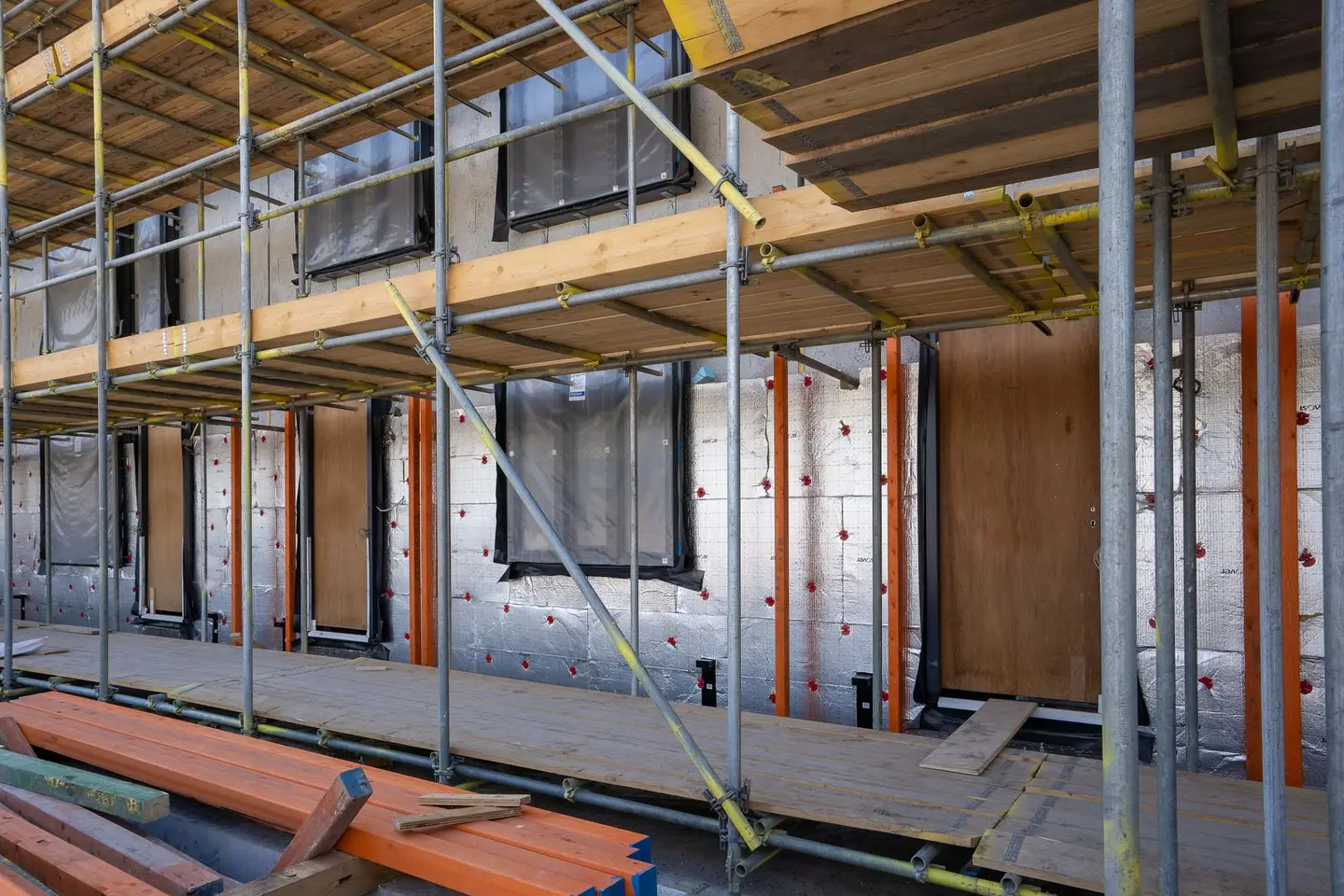
Scaffolding is one of those costs that homeowners rarely budget for until a quote arrives, yet it is often unavoidable for roof work, external rendering, chimney repairs, or painting above first-floor level. For a typical 3-bed semi with one to two weeks of hire, expect to pay £700–£1,500; for a four-week hire on the same property that rises to £1,200–£2,200. The type of access required, your property’s size, and local council permit rules are the main variables.
This guide breaks down typical 2026 UK scaffolding costs, explains what drives the price, and covers the legal safety requirements you and your contractor need to meet.
Typical Scaffolding Costs by Job Type
The table below covers the most common domestic scenarios. All prices include erection, dismantling, and the initial hire period stated, they do not include a pavement licence if one is needed (covered separately below).
| Job type / property | Hire period | Typical cost (2026) |
|---|---|---|
| Chimney stack only (access scaffold) | 1–2 weeks | £500–£9001 |
| 3-bed semi, roof or render work | 1–2 weeks | £700–£1,500 |
| 3-bed semi, full perimeter | 4 weeks | £1,200–£2,200 |
| Detached 4-bed, one elevation | 2–3 weeks | £1,200–£2,000 |
| Detached 4-bed, full perimeter | 4 weeks | £1,800–£3,500 |
| Additional hire (any property) | Per week after initial period | £80–£200/week |
| Confined or complex access | Project-specific | Significantly more |
These are guide ranges based on typical contractor pricing across England and Wales in early 2026. Prices in central London and parts of the South East tend to sit at the upper end or above.
What Drives the Price?
Size and height of the structure
More scaffold boards, more tubes, more fittings, and more labour. A two-storey semi needs considerably less material than a three-storey Victorian terrace. Each additional lift (horizontal working platform level) adds cost.
Type of scaffold: tube and fitting vs. system scaffold
Tube and fitting is the traditional method: individual steel tubes are cut to length and joined with proprietary couplers. It can be adapted to almost any shape and is common on older or irregular properties. It takes longer to erect and dismantle, which increases labour costs.
System scaffold (sometimes called modular or frame scaffold) uses pre-engineered components that clip together quickly. Erection is faster and therefore cheaper, but it suits regular, rectilinear structures best. On a straightforward semi-detached house, system scaffold is commonly used and will generally cost less than an equivalent tube-and-fitting design.
The cost difference between the two approaches on a typical domestic job can be £150–£400, though this narrows on complex projects where system scaffold loses its assembly-speed advantage.
Hire period
Scaffolding quotes normally bundle erection, dismantling, and a fixed hire period (commonly one or two weeks for smaller jobs, four weeks for larger ones). Beyond that initial period, most contractors charge a weekly continuation rate, typically £80–£200 per week depending on the volume of scaffold in place. If your roofer or renderer overruns, those extra weeks add up quickly. Always agree the continuation rate in writing before work starts.
Access difficulty
Rear gardens with narrow side access, properties on slopes, or jobs requiring scaffold over conservatories or outbuildings all add complexity and cost. So does work near overhead power lines, which requires a safe-distance clearance plan and may involve the network operator. Confined sites in tight terraced streets can restrict the size of delivery lorry, increasing time on site.
Pavement licences and permits
If any part of the scaffold sits over a public footpath or road, the contractor must obtain a licence from the local council (technically a licence under Section 169 of the Highways Act 1980, or equivalent local authority permit).2 The fee varies widely: most councils charge £100–£400, but some urban boroughs charge more. The licence application takes time, typically 5–10 working days, so factor this into your programme. The licence cost is usually passed on to you.
Chimney Scaffold: A Common Special Case
A chimney-only access scaffold, a small structure designed to reach just the stack and pot, is considerably cheaper than full-elevation scaffolding. Expect to pay £500–£900 for a straightforward two-storey chimney stack. This covers access for a chimney repoint, pot replacement, or flaunching repair.
Watch how that sits against a repair price. Published repair rates exclude access on the face of the item, so a chimney rebuild quoted at a few hundred pounds and a scaffold at £500–£900 are two numbers that both have to be paid: see the costs that only small jobs carry.
Note that some chimney repair specialists use an alternative, a chimney scaffold tower or a MEWP (mobile elevated work platform), which may reduce costs further but is subject to the same legal requirements for working at height.
Worked Example: 3-Bed Semi, Full Re-Roof
Say you have a standard 1970s three-bedroom semi-detached house and your roofer needs four weeks to strip and relay the roof on both the front and rear elevations.
| Item | Cost |
|---|---|
| Scaffold erection, hire (4 weeks), dismantling | £1,400 |
| Pavement licence (front elevation over footpath) | £180 |
| Week 5 continuation (roofer overruns by one week) | £130 |
| Total scaffolding cost | £1,710 |
This is a realistic mid-range outcome for the Midlands or the North. In London, add 20–40% to the scaffold line.
Safety Regulations You Need to Know
Scaffolding is a safety-critical structure. UK law and industry standards impose clear obligations, both on the contractor and, to some extent, on you as the homeowner commissioning the work.
Work at Height Regulations 2005
These regulations require that all work at height is properly planned, appropriately supervised, and carried out by competent people.34 “Competent” has a specific meaning here: the individual must have the skills, knowledge, and experience appropriate to the task. For scaffold erection, this typically means a CISRS (Construction Industry Scaffolders Record Scheme) card-holder.5 Always check your scaffolding contractor’s operatives hold valid CISRS cards, ask to see them.
NASC Standards
The National Access & Scaffolding Confederation (NASC) publishes the main technical guidance document for scaffolding in the UK: TG20, which covers the design, erection, and dismantling of tube-and-fitting scaffolding.6 NASC member companies are audited against safety and competency standards. Choosing an NASC member is a straightforward way to reduce risk on your project.
Scaffold Inspection Requirements
Once erected, a scaffold must be inspected:
- Before first use, to confirm it is safe and complete7
- Every seven days thereafter while in use7
- Following any event likely to have affected stability, this includes high winds, heavy snow loading, or an impact7
Each inspection must be carried out by a competent person and the findings recorded in writing.7 Your contractor should provide you with copies of inspection reports as a matter of course; if they do not, ask for them.
Licences for Scaffolding Over Public Footpaths
As noted above, any scaffold that encroaches on a public highway, even just a toe-board or a ladder, requires a council licence. Erecting scaffold on the public highway without a licence is an offence under the Highways Act and exposes both the contractor and potentially the property owner to liability.2 Reputable contractors handle this automatically; if yours does not raise it, that is a warning sign.
Getting the Best Value
- Get at least three quotes. Scaffolding pricing varies more than many homeowners expect between contractors. Describe the job clearly, elevations, approximate height, hire period, so quotes are comparable.
- Agree the continuation rate upfront. Put it in the contract before work starts.
- Coordinate with your main contractor. Scaffold should go up just before your roofer or renderer starts, not weeks in advance. Every idle week costs money.
- Ask about shared scaffolding. If you are having a loft conversion at the same time as a roof repair, a combined scaffold design is nearly always cheaper than two separate structures.
- Check NASC membership and CISRS cards. Not just for safety, NASC members generally carry proper insurance and are less likely to leave you with an invoice dispute or an unsafe structure.
Scaffolding is rarely the largest cost on a renovation project, but it is one where poor planning, overrunning hire periods, unexpected permit fees, or choosing an uninsured contractor, can push the final bill well above the original estimate.
References (7)
Figures in this note were checked against the sources below on 7 September 2026. Superscript numbers in the text point to them. Every source the site cites, by topic.
- 1costsupplier figureChichester Scaffolding Ltd.RN-WVW1W1A price, true at 2026-09. Chichester Scaffolding Ltd publishing its own price guidance for this work. A trade supplier writing about what it charges is evidence of the market rate and not a quotation, and the cost book treats it as one figure among several rather than on its own
- 2technicalvery strongThe National Archives (legislation.gov.uk), legislation.RN-CEXTH9Section 169(1) bars anyone erecting or retaining scaffolding or any other obstructing structure on or over a highway in connection with building, demolition, alteration, repair, maintenance or cleaning work unless the highway authority has issued a licence in writing, and the licence may carry any terms the authority thinks fit. Section 169(2) obliges the authority to grant a licence once reasonable particulars are supplied, unless the structure would cause unreasonable obstruction or a differently arranged structure would obstruct less; 169(3) gives a right of appeal to a magistrates' court against refusal or against the terms. Section 169(4) requires the licence holder to light the structure from half an hour after sunset to half an hour before sunrise, to comply with written directions on traffic signs, and to protect statutory undertakers' apparatus. Breach is an offence under 169(5) with a fine up to level 5 on the standard scale. This is the legal basis for the pavement licence fee that appears on a scaffolding quote.
- 3technicalvery strongThe National Archives (legislation.gov.uk), legislation.RN-Y45NFIRegulation 4 of the Work at Height Regulations 2005, organisation and planning. Work at height must be properly planned, appropriately supervised and carried out so far as reasonably practicable safely, and the planning must include emergencies and rescue. The duty that sits behind a method statement for roof work, and the reason rescue is part of the plan rather than an afterthought.
- 4technicalvery strongThe National Archives (legislation.gov.uk), legislation.RN-69B4KXRegulation 5 of the Work at Height Regulations 2005, competence. Nobody may organise, plan, supervise or carry out work at height unless competent to do so, or supervised by a competent person while training. One sentence, and it is the legal reason scaffolding is erected by a trained scaffolder rather than by whoever is on site.
- 5technicalvery strongHealth and Safety Executive, guidance.RN-2KFK3DHSE's scaffolding page states that employers and self-employed contractors must assess the risk from work at height and plan the work so it is done safely, providing general access scaffolds wherever practicable. Scaffolding must be designed, erected, altered and dismantled only by competent people under the direction of a competent supervisor, following NASC Safety Guidance SG4 'Preventing falls in scaffolding operations' or equivalent manufacturer guidance for system scaffold. Strength and stability calculations are required unless the scaffold matches a generally recognised standard configuration for which a note of calculations exists, and a competent person must draw up an assembly, use and dismantling plan. Covers guard rails, toe boards, scaffold design, structures needing bespoke design, operative competence and scaffold inspection.
- 6technicalgoodNational Access & Scaffolding Confederation, guidance.RN-VI0GV9The NASC ePortal, the scaffolding industry's guidance library, including TG20 for tube and fitting scaffolds and TG30 for system scaffolding. TG20 compliance is what a scaffold design is measured against and what a TG20 compliance sheet certifies. The trade confederation for scaffolding, so this is the industry's own technical authority.
- 7technicalvery strongThe National Archives (legislation.gov.uk), legislation.RN-B5DM7ERegulation 12 of the Work at Height Regulations 2005, inspection of work equipment. Where safety depends on how equipment is installed or assembled, it must not be used until inspected in that position, and equipment exposed to deteriorating conditions must be inspected at intervals. This is the legal basis for a scaffold handover certificate and the weekly scaffold inspection, which is a real cost line on a job rather than an optional formality.
-
Cost of Scaffolding Hire, Scaffold Rental Prices for 2026, Chichester Scaffolding Ltd, accessed 18 September 2026. Priced at 2026-09, so no calibration is needed. chichesterscaffolding.co.uk
-
Highways Act 1980, section 169, legislation.gov.uk, accessed 7 September 2026. legislation.gov.uk
-
The Work at Height Regulations 2005, regulation 4, legislation.gov.uk, accessed 7 September 2026. legislation.gov.uk
-
The Work at Height Regulations 2005, regulation 5, legislation.gov.uk, accessed 7 September 2026. legislation.gov.uk
-
Scaffolds, Health and Safety Executive, accessed 7 September 2026. hse.gov.uk
-
NASC ePortal, National Access & Scaffolding Confederation, accessed 7 September 2026. nasc.org.uk
-
The Work at Height Regulations 2005, regulation 12, legislation.gov.uk, accessed 7 September 2026. legislation.gov.uk