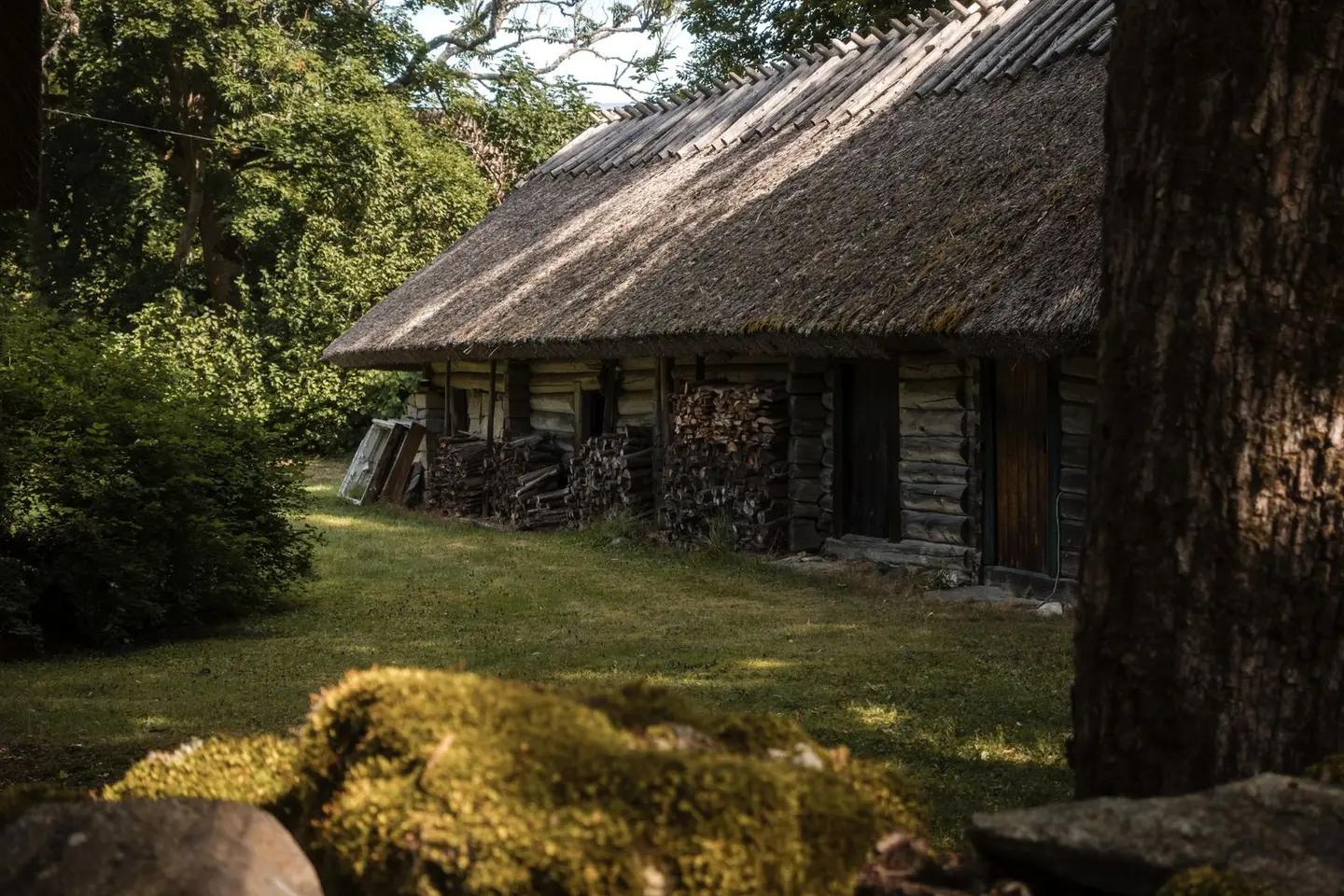
Re-thatching a typical English cottage costs £12,000–£28,000 in 2026, depending on the material chosen, the pitch and complexity of the roof, and regional labour rates. New thatch on a barn conversion or self-build runs higher still, expect £20,000–£45,000 for a larger dwelling where the entire structure requires thatching from scratch. These are significant numbers, but the finish is unmistakable and, with the right material, a well-laid roof needs no major intervention for 25–50 years.
The three mainstream thatching materials, water reed, combed wheat reed, and long straw, differ substantially in cost, lifespan, and visual character. Your choice may also be constrained by a Listed Building consent condition or a local planning policy specifying the traditional material for the area.
Thatching Materials Compared
| Material | Cost per m² (installed) | Typical lifespan | Visual character |
|---|---|---|---|
| Water reed (Norfolk/imported) | £180–£260 | 40–50 years | Neat, tight, sharp eaves |
| Combed wheat reed | £140–£200 | 25–35 years | Slightly softer finish than water reed |
| Long straw | £120–£180 | 20–30 years | Shaggy, rustic appearance; traditional in East Midlands and East Anglia |
Prices above reflect a master thatcher and one labourer working a standard pitched roof with reasonable access. Steep pitches (over 50°), complex hips, dormers, or ornamental ridge work will push costs to the upper end or beyond.
Imported water reed, primarily from Turkey, Eastern Europe, and China, now dominates the UK market because domestic Norfolk reed production cannot meet demand. Quality varies; ask your contractor about reed origin and whether it meets the British Standards requirement for moisture content and stem length.
Typical Project Costs by House Size
| Roof area | Material | Estimated total cost |
|---|---|---|
| 40 m² (small cottage) | Long straw | £5,000–£7,500 |
| 40 m² (small cottage) | Combed wheat reed | £5,600–£8,000 |
| 40 m² (small cottage) | Water reed | £7,200–£10,400 |
| 65 m² (medium cottage) | Long straw | £7,800–£11,700 |
| 65 m² (medium cottage) | Combed wheat reed | £9,100–£13,000 |
| 65 m² (medium cottage) | Water reed | £11,700–£16,900 |
| 90 m² (large cottage/farmhouse) | Long straw | £10,800–£16,200 |
| 90 m² (large cottage/farmhouse) | Water reed | £16,200–£23,400 |
Scaffold is almost always required and is typically charged separately at £800–£2,500 depending on height and the number of lifts needed.
New Thatch vs Re-Thatching
Re-thatching (laying a new coat over an existing base layer, or stripping and replacing) is the most common work. In most cases the contractor strips the worn surface coat back to the spar coat or base coat, checks the underlying timbers, and applies a new surface. If the base coat is sound, stripping to bare rafters is avoided, this saves cost but the base coat must be inspected carefully for rot, pest damage, and compaction.
New thatch on a conversion or new-build requires building up all layers from scratch: a base coat fixed to the rafters, a spar coat, and a surface coat. This is more material-intensive and takes longer, a 65 m² new roof might take a master thatcher and labourer 4–6 weeks to complete.
Labour Day Rates
Thatching is a skilled trade with a relatively small number of qualified practitioners in the UK. Master thatchers affiliated with the National Society of Master Thatchers (NSMT) or the Thatching Advisory Services typically charge:
- Master thatcher: £350–£500 per day (2026 rates, South of England higher)
- Thatcher’s labourer: £150–£220 per day1
- Ridge layer specialist (for ornamental ridges): £400–£550 per day
A two-person team re-thatching a 65 m² cottage will typically take 10–18 working days depending on material and complexity. Ridge work, which may need replacing every 10–15 years between full re-thatches, is charged separately: expect £80–£140 per linear metre for a plain block ridge, and £150–£250/m or more for decorative pheasant or ornamental patterns.
Maintenance Costs
Thatch is not a set-and-forget material. Ongoing costs to budget for include:
- Annual inspection: £100–£200 for a thatcher to assess the roof condition
- Ridge replacement: every 10–15 years at £2,000–£6,000 depending on length and style
- Moss and lichen treatment: £300–£600, sometimes needed every 5–8 years in damp climates
- Localised patch repairs: £500–£2,000 depending on extent
- Netting: Wire or polypropylene netting fixed over the surface deters birds and vermin; replacement every 15–25 years at £800–£2,500
Over the full life of a water reed roof, annual maintenance costs average £400–£900 per year, lower than many homeowners expect, but the irregular nature of the expenditure (large ridge bills every decade or so) catches some owners off guard.
Fire Risk and Insurance
Thatched roofs carry a higher fire risk than tile or slate, primarily because the material is combustible and embers from chimneys or external fires can ignite a surface that is difficult to extinguish once alight. Insurers factor this in substantially.
Typical insurance premium uplift: 20–50% above an equivalent tiled property, though some specialist insurers, who understand the market, offer more competitive terms than mainstream providers. Standard home insurance policies frequently exclude thatched properties entirely; owners must use specialist thatched property insurers.
Key factors affecting insurance cost:
- Chimney condition: A sound, swept chimney with a good spark arrestor reduces risk and premiums. Insurers often require annual sweeping as a policy condition.
- Separation from neighbours: Detached cottages are cheaper to insure than semi-detached or terraced thatched properties, which represent a greater loss-accumulation risk for the insurer.
- Proximity of the thatch to the chimney: Less than 600 mm is considered high-risk.
- Presence of a fire suppression system: Sprinkler systems, particularly in the roof void, can reduce premiums significantly, sometimes by 15–25%.
Rebuilding cost estimates for thatched properties must reflect the premium cost of thatching; standard rebuild calculators will undervalue the roof element significantly.
Listed Buildings and Conservation Areas
The vast majority of thatched properties in England are Listed (predominantly Grade II) or sit within a designated conservation area. This affects both the work you can undertake and the materials you must use.
Listed Building Consent (LBC) is required for any work that affects the character of a listed structure. In practice:
- Stripping and re-thatching in the same material is generally considered routine maintenance and may not require formal consent, but you should confirm with your Local Planning Authority (LPA) before starting. Many LPAs have pre-application advice services.
- Changing the thatching material, for example, switching from long straw to water reed, almost always requires Listed Building Consent and is frequently refused in areas where long straw is the traditional local material. East Anglian authorities in particular enforce material continuity strictly.
- Ridge style changes (from plain block ridge to ornamental ridge or vice versa) may also need consent.
- Unauthorised changes to a listed building’s thatching material can result in an enforcement notice requiring reinstatement at the owner’s cost.
For properties in conservation areas without a listing, permitted development rights generally permit like-for-like re-thatching, but again, material changes are likely to be controlled.2
Grant funding: Historic England and some county and district councils offer grants or low-interest loans for maintaining traditional building materials on listed properties. Contact Historic England directly or check your LPA’s conservation officer; funding is competitive and varies by region.
Finding a Thatching Contractor
The National Society of Master Thatchers (NSMT) and the Thatching Advisory Service (TAS) both maintain registers of qualified practitioners. As with any specialist trade, obtain at least three quotes and ask to see recently completed work, the quality difference between an experienced master thatcher and a less-experienced contractor is visible and significant.
Thatching is not regulated by a government-endorsed competent person scheme in the way that electrical or gas work is, so professional body membership and a portfolio of verifiable local work are the main quality signals available to homeowners.
References (2)
Figures in this note were checked against the sources below on 14 September 2026. Superscript numbers in the text point to them. Every source the site cites, by topic.
- 1costvery strongOffice for National Statistics.RN-MMT1DOA price, true at 2026-09. The ASHE Table 14 dataset gives annual estimates of paid hours worked and earnings for UK employees by sex and by full-time or part-time status, broken down to four-digit Standard Occupational Classification, which is the level that isolates individual construction trades such as bricklayers, carpenters, plasterers and electricians. Released 23 October 2025 as the 2025 provisional edition (zip, about 10.7 MB), with revised and provisional editions back to 2017. A correction dated 19 December 2025 suppressed annual pay estimates for SOC 3312 police officers in some areas; construction occupations are unaffected.
- 2technicalvery strongThe National Archives, legislation.RN-OWGIY3Schedule 2 Part 1 of the GPDO 2015, development within the curtilage of a dwellinghouse. This is permitted development itself: Class A enlargement and alteration, with the limits and conditions, through the classes covering roof alterations, porches, outbuildings and hard surfaces. Every statement about what can be built without planning permission traces to this Part, and the exclusions at the start of each class are where most projects actually fall out.
-
Earnings and hours worked, occupation by four-digit SOC: ASHE Table 14, Office for National Statistics, accessed 18 September 2026. Priced at 2026-09, so no calibration is needed. ons.gov.uk
-
The Town and Country Planning (General Permitted Development) (England) Order 2015, Schedule 2, Part 1, The National Archives, accessed 14 September 2026. legislation.gov.uk