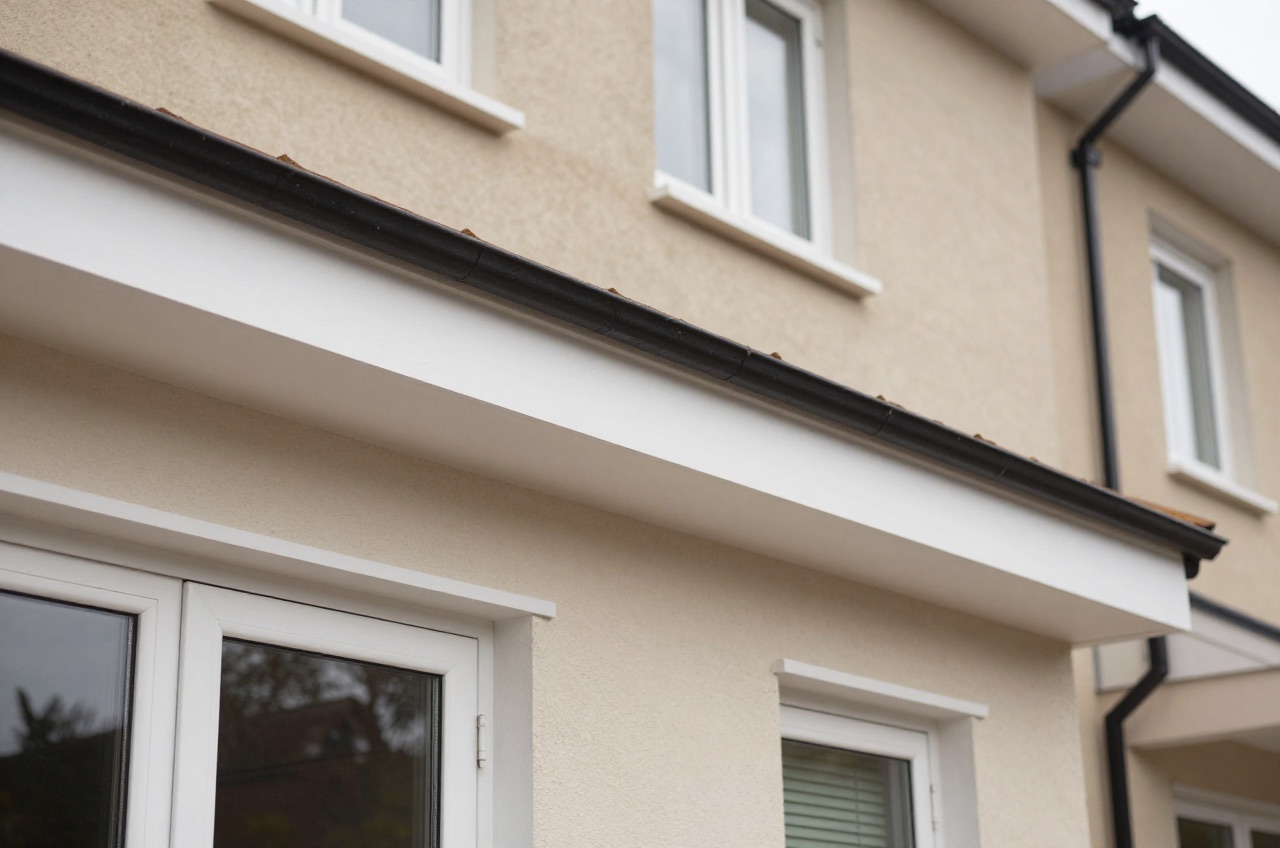
Fascias, soffits, and barge boards collectively form the roofline of your home, the visible trim along the eaves and gable ends that keeps moisture, birds, and cold air out of the roof void. When they rot or crack, they are not just unsightly: water ingress can lead to damp in the ceiling, timber decay in the roof structure, and pest problems. Replacement is one of the more straightforward roofing jobs, but costs vary considerably depending on material, property size, and access.
What Each Component Does
Fascia boards run horizontally along the eaves at the base of the roof, directly beneath the bottom row of tiles. The guttering attaches to the fascia.
Soffits are the horizontal or sloped panels that close in the gap between the fascia and the wall. They are often vented (with small holes or grilles) to allow air circulation into the roof void, which helps prevent condensation and interstitial damp.
Barge boards (also called verge boards or gable boards) run along the sloped edges of a gable end roof, covering the exposed rafter feet and protecting the roof edge from weather.
Replacement Cost Guide
| Property type | uPVC roofline (inc. VAT) | Timber roofline (inc. VAT) |
|---|---|---|
| 1-bed flat / small terraced | £900–£1,600 | £1,400–£2,500 |
| 2–3 bed mid-terraced | £1,400–£2,200 | £2,000–£3,500 |
| 3-bed semi-detached | £1,800–£3,000 | £2,500–£4,500 |
| 4-bed detached | £2,800–£4,500 | £4,000–£7,000 |
| Large detached / extended | £4,000–£7,000+ | £6,000–£12,000+ |
Costs include removal of the existing roofline, supply and installation of new boards, and guttering rehang or replacement where needed. Scaffolding is usually included in quotes from reputable roofline companies for two-storey work; confirm this before accepting a quote.
uPVC vs Timber: Which Is Better?
uPVC (most common)
uPVC (unplasticised polyvinyl chloride) has largely replaced timber as the standard roofline material in the UK since the 1990s. Advantages:
- Maintenance-free, never needs painting or treating; occasional wash with soapy water is all that is required
- Rot-proof, will not decay even in sustained wet weather
- Long lifespan, reputable makers guarantee uPVC roofline for 10–20 years or more (Freefoam, for example, gives a standard 20-year guarantee on its roofline range), and the boards can last for decades1
- Lower cost, approximately 30–40% cheaper than timber to supply and install
Downsides: uPVC can look plastic and flat in comparison to painted timber, and it cannot be satisfactorily painted a different colour in later years. It may also not be suitable in conservation areas where planning conditions specify timber.
uPVC fascias come either as full replacement boards, commonly about 18 mm thick, or as thinner cap-over boards that clad the existing timber fascia.2 Full replacement boards are stiffer and do not depend on the old timber staying sound.
Timber (traditional)
Painted softwood or hardwood roofline boards remain the right choice for period properties and conservation areas. Modern treated softwood (e.g. tanalised redwood) lasts longer than the old untreated boards, but still requires repainting every 5–8 years (£300–£800 for a painter, depending on access and property size). Hardwood barge boards (oak, iroko, or western red cedar) are more durable but cost significantly more to supply.
If timber is specified, ensure the replacement boards are pre-primed on all four faces before installation, painting only the front face after fitting leaves the back face vulnerable to moisture.
Aluminium and composite
Aluminium fascia boards are used on some modern builds and flat-roof extensions. They are durable and maintenance-free but more expensive than uPVC and less widely available. Composite (wood-effect) roofline boards offer the appearance of timber with lower maintenance; costs sit between uPVC and timber.
What Affects the Total Cost
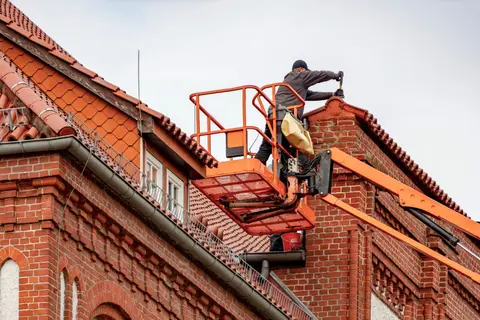
Scaffolding, The single biggest variable. A two-storey semi needs a scaffold that typically adds £500–£1,200 depending on the contractor. Some companies use mobile tower scaffolds or MEWP (cherry pickers) for smaller jobs to reduce cost, but these are not always suitable for all roof profiles.
Gutter replacement, Many roofline jobs coincide with gutter replacement. Adding full half-round or ogee uPVC guttering to a semi-detached house adds £300–£700 for materials and labour.
Condition of the roof structure, If the old boards are hiding rotten rafter ends or damaged noggins, additional timber repairs will add cost. A good roofer will point this out before boarding over; be wary of anyone who doesn’t inspect the substrate.
Asbestos, Soffits on houses built or refurbished before 2000 can contain asbestos insulating board or asbestos cement.3 Have suspect boards identified before anyone cuts, drills or breaks them out; removal by a suitably trained or licensed contractor adds cost.
Ventilation, Building Regulations guidance (Approved Document C) expects cold roofs, where moisture from the house can reach the insulation, to be ventilated, and points to BS 5250 for how.4 For a typical pitched roof insulated at ceiling level, that usually means eaves ventilation equivalent to a continuous 10 mm strip along each side. If the existing soffits were not vented, new soffits should include ventilation inserts or a vented soffit board. This adds very little to material cost but is important for the longevity of the roof structure.
Access difficulties, Bay windows, extensions, or tall chimneys that complicate scaffold erection increase costs. Properties on steep slopes or with limited access can add 15–25% to the scaffold element.
Signs You Need Replacement
- Paint peeling or timber boards visibly soft or crumbling when prodded
- Gaps appearing between boards and tiles or at joints
- Evidence of birds or squirrels nesting in the eaves
- Staining or moss growth spreading from the roofline onto the wall
- Gutters pulling away from the fascia (a sign the fascia itself is failing behind the fixing point)
If birds are nesting in the eaves, the work has to wait until the nest is no longer in use: it is an offence to intentionally take, damage or destroy the nest of a wild bird while it is in use or being built.5 Bats are protected too: repairing or replacing a roof can affect them, and it is an offence to damage or destroy a breeding or resting place, so if you find bats, contact the National Bat Helpline before work starts.6
A knowledgeable roofline contractor can carry out a free visual inspection from ground level and use a scaffold or ladder to confirm the condition before quoting. Do not accept a quote that is based solely on a drive-past assessment.
Choosing a Contractor
Roofline work does not require a specialist licence, but you should look for:
- A trader registered with a recognised scheme such as TrustMark or Which? Trusted Traders (a listing on a review site such as Checkatrade is not the same thing)
- Public liability insurance (minimum £2 million)
- A written guarantee on materials and workmanship (10 years is common from established companies)
- Evidence they will check the rafter ends and roof structure as part of the job
Avoid door-to-door salespeople who pressure-sell on the day. Get three written quotes and check reviews on Google or Checkatrade before committing.
The rules in this note are those that apply in England. Scotland, Wales and Northern Ireland have their own building standards and permitted development rights.
References (6)
Figures in this note were checked against the sources below on 30 September 2026. Superscript numbers in the text point to them. Every source the site cites, by topic.
- 1technicalsupplier figureFreefoam, guidance.RN-BBH7EEFreefoam's guarantee page for its fascia, soffit and gutter products. It confirms a standard 20-year guarantee on its roofline range, showing guarantees of 10–15 years understate what a major maker offers.
- 2technicalsupplier figureFreefoam, guidance.RN-LEAWAJFreefoam's full replacement fascia range page, listing its 18 mm full replacement boards. It is a maker's product fact supporting the typical thickness of a full replacement uPVC fascia.
- 3technicalvery strongHealth and Safety Executive, guidance.RN-GKGY2HHSE's material-by-material guide to where asbestos sits in a building and what class of work removing each one is. On textured coatings it states they 'were used to produce decorative finishes on ceilings and walls' and that 'in the past, they have had various trade names such as Artex', which is the source to cite when a note names Artex rather than a generic textured coating. It classes work on textured coatings as low-risk work that a trained non-licensed worker may carry out, while large-scale removal by steaming or gelling is notifiable non-licensed work and removal by energetic methods such as wet abrasive blasting requires a licensed contractor. Useful alongside the why-and-where page, which gives the before-2000 date but does not name Artex.
- 4technicalvery strongMinistry of Housing, Communities and Local Government.RN-NPO8FJThe statutory figures behind a damp diagnosis, and the numbers to quote when a note explains why ground levels or a bridged damp proof course cause rising damp. Paragraph 5.2 requires that in an external wall the damp-proof course should be at least 150mm above the level of the adjoining ground (Diagram 8) unless part of the building protects the wall, and that in an external cavity wall the cavity should be taken down at least 225mm below the level of the lowest damp-proof course, or a damp-proof tray provided (Diagram 9a). For suspended timber ground floors it requires a ventilated air space of at least 75mm from the ground covering to the underside of any wall-plates and at least 150mm to the underside of the suspended timber floor or insulation, with ventilation openings on two opposing external walls of not less than 1,500mm2 per metre run of external wall or 500mm2 per square metre of floor area, whichever is greater; for suspended concrete floors the clear ventilated space is at least 150mm with the same opening sizes. Section 2.39 onwards covers radon, referring to BRE Report BR 211 for protective measures. The 2013 edition was published on 3 September 2013 with changes in effect from 1 October 2013.
- 5technicalvery strongThe National Archives (legislation.gov.uk), UK Public General Act 1981 c.69, legislation.RN-U95SABThe law behind the advice not to cut hedges or strip ivy and soffits in the nesting season. Section 1(1) makes it an offence to intentionally (a) kill, injure or take any wild bird, (b) take, damage or destroy the nest of any wild bird while that nest is in use or being built, or (c) take or destroy an egg of any wild bird. Section 1(2) creates a possession offence for a live or dead wild bird, any part of or thing derived from one, or an egg or part of an egg. Section 1(5) adds a higher tier of protection for Schedule 1 species, making it an offence to intentionally or recklessly disturb such a bird while it is building a nest or is in, on or near a nest containing eggs or young, or to disturb its dependent young. The prohibition is tied to the nest being in use, not to a fixed calendar window, which is why guidance points at the main March to August season but does not treat it as a safe harbour.
- 6technicalvery strongGOV.UK (Natural England), guidance.RN-VH12D4Natural England guidance for England. All bat species, their breeding sites and resting places are fully protected; it is an offence to deliberately capture, injure or kill bats or to damage or destroy a breeding or resting place, with penalties up to 6 months imprisonment and an unlimited fine. Building activities including roof repairs, conversions and demolition can affect bats, so an expert bat survey is needed where bats may be present, and where disturbance or destruction cannot be avoided a mitigation licence must be obtained from Natural England. Useful wherever a cost guide has a 'bat survey' line with no explanation of why it exists.
-
Guarantees, Freefoam, accessed 30 September 2026. freefoam.com
-
Full Replacement Fascia Boards, Freefoam, accessed 30 September 2026. freefoam.com
-
Locations of asbestos and taking the right action, Health and Safety Executive, accessed 30 September 2026. hse.gov.uk
-
Approved Document C, Site preparation and resistance to contaminants and moisture, 2004 edition incorporating 2010 and 2013 amendments, Ministry of Housing, Communities and Local Government, accessed 14 September 2026. assets.publishing.service.gov.uk
-
Wildlife and Countryside Act 1981, section 1, legislation.gov.uk, accessed 30 September 2026. legislation.gov.uk
-
Bats: protection, surveys and licences, GOV.UK (Natural England), accessed 30 September 2026. gov.uk