Asbestos was used extensively in British homes built before 2000, particularly between the 1950s and 1980s.1 It is not always a danger, undisturbed asbestos-containing materials (ACMs) that are in good condition generally pose little risk. The hazard arises when fibres are released into the air during drilling, cutting, or demolition. Before any renovation affecting pre-2000 fabric, knowing what you are dealing with is essential.1
Where Is Asbestos Found in Homes?
Asbestos appears in dozens of building products. Common locations in UK residential properties include:
- Roofing sheets and tiles, corrugated cement sheets on garages, sheds, and outhouse roofs (chrysotile asbestos)
- Artex and textured coatings, swirled ceiling finishes popular in the 1970s–1980s
- Floor tiles, vinyl floor tiles and the adhesive beneath them
- Pipe lagging and boiler insulation, especially in properties with older heating systems
- Soffit boards and rainwater goods, particularly on extensions built pre-1980
- Airing cupboard panels and boxing, often insulating board containing amosite (brown asbestos)
- Roof felt, underlays in some flat and pitched roof constructions
- Partition walls, AIB (asbestos insulating board) in some prefabricated or system-built homes
Not all of these materials are high-risk; the type and condition of asbestos matters enormously. Sprayed coatings and pipe lagging (amphibole types) are far more hazardous than chrysotile cement sheets.
Types of Asbestos Survey
The Control of Asbestos Regulations 2012 defines two survey types. For domestic work, these are not always legally mandated for homeowners, but any contractor working in the property should be aware of ACMs, and mortgage lenders and insurers increasingly expect surveys on pre-2000 homes.1
| Survey type | Purpose | Typical cost |
|---|---|---|
| Management survey | Identifies ACMs in normal occupation areas; materials are sampled but not removed | £200–£500 |
| Refurbishment & demolition survey | Full intrusive survey before renovation or demolition; all suspect materials sampled | £400–£800+ |
| Bulk sampling only | Lab analysis of specific samples you supply (not a full survey) | £25–£75 per sample |
Surveyors must be competent, look for BOHS P402 qualified analysts or surveying companies with UKAS-accredited labs. Avoid unqualified “asbestos testers” offering suspiciously cheap services; incorrect identification can be more dangerous than ignorance.
Asbestos Removal Costs
Removal cost depends on the type of ACM, its condition, volume, accessibility, and whether a licensed or non-licensed contractor is required.
Licensed vs Non-Licensed Work
Under the Control of Asbestos Regulations 2012, work on high-risk materials (sprayed coatings, lagging, AIB in poor condition) must be carried out by an HSE-licensed contractor. Lower-risk work, such as removing intact cement sheets, can be done by a non-licensed but notifiable contractor following strict precautions.
Licensed contractors must notify the HSE at least 14 days before starting work. They will encapsulate the work area, use full respiratory protective equipment, and dispose of waste at a licensed facility.
Cost Breakdown by Material Type
| Material | Scale | Typical cost range |
|---|---|---|
| Garage/shed roof (cement sheets) | Single garage | £500–£1,500 |
| Garage/shed roof (cement sheets) | Double garage | £900–£2,500 |
| Artex testing + ceiling removal | One room | £800–£2,500 |
| Vinyl floor tiles | Single room | £600–£1,800 |
| Pipe lagging (licensed work) | Per linear metre | £150–£400 |
| AIB partition panels (licensed) | Per room | £2,500–£6,000 |
| Whole-house removal | Larger pre-1980s property | £10,000–£20,000+ |
Prices include disposal to a licensed landfill site. Asbestos waste must be double-bagged, clearly labelled, and transported on a waste carrier licence, it cannot go into a skip or general waste.
The Asbestos Removal Process
Step 1, Survey and identification. Commission a refurbishment survey before any renovation work. The surveyor produces a report identifying every ACM, its condition, risk rating, and recommended action.
Step 2, Contractor selection. For licensed work, check the HSE’s online register of licensed asbestos contractors. For non-licensed work, confirm the company follows current CAR 2012 requirements and carries adequate liability insurance.
Step 3, Notifications. Licensed contractors notify the HSE. The contractor must also notify their local authority environmental health team and the local hospital if work is in a domestic setting.
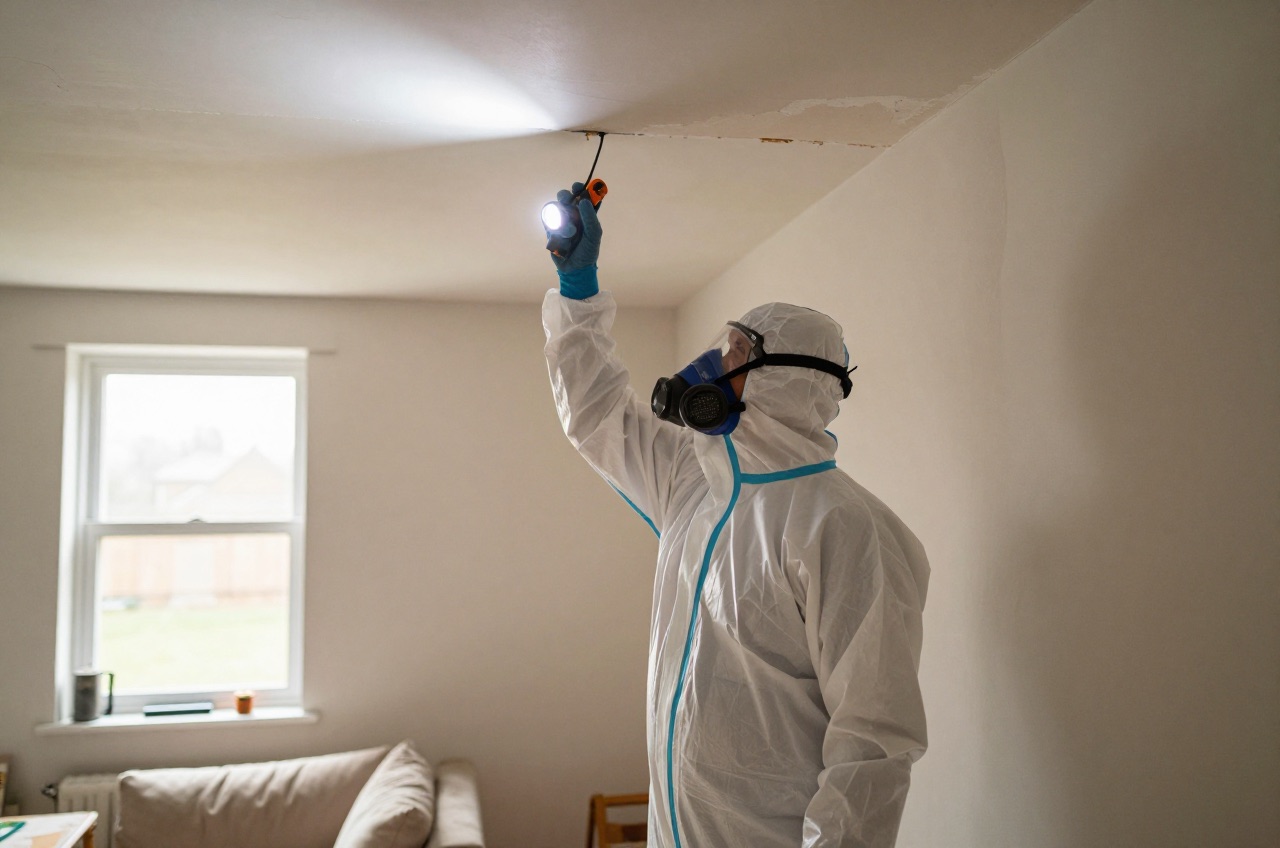
Step 4, Enclosure and removal. The area is sealed with polythene sheeting, negative-pressure air units are used for high-risk work, and operatives wear appropriate RPE (typically FFP3 or air-fed respirators for licensed work).
Step 5, Air testing and clearance. After removal, an independent UKAS-accredited analyst carries out air tests before the enclosure is removed. This is mandatory for licensed work and strongly recommended for any removal.
Step 6, Disposal. Waste is taken to a permitted hazardous waste facility. You should receive a consignment note (a legal requirement for licensed waste) confirming disposal.
What About Artex Ceilings?
This is one of the most common concerns for UK homeowners. Artex and similar textured coatings applied before 2000 may contain chrysotile asbestos, typically at 3–5% concentration.2 A ceiling in good condition, left alone, poses negligible risk. The danger arises if you sand it, drill through it, or strip it.
Options:
- Leave it, if in good condition, this is often the safest choice.
- Overboard it, plasterboard fixed over the existing ceiling, encapsulating the artex. Cost: £200–£400 per room (materials and labour), no asbestos removal required.
- Test and remove, have a sample tested (£25–£50), and if positive, commission a licensed contractor for removal.
Most removal companies will recommend overboarding as cost-effective and low-risk.
Finding a Licensed Contractor
Only an HSE-licensed contractor may remove the higher-risk materials, and the HSE sets out which work needs a licence. There is no searchable public directory, so vet each firm yourself. Always:
- Get at least three written quotes with scope of work clearly defined.
- Check that the quote includes air testing, waste disposal, and a clearance certificate.
- Confirm the company carries public liability insurance of at least £5 million.
- Ask for a copy of their HSE licence before work starts.
Avoid cash-in-hand offers for asbestos work. Unlicensed removal of licensed materials is a criminal offence under the Control of Asbestos Regulations 2012, and you as a homeowner can be held liable for fly-tipped asbestos waste.
Disturbing asbestos without testing
Drilling, sanding, or breaking ACMs releases fibres that can cause mesothelioma and lung cancer decades later. Always test before you cut, drill, or sand any pre-2000 surface you are unsure about.1
Do I Have to Declare Asbestos When Selling?
There is no legal duty to survey for asbestos before selling a home in England and Wales, but the Misrepresentation Act 1967 means knowingly concealing a known hazard can expose sellers to claims. In practice, most solicitors advise disclosing any known ACMs in the property information form (TA6). A management survey carried out before listing, at £200–£500, can actually be a selling advantage, it shows buyers exactly what is present and in what condition, removing uncertainty that might otherwise kill a sale.
References (2)
Figures in this note were checked against the sources below on 14 September 2026. Superscript numbers in the text point to them. Every source the site cites, by topic.
- 1technicalvery strongHealth and Safety Executive, guidance.RN-A47PNLHSE's introduction to why asbestos is dangerous and where it is found: it can be present in any building built or refurbished before 2000, in artex, insulation board, cement sheet, floor tiles, pipe lagging and more. The list of locations is what makes it useful, because it is how somebody stripping out a room knows what they are looking at.
- 2technicalvery strongHealth and Safety Executive, guidance.RN-5PLWW8HSE's asbestos frequently asked questions: the health risks, which work is licensed and which is not, what a householder may and may not do themselves, and where the free HSE publications are. The quickest authoritative answer to whether a particular job needs a licensed contractor.
-
Introduction to asbestos safety: Why asbestos is dangerous and where it can be found, Health and Safety Executive, accessed 7 September 2026. hse.gov.uk
-
Asbestos: frequently asked questions, Health and Safety Executive, accessed 7 September 2026. hse.gov.uk