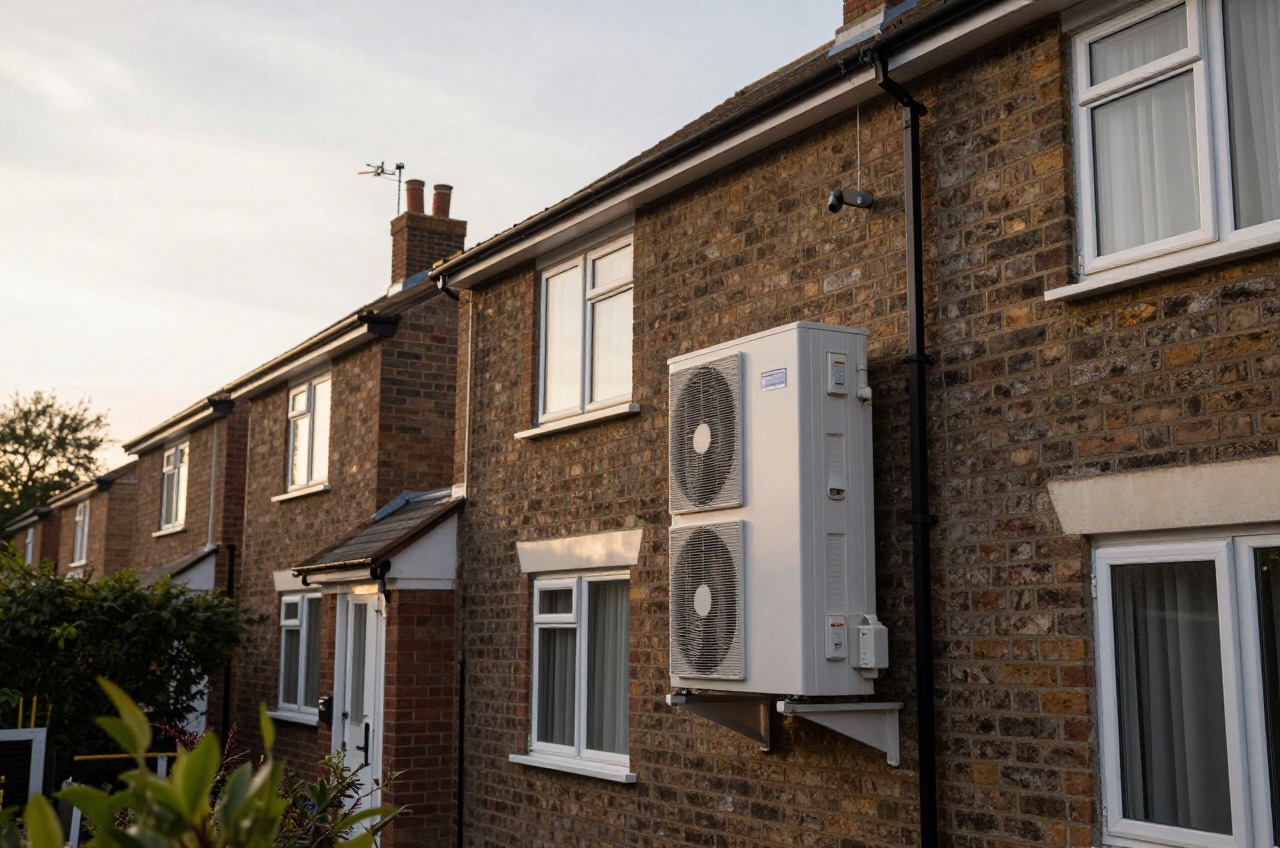
The Boiler Upgrade Scheme (BUS) is the UK government’s main financial incentive to help homeowners in England and Wales replace fossil-fuel heating systems with low-carbon alternatives. As of 2026 the grant values are:
- Air source heat pump (ASHP): £7,5001
- Ground source heat pump (GSHP) or water source heat pump: £7,500
- Air-to-air heat pump: £2,500
- Biomass boiler (limited eligibility): £5,000
From 21 July 2026 to 31 March 2027, eligible off-gas-grid properties get an uplifted £9,000 for an air source or ground source heat pump instead of £7,500. If your home has no mains gas connection, check with your installer whether you qualify before the voucher is claimed.
These grants are deducted at point of purchase, you never receive cash directly. Your MCS-certified installer claims the voucher from Ofgem on your behalf and discounts it from the invoice.
Who Is Eligible
| Requirement | Detail |
|---|---|
| Property type | Owner-occupied or private rented in England or Wales |
| Existing heating | Must be replacing a fossil fuel system (gas, oil, LPG, electric storage heaters) |
| EPC requirement | Property must have a valid EPC with no outstanding loft or cavity insulation recommendations* |
| Installer | Must use an MCS-accredited contractor |
| Grant per property | One grant per property (some exceptions for properties that already claimed under an earlier round) |
*If your EPC recommends loft or cavity insulation, you do not automatically lose eligibility, but you must either complete those measures first or obtain a written exception from an energy assessor.
The scheme does not apply to new-build homes (which should already meet higher energy standards) or social housing (covered by separate programmes such as the Social Housing Decarbonisation Fund).
How to Apply
- Get an EPC if you do not already have a valid one (£60–£120 from an accredited assessor).
- Obtain quotes from at least two MCS-accredited installers. Use the MCS installer finder at mcscertified.com.
- Choose your installer and confirm the work qualifies for BUS.
- The installer creates a voucher application on the Ofgem portal before work begins. You will receive a voucher confirmation email; the voucher is valid for three months.
- Work is completed and the installer redeems the voucher, deducting £7,500 from your invoice.
- You pay the net cost (total installed price minus £7,500) and the installer handles all paperwork with Ofgem.
There is no income test. The BUS is open to all owner-occupiers regardless of household income, making it different from means-tested schemes such as the ECO4 obligation.
Typical Installed Costs After the Grant
| System | Gross Installed Cost | BUS Grant | Typical Net Cost |
|---|---|---|---|
| Air source heat pump (ASHP) | £10,000–£18,0002 | £7,500 | £2,500–£10,500 |
| Ground source heat pump (GSHP) | £18,000–£35,0003 | £7,500 | £10,500–£27,500 |
| Biomass boiler | £12,000–£22,000 | £5,000 | £7,000–£17,000 |
Costs vary with property size, installer region, and whether existing pipework and radiators need upgrading. Heat pumps typically require either underfloor heating or oversized radiators to work efficiently. Budget £1,000–£4,000 extra if you need to upgrade radiators throughout.
Running Costs After Installation
Heat pump running costs depend heavily on your electricity tariff. At a typical 2026 residential rate of around 24–28 p/kWh and a SCOP of 3.0, the effective heat cost is roughly 8–9 p/kWh, comparable to or slightly above gas at current rates. Households that switch to an EV tariff with off-peak overnight rates (commonly 7–10 p/kWh) can reduce their heat pump running costs substantially by pre-heating the home at night.
The Heat Pump Ready programme and Ofgem’s smart tariff work are expected to improve the economics further through 2027.
Other Heating Grants Available in 2026
ECO4 (Energy Company Obligation)
Funded by energy suppliers and targeted at low-income households and those in fuel poverty. ECO4 can fund:
- Loft and cavity wall insulation
- Solid wall insulation
- First-time central heating
- Heat pump installations in eligible properties
ECO4 runs to 31 December 2026, so apply well before that date. To check eligibility, use the Ofgem ECO4 eligibility checker or contact your energy supplier directly. There is no application fee.
Great British Insulation Scheme (GBIS): closed 31 March 2026
GBIS was a separate Ofgem-administered programme funding single insulation measures (typically loft or cavity wall) for homes rated EPC D–G. It closed to new applications on 31 March 2026, so it is no longer a route to fabric improvements before a heat pump. ECO4 and the Warm Homes: Local Grant are the remaining options.
Warm Home Discount
A £150 rebate applied directly to electricity bills for eligible low-income households. Qualifying households are identified automatically by the DWP/energy suppliers from April each year; you do not need to apply.
Warm Homes: Local Grant (successor to HUG2)
The Home Upgrade Grant (HUG2) has been replaced by the Warm Homes: Local Grant, delivered by local authorities in England. It is open to households in properties rated EPC D to G with a household income of £36,000 or under, and can fund insulation and low-carbon heating together. Contact your local council to check if your area is participating.4
Wales: Nest and Arbed
The Nest scheme (managed by Warm Wales) provides free energy efficiency improvements to eligible homeowners and private renters in Wales. Arbed is the area-based scheme for community energy improvements. Both target low-income and fuel-poor households.
Scotland: Warmer Homes Scotland
Scottish Government programme providing free energy efficiency improvements and heating systems to low-income households. Delivered by Home Energy Scotland; call 0808 808 2282 to check eligibility.
Stacking Multiple Grants
You can combine BUS with other grants in some cases. For example:
- BUS grant for the heat pump + ECO4 insulation (if income-eligible) = significant combined support
- BUS + local council Sustainable Warmth grant = possible for off-gas-grid properties
Always confirm with your installer and the relevant scheme administrator before assuming grants can be combined. Some schemes prohibit double-funding of the same measure.
Voucher Expiry
A BUS voucher is valid for three months from issue. If the installation is delayed (supply chain, planning issues), ask your installer to apply for a reissue before expiry, Ofgem does allow extensions in some circumstances.
What to Ask Your Installer
- Are you MCS accredited for heat pump installations?
- Will my existing radiators and pipework be suitable, or will they need upgrading?
- What SCOP rating do you design to, and can I see the MCS heat loss calculation?
- Will the system work with my current hot water cylinder, or do I need a new one?
- Do you handle the BUS voucher application, and when will you submit it?
A reputable installer will provide a full MCS Microgeneration Installation Standard (MIS) compliant heat loss calculation before quoting, showing that the heat pump is correctly sized for your home.
References (4)
Figures in this note were checked against the sources below on 14 September 2026. Superscript numbers in the text point to them. Every source the site cites, by topic.
- 1costvery strongGOV.UK.RN-9EFNVZA price, true at 2026-09. The grant values: £7,500 towards an air source heat pump, £7,500 towards a ground source heat pump including water source heat pumps and those on shared ground loops, and £5,000 towards a biomass boiler. A further £1,500 is available until March 2027 where the property is heated by oil or LPG and has no mains gas connection. Only one grant is available per property. Capacity limits are 45kWth for an individual system, 70kWth for multiple heat pumps and 300kWth for shared ground loops. Hybrid systems pairing a gas boiler with a heat pump are not eligible, and an existing low carbon heating system cannot be replaced under the scheme.
- 2costvery strongDepartment for Energy Security and Net Zero.RN-AC5XPIA price, true at 2025. The summary business case for the Boiler Upgrade Scheme 2026 to 2030. Sets out the grant amounts, the budget, expected installation volumes and the department's reasoning for continuing the scheme. This is where the scheme's own numbers come from, as opposed to the application page, which tells a householder what to do but not what it is expected to cost the state or how long the money lasts.
- 3costvery strongDepartment for Energy Security and Net Zero / Ofgem / MCS.RN-7X7D1VA price, true at 2025. DESNZ Boiler Upgrade Scheme statistics, July 2026, Table A1.3A. Voucher applications, redemptions and values by technology, so it says what the scheme is actually paying out rather than what it offers.
- 4costvery strongDepartment for Energy Security and Net Zero, guidance.RN-BCN48CA price, true at 2026-07. Warm Homes: Local Grant, policy guidance for local authorities (updated July 2026), government guidance cited for the figures and rules it sets out
-
Apply for the Boiler Upgrade Scheme: What you can get, GOV.UK (Department for Energy Security and Net Zero), accessed 15 September 2026. Priced at 2026-09, so no calibration is needed. gov.uk
-
Boiler Upgrade Scheme 2026-2030: Summary Business Case, Department for Energy Security and Net Zero, accessed 15 September 2026. Priced at 2025/26, so no calibration is needed. assets.publishing.service.gov.uk
-
Boiler Upgrade Scheme statistics, July 2026, Table A1.3A, Department for Energy Security and Net Zero / Ofgem / MCS, accessed 15 September 2026. Priced at 2025/26, so no calibration is needed. assets.publishing.service.gov.uk
-
Warm Homes: Local Grant, policy guidance for local authorities (updated July 2026), Department for Energy Security and Net Zero, accessed 15 September 2026. Priced at 2026-07, so no calibration is needed. assets.publishing.service.gov.uk