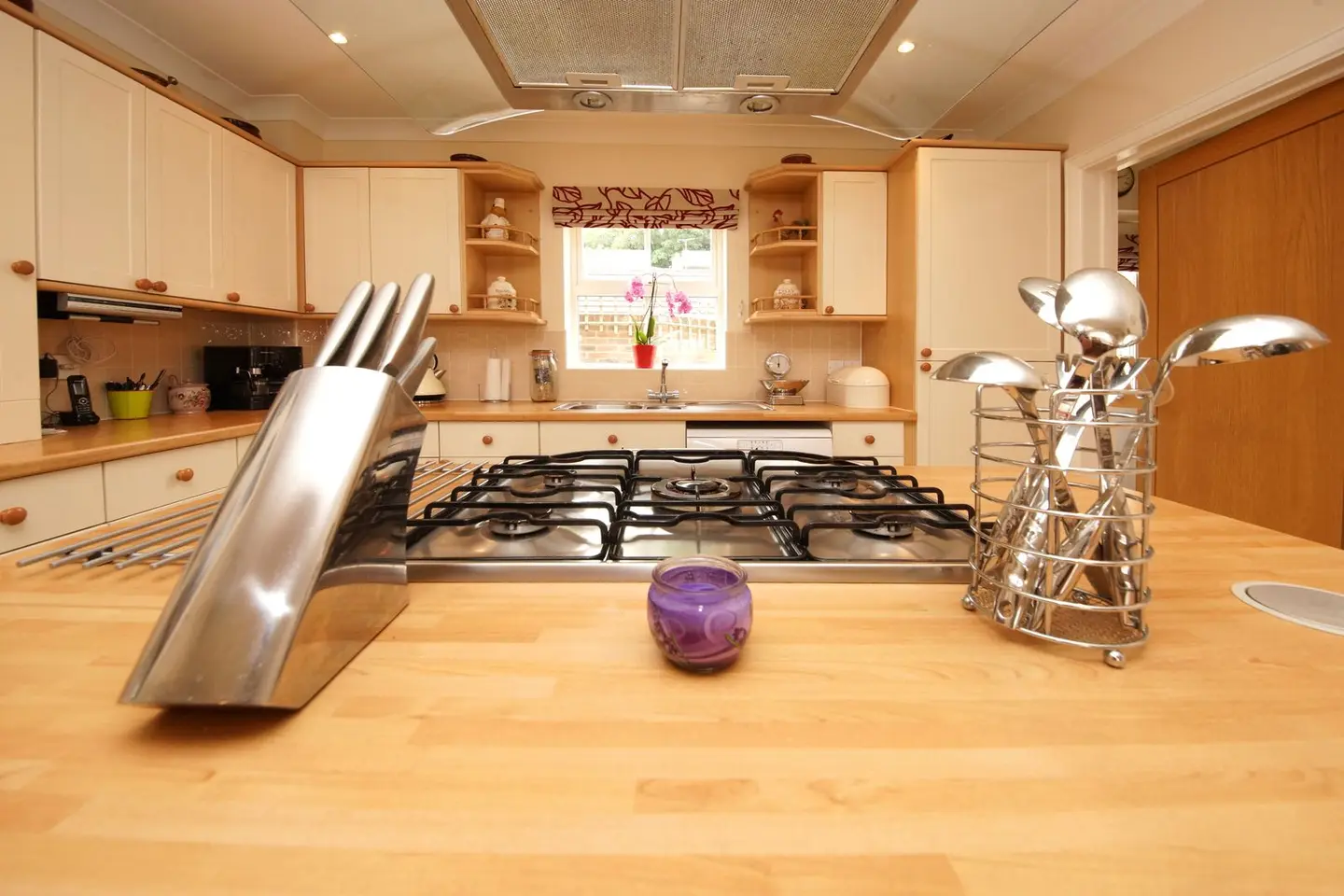
Butcher block worktops, thick solid-wood surfaces assembled from glued lengths or blocks of timber, have been popular in UK kitchens for decades. They’re warm, repairable, and genuinely attractive. They’re also one of the few kitchen surfaces you can sand back to new when they look tired.
This guide sets out 2026 UK costs by wood species and construction type, explains what fitting involves, and covers the practical realities of ownership so you can decide whether they suit your kitchen.
What “Butcher Block” Means in the UK
In North America, “butcher block” almost always means end-grain construction, where the rings of the wood face upward, like the classic butcher’s block chopping surface. In the UK, the term is used more loosely and often refers to any thick solid-wood worktop, including:
- Stave (face grain): planks glued edge-to-edge, grain running lengthwise. The most common type in UK kitchens.
- End grain: blocks cut and arranged so the end-grain surface faces up. More expensive, requires more wood, and is used for chopping areas.
- Edge grain: planks glued with the edge of the board facing up, between stave and end grain in cost and durability.
For worktops (rather than dedicated chopping blocks), stave construction is standard.
Cost by Wood Species
| Wood Species | Stave (per linear metre, 40 mm thick) | End Grain (per linear metre) |
|---|---|---|
| Beech | £60–£120/m | £180–£320/m |
| Solid oak | £90–£200/m | £250–£450/m |
| Maple | £100–£200/m | £220–£420/m |
| Ash | £90–£180/m | £220–£380/m |
| Walnut | £200–£400/m | £450–£800/m |
| American cherry | £180–£350/m | £400–£700/m |
| Iroko (African teak) | £100–£200/m | N/A (less common) |
Prices are per linear metre at standard 600–650 mm depth. Wider formats (900 mm island) add 30–50%.
Beech is the budget entry point, it’s hard, food-safe, and takes oil well, but marks more easily than oak. Oak is the best-seller in UK kitchens for its balance of looks, durability, and cost. Walnut is the premium choice; it’s rich in colour, slightly softer than oak, and commands a significant price premium.
Standard vs Custom Worktops
Off-the-shelf / standard lengths are sold in set lengths (2.0 m, 3.0 m, 4.0 m) and standard depths (600 mm most common). These are stocked by timber merchants, DIY sheds, and kitchen retailers. They’re the most affordable option and fine for straightforward kitchens with standard runs.
Custom-made worktops are cut to your exact dimensions and may include internal mitre joints for corners, cutouts for sinks pre-made to template, and bespoke edge profiles. Custom adds £50–£200+ per piece over standard pricing, plus longer lead times (2–4 weeks typically).
For an L-shaped kitchen, standard lengths mitre-jointed on site are usually the most cost-effective approach. A bespoke one-piece U-shape is possible but the cost and complexity increase significantly.
Fitting Costs
Fitting a solid wood worktop is more skilled work than laminate because:
- Timber must be allowed to acclimatise (24–48 hours in the kitchen before fitting)
- Joints need to be tight and properly supported to avoid movement cracking them
- Sink and hob cutouts require careful template work, especially for end-grain
- The worktop must be securely (but not rigidly) fastened to allow for seasonal movement
- Final oiling or sealing on-site takes additional time
Labour costs in 2026: a kitchen fitter charges £200–£350 per day. A standard 4–5 m run of worktop with one sink cutout is typically a full day’s work. A complex U-shaped kitchen with island might take 1.5–2 days.
Expect to add £250–£600 for fitting to most kitchen projects.
Finishing and Maintenance
Solid wood worktops must be finished to protect against water and staining. The two main approaches:
Oiled finish (most common): food-safe hardwax oil or pure linseed/tung oil penetrates the wood and needs reapplication 1–4 times per year depending on use. Oiled worktops are repairable, scratches and stains can be sanded out. Hardwax oil (e.g., Osmo or Treatex) costs £20–£50 per litre and is applied very thinly, so a litre covers roughly 20–30 m² per coat depending on brand and how absorbent the timber is. One tin will finish a whole kitchen’s worth of worktop several times over.
Lacquered finish: a harder surface coat that requires less frequent maintenance but cannot be sanded back and repaired in sections. Less common for worktops that will see chopping and heavy use.
What to avoid: leaving standing water. Even with a good oil finish, pooled water around the sink or at the back edge behind a hob will eventually cause swelling or darkening. Fit a drainer tray and clean up spills promptly.
Comparison with Other Worktop Materials
| Material | Cost per Metre | Durability | Repairability | Heat Resistance |
|---|---|---|---|---|
| Beech butcher block | £60–£120/m | Good | Excellent | Poor |
| Oak butcher block | £90–£200/m | Very good | Excellent | Poor |
| Laminate | £20–£60/m | Moderate | Poor | Moderate |
| Quartz (engineered stone) | £250–£600/m | Excellent | None | Good |
| Granite (natural stone) | £200–£700/m | Excellent | None | Excellent |
| Compact laminate (Fenix NTM) | £155–£227/m, supply only1 | Excellent | Poor | Excellent |
| Sintered stone (Dekton) | £240–£450/m, supplied and fitted2 | Excellent | Poor | Excellent |
Wood’s defining advantage over stone and engineered quartz is repairability. A scratched or burned section of oak worktop can be sanded back to pristine condition; the same defect in quartz requires an expensive full replacement. For families with children and busy kitchens, the ability to sand and re-oil is genuinely useful.
Worked Example: Standard Kitchen Run
A standard kitchen with 3.2 m of continuous worktop (one sink cutout) in oak stave:
- Oak stave worktop, 3.2 m × 600 mm, 40 mm: 2 × 2.0 m lengths at £160/m = £640
- Hardwax oil + sundries: £45
- Fitting (1 day): £270
- Total: approximately £955 (ex. VAT)
The same run in quartz would typically be £250–£450 per metre fitted, £800–£1,440 total, making solid oak competitively priced once fitting is included.
Key Questions to Ask Before Buying
- Is the timber FSC or PEFC certified? Reputable UK suppliers will confirm this.
- What moisture content was the timber dried to? Wood for kitchen use should be kiln-dried to 8–12%, and joinery timber for a heated building should not exceed 13% in any case.3
- Are the joints dowelled or just glued? Dowels add strength for longer runs.
- What finish has been applied at the factory (if any)? Some worktops arrive pre-oiled; others are bare and need finishing before installation.
References (3)
Figures in this note were checked against the sources below on 10 September 2026. Superscript numbers in the text point to them. Every source the site cites, by topic.
- 1costsupplier figureWorktop City.RN-2SEPU1A price, true at 2026-09. the retailer's published size options and prices for a 12 mm Fenix NTM solid compact laminate worktop, including the 3000 x 645 x 12 mm sheet at GBP 577.12 and the 4100 x 645 x 12 mm sheet at GBP 930.20, which are two of the four published sheet prices the cost book divides by their stated lengths to get a rate per linear metre
- 2costsupplier figureCawdor Worktops.RN-PDZJFOA price, true at 2026-09. Cawdor Worktops publishing its own price guidance for this work. A trade supplier writing about what it charges is evidence of the market rate and not a quotation, and the cost book treats it as one figure among several rather than on its own
- 3technicalgoodBritish Woodworking Federation, guidance.RN-5MTP2PBWF guidance on timber durability and specification. States that where national requirements and end use are not available, the moisture content of the timber shall not exceed 13% for heated buildings or 16% for use in unheated buildings. Useful as the ceiling figure against which the common trade rule of thumb of 8 to 12% kiln-dried moisture content for kitchen worktops and interior joinery can be sanity-checked.
-
Fenix Nero Ingo NTM Solid Fenix Kitchen Worktop 12mm (T), Ultra matt Finish, Worktop City, accessed 16 September 2026. Priced at 2026-09, so no calibration is needed. worktopcity.com
-
How Much Does Sintered Stone Cost? Dekton and Neolith Prices (2026), Cawdor Worktops, accessed 15 September 2026. Priced at 2026-09, so no calibration is needed. cawdorworktops.co.uk
-
Durability, British Woodworking Federation, accessed 10 September 2026. bwf.org.uk