Choosing a kitchen worktop means balancing upfront cost against long-term durability, maintenance commitment and how hard you actually cook. Laminate can look excellent for well under £100/m², while engineered and natural stone offer a step change in robustness at three to ten times the price. Neither choice is wrong, the right material is the one that matches your kitchen use and budget without compromises you’ll regret in year five.
This guide covers the six most common worktop materials available in the UK in 2026, with realistic price ranges, performance characteristics, thickness options and practical advice on what to ask a fitter before you sign anything.
UK Standard Worktop Thicknesses
Most worktops are manufactured in 20 mm, 30 mm or 40 mm profiles. Laminate post-form worktops are almost always 38 mm (a legacy imperial-derived size, effectively 40 mm class). Stone slabs are commonly 20 mm or 30 mm, with 20 mm used for lighter installations and 30 mm where a more substantial edge profile is wanted. Thicker slabs weigh significantly more and require adequately braced carcasses, a 30 mm granite run can exceed 80 kg/m², so always confirm cabinet structural load ratings with your supplier before ordering.
Quartz (Engineered Stone)
Quartz worktops are engineered stone: HSE defines that as artificial stone made from crushed natural stone or minerals bonded together with resin.1 Mineral content is typically around 90% by weight, but the crystalline silica fraction is no longer a fixed figure. Cosentino, which makes Silestone, states that since 2022 its whole portfolio is produced with a maximum of 40% crystalline silica, and labels individual ranges at maximum 10%, 40% or 50% in its own product guide. Because they are engineered rather than quarried, colour and pattern are highly consistent across a slab, useful when matching multiple sections.
Hardness: Mohs 7, making quartz harder than most kitchen knives and highly resistant to everyday scratching.
Non-porous: The resin binder renders quartz non-porous, so no sealing is required. Bacteria and liquids cannot penetrate the surface.
Heat sensitivity: Resin is the weak point. Sustained heat above approximately 150°C, a hot pan placed directly on the surface, can cause discolouration, cracking or delamination that is not repairable. Always use trivets or pan stands.
Cost: £300–£800/m² supplied and installed, depending on thickness, edge profile and supplier. Budget-end quartz tends to have simpler colour options; premium ranges offer marble-effect veining.
Lifespan: 10–25 years with normal use; effectively unlimited if heat damage is avoided and the surface is not struck with heavy objects.
Granite
Granite is an igneous natural stone and each slab is unique. Veining, fleck patterns and background colour vary across the same quarry run, so viewing the actual slab before purchase is strongly recommended when a matched appearance across joints matters.
Hardness: Mohs 6–7. Harder than steel and extremely resistant to scratching, though not quite as uniform in surface hardness as engineered quartz.
Heat resistance: One of granite’s genuine advantages over quartz is its thermal stability. Pans can be placed directly on polished granite without risk of heat damage, making it popular with serious cooks.
Sealing: Granite is porous to varying degrees depending on the variety. It requires sealing on installation and resealing annually using a suitable impregnating stone sealer. Without sealing, oils and wine can stain. Some very dense granites are more resistant, but annual maintenance should be the default assumption.
Cost: £200–£600/m² supplied and installed. Entry-level granites (popular commercially imported varieties) sit toward the lower end; rarer colours and thicker slabs push toward the top.2
Lifespan: Effectively indefinite if sealed and not subjected to impact damage.
Laminate
Laminate worktops are a high-density particleboard or MDF core faced with a thin melamine paper layer, heat-bonded under pressure. They are the dominant budget option in UK kitchens and have improved substantially in terms of surface texture and print fidelity, realistic stone and wood effects are now widely available.
Performance: The surface layer is resistant to light scratching and everyday wear, but it is neither heat-proof nor water-proof at the edges and seams. Placing a hot pan directly on laminate will blister the surface immediately. Water infiltrating unsealed cut edges or joins causes the substrate to swell irreparably.
Cost: £30–£150/m² supplied. Post-formed (one-piece curved-front) worktops are the cheapest; laminate with applied edge strips and square profiles cost a little more. Installation is simpler than stone, which reduces fitting costs.
Lifespan: 10–15 years in a well-maintained kitchen; shorter if joins are not properly sealed and water ingress occurs.
Solid Wood
Timber worktops, oak, walnut and beech being the most common UK options, are popular for their warmth and the ability to be sanded and re-oiled if surface damage occurs. A badly scratched solid wood worktop can be brought back to near-new condition with light sanding and a fresh oil treatment; the same damage on quartz or laminate is permanent.
Maintenance: Solid wood must be oiled on installation and re-oiled every three to twelve months depending on use and the oil product. Insufficient oiling leads to grain raising, warping and cracking. Water standing on the surface for extended periods, particularly around the sink, degrades the timber. Solid wood is not recommended immediately adjacent to a sink unless a stainless steel or composite inset sink is used with a tight seal and very diligent oiling regime.
Cost: £200–£500/m² supplied and fitted. Solid oak is at the lower end of this range; American black walnut and other premium timbers push higher.
Lifespan: 20+ years with consistent maintenance; some oak worktops in period kitchens have lasted 40–50 years with periodic re-oiling.
Dekton and Sintered Stone
Dekton is a sintered surface material, a compressed mixture of glass, porcelain and quartz fused at extreme temperature and pressure to produce an ultra-compact, non-porous slab. Other brands include Neolith and Lapitec. These materials represent the premium performance tier.
Heat resistance: Unlike quartz, sintered stone is unaffected by direct heat, pans can be placed directly on the surface.
Scratch resistance: Very hard. Cosentino rates Dekton at seven out of ten on the Mohs scale, the same as quartz, not the eight-plus often quoted, but that is still well above anything in a kitchen drawer.
Brittle under impact: The same hardness that resists scratching makes sintered stone brittle under a sharp point impact (a dropped knife corner, for instance). Edge chipping is the primary failure mode.
Cost: £500–£1,200/m² supplied and installed. The fabrication and material costs are genuinely higher than quartz, and fewer fitters are experienced with the material, which affects availability and price.3
Lifespan: Indefinite under normal conditions.
Corian and Solid Surface
Solid surface worktops (Corian is the best-known brand, though the category includes several manufacturers) are made from an acrylic polymer and mineral composite. The material is homogeneous, colour runs all the way through, and can be thermoformed and joined invisibly.
Seamless joins: Joints between sections are chemically bonded and sanded flat, leaving no visible line or gap. This is a hygiene advantage over stone, where joins always leave some form of grout or silicone.
Repairable: Surface scratches, burns and stains can be sanded out and buffed. A solid surface worktop can be refurbished in situ by a qualified fabricator.
Not as hard as stone: Mohs approximately 3–4, meaning solid surface scratches more readily than quartz or granite under daily use. Cutting directly on the surface is not recommended.
Cost: £300–£600/m² supplied and installed. Corian and equivalents are mid-range in price; the seamless fabrication often makes them competitive with entry-level quartz when compared on a whole-kitchen basis.
Lifespan: 15–25 years before the surface is too degraded to refurbish cost-effectively.
Material Comparison Table
| Material | Cost (£/m²) | Heat Resistance | Scratch Resistance | Maintenance | Lifespan |
|---|---|---|---|---|---|
| Laminate | £30–£150 | Poor (blisters) | Moderate | Low, avoid wet edges | 10–15 years |
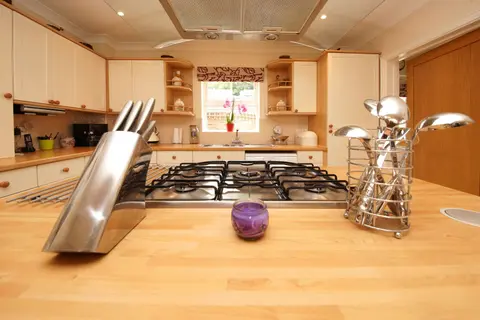
| Solid Wood | £200–£500 | Moderate (marks) | Moderate | High, oil regularly | 20+ years |
| Granite | £200–£600 | Excellent | High (Mohs 6–7) | Medium, annual seal | Indefinite |
| Corian / Solid Surface | £300–£600 | Moderate (scorches) | Low-moderate | Low, repairable | 15–25 years |
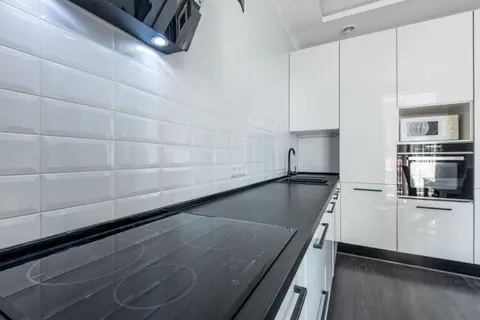
| Quartz | £300–£8004 | Poor (resin damage) | Very high (Mohs 7) | Low, no sealing | 10–25 years |
| Dekton / Sintered Stone | £500–£1,200 | Excellent | Excellent (Mohs 7) | Very low | Indefinite |
Installation Costs
Stone worktops (quartz, granite, Dekton) must be templated, cut and installed by a specialist fabricator, the material cannot be worked on site with standard carpentry tools. Expect to pay £150–£300 per day for a worktop fitter, plus templating fees of £75–£150. Most stone jobs require two fitters for safe handling of heavy slabs.
Laminate and solid wood can be installed by a competent kitchen fitter. Laminate in particular is straightforward to cut and join on site.
Allow an additional £50–£120 for plumbing disconnection and reconnection if an existing sink and taps must be removed to allow worktop access.
Stone Dust: The Risk Nobody Quotes You For
Cutting, grinding or polishing stone releases respirable crystalline silica, which HSE links to silicosis, lung cancer and COPD, and it names over 500 construction deaths a year from silica dust.5 Engineered stone is the sharp end of this because the resin binds crushed mineral, and HSE has separate guidance for working it.1 The workplace exposure limit for respirable crystalline silica is 0.1 mg/m³.6
For worktops specifically, HSE says to do as much cutting, shaping and polishing as possible off site in a properly equipped workshop, and to keep unavoidable on-site modifications to a well-ventilated, segregated area, using water suppression or on-tool extraction with a shroud and an M-class vacuum, plus RPE such as an FFP3 mask with an assigned protection factor of at least 20.7 That APF of 20 is the general level HSE sets for construction dust, meaning the wearer breathes one twentieth of the dust in the air, and the only disposable HSE lists against it is an FFP3, or a half mask with a P3 filter. An FFP2 is not on that list.5 For powered hand tools on engineered stone, HSE goes further and asks for a powered air purifying respirator with an APF of at least 20.1 If a fitter proposes to dry-cut a quartz slab in your kitchen with an angle grinder and a paper mask, that is the moment to stop the job.
Building Regulations and Standards
Kitchen worktops are not directly subject to Building Regulations approval, but associated work may be notifiable. Replacing or installing a gas hob requires a Gas Safe registered engineer: regulation 3 of the Gas Safety (Installation and Use) Regulations 1998 bars anyone who is not competent from working on a gas fitting, and requires a business or self-employed person doing that work to belong to a class of persons approved by the Health and Safety Executive.8 Electrical work in a kitchen falls under Part P, but only some of it is notifiable: under Approved Document P the notifiable jobs are a new circuit, a consumer unit replacement, and any work in a special location, so installing a built-in cooker is not notifiable unless a new cooker circuit is needed. Where it is notifiable, there are three routes, self-certification by a registered competent person, third-party certification by a registered third-party certifier, or certification by a building control body.9
If the worktop replacement is part of a wider kitchen extension or structural alteration, those elements will have their own Building Regulations requirements independent of the worktop choice itself.
How to Choose
Go with laminate if budget is the primary constraint and you are willing to replace the worktop within a decade. Modern laminate with quality edge strips looks good and performs adequately for most households.
Go with quartz if you want a low-maintenance surface with a long lifespan and you are disciplined about using trivets. It is the best all-round performer in the mid-to-upper price bracket for kitchens where aesthetics and easy cleaning matter more than placing hot pans directly down.
Go with granite if you cook heavily, want the option to rest pans directly on the surface, and do not mind annual sealing. The natural variation adds character that engineered stone cannot fully replicate.
Go with Dekton or sintered stone if budget is secondary and you want the most robust surface available, particularly relevant in households with young children or high cooking volumes.
Go with solid wood if you value warmth and repairability and are committed to the maintenance routine. Avoid it next to the sink unless you are meticulous about drying and sealing.
Go with Corian if seamless joins and in-situ repairability matter, typically relevant in kitchens where hygiene is a priority or where an integrated sink and worktop in one material is the goal.
The rules in this note are those that apply in England. Scotland, Wales and Northern Ireland have their own building standards and permitted development rights.
References (9)
Figures in this note were checked against the sources below on 9 September 2026. Superscript numbers in the text point to them. Every source the site cites, by topic.
- 1technicalvery strongHealth and Safety Executive (HSE), guidance.RN-G9LT14The HSE's guidance on engineered stone specifically, which matters because quartz worktops carry a far higher crystalline silica content than granite or laminate. It defines engineered stone as artificial stone manufactured from crushed natural stone or minerals bonded with resin, and notes that cutting or drilling it creates dust, the respirable fraction of which is respirable crystalline silica. The control steps it lists for cutting, grinding and polishing engineered stone with powered handheld rotary tools are: work with stone containing the lowest crystalline silica content available; use powered air purifying respirators with an assigned protection factor of at least 20 when processing, cleaning or maintaining machinery; and provide health surveillance for workers regularly exposed to RCS dust where there is a reasonable likelihood that COPD or silicosis may develop. It points to COSHH essentials for stoneworkers sheet ST3A for the detailed guidance. This is the citable basis for advising a reader to ask a fabricator about silica content and wet cutting rather than treating quartz as a purely aesthetic choice.
- 2costsupplier figureRoyal Marble.RN-RVCGHUA price, true at 2026-09. a stone fabricator publishing its own granite pricing, cited as a market figure for supplied and fitted stone rather than as a quotation
- 3costsupplier figureCawdor Worktops.RN-PDZJFOA price, true at 2026-09. Cawdor Worktops publishing its own price guidance for this work. A trade supplier writing about what it charges is evidence of the market rate and not a quotation, and the cost book treats it as one figure among several rather than on its own
- 4costsupplier figureAKG Surfaces.RN-QOH38RA price, true at 2026-09. AKG Surfaces publishing its own price guidance for this work. A trade supplier writing about what it charges is evidence of the market rate and not a quotation, and the cost book treats it as one figure among several rather than on its own
- 5technicalvery strongHealth and Safety Executive, guidance.RN-CDLNT7The specific HSE information sheet behind the dust advice, with the numbers a note can quote. Names three types of construction dust: silica dust, also called respirable crystalline silica, from concrete, mortar and sandstone; wood dust from softwood, hardwood and wood-based products including MDF and plywood; and other general dust from materials with little or no silica, most commonly gypsum as in plasterboard, limestone, marble and dolomite. States that over 500 construction workers are believed to die from exposure to silica dust every year, and that the main dust-related diseases are lung cancer, silicosis, chronic obstructive pulmonary disease and asthma, most developing slowly though advanced silicosis and asthma can come on quickly. The legal framework is the Control of Substances Hazardous to Health Regulations 2002, and the three required steps are Assess, Control and Review. On damping down it corrects a common site habit: water needs enough supply at the right levels for the whole time the work is being done, and just wetting the material beforehand does not work. High dust levels come from high-energy tools such as cut-off saws, grinders and grit blasters.
- 6technicalvery strongHealth and Safety Executive, guidance.RN-VEGC3YHSE's stoneworking FAQ gives the workplace exposure limit for respirable crystalline silica as 0.1 mg/m3, and notes that reducing exposure below the WEL alone may not amount to adequate control in most cases. It gives silica content by stone type: limestone usually, but not always, below 2 per cent; marble typically below 5 per cent although it can be as high as 30 per cent; and engineered or artificial marble may be as high as 30 per cent. This is the citation for why cutting and shaping an engineered stone worktop on site is a controlled activity and why a fabricator should be cutting wet rather than dry.
- 7technicalvery strongHealth and Safety Executive, guidance.RN-DNUV4QHSE guidance aimed squarely at worktop installers. It states that respirable crystalline silica is present in most rocks, sands and clays and in products such as bricks, tiles and concrete, and that breathing stone dust containing RCS causes silicosis, lung cancer and chronic obstructive pulmonary disease. The controls it names are water suppression, or on-tool extraction with a shroud and dust collector attached to an M-class vacuum, and it warns against dry sweeping dust and debris or anything else that makes dust go airborne. For respiratory protection it specifies a face mask such as an FFP3 with an assigned protection factor of at least 20, meaning it reduces the dust inhaled by a factor of 20. Cite it when a note tells a reader what to ask a worktop fitter about site cutting.
- 8technicalvery strongThe National Archives (legislation.gov.uk), legislation.RN-UFY1XPRegulation 3(1) makes it unlawful for any person to carry out work in relation to a gas fitting or gas storage vessel unless he is competent to do so, and 3(2) places the duty to ensure that on the employer, on every other employer or self-employed person with any control over the work, and on anyone who required the work to be done at a place of work under their control. Regulation 3(3) goes further: no employer may let an employee, and no self-employed person may themselves, carry out work on a gas fitting or service pipework unless that employer or self-employed person is a member of a class of persons approved by the Health and Safety Executive, which in practice is registration with the Gas Safe Register. Regulation 3(4) exempts only replacing a hose or regulator on a portable or mobile space heater and replacing the hose connecting a re-fillable cylinder to installation pipework. Regulation 3(7) makes it an offence to falsely pretend to be a member of an approved class. This is the legal basis for saying a boiler must be fitted by a Gas Safe registered engineer.
- 9technicalvery strongMinistry of Housing, Communities and Local Government.RN-JYJ3I5The document that decides what electrical work a homeowner may legally do themselves, and the exact list of notifiable jobs. Regulation 12(6A), reproduced at paragraph 2.5, makes only three things notifiable: the installation of a new circuit, the replacement of a consumer unit, and any addition or alteration to existing circuits in a special location. Regulation 12(9) defines special location as, in a room containing a bath or shower, the zone extending vertically from finished floor level to 2.25 metres (or the shower head position if higher) and horizontally 600mm from the edge of the bath tub or shower tray. Paragraph 2.7 states that all other electrical installation work is not notifiable, namely additions and alterations to existing installations outside special locations, and replacements, repairs and maintenance anywhere. Paragraph 2.8 gives worked examples: a built-in cooker is not notifiable unless a new cooker circuit is needed, and connecting an electric gate or garage door to an existing isolator is not notifiable but running a new circuit from the consumer unit to that isolator is. Paragraph 2.2 confirms Part P reaches outdoor work including fixed garden lighting, pond pumps and outbuildings such as sheds, detached garages and domestic greenhouses. Notifiable work must be certified by self-certification by a registered competent person, third-party certification, or a building control body (paragraph 3.1), with the compliance certificate issued within 30 days (paragraph 3.4). Note that Approved Document P is a source of guidance rather than a ban: non-notifiable work still has to comply with BS 7671.
-
Working engineered stone: control silica risk, Health and Safety Executive, accessed 9 September 2026. hse.gov.uk
-
Granite Pricing, Royal Marble, accessed 15 September 2026. Priced at 2026-09, so no calibration is needed. royalmarble.co.uk
-
How Much Does Sintered Stone Cost? Dekton and Neolith Prices (2026), Cawdor Worktops, accessed 15 September 2026. Priced at 2026-09, so no calibration is needed. cawdorworktops.co.uk
-
Quartz Worktop Prices UK 2026, AKG Surfaces, accessed 15 September 2026. Priced at 2026-09, so no calibration is needed. akgsurfaces.co.uk
-
Construction dust, Construction Information Sheet No 36 (Revision 3), Health and Safety Executive, accessed 9 September 2026. hse.gov.uk
-
Stoneworkers: frequently asked questions, Health and Safety Executive, accessed 9 September 2026. hse.gov.uk
-
Installing stone worktops: protect against harmful natural or artificial stone dust, Health and Safety Executive, accessed 9 September 2026. hse.gov.uk
-
The Gas Safety (Installation and Use) Regulations 1998, regulation 3: qualification and supervision, legislation.gov.uk, accessed 9 September 2026. legislation.gov.uk
-
Approved Document P, Electrical safety, Dwellings, 2013 edition, Ministry of Housing, Communities and Local Government, accessed 9 September 2026. assets.publishing.service.gov.uk