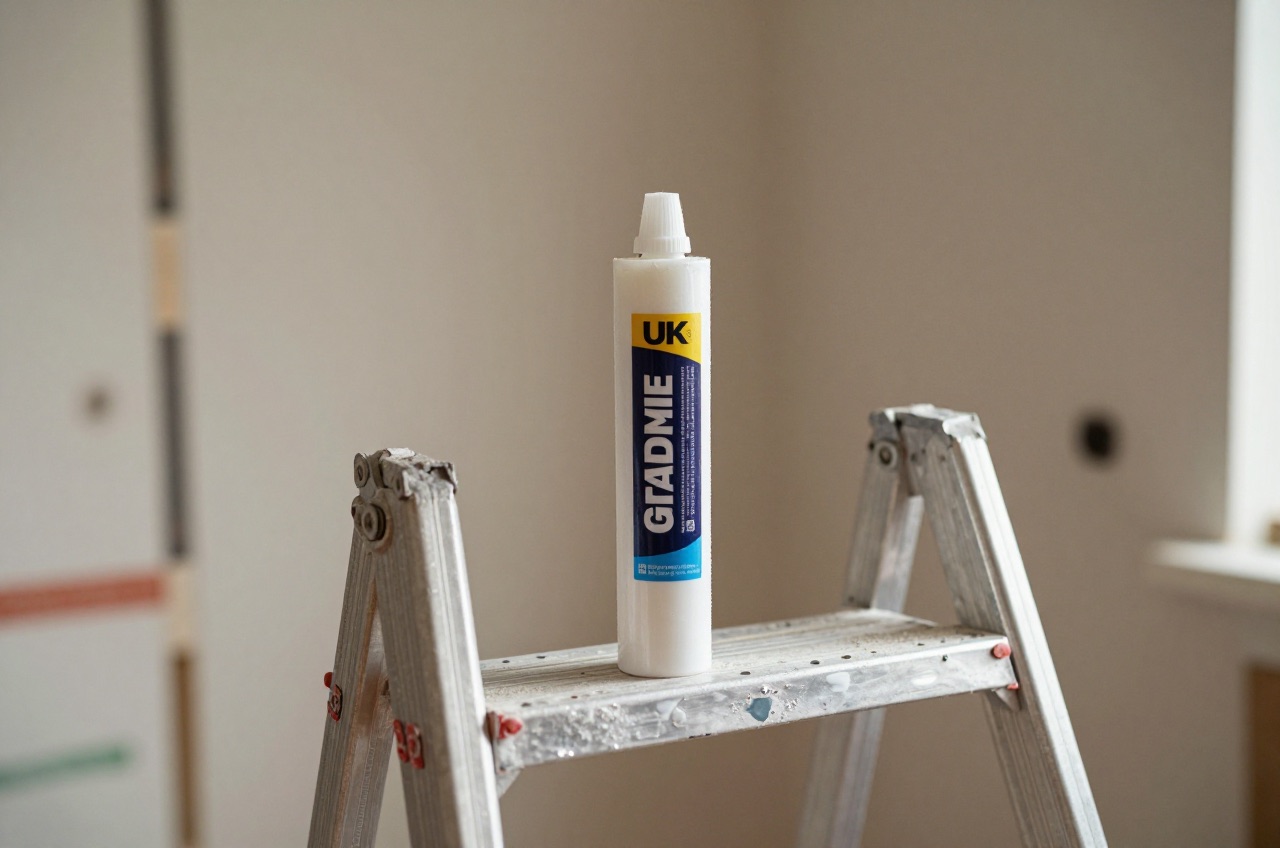
Grab adhesive, also sold as construction adhesive, panel adhesive, or “no more nails” type products, is a thick, fast-bonding compound designed to fix materials together without screws, nails, or clamps. A single 310 ml cartridge, applied to a clean surface, can hold cladding panels, skirtings, mirrors, and worktop off-cuts with impressive permanence.
The category covers several chemistries, and choosing the wrong one is a common (and expensive) mistake. This guide explains the main types, their strengths and limitations, and the best applications for each.
How Grab Adhesives Work
Unlike PVA or standard contact adhesives, grab adhesives are formulated to provide immediate mechanical grip on contact, the “grab”, while continuing to cure from the outside in. Cure is quoted as a depth per day, not a fixed time: Soudal’s hybrid polymer adhesives cure at roughly 2 to 3 mm every 24 hours, so a thin bead is through in a day and a 10 mm one takes the best part of a week.12 They’re typically applied by skeleton gun from a 290 ml or 310 ml cartridge, though 80 ml and 125 ml squeeze tubes and 400 ml and 600 ml foil bags are available.2
The grab action comes from a high initial tack that holds the item in place while the adhesive cures. This means you don’t need to wedge or prop most fixings, the adhesive does the holding. That said, “no-clamp” is an aspiration rather than a guarantee: very heavy, smooth-faced materials often still need temporary support.
Types of Grab Adhesive
Solvent-Free (MS Polymer / Hybrid)
Modified silane (MS polymer) adhesives are currently the most versatile construction adhesive chemistry available to the UK market. They’re solvent-free, low-odour, and combine the flexibility of silicone with the paintability of acrylic. They adhere to almost all building materials, timber, plasterboard, concrete, steel, and most plastics, and remain permanently flexible after curing.
MS polymer adhesives are the first choice for most professional applications and the best all-rounder for DIY.
Typical initial grab: manufacturers quote this as a weight per square metre of bonded area. Soudal’s highest-tack hybrid polymer is rated at more than 200 kg/m², which is about 2 kg on a 100 cm² patch, and it reaches a hand-tight bond in 30 minutes.1
Full cure: about 3 mm of depth per 24 hours1
Flexibility after cure: High. A high-tack grade cures hard, 70 ± 5 Shore A, while a flexible grade is softer at 40 ± 5 Shore A with far more stretch, which is the trade-off between an adhesive and a movement joint13
Solvent-Based (Traditional Neoprene)
Older neoprene or polychloroprene-based grab adhesives (such as Evode Evo-Stik variants) are fast-grabbing and very strong, but they emit VOCs (volatile organic compounds) and can attack expanded polystyrene (EPS) foam, PVC, and some soft plastics. They’re less common now, partly due to environmental regulations and partly because MS polymers have largely superseded them.
Note: Check compatibility before use on plastics or foam. Published initial grab figures for neoprene adhesives are not directly comparable with the kg/m² figures hybrid polymer manufacturers quote, so compare datasheets from the same maker rather than across chemistries.
Water-Based (Acrylic Construction Adhesive)
Water-based grab adhesives are lower strength but safer to use near polystyrene, painted surfaces, and in confined spaces. They’re the right choice for coving and decorative EPS mouldings, where a solvent-based product would dissolve the material. Drying time is longer and they’re more sensitive to moisture on the substrate.
Full cure: longer than a hybrid polymer, and slower again in cold or humid conditions, because the water has to leave the joint rather than enter it
Product Comparison
| Type | Initial grab | Solvent-free | Safe on foam | Paintable | Best for |
|---|---|---|---|---|---|
| MS polymer | High | Yes | Yes | Yes | General fixing, cladding, timber |
| Hybrid / SMP | High | Yes | Yes | Yes | Heavy loads, flexible joints |
| Neoprene (solvent) | Very high | No | No | No | Heavy timber, concrete |
| Water-based acrylic | Medium | Yes | Yes | Yes | Coving, polystyrene, light panels |
| Mirror adhesive | High | Varies | No | No | Mirrors (non-metallic backing safe) |
| Ceramic tile on tile | High | Yes | N/A | No | Tile renovations over existing tiles |
Tile adhesives sit in a different family and carry their own classification. BS EN 12004-1:2017 splits them into cementitious, dispersion and reaction resin types and sets the letter and class marking on the tub, which is where the C, D and R codes come from; it does not tell you how to design or install the tiling.4
Specific Applications
Skirting Boards and Architraves
Decorator’s grab adhesive (MS polymer or water-based) is widely used alongside a few panel pins to fix timber skirtings. Apply a continuous bead or spot pattern to the back of the skirting, press into position, and tap in pins at each stud if required. The adhesive compensates for a wavy or irregular plaster wall, bridging gaps of up to 10–15 mm.
Cladding and Panelling
For MDF wall panels, tongue-and-groove timber, or composite cladding, an MS polymer adhesive applied in vertical stripes (one bead per 200–300 mm of panel width) provides a strong, flexible bond. Apply to the panel, leave for a few minutes to become tacky (known as “flashing off”), then press into position.
Mirrors
Mirror adhesive is a specialist sub-category. Standard solvent-based adhesives can corrode the silver or aluminium backing on mirrors, leaving black spots over time. Always use an adhesive specifically labelled as safe for mirrors, these are typically MS polymer or neutral-cure formulations. For large or heavy mirrors (over 10 kg), supplementary mechanical fixings (mirror clips or screws through the frame) are advisable regardless.
Coving and Decorative Mouldings
Use a water-based adhesive for polystyrene (EPS) coving. Apply to both the ceiling and wall faces of the coving, allow to tack slightly, then press firmly into position and support for 20–30 minutes while the adhesive grabs.
External Cladding and WBP Applications
Check the adhesive’s stated temperature range and weather resistance. External applications require a product with extended waterproof performance, most MS polymers will specify outdoor suitability, but verify the datasheet.
Cost Guide
| Product type | Pack size | Typical price |
|---|---|---|
| Water-based grab adhesive | 310 ml | £3–£6 |
| MS polymer construction adhesive | 290 ml | £5–£9 |
| Heavy-duty hybrid grab | 310 ml | £6–£10 |
| Mirror adhesive | 290 ml | £5–£9 |
| Contractor-grade cartridge (bulk buy) | 12-pack | £35–£60 |
Coverage varies considerably with application method. Spot bonding (dots every 150–200 mm) uses less adhesive and is often sufficient for light panels; full-coverage bonding is better for waterproofing or where the surface is uneven.
Surface Preparation
Bond strength is dramatically affected by surface condition. For best results:
- Surfaces must be clean, dry, and free of dust, oil, and loose material.
- New plaster should be sealed with a coat of diluted PVA and allowed to dry before applying grab adhesive.
- Very smooth, non-porous surfaces (glazed tiles, glass, polished metal) benefit from light abrading with 120-grit sandpaper.
- Primed or painted surfaces generally bond well; powdery or flaky paint will fail before the adhesive does, strip back to sound substrate.
- Cold surfaces significantly slow cure time. Soudal gives an application temperature range of +5°C to +35°C for its hybrid polymer adhesives, with the cured product then serviceable from -40°C to +90°C.12
Safety and Environmental Notes
MS polymer and water-based adhesives are significantly safer to work with than older solvent-based products. However, even low-VOC products should be used in well-ventilated spaces. Wear nitrile gloves, cured adhesive is very difficult to remove from skin. Clean tools immediately after use with white spirit (solvent-based products) or water (water-based), before the adhesive skins over.
Most construction adhesives are not recyclable through standard household waste. Check the cartridge label for disposal guidance, partial cartridges should be allowed to fully cure before disposal in general waste.
When Grab Adhesive Isn’t Enough
Grab adhesive is excellent for light-to-medium loads on well-prepared surfaces. It should not be the sole fixing for:
- Structural timbers (use mechanical fixings)
- Anything load-bearing over people (shelves, stairs, handrails)
- Very heavy panels or stone (over approximately 15 kg/m² without supplementary fixings)
- Applications subject to high continuous vibration
When in doubt, use adhesive in combination with mechanical fixings rather than instead of them.
References (4)
Figures in this note were checked against the sources below on 9 September 2026. Superscript numbers in the text point to them. Every source the site cites, by topic.
- 1technicalsupplier figureSoudal UK.RN-5WIE98Soudal UK technical datasheet for Fix ALL TurboTack, master code 9902051, revision 08-05-2026. This is the sheet that gives the number a grab adhesive note needs: 'Extreme high initial tack of min. 200 kg/m2', listed again in the technical data table as Initial tack > 200 kg/m2. That is about 2 kg held by a 100 cm2 patch of adhesive, which is an order of magnitude below the 70 to 150 N per 100 cm2 figures repeated in DIY guidance. Base is SMX hybrid polymer, moisture curing. Skin formation ca. 5 minutes, curing speed ca. 3 mm per 24 hours, so cure is a depth per day and a deep bead takes days. Hardness 70 plus or minus 5 Shore A. Elasticity modulus ca. 2.80 N/mm2 and maximum tension ca. 3.60 N/mm2 to ISO 37. Maximum allowed joint movement plus or minus 20 per cent. Application temperature +5C to +35C, temperature resistance -40C to +90C. It achieves a hand tight bond in 30 minutes and is non staining on natural stone.
- 2technicalsupplier figureSoudal, a data sheet.RN-WM8MP8Manufacturer technical data for a high initial grab hybrid polymer adhesive. Skin formation at 23C and 50 per cent relative humidity is about 5 minutes, half that of the flexible grade, and curing speed is 3 mm per 24 hours. Hardness is 65 plus or minus 5 Shore A with elongation at break of 400 per cent, so it is markedly harder and less elastic than the flexible grade, which is the trade-off between an adhesive and a movement joint sealant. Joint design is minimum 2 mm and maximum 10 mm width for bonding, and minimum 5 mm to maximum 30 mm width with 5 mm minimum depth for joints. It is impervious to mould and can be painted with water based systems. Shelf life is 15 months unopened between +5C and +25C. Soudal notes it can only be used on the bottom of natural stone tiles and not as a joint sealant on that surface.
- 3technicalsupplier figureSoudal, a data sheet.RN-VIHRZSManufacturer technical data for a hybrid polymer adhesive sealant. Skin formation at 23C and 50 per cent relative humidity is about 10 minutes and curing speed is 2 to 3 mm per 24 hours, so a 10mm deep joint takes several days to cure through. Hardness is 40 plus or minus 5 Shore A with elongation at break of 750 per cent. The joint design rules are minimum 2 mm and maximum 10 mm width for bonding, and for joints minimum 5 mm and maximum 30 mm width with a minimum 5 mm depth. It can be painted with water based systems and is EC1+ certified for very low emission. Shelf life is 15 months in unopened packaging stored cool between +5C and +25C. Soudal warns that a total absence of UV can cause a colour change in the sealant, and that where different reactive sealants meet, the first must be completely hardened before the next is applied.
- 4technicalstrongBSI, a standard.RN-TL1I4RBS EN 12004-1:2017, published 28 February 2017, committee B/539, prepared by CEN/TC 67 Ceramic tiles, current; it supersedes BS EN 12004:2007+A1:2012. The scope covers three types of ceramic tile adhesive: cementitious for internal and external installations, and dispersion and reaction resin for internal installations only, on walls and floors. It gives the terminology for the products, working methods and application properties, specifies the performance requirements and the appurtenant test methods, the assessment and verification of constancy of performance, and the classification, designation and marking of tile adhesives, which is where the C, D and R type letters and class numbers on a bag of adhesive come from. It expressly does not provide criteria or recommendations for the design and installation of ceramic tiles, which is BS 5385. It notes tile adhesives may also be used for natural and agglomerated stones if they do not adversely affect the material. BS EN 12004-2:2017 gives the test methods.
-
Fix ALL TurboTack technical datasheet, Soudal UK, accessed 9 September 2026. soudal.co.uk
-
Fix ALL High Tack technical datasheet, Soudal, accessed 9 September 2026. soudal.co.uk
-
Fix ALL Flexi technical datasheet, Soudal, accessed 9 September 2026. soudal.co.uk
-
BS EN 12004-1:2017 Adhesives for ceramic tiles. Requirements, assessment and verification of constancy of performance, classification and marking, BSI, accessed 9 September 2026. knowledge.bsigroup.com