Kitchen taps and sinks are two of the most heavily used fittings in any home, yet they are often chosen last, with whatever budget is left over. Getting them right from the start matters: a tap that drips, a sink that chips, or an undersized bowl that cannot fit a roasting tin will become a daily irritation.
For most UK kitchens, a single-lever monobloc mixer tap paired with a 1.5-bowl stainless steel sink remains the most practical and cost-effective combination. This guide covers what to look for, the real costs involved, and where compromises are worth making.
Types of Kitchen Tap
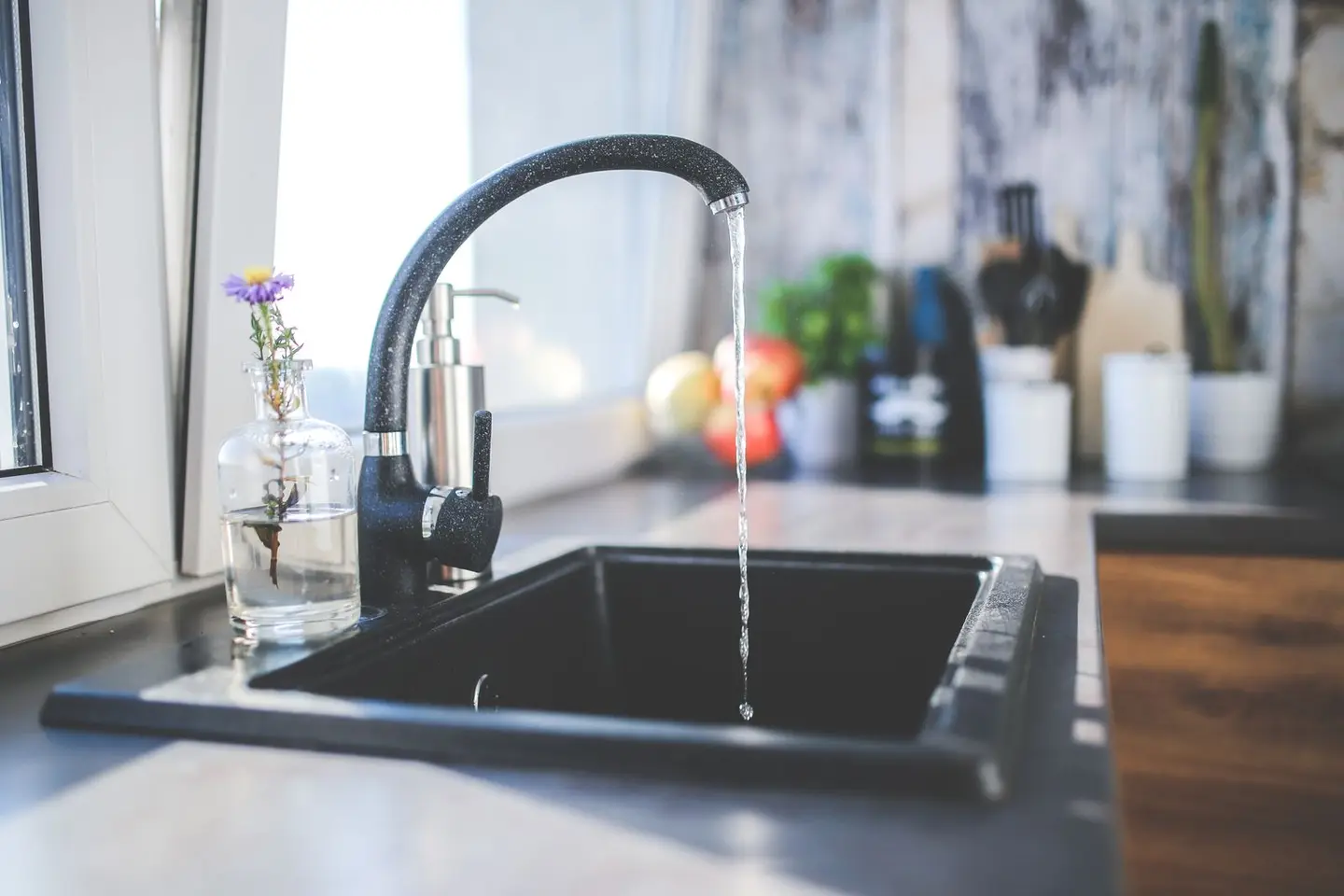
Monobloc mixer taps have a single body with one or two handles that blend hot and cold from a pair of quarter-turn valves. They are the most common kitchen tap type in the UK. Most mount through a single 35 mm hole in the sink or worktop. Prices run from around £50 for a basic chrome unit to £600 or more for designer ranges in premium finishes.
Bridge mixer taps use a traditional two-tap format linked by a bridge. They suit period kitchens well and give a robust, distinctive look, but require two or three fixing holes. Expect to pay £120–£500.
3-in-1 boiling water taps dispense instant near-boiling water (typically 98 °C) alongside a standard mixer function. They need a small tank unit installed under the sink, usually around 2–4 litres, plus a dedicated cold water feed. Running costs are broadly £30–£60 per year in electricity depending on usage and whether you use the standby setting. Purchase prices start at around £350 and rise to £1,200 or more for premium models. They are genuinely useful for households that make frequent hot drinks or regularly blanch vegetables, but the economics only stack up if you would have used a separate kettle several times a day.
Pull-out and pull-down taps incorporate a flexible hose into the spout, useful for rinsing the sink or filling pots on the hob. They suit larger kitchen layouts where the sink is away from the cooker. Budget £80–£350.
Wall-mounted taps are less common in UK kitchens but can work well with butler or Belfast sinks where there is no drainer to mount a tap into. They require supply pipes to be run through the wall during first fit, which adds cost.
Flow Rate and Water Pressure
Standard UK mains-fed taps deliver around 12–15 litres per minute at typical domestic pressures (1–4 bar). Low-flow aerator inserts can reduce this to 6 l/min, cutting water use without affecting most tasks. For a kitchen sink, a higher flow rate is generally preferable, a 6 l/min tap takes noticeably longer to fill a large pan.
Taps designed for low-pressure systems (gravity-fed, unvented cylinders, or older combination boilers) are widely available but must be specified correctly. If your home runs on a gravity-fed hot water system, check the minimum operating pressure stated on the tap data sheet; many standard taps require at least 0.5 bar.
WRAS Approval
Under the Water Supply (Water Fittings) Regulations 1999, any fitting connected to the mains supply in England, Scotland, Wales, or Northern Ireland must comply with UK water fittings requirements. In practice, this means buying taps, sinks, valves, and waste fittings that carry WRAS (Water Regulations Advisory Scheme) approval. Approved products appear on the WRAS product approval database. This is not optional, non-compliant fittings are a legal issue and can affect buildings insurance. Most reputable UK suppliers stock WRAS-approved products as standard, but it is worth confirming, particularly when buying from online marketplaces.
Tap Finishes
| Finish | Durability | Notes |
|---|---|---|
| Chrome | Excellent | Hardest-wearing, easiest to clean, lowest maintenance |
| Brushed nickel | Good | Hides water spots better than chrome; more vulnerable to harsh cleaners |
| Matte black | Moderate | Fashionable but prone to showing limescale in hard water areas |
| Brushed brass / gold | Moderate | Period kitchens and statement installs; can tarnish without PVD coating |
| Gunmetal / antique bronze | Moderate | Similar caveats to brass; check for lacquer or PVD finish |
Chrome is consistently the most durable finish and the easiest to maintain over a decade or more of daily use. If you are in a hard water area (much of the South and East of England), matte black and brass finishes will require more frequent descaling.
Types of Kitchen Sink
Sinks are available in several materials, each with distinct characteristics in terms of durability, maintenance, and cost.
Stainless steel is by far the most widely fitted kitchen sink material in the UK. Gauge (thickness) matters: look for 1 mm–1.2 mm steel for a quieter, more rigid bowl. Budget sinks at 0.6–0.8 mm are common but flex underfoot and produce more drumming noise when water hits them. Fitting a sound-deadening undercoat pad is worthwhile on thinner-gauge sinks. A standard 1.5-bowl inset stainless sink costs £80–£400.1
Ceramic and fireclay (the material used in traditional Belfast sinks) is extremely hard-wearing and resistant to heat and scratching. Belfast sinks in particular suit country-kitchen aesthetics and are deep enough for large pots. The weight is significant, often 25–40 kg, so the cabinet beneath must be able to bear the load. Budget £200–£800 for a ceramic Belfast sink.
Granite composite is a mixture of crushed granite and acrylic resin. It is impact-resistant, available in a range of muted colours, and resistant to staining if sealed. Abrasive pads and harsh chemicals can damage the surface. Prices range from £150 to £600.
Solid surface and Corian-type sinks are usually part of integrated worktop solutions and outside the scope of a standard tap-and-sink swap.
| Sink Type | Material | Cost Range | Pros | Cons |
|---|---|---|---|---|
| Inset 1.5 bowl | Stainless steel | £80–£400 | Affordable, durable, hygienic | Can be noisy, shows scratches |
| Undermount | Stainless steel or granite composite | £150–£6002 | Clean worktop edge, easy to wipe | More complex to fit, worktop must be sealed |
| Belfast / butler | Ceramic / fireclay | £200–£800 | Classic look, very deep bowl, heat-resistant | Heavy, needs strong cabinet support |
| Granite composite inset | Composite | £150–£600 | Wide colour choice, impact-resistant | Needs careful cleaning, can fade |
| Inset single bowl | Stainless steel | £50–£2503 | Maximises bowl space | No drainer bowl |
Waste Fittings
The three common waste types for kitchen sinks are:
- Basket strainer waste, a removable perforated basket sits in the plug hole and catches food debris. The most hygienic and low-maintenance option for kitchen use.
- Push-button pop-up waste, operated by pressing the plug down to open or close. Convenient but can harbour bacteria around the mechanism if not cleaned regularly.
- Overflow waste, standard on many inset sinks; a secondary hole near the rim prevents overfilling. Not all Belfast or undermount sinks include an overflow.
For most kitchen sinks a basket strainer is the practical choice. If the sink has two bowls, you will typically need a 40 mm waste outlet per bowl, plus any overflow, all connected via a bottle trap or P-trap to the 40 mm waste stack.
Plumbing Considerations
Most UK kitchens have hot and cold supply pipes terminating 150 mm apart (centre to centre). Standard monobloc taps are designed for this spacing and include flexible braided hoses to connect to the supplies. Confirm the hose lengths before ordering, if the cabinet is deep or the pipework runs at the back of the unit, you may need 500 mm hoses rather than the more common 300 mm.
Boiling water taps need a 15 mm cold mains supply to the tank unit, plus a low-voltage power connection (typically from a switched fused spur inside the cabinet). The tank itself is usually 280–350 mm tall and 150–200 mm in diameter, so check that it fits in the cabinet alongside the waste and supply pipes before purchasing.
For undermount sinks, the worktop cutout must be sealed at the junction between the sink rim and the worktop underside, this is usually done with silicone sealant. Stone and solid-surface worktops require professional cutting.
Fitting Costs
A plumber in the UK typically charges £50–£80 per hour in 2026. A straightforward tap and sink swap, removing the existing units, fitting the new ones, reconnecting supplies and waste, and testing, usually takes 2–3 hours. Budget £100–£240 for labour, plus any materials such as new flexi hoses, PTFE tape, or a replacement trap.
Fitting a boiling water tap takes longer because of the tank installation and electrical connection, typically 3–4 hours including commissioning. If a new fused spur is needed, an electrician registered with a competent person scheme is required, adding roughly £60–£120.
If replacing the sink and tap alongside a new worktop, coordinate trades so the plumber connects everything once the worktop is in place, avoiding a return visit.
What to Buy
For a practical, long-lasting combination, prioritise build quality over aesthetics:
- Choose a WRAS-approved monobloc mixer in chrome for the best durability.
- Specify a stainless steel sink at 1 mm gauge or above with a basket strainer waste.
- If colour choice matters, granite composite is a better option than ceramic for a busy kitchen.
- Only specify a boiling water tap if your household will use it daily, the capital outlay and running costs (£30–£60/year) need to offset a standard kettle.
- Get two or three plumber quotes; ask whether they carry flexi hoses and traps in their van to avoid a return visit.
References (3)
Figures in this note were checked against the sources below on 14 September 2026. Superscript numbers in the text point to them. Every source the site cites, by topic.
- 1costsupplier figureToolstation.RN-TGVW5EA price, true at 2026-09. the retail price Toolstation publishes for the Maine Stainless Steel Reversible Kitchen Sink & Drainer 1.5 Bowl, which is the supply figure the cost book records for this item
- 2costsupplier figureToolstation.RN-XATGV8A price, true at 2026-09. the retail price Toolstation publishes for the Maine Celyn Granite Composite Reversible Kitchen Sink & Drainer Small Single Bowl White, which is the supply figure the cost book records for this item
- 3costsupplier figureToolstation.RN-UFCUP0A price, true at 2026-09. the retail price Toolstation publishes for the Maine Coniston Reversible Stainless Steel Compact Kitchen Sink & Drainer Single Bowl, which is the supply figure the cost book records for this item
-
Maine Stainless Steel Reversible Kitchen Sink & Drainer 1.5 Bowl, Toolstation, accessed 16 September 2026. Priced at 2026-09, so no calibration is needed. toolstation.com
-
Maine Celyn Granite Composite Reversible Kitchen Sink & Drainer Small Single Bowl White, Toolstation, accessed 16 September 2026. Priced at 2026-09, so no calibration is needed. toolstation.com
-
Maine Coniston Reversible Stainless Steel Compact Kitchen Sink & Drainer Single Bowl, Toolstation, accessed 16 September 2026. Priced at 2026-09, so no calibration is needed. toolstation.com