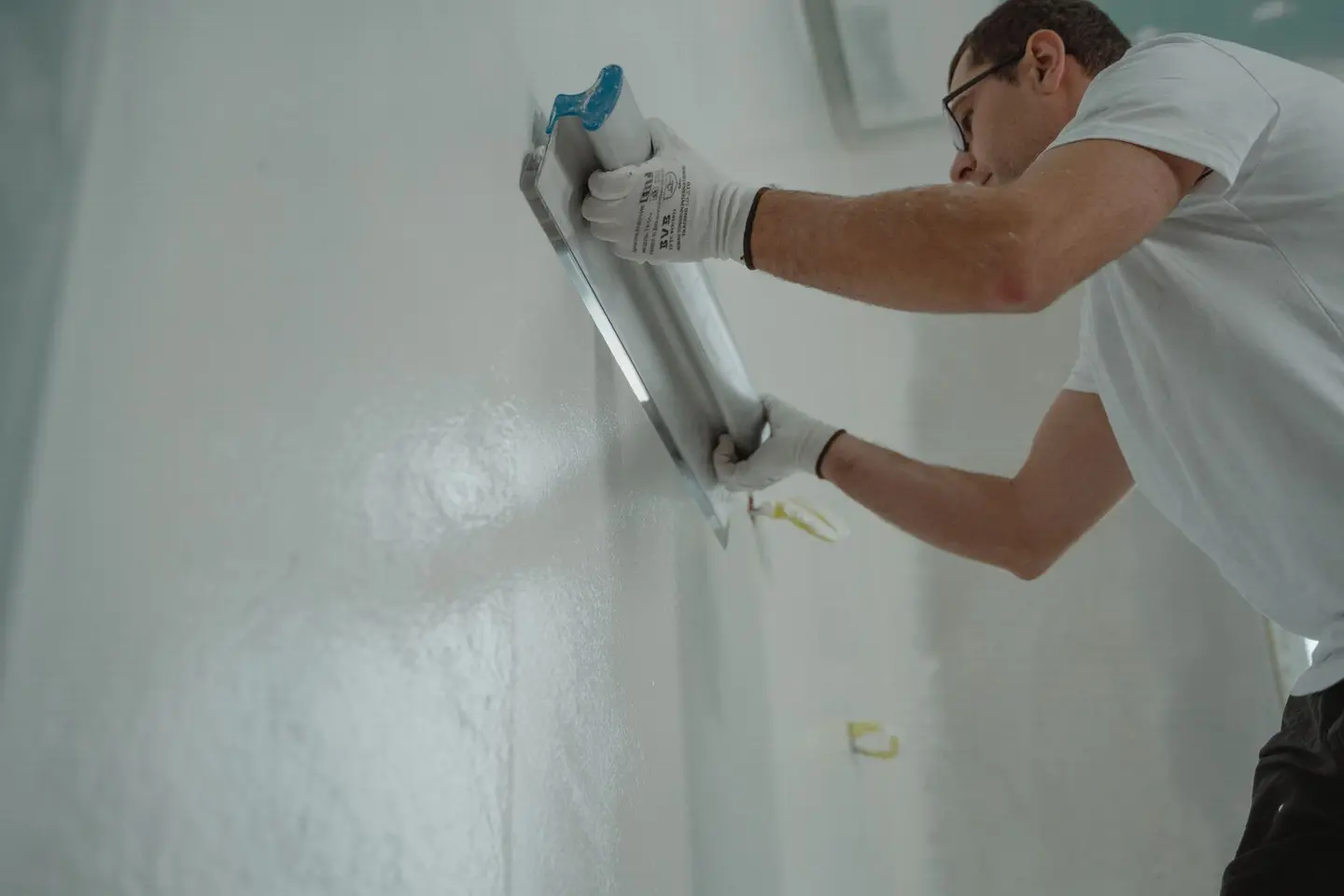
Plastering is one of the most visible trades in any home renovation. A well-plastered wall or ceiling sets the foundation for a quality paint finish; a poor one, full of trowel marks, hollows or cracks, undermines everything that follows. Understanding what type of plastering your project needs, what it realistically costs and whether it is a job for a professional or an ambitious DIYer is the starting point for any project involving plasterwork.
Types of Plastering Work
The word “plastering” covers several distinct operations, each with different materials, skill requirements and costs.
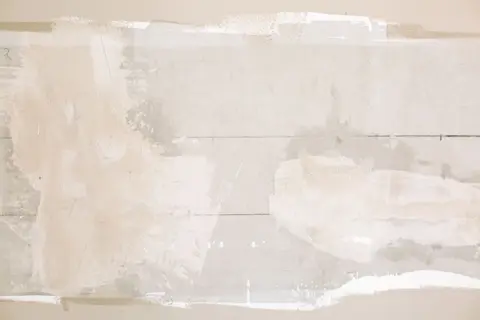
Skim coat (finish plaster): A thin layer, usually at least 2 mm, of finishing plaster applied over plasterboard, existing plaster or a base coat.1 This is the most common plastering job in UK homes; it smooths out the surface to receive paint or wallpaper. Skill-intensive: the trowel work must be completed while the plaster is setting, and timing is critical.
Backing coat / base coat (browning): A thicker layer (8–12 mm) of sand-and-cement or bonding plaster applied to bare masonry or blockwork before the skim coat. Required on new extensions, knocked-out walls and anywhere bare brick or block is exposed.
Dot and dab plasterboard: Sheets of plasterboard bonded directly to the masonry using dabs of adhesive. No wet plaster, the board joints and screw holes are then filled and the surface skimmed or taped. Common in modern construction.
Rendering: External plasterwork applied to the outside of a building. Usually a two-coat sand-and-cement render or a proprietary through-coloured or silicone render system. Outside the scope of internal plastering.
Artex and textured finish removal: Many UK homes built between the 1960s and 1990s have textured ceilings. Removing these (or overboarding and skimming) is a common preparatory job. Pre-2000 textured coatings may contain white asbestos, test before disturbing.2
Plastering Costs (2026)
| Job Type | Cost per m² | Typical Room Cost |
|---|---|---|
| Skim coat (over plasterboard) | £8–£15/m² | £200–£450 |
| Skim coat (over existing plaster) | £10–£18/m² | £250–£550 |
| Two-coat plaster (base + skim) | £25–£45/m² | £625–£1,350 |
| Single room replaster, two coats (25–30 m²) | - | £625–£1,350 |
| Full house skim (4 bed semi) | - | £3,500–£7,000 |
| Ceiling skim only (15 m²) | £150–£350 | - |
| Patch repair (small crack or hole) | £80–£200 | - |
| Artex ceiling removal + skim | £18–£30/m² | £350–£600 |
Plasterer Day Rates (2026)
| Location | Day Rate |
|---|---|
| London | £300–£450/day3 |
| South East | £280–£400/day |
| Midlands | £250–£350/day4 |
| North England | £220–£320/day |
| Scotland/Wales | £200–£300/day |
Most plasterers prefer to quote by the job rather than per day or per m², because productivity varies significantly with room shape, access and the number of openings. A clear breakdown by room is the most useful basis for comparison.
Types of Plaster and When to Use Them
| Product | Use | Setting Time |
|---|---|---|
| Thistle MultiFinish | Skim over most backgrounds | 90–120 min |
| Thistle Board Finish | Skim over plasterboard | 90–120 min |
| Thistle Bonding Coat | Base coat on low-suction surfaces | 2–3 hrs |
| Thistle Browning | Base coat on brick/blockwork | 2–3 hrs |
| Thistle Hardwall | High-impact base coat | 2–3 hrs |
| Renovating plaster | Damp-resistant; old buildings | 2–3 hrs |
Thistle, British Gypsum’s plaster range (part of Saint-Gobain), is widely used in the UK. A 25 kg bag of Thistle MultiFinish costs about £11–£12 from DIY stores and builders’ merchants.5 Each bag covers about 10 m² at the standard 2 mm finish thickness, so skimming a room of 25–30 m² takes about three bags, more on uneven walls.1
Preparing for Plastering
Good preparation makes the difference between plaster that bonds properly and work that cracks or falls away within months.
PVA bonding agent: Often applied to the surface before plastering to reduce suction and help the plaster key in, usually diluted with water and left to go tacky before the plaster goes on. Check the plaster maker’s instructions first: some makers recommend their own primer or bonding agent instead of PVA under their finishing plasters.
Surface preparation:
- Remove loose or hollow plaster (tap and listen, a hollow sound indicates detached areas)
- Rake out cracks and fill large voids with bonding coat before skimming
- Remove wallpaper completely, any remaining backing absorbs moisture unevenly and causes blisters
- Treat any mould or damp before plastering (plastering over active damp is a waste of money)
Room preparation:
- Remove or sheet-cover all furniture
- Turn off and tape over electrical sockets and switches
- Lay dust sheets on floors, plaster droppings stain carpet and are hard to remove once cured
Can You Plaster Yourself?
Skim plastering is genuinely difficult to do well. It requires learning to read the set, understanding when the plaster is at the right stage for each pass of the trowel, and to apply even pressure across large areas. Most first attempts produce visible trowel marks, pulling, and unevenness that require heavy sanding to flatten.
DIY is reasonable for: Small patch repairs, gap filling, and touch-ups to existing plaster. A pre-mixed repair product such as Polyfilla or Gyproc EasiFill is more forgiving than bagged finishing plaster for small areas.
DIY is challenging for: Full room skims, large area base coats, and ceilings (the most physically demanding and technically unforgiving surfaces). Mistakes in a full room are expensive to fix after the plaster sets.
If you want to learn, a one or two-day plastering course (£150–£300 at most trade colleges) covers the fundamentals. Practising on a spare room or utility space before tackling main rooms is strongly recommended.
Hiring a Plasterer
Ask for recommendations from local builders or use review platforms such as Checkatrade or TrustATrader. Key questions to ask:
- Do they work alone or with a labourer? (A labourer mixing and loading speeds up a job significantly, but adds cost)
- Can they provide references from previous work, ideally in a similar property type?
- Will they supply materials or will you source them?
- What do they include in the prep, are they clearing the room, hacking off old plaster, or only applying new product?
Get two or three written quotes covering the same scope. Pricing can vary by 25–40% for the same job.
Summary
Plastering is a skilled trade that significantly affects the quality of every subsequent finish in a room. In 2026, expect to pay roughly £200–£550 to skim an average room or £625–£1,350 to replaster it in two coats, and £3,500–£7,000 to skim a full four-bedroom house. For small repairs and filling, DIY is practical. For skim work across full walls and ceilings, the investment in a skilled plasterer will show, and save you, in the finished result.
References (5)
Figures in this note were checked against the sources below on 30 September 2026. Superscript numbers in the text point to them. Every source the site cites, by topic.
- 1technicalsupplier figureB&Q, guidance.RN-KPL6ZVB&Q product page for Thistle MultiFinish, reproducing the maker's application steps. It gives a two-coat skim of at least 2 mm total, the setting timeline and coverage of about 10 m² per 25 kg bag.
- 2technicalvery strongHealth and Safety Executive, guidance.RN-5PLWW8HSE's asbestos frequently asked questions: the health risks, which work is licensed and which is not, what a householder may and may not do themselves, and where the free HSE publications are. The quickest authoritative answer to whether a particular job needs a licensed contractor.
- 3costvery strongHomes and Communities Agency, a government page.RN-IJYN87A price, true at 2026-07. The GOV.UK publication page for the Homes and Communities Agency guidance on dereliction, demolition and remediation costs, prepared with Ove Arup and Partners. Held for its regional adjustment factors, which are what the register uses it for: the multipliers that take a national construction rate to a region. It is not a source of current prices, and the rates in the guidance itself are of its own date.
- 4costvery strongOffice for National Statistics.RN-MMT1DOA price, true at 2025-03. The ASHE Table 14 dataset gives annual estimates of paid hours worked and earnings for UK employees by sex and by full-time or part-time status, broken down to four-digit Standard Occupational Classification, which is the level that isolates individual construction trades such as bricklayers, carpenters, plasterers and electricians. Released 23 October 2025 as the 2025 provisional edition (zip, about 10.7 MB), with revised and provisional editions back to 2017. A correction dated 19 December 2025 suppressed annual pay estimates for SOC 3312 police officers in some areas; construction occupations are unaffected.
- 5costsupplier figureWickes.RN-2UJQBOA price, true at 2026-09. Wickes's product page for British Gypsum Thistle Multi Finish plaster in a 25 kg bag, the standard finish plaster for skimming. A published retail price per bag, which with the stated coverage is where a per square metre material cost for skimming comes from.
-
Thistle MultiFinish Plaster, 25kg Bag, B&Q, accessed 30 September 2026. diy.com
-
Asbestos: frequently asked questions, Health and Safety Executive, accessed 7 September 2026. hse.gov.uk
-
Guidance on dereliction, demolition and remediation costs, regional adjustment factors, Homes and Communities Agency with Ove Arup and Partners, accessed 18 September 2026. Priced at 2026-07, so no calibration is needed. gov.uk
-
Annual Survey of Hours and Earnings 2025, Table 14.6a, SOC 5321, Office for National Statistics, accessed 18 September 2026. Priced at 2025-03, so no calibration is needed. ons.gov.uk
-
British Gypsum Thistle Multi Finish Plaster - 25kg, Wickes, accessed 30 September 2026. Priced at 2026-09 and left there. wickes.co.uk