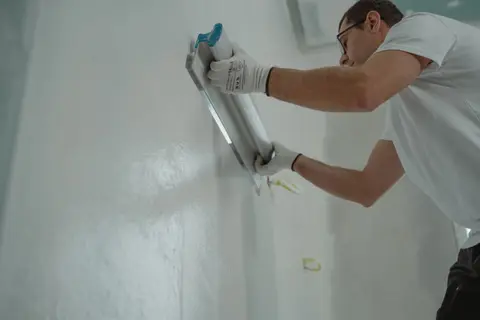
A freshly plastered ceiling is one of those improvements that is easy to underestimate in impact, until you see it. Old blown plaster, hairline cracking, or a mismatched, pitted surface is instantly transformed by a well-applied skim coat into a smooth, paintable finish. In 2026, plastering a ceiling in the UK costs between £150 and £600 depending on the room size, the condition of the existing ceiling, and the type of plaster work required.
Most homeowners pay around £200–£350 for a standard single-room ceiling skim.
Skim Coat vs Full Re-plaster
Understanding the difference is important because it determines both the cost and the disruption involved.
Skim coat (re-skim), a thin finishing coat (2–3 mm) of multi-finish plaster is applied directly over the existing ceiling surface, whether existing plaster or plasterboard. This is suitable where the existing base is sound, flat, and properly keyed. It is the most common option for ceilings that have been painted too many times, have minor cracking, or simply need refreshing.
Full re-plaster, the existing plaster (or plasterboard) is stripped back to the structure, new plasterboard is fixed to the joists, and then skimmed. Required where the existing plaster has failed (blown, detached from background), where the ceiling is badly sagging, or where the room is being fully renovated and the ceiling structure is being altered.
Artex over-boarding, old artex textured ceilings are often over-boarded with 6 mm or 9.5 mm plasterboard and then skimmed, avoiding the mess and potential asbestos risk of removing the artex. Artex applied before 2000 may contain chrysotile (white) asbestos; if in doubt, commission an asbestos survey (£100–£300) before any disturbance.1 The HSE names textured coatings, “various trade names such as Artex”, as a low-risk material that a trained non-licensed worker may remove, though wet abrasive blasting to take one off needs a licensed contractor.2
2026 Ceiling Plastering Cost Guide
| Job type | Small room (up to 10 m²) | Medium room (10–16 m²) | Large room (16–25 m²+) |
|---|---|---|---|
| Skim coat only | £150–£220 | £200–£320 | £280–£450 |
| Skim coat with minor patch repairs | £200–£300 | £250–£380 | £320–£500 |
| Over-board artex and skim | £300–£450 | £400–£600 | £550–£850 |
| Full strip, board, and skim | £350–£550 | £500–£750 | £700–£1,100 |
| Coving and ceiling rose, labour only | £100–£200 | - | - |
Costs are for labour and materials. Materials (multi-finish plaster, PVA bonding agent, boards) are usually included in a plasterer’s fixed price.
Cost Per Square Metre
For very large or commercial ceilings, plasterers sometimes quote by the m²:
| Work type | Cost per m² (2026) |
|---|---|
| Skim coat | £12–£22/m²3 |
| Board and skim | £22–£38/m² |
| Over-boarding artex and skim | £20–£35/m² |
The cited prices in this table were published in 2023 and brought to 2026. What that means.
Plasterer Day Rates in 2026
| Region | Day rate |
|---|---|
| London | £280–£420/day4 |
| South East | £250–£370/day |
| Midlands | £200–£300/day |
| North England | £190–£280/day |
| Scotland | £200–£300/day |
| Wales | £180–£270/day |
A standard ceiling skim in a bedroom or living room (12–16 m²) typically takes one plasterer one day, including preparation, application of bonding coat (if needed), and two coats of finish. Very large ceilings or those with complex features (boxings, dropped sections, coving) may require 1.5–2 days.
What Drives the Price?
Room height adds significant time. Standard 2.4 m ceilings are plastered from a hop-up or low-level scaffold board. Rooms with high ceilings (3 m or above, common in Victorian houses) require a full trestle scaffold or stilts, adding time, risk, and often a day rate premium.
Access and setup, plastering is messy. The plasterer needs room to work freely and time to sheet up floors and furniture. Tight rooms or rooms crammed with furniture cost more because of the restricted working space.
Background condition, a ceiling coated in multiple layers of emulsion or a surface that has been wallpapered needs a coat of PVA bonding agent (SBR/PVA diluted) to regulate suction before the skim goes on. Without it, the plaster dries at different rates and cracks or flashes. This is normally included in the preparation; confirm it is when getting quotes.
Damaged joists or noggins, if the ceiling structure is damaged or inadequate (a problem in older houses where joists are undersized or rotted), this is a carpentry repair job before the plasterer attends. Structural repairs are not included in plastering quotes.
Coving and roses, fitting plaster coving at the junction of ceiling and walls is priced separately (typically £8–£15 per linear metre installed for standard coving; £15–£30/lm for ornate period profiles). Fitting a plaster ceiling rose in a living room adds £60–£150 for labour.
What to Expect on the Day
A plasterer doing a ceiling skim will typically:
- Sheet up the floor and protect light fittings
- Fill any holes or cracks in the existing ceiling with finishing plaster or bonding compound
- Apply a coat of diluted PVA to regulate suction (if required by background)
- Mix multi-finish plaster to a smooth, creamy consistency
- Apply a first coat (scratch coat) across the whole ceiling with a trowel
- Apply a second trowelled coat, building thickness to approximately 3 mm total
- Lay off (final smooth passes with a dampened trowel) as the plaster begins to stiffen
- Leave the room for the plaster to dry, typically 24–48 hours before the surface goes from dark brown to an even pale pink
The room should be ventilated but not cold during drying. Avoid painting for at least 4–6 weeks after new plaster to allow all moisture to escape; use a diluted mist coat (50% emulsion, 50% water) as the first paint coat to seal the surface without trapping moisture.
Getting Quotes
Plastering is a trade where reputation matters enormously. The difference between a skilled finisher and a mediocre one is visible every time you turn on a raking light. When seeking quotes:
- Ask to see recent finished work (photos at minimum; in person is better)
- Get a fixed price per ceiling rather than a day-rate quote where possible, it removes ambiguity
- Confirm that preparation (PVA, crack filling, sheeting up) is included
- Ask specifically whether materials are included or charged separately
- Check that the plasterer has public liability insurance
Three quotes for a plastering job is good practice. Do not automatically choose the cheapest, a poorly finished ceiling requires sanding, re-skimming, or living with indefinitely.
References (4)
Figures in this note were checked against the sources below on 10 September 2026. Superscript numbers in the text point to them. Every source the site cites, by topic.
- 1technicalvery strongHealth and Safety Executive, guidance.RN-A47PNLHSE's introduction to why asbestos is dangerous and where it is found: it can be present in any building built or refurbished before 2000, in artex, insulation board, cement sheet, floor tiles, pipe lagging and more. The list of locations is what makes it useful, because it is how somebody stripping out a room knows what they are looking at.
- 2technicalvery strongHealth and Safety Executive, guidance.RN-GKGY2HHSE's material-by-material guide to where asbestos sits in a building and what class of work removing each one is. On textured coatings it states they 'were used to produce decorative finishes on ceilings and walls' and that 'in the past, they have had various trade names such as Artex', which is the source to cite when a note names Artex rather than a generic textured coating. It classes work on textured coatings as low-risk work that a trained non-licensed worker may carry out, while large-scale removal by steaming or gelling is notifiable non-licensed work and removal by energetic methods such as wet abrasive blasting requires a licensed contractor. Useful alongside the why-and-where page, which gives the before-2000 date but does not name Artex.
- 3coststrong locallyRoyal Borough of Greenwich, Housing and Safer Communities, a government page.RN-SXB1KMA price, true at 2023-06, brought forward on the Construction Output Price Index. The priced schedules from a London borough's capital programme delivery contract with its contractor, published as a spreadsheet. Genuine competitively tendered rates for housing works at real scale, which is rare to see in public. Read them as contract rates for volume work under a framework, which is a different market from a homeowner buying one job.
- 4costvery strongHomes and Communities Agency, a government page.RN-IJYN87A price, true at 2026-07. The GOV.UK publication page for the Homes and Communities Agency guidance on dereliction, demolition and remediation costs, prepared with Ove Arup and Partners. Held for its regional adjustment factors, which are what the register uses it for: the multipliers that take a national construction rate to a region. It is not a source of current prices, and the rates in the guidance itself are of its own date.
-
Introduction to asbestos safety: Why asbestos is dangerous and where it can be found, Health and Safety Executive, accessed 7 September 2026. hse.gov.uk
-
Locations of asbestos and taking the right action, Health and Safety Executive, accessed 10 September 2026. hse.gov.uk
-
Equans pricing schedules, contract SPS-2686, Kitchens schedule item 31, Royal Borough of Greenwich, Housing and Safer Communities, accessed 16 September 2026. Priced at 2023-06; brought to 2026 on the Construction Output Price Index, housing repair and maintenance (Great Britain), published by Office for National Statistics, a factor of 1.0358. royalgreenwich.gov.uk
-
Guidance on dereliction, demolition and remediation costs, regional adjustment factors, Homes and Communities Agency with Ove Arup and Partners, accessed 21 September 2026. Priced at 2026-07, so no calibration is needed. gov.uk