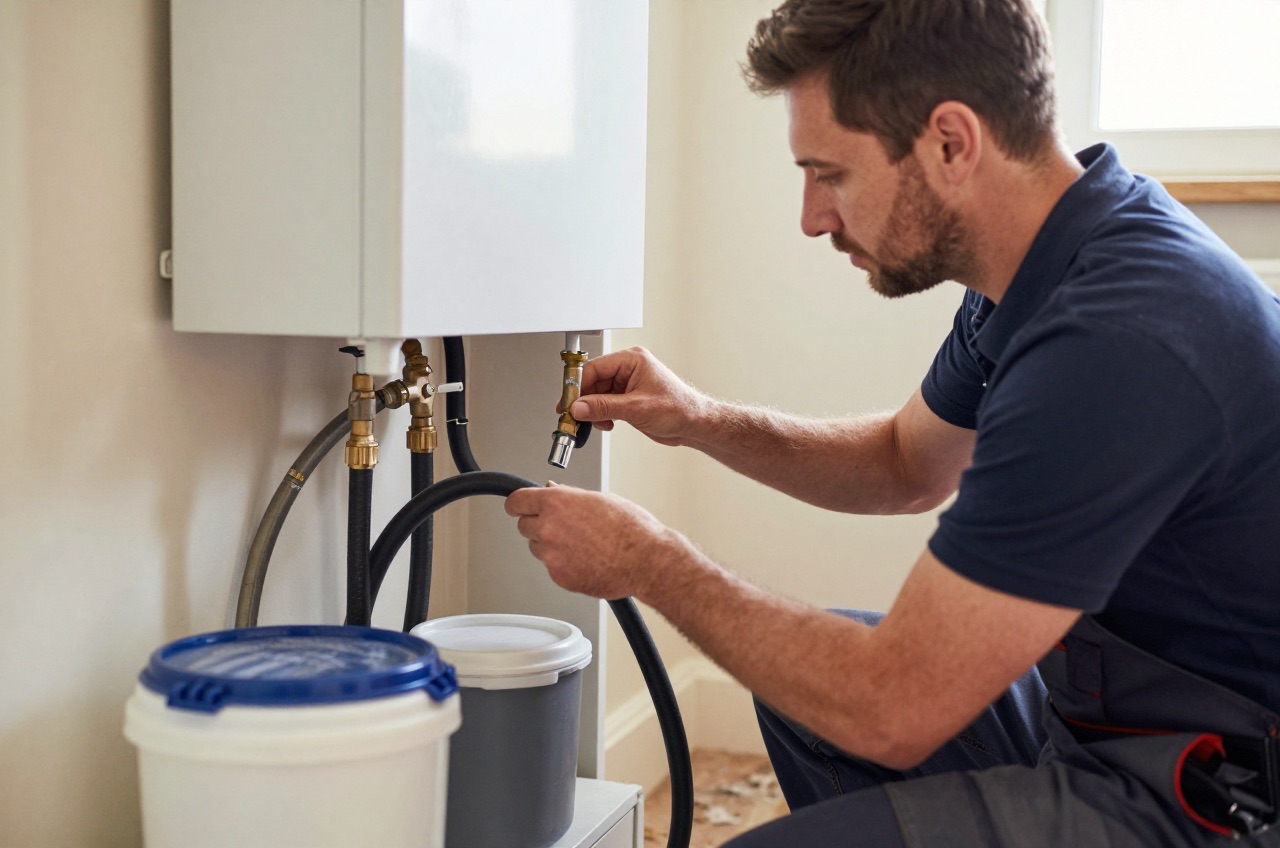
Sludge, a black, sticky mixture of corroded steel particles (magnetite) and debris, silently accumulates in central heating systems over years. It settles in radiators, blocks narrow heat exchanger passages, and can cut boiler efficiency by 10–15 % or more. A powerflush is the most effective way to remove it. This guide explains when you need one, what the process involves, and whether the cost is justified.
What Is a Powerflush?
A powerflush uses a specialist pump to force water and chemical cleaners through the central heating circuit at low pressure but high velocity. The turbulent flow dislodges sludge and scale that normal circulation cannot shift. The contaminated water is then expelled from the system and replaced with clean water dosed with corrosion inhibitor.
The process takes 4–8 hours for a typical three-bedroom semi-detached home, depending on the number of radiators, the severity of contamination, and how old and complex the pipework is.
Signs Your System Needs a Powerflush
- Radiators with cold spots, particularly cold at the bottom, which indicates settled sludge restricting flow
- Boiler noise, banging, rumbling, or kettling sounds from the heat exchanger mean scale and sludge are causing localised boiling
- Slow warm-up, the system takes noticeably longer to reach temperature than it did a few years ago
- Discoloured water when you bleed radiators (very dark, almost black water is classic magnetite contamination)
- Repeated pump failures, abrasive particles in the water accelerate wear on pump impellers
- New boiler installation, most manufacturers require system cleanliness as a condition of their warranty; installing a new boiler onto a contaminated system will void the guarantee and damage the new heat exchanger within months. The heating industry’s own position is that fitting a new heat generator to an existing system means flushing it, cleaning it and adding an inhibitor1
What the Process Involves
- Assessment, the engineer checks radiator temperatures with an infrared thermometer and takes a water sample. Some also use a TDS (total dissolved solids) meter or check magnetic pull on a sample container.
- Chemical cleaner dosed, a descaler and sludge remover is added and the system is run for 30–60 minutes to break down deposits.
- Powerflush pump connected, typically connected at the pump head or a drain valve. The engineer works through each radiator in turn, isolating others to concentrate flow.
- Flushing each radiator, flow direction is reversed repeatedly to shift settled sludge. A bypass loop allows contaminated water to be expelled safely without discharging directly to drain in all cases (some systems use drain-to-waste; others collect and dispose).
- Final system refill and inhibitor dose, the clean system is refilled with fresh mains water and dosed with a long-life corrosion inhibitor suitable for a mixed-metal system of steel, copper and aluminium. Inhibitor concentration should be checked annually.2
- Magnetic system filter fitted, most engineers now include a magnetic filter (Magnaclean or similar) as part of the powerflush package, or strongly recommend fitting one. This catches magnetite particles between services to prevent re-contamination. The British Standard behind all of this is BS 7593:2019+A1:2024, which covers cleaning and flushing, scale and corrosion treatment, and the use of in-line filters in domestic heating systems.3
Powerflush Cost Breakdown
| Home size | Radiators | Typical cost |
|---|---|---|
| 1-bedroom flat | 4–6 | £250–£380 |
| 2-bedroom house | 6–8 | £290–£420 |
| 3-bedroom semi | 8–10 | £320–£500 |
| 4-bedroom detached | 10–14 | £400–£600 |
| 5+ bedroom | 14+ | £550–£800+ |
Prices generally include labour, chemicals, and inhibitor top-up. A magnetic filter is sometimes included, sometimes charged separately at £60–£120 supply and fit. VAT at the standard rate of 20 % applies to the full job.4
Firms quoting well below these figures may use lower-quality chemicals, rush the process, or not properly flush each radiator individually, all of which reduce effectiveness.
Powerflush vs Chemical Flush
A powerflush is not always the right answer. A chemical flush (also called a system cleanse) is a cheaper alternative where a cleaner is added to the existing system water and left to circulate for several weeks before draining and refilling. It costs around £80–£150 as an add-on at a boiler service and is appropriate for lightly contaminated systems or newer installations where sludge has not yet built up significantly.
A powerflush is the better option when:
- The system is heavily contaminated (black sludge, multiple cold radiators)
- A new boiler is being installed
- The boiler heat exchanger is showing signs of restriction
A chemical flush is adequate when:
- Contamination is mild or the system is under 10 years old
- You are maintaining a healthy system rather than rescuing a neglected one
Does It Always Work?
In most cases, yes, but there are exceptions:
- Severely corroded pipework or radiators that are structurally weakened may leak once flow rates increase. A good engineer will flag obvious corrosion before starting.
- Microbore pipework (8 mm or 10 mm) can be harder to powerflush effectively due to the narrow bore and greater risk of blockage dislodgement.
- Very old solid-fuel systems with bespoke pipework layouts can be complex and may require more time (and cost).
After the Powerflush
- Annual inhibitor check, the inhibitor concentration degrades over time. It should be checked at every boiler service using a test strip or refractometer, and the Benchmark service record treats an inhibitor efficacy test at every annual service as a requirement.2 Top up as needed (a 1-litre inhibitor bottle costs £10–£20).
- Magnetic filter service, clean the magnetic filter cartridge at every annual boiler service. Takes about 10 minutes and keeps the system clean long-term.
- Bleed radiators after the first few weeks of use, disturbed air from the flush often needs to be vented.
Building Regulations and Warranty Implications
There are no specific Building Regulations requirements for powerflushing existing systems. However, if you are having a new boiler installed:
- Most modern boiler manufacturers (Worcester Bosch, Ideal, Vaillant, Baxi) explicitly state in their warranty terms that the system must be clean and that a corrosion inhibitor must be present and maintained. The industry Benchmark checklist that accompanies almost every new boiler asks the installer to confirm the system has been flushed and cleaned in accordance with BS 7593, and states that failure to complete it will invalidate the warranty.2
- Building Regulations Part L (applicable to new boiler installations in England) requires that heating systems are appropriately commissioned. Approved Document L is explicit: before a new heating appliance is installed, all central heating and primary hot water circuits should be thoroughly cleaned and flushed out, a suitable chemical inhibitor should be added, and the system should be prepared and commissioned to BS 7593.5
- The commissioning notice confirming this has to reach the building control body, and until it does the body may decide not to issue a completion certificate.5
Finding a Competent Engineer
Powerflush engineers do not need a specific licence, but the job should be done by a heating engineer who understands the system. Look for:
- Membership of CIPHE (Chartered Institute of Plumbing and Heating Engineering) or APHC (Association of Plumbing and Heating Contractors)
- Engineers who carry a recognised powerflush machine (Kamco, Fernox Powerflow, or similar) rather than a basic pump
- Someone who will provide a written report of water sample results before and after, including inhibitor concentration
Get at least two quotes and be wary of anyone who guarantees results on a heavily contaminated old system without first assessing it.
The rules in this note are those that apply in England. Scotland, Wales and Northern Ireland have their own building standards and permitted development rights.
References (5)
Figures in this note were checked against the sources below on 9 September 2026. Superscript numbers in the text point to them. Every source the site cites, by topic.
- 1technicalgoodHeating and Hotwater Industry Council, guidance.RN-SAI6DEHHIC installer guidance, 17 pages, tying Building Regulations to the water treatment standards. States that when installing a new heat generator to an existing hydronic system the system should be flushed and cleaned and an inhibitor added, and names BS 7593:2019+A1:2024 as the current edition. Reproduces Approved Document L Volume 1 paragraph 8.8 verbatim. Describes BS 9593:2024 as the new inhibitor performance test method replacing the NSF (formerly BuildCert) Chemical Inhibitor Approval Scheme standard, tested in three stages for corrosion rate and pitting of metal coupons, scale-forming tendency and effect on non-metallic materials. Lists the A1:2024 changes: reference to BS 9593:2024, the water hardness website address, clarity that an in-line filter does not mean a strainer, and guidance on microbiological growth in low temperature systems below 60 C. States that checking and recording inhibitor levels is mandatory in Benchmark, and that annual service checks cover safety, water quality, inhibitor and system efficiency.
- 2technicalgoodHeating and Hotwater Industry Council, guidance.RN-176JNCThe Benchmark checklist supplied with almost every UK domestic boiler. States that failure to install and commission according to the manufacturer's instructions and complete the checklist will invalidate the warranty, and that the boiler must be registered with the manufacturer within one month of installation. Requires the installer to confirm the system has been flushed and cleaned in accordance with BS 7593 and the boiler manufacturer's instructions, to record which inhibitor was used, and to record whether a primary water system filter is fitted. The annual service record repeats, at every service year, that system inhibitor concentration has been checked and appropriate action taken in accordance with BS 7593 and the boiler manufacturer's instructions, with a footnote that a system inhibitor efficacy test is required on every annual service and is only excusable for an interim visit to a non-water-facing component. Also states the boiler must be serviced at least annually by a competent Gas Safe registered engineer.
- 3technicalstrongBSI (British Standards Institution), a standard.RN-W6LO6XSTATUS: CURRENT. BS 7593:2019+A1:2024 was published 31 October 2024 and supersedes BS 7593:2019, which is withdrawn. Amendment A1 is dated 30 November 2024 in the NBS index and links the code to the new BS 9593:2024 Assessment for the performance of chemical inhibitors for use in domestic central heating and cooling water systems, test method. The code gives recommendations on best practice for preparing circulating water in open vented or sealed heating and cooling systems in individual domestic premises during initial commissioning or re-commissioning after major remedial work such as a boiler replacement, and on ongoing water treatment. It covers sealed cooling systems, treatment of water to overcome scale and corrosion, cleaning and flushing of systems, and the use of in-line filters. It excludes commercial, municipal and most multiple-residential premises but does apply to individual circuits within multi-unit dwellings. IMPORTANT for citation: the reference book still carries the withdrawn BS 7593:2019 base-edition page; this is the live edition page.
- 4technicalvery strongHM Revenue & Customs (GOV.UK), guidance.RN-4W7T33Sets the three UK VAT rates: standard 20% on most goods and services, reduced 5% on some goods and services such as children's car seats and home energy, and zero 0% on zero-rated goods such as most food and children's clothes. The standard rate rose to 20% on 4 January 2011 from 17.5%. Some supplies are exempt rather than rated, including postage stamps and financial and property transactions. This is the reference for converting a merchant's ex-VAT trade quote into the figure a homeowner actually pays.
- 5technicalvery strongMinistry of Housing, Communities and Local Government.RN-L0FCJXThe in-force U-value tables a DIY insulation or door note must quote, with the exact numbers. Table 4.2, limiting U-values for new fabric elements in existing dwellings, sets roof 0.15, wall 0.18, floor 0.18, swimming pool basin 0.25, window 1.4 or Window Energy Rating Band B minimum, rooflight 2.2, doors with more than 60 per cent of the internal face glazed 1.4 or Doorset Energy Rating Band C minimum, and other doors 1.4 or Doorset Energy Rating Band B minimum. Table 4.3, for existing elements, gives a roof threshold of 0.35 and an improved value of 0.16, which is the figure a loft insulation note needs: paragraph 4.12 says a retained element whose U-value is higher than the column (a) threshold, for example through a loft or garage conversion, should be upgraded to the column (b) value. Paragraph 4.13 allows a lesser upgrade only where the improved value is not technically or functionally feasible or would not achieve a simple payback of 15 years or less. Paragraph 4.8 requires a replacement element to be no worse than the one it replaces as well as meeting Table 4.2. Paragraph 4.10 gives the heritage exception: where character must be maintained, a centre pane U-value of no more than 1.2 or low-emissivity secondary glazing. Note 9 records that the timber window concession of 1.6 or Band C ended on 14 June 2023. The 2021 edition came into force on 15 June 2022; a 2026 edition exists at https://assets.publishing.service.gov.uk/media/69c122a6cfa346b9d4704a55/ADL1_2026.pdf.
-
Maintaining a Healthy & Efficient Domestic Heating & Hot Water System, Heating and Hotwater Industry Council, accessed 9 September 2026. hhic.org.uk
-
Benchmark Commissioning & Warranty Validation Service Record, Heating and Hotwater Industry Council, accessed 9 September 2026. hhic.org.uk
-
BS 7593:2019+A1:2024 Code of practice for the preparation, commissioning and maintenance of domestic central heating and cooling water systems, BSI (British Standards Institution), accessed 9 September 2026. knowledge.bsigroup.com
-
VAT rates, HM Revenue & Customs, accessed 9 September 2026. gov.uk
-
Approved Document L, Conservation of fuel and power, Volume 1: Dwellings, 2021 edition incorporating 2023 amendments, Ministry of Housing, Communities and Local Government, accessed 9 September 2026. assets.publishing.service.gov.uk