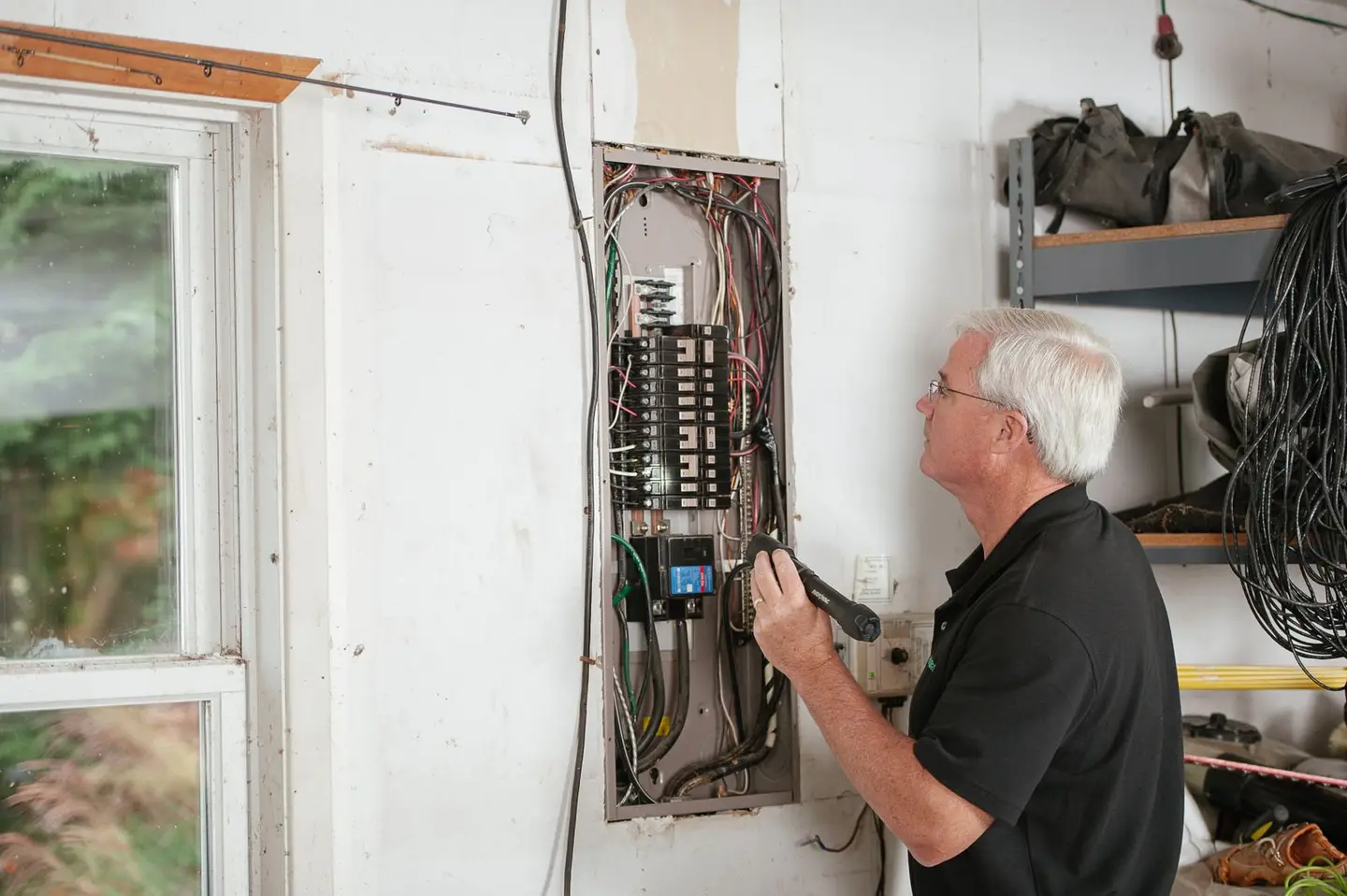
Deciding between a full rewire and repairing existing wiring comes down to three things: how old the wiring is, what condition it is in, and how much of it is affected. For most homes built before 1970 with untouched wiring, a full rewire is almost always the cheaper and safer long-term option. For more recent properties with isolated faults, targeted repairs are proportionate and cost far less.
A full rewire on a three-bed semi costs £3,500–£6,500 in 2026. Repairing a single faulty circuit typically costs £150–£400. The gap is large, which is why getting an Electrical Installation Condition Report (EICR) before committing to either route is money well spent.
UK Electrical Costs at a Glance (2026)
| Work | Typical Cost Range |
|---|---|
| EICR (Electrical Installation Condition Report) | £150–£300 |
| Single circuit repair or replacement | £150–£400 |
| Consumer unit (fuse board) replacement | £500–£1,000 |
| Partial rewire (one or two floors, or one ring circuit) | £1,500–£3,000 |
| Full rewire, 2-bed flat or cottage | £2,500–£4,500 |
| Full rewire, 3-bed house | £3,500–£6,500 |
| Full rewire, 4-bed house | £5,000–£9,000 |
| Full rewire, 5-bed house | £7,000–£12,000 |
| Aluminium wiring remediation | £500–£2,000+ (on top of rewire) |
| Part P notification fee (if not self-certified) | £200–£400 |
Prices assume work in England or Wales by a registered electrician. London rates sit at the upper end or above these ranges. Making good plasterwork and redecoration after a rewire is not included above, budget an additional 15–25% of the electrical cost for this.
What Drives the Price?
Property size and number of circuits
Electricians price rewires mainly by the number of circuits and cable runs required. A typical three-bed house has 8–14 circuits (ring mains, radial circuits for kitchen appliances, lighting circuits per floor, garage, outdoor sockets, cooker, EV charger, and so on). Each additional circuit adds labour and materials.
Wiring type and age
The type of existing wiring significantly affects both the decision to repair and the cost to do so:
- PVC-insulated cables (post-1970s): These can often be repaired selectively. Isolated faults are straightforward to fix without disturbing the whole installation.
- Rubber-insulated wiring (pre-1960s to early 1970s): The rubber insulation hardens and cracks with age, creating a serious fire and shock risk. It cannot be safely repaired in isolation, a full rewire is invariably recommended and insurers increasingly require it.
- Aluminium wiring (common in some 1960s–70s properties): Aluminium conductors corrode at connection points, causing overheating. This requires specialist connectors or replacement with copper cable. Costs can add £500–£2,000 or more on top of a standard rewire.
- Lead-sheathed wiring (pre-1950s): Extremely old, now very rare, but occasionally found in Victorian or Edwardian properties. Always requires full replacement.
Electrician day rates
Qualified electricians charge £250–£450 per day in 2026 depending on location and experience. A two-person team (as is common on rewires) therefore costs £500–£900 per day in labour alone. A full rewire on a three-bed house typically takes 5–8 days for the electrical work, before any making good.1
Hourly rates for repair jobs typically run at £50–£90 per hour, with a minimum call-out of one or two hours.
Access and disruption
Rewiring requires lifting floors, cutting into walls, and opening ceiling voids to run new cable. On a property with timber suspended floors, this is relatively straightforward. Solid concrete floors or ceilings with plasterboard-over-artex make cable runs significantly harder and more expensive.
Repair vs Rewire: Which Scenarios Call for Which?
When repair is appropriate
- A single socket, switch, or light circuit is faulty and the rest of the installation is modern PVC cable with an up-to-date consumer unit.
- An EICR produces a C3 (improvement recommended) observation on one or two points, with the rest of the installation satisfactory.
- The property is less than 25–30 years old and has had no previous electrical issues.
- You need to add a circuit (EV charger, outbuilding, new kitchen appliance) without touching the existing installation.
When a full rewire is the right call
- The property has rubber-insulated, lead-sheathed, or aluminium wiring throughout.
- An EICR returns multiple C1 (danger present) or C2 (potentially dangerous) codes across several circuits.
- The consumer unit is an old-style fuse board without residual current devices (RCDs) and the wiring is also outdated, at this point replacing the board without addressing the cables is a temporary fix.
- The house has never been rewired and is more than 40 years old.
- You are undertaking a full renovation anyway, rewiring during a gut-out strips out disruption costs that would otherwise be incurred separately.
The partial rewire option
A partial rewire, replacing the circuits on one floor, or replacing the lighting circuits across the whole house, can be a pragmatic middle ground. It costs £1,500–£3,000 depending on scope. However, insurers and mortgage lenders sometimes push back on partial rewires on older properties, so confirm acceptability with both before proceeding.
Regulatory Requirements: BS 7671, Part P, and Certification
All electrical work in domestic properties in England and Wales must comply with BS 7671, the IET Wiring Regulations. Check the amendment before quoting a regulation number, because it moves: BS 7671:2018+A4:2026 was published on 15 April 2026, and the previous amendment state is withdrawn on 15 October 2026 after a six month transition. Regulation numbering and requirements change between amendments, so cite BS 7671 without a year unless you have the current one in front of you. This is the technical standard that sets out how installations must be designed, installed, and verified.
Full rewires and most significant electrical work also fall under Part P of the Building Regulations, which requires that the work is either:
- Carried out by a competent person registered with a government-approved scheme (such as NAPIT or NICEIC), who self-certifies the work; or
- Notified to and inspected by building control before or during the work, at a cost of £200–£400.
In practice, most homeowners use a registered electrician who self-certifies, you receive an Electrical Installation Certificate (EIC) on completion, which is the document you will need when you come to sell the property.
Replacements, repairs and like-for-like swaps of a socket or switch are not notifiable, anywhere in the house. In England only three kinds of work are: installing a new circuit, replacing the consumer unit, and adding to or altering an existing circuit inside a special location, which means the zone around a bath or shower (or a room containing a swimming pool or sauna heater).2 A kitchen has not been a special location since 2013, and neither has a garden. When in doubt, use a registered electrician.
An EICR, the standard periodic inspection, is the starting point for any older property. Cost is £150–£300 for a typical house. It grades every observation C1, C2, or C3, and gives you an objective basis for deciding whether to repair or rewire, rather than relying on a quote from an electrician who may have an incentive to recommend a full job.
Worked Example: Three-Bed 1960s Semi
Property: Three-bed semi-detached, 1962 build. Owner inherited the property and the last known electrical work was in the 1980s. Some sockets spark slightly when plugging in.
Step 1, EICR: An NICEIC-registered electrician inspects the installation and issues the report (cost: £220). Findings: rubber-insulated wiring on most circuits; consumer unit is a rewirable fuse board without RCDs; one C1 code (exposed conductors in loft); four C2 codes across ring mains and lighting circuits.
Step 2, Decision: The combination of rubber insulation throughout and multiple C2 codes makes targeted repair impractical. A full rewire is the only sensible course.
Step 3, Rewire quote: Two electricians, five working days. Quote breakdown:
| Item | Cost |
|---|---|
| Labour (2 electricians × 5 days × £350/day) | £3,500 |
| Consumer unit (18-way dual RCD) | £350 |
| Cable, back boxes, sockets, switches, materials | £900 |
| Certification (EIC, Part P self-certification) | £150 |
| Total electrical works | £4,900 |
Step 4, Making good: The owner arranges a plasterer and decorator separately. Plastering damaged sections: £600. Redecoration throughout: £1,200.
Total all-in cost: approximately £6,700
Had the wiring been PVC from the 1990s with a single faulty ring main circuit, the repair cost would have been £200–£350, a fraction of the above.
Choosing an Electrician
Look for registration with NICEIC, NAPIT, or another scheme authorised by government, the competent person schemes that cover Part P. Registration is searchable on each scheme’s public website. Registered electricians self-certify their work, saving you the separate building control notification fee and ensuring the work is backed by the scheme’s guarantee.2
Get at least two or three quotes for any job over £500. On a rewire, ask each electrician to specify whether their price includes the consumer unit, all materials, certification, and making good, or whether these are priced separately. Comparing itemised quotes is far more reliable than comparing headline numbers.
References (2)
Figures in this note were checked against the sources below on 14 September 2026. Superscript numbers in the text point to them. Every source the site cites, by topic.
- 1costvery strongOffice for National Statistics.RN-MMT1DOA price, true at 2026-01. The ASHE Table 14 dataset gives annual estimates of paid hours worked and earnings for UK employees by sex and by full-time or part-time status, broken down to four-digit Standard Occupational Classification, which is the level that isolates individual construction trades such as bricklayers, carpenters, plasterers and electricians. Released 23 October 2025 as the 2025 provisional edition (zip, about 10.7 MB), with revised and provisional editions back to 2017. A correction dated 19 December 2025 suppressed annual pay estimates for SOC 3312 police officers in some areas; construction occupations are unaffected.
- 2technicalvery strongMinistry of Housing, Communities and Local Government.RN-JYJ3I5The document that decides what electrical work a homeowner may legally do themselves, and the exact list of notifiable jobs. Regulation 12(6A), reproduced at paragraph 2.5, makes only three things notifiable: the installation of a new circuit, the replacement of a consumer unit, and any addition or alteration to existing circuits in a special location. Regulation 12(9) defines special location as, in a room containing a bath or shower, the zone extending vertically from finished floor level to 2.25 metres (or the shower head position if higher) and horizontally 600mm from the edge of the bath tub or shower tray. Paragraph 2.7 states that all other electrical installation work is not notifiable, namely additions and alterations to existing installations outside special locations, and replacements, repairs and maintenance anywhere. Paragraph 2.8 gives worked examples: a built-in cooker is not notifiable unless a new cooker circuit is needed, and connecting an electric gate or garage door to an existing isolator is not notifiable but running a new circuit from the consumer unit to that isolator is. Paragraph 2.2 confirms Part P reaches outdoor work including fixed garden lighting, pond pumps and outbuildings such as sheds, detached garages and domestic greenhouses. Notifiable work must be certified by self-certification by a registered competent person, third-party certification, or a building control body (paragraph 3.1), with the compliance certificate issued within 30 days (paragraph 3.4). Note that Approved Document P is a source of guidance rather than a ban: non-notifiable work still has to comply with BS 7671.
-
ASHE Table 14.6a, hourly pay excluding overtime by occupation, 2025 provisional, Office for National Statistics, accessed 17 September 2026. Priced at 2026-01, so no calibration is needed. ons.gov.uk
-
Approved Document P: Electrical safety, Dwellings, 2013 edition, HM Government (GOV.UK), accessed 10 September 2026. assets.publishing.service.gov.uk